

"Accept it. Accept it. It’s an uncontrollable. You cannot change it. Get over it. Get on with it."
Emma Hayes's words may have aspired to equanimity, but her tone betrayed her. Coming off a 2-1 loss to Brazil in São Paolo—the first of two consecutive friendlies played on the Brazilians' turf—the U.S. Women's National Team coach kept coming back to her refrain: the raucous crowds, their opponent's physicality, the officials' (in)competence, and the late start time for Tuesday's match were things the U.S. couldn't control, so best not to dwell on them.
It was an exercise in powerlessness for a team used to friendly crowds and conditions. Playing in the rare friendly outside the confines of the United States, the protective arms of U.S. Soccer were nowhere to be found.
Hayes recalled coaching in the Champions League at Barcelona's Camp Nou, and said that Saturday's match in São Paolo was something entirely different. "They live and they breathe it in a certain way. This is the most extreme but beautiful end of it. The crowd are fantastic, but you have to perform with all of that," she said. "That's why I keep leaning into the fact that sometimes I think we create too many perfect conditions. We've created a culture in our football world in the United States that's, 'Well, do we need to do as much of that? Do we do less of this?' We've got to be tougher, and we've got to be more durable."
The Yanks' trip to Brazil precedes next year's World Cup there, and the thought was there's no better preparation for the tournament—assuming the USWNT qualifies in November—than doing a dry run.
Had the series ended after the first game, it would have been enough to teach the players about where they needed to grow. Sophia Wilson, that maverick who seems to have only improved since giving birth in September, got the Americans on the board in the second minute, but mental lapses from the U.S. and technical brilliance by Brazil made for two quick goals the other way within 12 minutes. The Americans couldn't bust through Brazil's disruptive, physical play to find an equalizer. It was an emotional, mental challenge as much as a technical one, and the U.S. failed on both fronts.
"You've got people wrestling you to the ground in the middle of the game. You've got a crowd that is cheering every goal our [backup] goalkeeper scores on our goalkeeper during the warm-up. We've got our players warming up on the side of the pitch while they're getting heckled or noises," Hayes said. "You can't replicate this stuff. And so you've got to drink it."
Drink up the noise, the energy, the tackles. Let them fuel you. That was the lesson for game two. Center back Kennedy Wesley said as much afterward: "We made it a goal of ours to frustrate them to play, to kind of beat them at their own game."
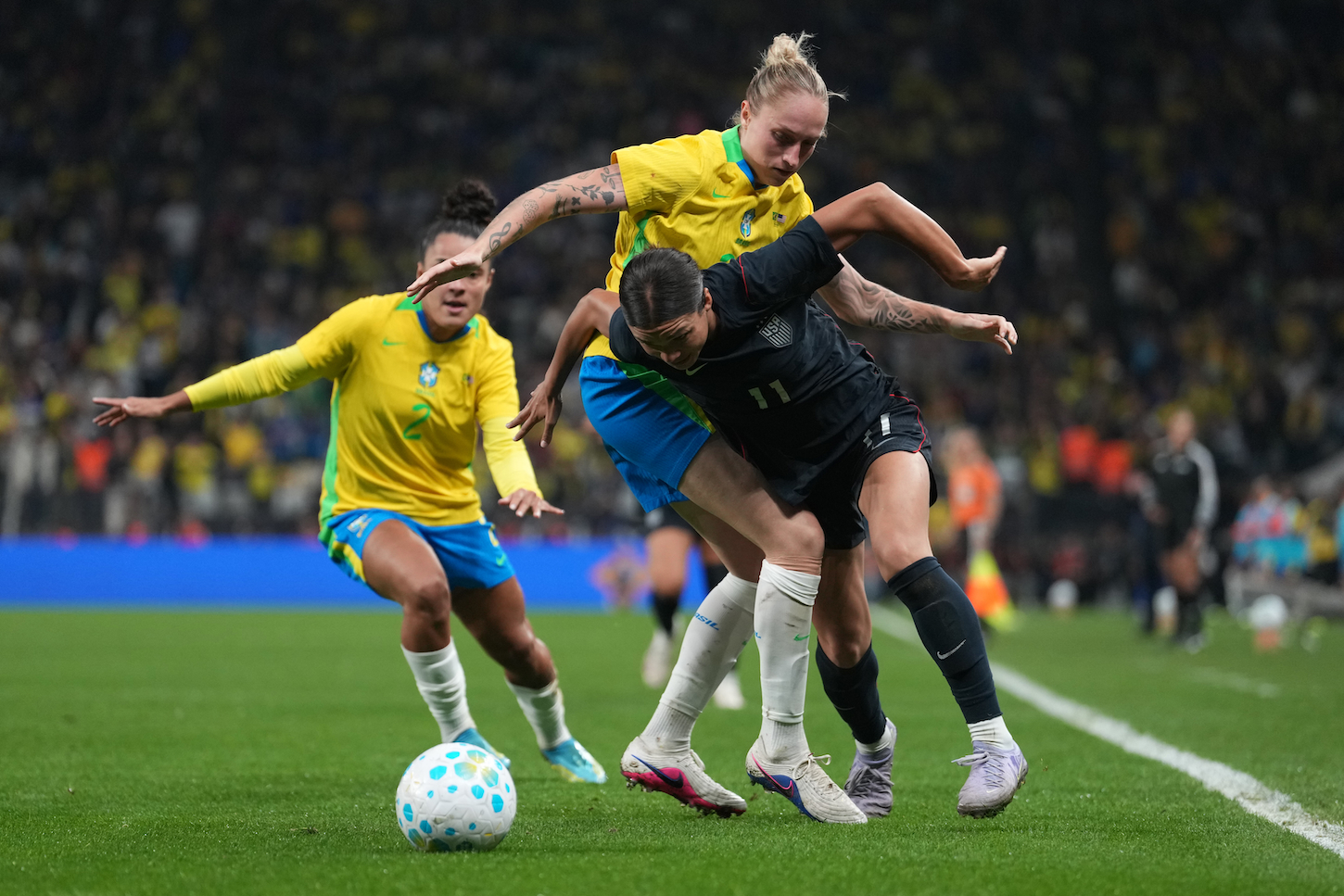
On that front, the Americans succeeded. In front of 55,744 fans in Fortaleza, the U.S. stepped up its aggression, and came away with the same amount of yellow cards in the first half as the opponents: two. (Brazilian coach Arthur Elias received one too, which was followed by him being forced to put on a white pinny—his navy shirt was too similar to the USWNT's kits, apparently.) It was a bloodbath, but not a massacre.
Mutual as it was, the intensity had a terrible cost. Dudinha, the 20-year-old forward who, alongside Barbra Banda, has been the best player in the NWSL this season, went down in a collision with Emily Sonnett with what looked to be a knee injury. The replays conjured up thoughts of those terrible three letters that haunt the sport, and the stretcher that took her off the pitch didn't offer any reassurance.
Instead of either side taking that injury as a caution, things only escalated. In the 63rd minute, Wilson had another marvelous DIY effort to put the U.S. up 1-0. She put her defender to her back, got sandwiched by another, exploded out of said sandwich, then took an unlikely shot that deflected off Isabela and into the net. Soon after, the Brazilians started playing with desperation. By the final whistle, Elias and three of his staff members, plus Bia Zaneratto and Tarciane had been ejected. (When Elias was ejected, he slung his pinny on a referee's shoulder and proceeded to have a tactical session with Marta before finally acquiescing and leaving the pitch.) Zaneratto's was for a second yellow—a two-hand push on Sonnett that the latter played up with an Oscar-worthy performance—and Tarciane's was for a genuinely horrendous elbow to Wilson's face. After the final whistle, which came after an unannounced 14 minutes of stoppage time, Kerolin and Ludmila were shown red cards for confronting the "ESPONHOLAAAAA" center referee. Security in riot gear quickly came to stand by the officials. Marta ranted to a Brazilian broadcast about the refereeing.
In their comments after the match, the U.S. players were clearly unhappy with the way Brazil played.
"I hope that's not what a World Cup final looks like come the World Cup. I hope that there's more football being played and I hope that it's the beautiful game again because for me, that's a whole different sport," captain Lindsey Heaps said. "I think this is a really good team with a lot of quality, but I just don't think the game should be played in that type of way."
Hayes said she was proud of herself and her players for their relative emotional control—"I can only talk about my behavior. And I thought my behavior was good"—but couldn't help but convey that come next summer, she expects things to be different. "What I am certain of, absolutely certain of, is that when the World Cup comes here next year with FIFA, there will be very clear behavioral expectations for all of us, which it should be. It's a global game because everybody there wants to watch football, and ideally the best football."
It's that aspect—the football—where the USWNT still fell short. It took so much energy for them to contain their emotional responses that they couldn't muster up enough mental focus to actually punish Brazil beyond Wilson's impressive but ultimately flukey forced own goal.
There's concern on the personnel side: Hayes's starting lineup was improved from the first match by the presence of Michelle Cooper, Avery Patterson, Wesley, and Emma Sears. Trinity Rodman, Claire Hutton, and Olivia Moultrie all came in as substitutes and impressed. However, Hayes's choice not to start Hutton, but keep on Heaps and Lily Yohannes from game one, was dubious (some great Yohannes long balls aside). It's a shame Sam Coffey is hurt, since this is the kind of game she'd devour. And speaking of defensive midfielders, this series deeply exposed the USWNT's lack of a Julie Ertz–type destroyer. Might we see Hal Hershfelt or Jaelin Howell get a call-up soon? I hope so, but Hayes's recent shift from expanding the player pool to dramatically tightening it suggests that's unlikely.
More than that, there's the fact that the Americans weren't flexible enough in their own style of play to force the Brazilians to play their game. The U.S., which likes to play with possession, was consistently slow with the ball, allowing all those crunchy challenges from the Brazilians. The moments when the Americans did put together real chances were either defused by some brilliant play from Brazil's keeper, Lorena, or squandered with inexcusable finishing.
The U.S. did enough out of possession to prevent the Brazilians from playing their best, to be sure. Brazil's ceiling is the sky. In 2025, they beat England, France, Japan, and Colombia. I feel pretty confident saying they're more talented, player-for-player, than the USWNT—and deeper. When Dudinha went out, she was replaced with none other than 2025 NWSL MVP nominee Zaneratto. If the Brazilians hadn't self-destructed, I'm just not confident the Americans would have been able to beat them. On Saturday, after all, they didn't.
Hayes's squad won't convene again until October, which will be the last time they will play together before the CONCACAF W Championship, North and Central America's World Cup qualifying tournament. She'll hope that these not-so-friendly friendlies against Brazil will serve a similar purpose as the team's 2025 loss to Japan: shocking her team into meaningful improvement. It's very possible that the next time the USWNT will be able to apply these lessons against Brazil is at the next World Cup. I can't wait.