Lily Yohannes plays soccer with an efficiency that would come off as mechanical if she didn't have the vision of an artist, resulting in some of the most beautiful dribbling sequences and long through balls that have ever graced a pitch. Indeed, the 18-year-old OL Lyonnes star is the USWNT's best midfield prospect in a decade.
Considering she shot into the elite echelons of soccer at such a young age—while she was 16 and playing for Ajax, she became the youngest player to ever start a Champions League group stage match—it's no surprise that her family has been a large part of her story. And what a family she has. Both of her brothers play professionally: 20-year-old Jayden plays for SC Telstar’s U21 side, and 22-year-old Aethan plays for Almere City FC's youth team as well as the Eritrean national team.
Her father, Daniel, has been her most outspoken supporter. Daniel's Twitter account reads like a standard—if more thoughtful than most—soccer stan account, so long as you ignore the posts when he mentions being Lily's father. He reposts compilation videos other people have made of Lily's highlights, writes tactical analyses of Lily's and other games (he's a Chelsea supporter), talks about pay equity in the women's game, and makes the occasional impassioned political post.
It takes one minute of scrolling through Daniel's feed to understand that this is a guy who adores his kids and is spirited about soccer. On April 3, after Lyon won its Champions League quarterfinal tie against Wolfsburg, he quote-tweeted an interview Lily had done with W Golazo. "That is pure joy in @LilyYohannes10, the kind that still sounds like the little girl who once dreamed out loud without knowing how far those dreams could travel," he wrote. "As parents, we learn to hold our pride in moderation, but there's something almost surreal about witnessing [these] things, like recognizing something so familiar in a place you never thought it would be."
The earnest pride with which Daniel wrote about Lily touched me immediately, and I got the sense that talking with him about soccer and his family would be a joy. Why not try? I quickly reached out to him asking to interview him for Defector, and he warmly responded with a yes.
Daniel works as a consultant in IT risk management. He comes from an Eritrean family and lived in Ethiopia before moving to the United States for college. His wife, Semhar, is Eritrean too. They raised their kids in Virginia, but moved to the Netherlands when Lily was 10. (Throughout 2024, Lily's decision about which national team to play for—the U.S. or the Netherlands—was hotly anticipated. Her commitment in November of that year to represent the U.S. moving forward was met with celebration and relief by USWNT fans.)
Daniel is involved in his kids' careers, but is not their agent. He periodically talks with his kids' clubs to ensure they're being supported, and, per a WhatsApp message he sent me, "handles inquiries on all football affairs and communication to assess the ask to better strategize action plans, rather than … negotiating football deals or managing transfers." He also runs the The Yohannes Trio Football Channel on YouTube, and recently got an assistant to help edit the videos of Lily as the volume of her games has increased.
Our conversation, which took place five days before Lily and Lyon take on Arsenal in the first leg of the Champions League semifinals on Sunday, has been edited for clarity.
You were just at the national team games, right? How was it?
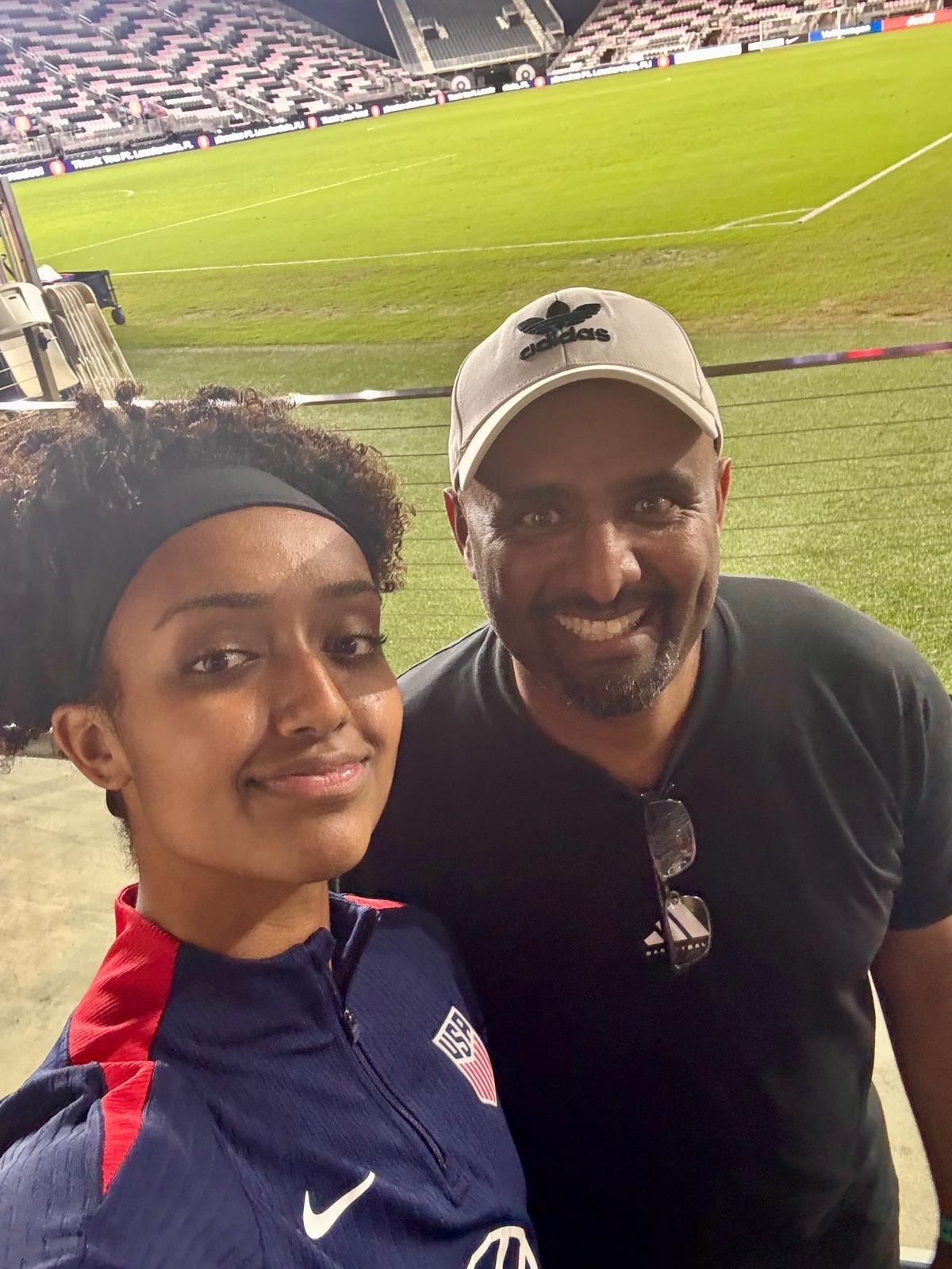
Yeah, I was actually at all three of them, in San Jose, Seattle, and Denver. It was nice. I mean, Seattle was just rainy. I grew up in Seattle, actually; I graduated from college in Seattle, and I lived there for a few years, so it was nice to be in the city. Lily had her day off, so I got to show her where I lived, in a way—the highlights of Seattle: the marketplace, the Space Needle, and the Bellevue area, just to give her a sense of what Seattle is all about. And it was raining the whole day as well, so I was like, "OK, well, this is the standard. If you live in Seattle, this is acceptable." It was a nice moment just to kind of take it easy, and not think football and just relax, spending some time with her.
Overall, I think the team did fantastic, showed growth as a whole. Japan's not an easy team—very technical and very organized, tactical. We were able to match them. We had quite a lot of possession. Often they do have that kind of statistics, but they did great. The group did well, winning—the one in Seattle, we lost, obviously—but overall, I think it was a very successful camp for the girls, and it shows the strength. I think Emma [Hayes] is putting together a fantastic group of young players as well as veterans, mixing them up. It shows the progress. This was great.
You switch so easily between just talking about being a parent, and then talking about football. Do you talk about these kinds of things with Lily and your other kids? How often are you talking about the actual football itself with your kids?
I think football is sort of like a culture, you know? Sort of a household identity, in a way, of conversation. I've loved the game as long as I can remember, since I was a child. So if you have to go out and play outdoors, it's always pickup football in my neighborhood. It's always something that we cherished from my upbringing. So we talk about football whenever we're at home. We have downtime and we're watching football, and then that's sort of a tradition. If we do something else and the TV is on, it's probably on some kind of game, even if we don't pay attention. So yeah, we do talk a lot about football amongst ourselves. I think my kids—all of them—are pretty engaged daily. They know what's going on. It is a part of our life.
I would love to hear you trace your own soccer origin story. How has football appeared throughout your life?
As a child, before moving to the U.S., the only sport that me and my friends played in my neighborhood was football. There was no other sport. Even if we don't have a real soccer ball, we kind of pull together plastic and kind of melt it and make it like a soccer ball, and we play football. There is no other sport. It was always more than just a sport to me, and to be honest, a lot of my friends growing up, so it's like a community—sort of your identity, a way to stay connected with your ecosystem, around your neighborhood, your school. With that goes also, growing up, following the games closely in the Premier League. I remember when I was a child, we were watching black and white TV—three games a week that comes to span of like, one hour a summary. We used to just sit and watch that one hour. Then you have the World Cup that we used to watch as kids. Basically you're immersed into the game, and you just love it, you know? National teams like Brazil—we used to try to mimic certain players. So the passion is just natural and becomes your home environment, in a sense.
With my kids, it was never really pushing them into it. From an early age they saw the joy of the sport, and what it takes—the discipline. Over time, they kind of built a relationship with the game, watching it and growing up every week and sitting down with me, even to the point where they used to wake me up, and say, "Hey, time to watch Chelsea," or Arsenal, or Liverpool.
I'm curious how you find that balance of wanting to support your kids and their passions, but also not wanting to put pressure on them and have them follow this path because it's what you want instead of what they want. When Tamerra Griffin wrote about your family a couple years ago, she wrote that you walked "Lily and her brothers through painstaking reviews of their game footage." Is that because they've asked you to do that? How did that come about?
I see my role as providing support and structure and educating based on what I know. But the motivation has to come from them. I saw it from an early age: They're competitive and they always want to win. They immersed their youth from an early age to basically play the game all the time. You have a halftime [of a game they're watching], and they go in the basement and basically kick around soccer balls [for the 15 minutes], because I've actually really made our basement sort of like a training pitch. So we played 2v2s, and we do drills and touches—technical—around cones, and things like that.
I'm involved in the sense that I help them navigate their decisions, protect their interests, and make sure they have the right environment around them: a support system. But very also conscious of not trying to live football through them, in a sense of controlling their path. Because you can't force football on anyone. It has to be natural. And there's really no decision that is made without calm deliberation, weighing all options, in the sense of what's best and what actually benefits, and what do they really like? At the end, they have to own their decision, because I don't want to be the one that's made the decision for them, and then they have to blame me, that kind of feeling—I don't want that to be created in their minds at all. So they're free to make any kind of decision, and I just have to say, "Are we sure of this? Have you weighed this? This is the benefit. This is the pro, and the con." Then we move forward. It's their choice. And they can say tomorrow, "I'm done," and I'm just like, "Fine, great. Let's find another thing that you can actually focus on, and I'll support you." That's basically how we do things.
Your kids are still so young: Your oldest is 22, and Lily is 18. Do you see your role changing at all as they grow up?
I would say that I am consistent in the way I work with my kids: They have a match, I get to watch the game, I'll point out certain things that they've done great, sort of give constructive criticism, in a sense—it's sort of a learning curve where they need to improve, not just be comfortable—and then to try to push them, to encourage them. You have to support them, and you have to be also consistent, in a sense, because that's sort of how we've been. And if I don't say anything, it's like, "So… how was the game?" You know? [laughs] It's normal, and they don't really take offense if I say something; they respect my input.
And I don't really go hard at them, either, because it's just not productive. You have to find the right timing, the right safe space communicating certain things that maybe when they're young, you can actually say, but when they're older, you have to be very sensitive, in a sense, to try to make what you're going to say really matter. It's been a fantastic relationship, I think. As a father, I am caring, and I make sure that I do my part to support them. Their mother is the same. And as sort of managing their affairs, that's going to be, what's the best interest of their development? And how they can become better—I think that's the focus most of the time.
Your care for your kids, and how excited you are for them really comes through on Twitter, which is not how that site usually is. Whenever I see one of your posts, it's the only earnest thing I see on my scroll. I'm curious how you decided to contribute publicly in that way, and how you find being part of the public discourse about soccer in general, but also about your kids.
I got on those platforms because I do care about the game and the way it's discussed. Before I was a father, I played the game and I was a fan. So there's obviously that passion and interest in having conversations about football that has always brought me to have debates with my friends and whatnot. Obviously, there's a lot of noise in football discourse, but there's also room, really, for thoughtful conversation. I try to be intentional—sharing perspective when it's useful—but not getting pulled into the negativity of things. But I think it's important to stay really authentic, and not let certain things dictate how you engage. Just because I'm a father of Lily or Jayden or Aethan, it shouldn't stop me from really expressing the love that I have for the game. But it has to be constructive, and if it's not, then I know when to step away.
I think it's authentic to show other parents that it's OK to really be passionate about football. Yeah, you have to draw a very fine line on certain things that you can really say on social media, and you have to really be careful, but for me, I think it comes really natural, because my intentions are always to highlight either the good, or to kind of promote the women's game, understanding a lot of the gap, in a way. So I just feel engaging and discussing things with other fans is sharing passion about football. And then obviously, Lily, when she plays, or when I see highlights or something other people really take the time to frame—as a father, it makes me really proud, and there's no reason why I can't share that to the rest of the world, you know? It's just being authentic. I'm proud, and I give credit to those people that actually put the time and effort to put stuff together I see on social media.
I was listening to an episode when Lily was on Into the Channel, and at the end she said, "My dad tells me you guys have been really supporting me from really early on."
I listen to all the podcasts actually discussing football in general. I walk probably about an hour to an hour and a half, and I know what I'm going to be covering during that walk, and it goes fast.
Speaking of the women's game, you've done quite a lot of posting about the global women's game and different pressing issues, like player salaries and transfer fees. And I think the way that you are able to put things might be more understandable, or at least it's more likely that a random person on Twitter is going to look at what you're saying and take it seriously than maybe a random article. So I'm curious about your thoughts in general about the women's game. It's at such a critical juncture, I feel, in different ways. Where do we go from here?
I think the women's game is really moving in the right direction. The last five years, 10 years, you can see the progression. The NWSL and in Europe—I think that the game has really taken hold, progressing. NWSL is extremely competitive now and very physical and demands consistency every week. We get to see it, but sometimes it's too late to actually watch it from Europe. But it's really a strong development environment in that sense.
And then you have Europe, where you see many different models, and all of them now integrated within the men's club structure, in a way. There's a lot of very different technical approaches, and some have a lot of financial flexibility at the top-end clubs: Lyonnes, Chelsea, Barcelona, Arsenal, and then Man City. There's strong financial backing that is actually really growing across every league in Europe. Without a strict salary cap, too, clubs are able to really retain, attract top talent and so forth in Europe. I don't think it's about one being better than the other.
When people compare and talk about football on the women's side and the NWSL, or in Europe, it's really about what's a fit. Different players develop in different environments. Having strong pathways is always, in my opinion at least, positive to the game.
But at the same time, you have to talk about the gap. I do think conversations around compensation are very important. The commitment required at the professional level in the men's game is the same in the women's game. In many ways, the demand on women can be even greater. So from my perspective as a parent and as a fan, I'm discussing these things because I want it to be better than what it is now for my daughter, for the next generation. I think we all have a shared responsibility across the ecosystem, in the leagues, the clubs, sponsors, supporters obviously, to ensure that players are compensated in a way that reflects their work, which allows for long term stability.
I'm generally supportive of making certain pathways that promote competitive balance. I don't want to say, "Because of the salary cap, things are actually off the rails." But I think that the cap, to make it equal—for example, in the NWSL—it needs to evolve. Increasing it meaningfully in the near term would help most likely more players to be financially secure during a relatively short career, [in a way that that still allows] clubs to operate sustainably. I understand business, and you have to make money, but investment—it needs to support the players and the quality of the game. Infrastructure and growth definitely matter, but it has to align to take care of the players at the center of it.
Is Lily paying attention to those policies made in the NWSL and other leagues regularly? How does it affect how she thinks about her career?
Those policies are very detailed, and there's a lot of elements to them. We sometimes just can have a conversation about it, and you have to be abreast with what's going on in the football world everywhere. So, yeah, we kind of discuss it, but it's not something that you can [say] should be this way or that way. You don't have all of the components and the data to really be in a position to make that kind of call of what would be best. You can say, "This is the right path," but there's always the other side that you probably don't know. So we don't really try to scrutinize every single thing to talk about it, but we kind of cover it like everybody covers it in the news and social media and whatnot.
But I think it's clear that we are moving into the right trajectory that's positive. We're seeing growing commercial interests, increased investment, landmark deals [laughs] that signal where the women's game is heading. That momentum—obviously, if it's managed well—can create a more balanced and sustainable future for everyone involved, including Lily.
For the U.S. Women’s National Team, the pay gap you mentioned was their battle for a really long time, and they spoke up about a lot of political issues. So in addition to being very good competitively, they had this greater cultural significance. As your kids were growing up, did your family associate the team with that greater-than-football meaning?
The U.S. national team—those that have actually really paved the way for equal pay at that stage have done significant service to many, including my daughter. I think we have to be commending them for having that kind of stand and to pave the way for the game to progress. No doubt about it. Lily is young, in a way, so what was being done in '99 is something well before her time.
Before my time, too.
[Laughs] So it's certainly an institution that actually moved a lot of bars—let me put it that way—to open transparency as well as access and support for all people that actually can play the game. It has been something that we've always observed and followed and we're very grateful for the path that we're currently going. You can see the progression, the quality, the attention, the investment across the board. I think leadership is really important, and I think the team is under fantastic leadership, top-down, in my opinion, currently. I can only see it moving higher and higher in its trajectory, personally.
I wanted to ask about what it's like to have kids who are playing on different national teams. I think it's so American to have such multinational ties; even on the U.S. Women's National Team, there are a few players who either are immigrants themselves or whose families, whose parents are immigrants. I know you're not primarily based in the U.S. anymore, but you post a lot of political things—you know that the anti-immigrant sentiment in the U.S. right now is pretty bad. So in light of all that, what's it like to have kids be playing on two different national teams?
[Daniel declined to respond to the question on the call, as he wanted to do justice to the sensitivity and importance of the topic. Less than an hour after we hung up, he sent me the following answer]:
Having two of my children playing for two National teams is something I carry with a lot of pride and perspective. As an American and as a first-generation immigrant, seeing my children represent two different national teams reflects the fullness of who we are as a family.
My wife and I are both Eritrean Americans, and although our paths to the U.S. were very different, they were both shaped by sacrifice, uncertainty, and a shared belief in building something better. Like many immigrants, we had to navigate challenges and start from scratch, but we also found opportunity here that allowed us to grow through hard work and perseverance.
That is where I really see the idea of America as a melting pot come to life. It is not just about where you come from. It is about what you are able to build when you get here. This country gave us the chance to pursue our dreams, and more importantly, it gave our children the space to dream even bigger.
So when I look at my son representing Eritrea, I see a deep connection to heritage and identity. When I look at Lily representing the U.S., I see the result of opportunity, support, and a system that allowed her to reach the highest level. Both are equally meaningful.
At the same time, I am very aware of the ongoing conversations around immigration in the U.S. And if I am being honest, there is a sadness in seeing what has traditionally been one of our greatest strengths, our diversity and our mix of backgrounds, sometimes being used to divide us instead of bring us together. Our story is rooted in that diversity, and for us, it has always been a source of strength, not separation.
Our experience does not erase the real challenges many families are facing, but it does show what is possible when opportunity and hard work meet. For me, it comes down to this: Identity is not either/or. You can honor where you come from while embracing where you are. Watching my kids carry both with pride, responsibility, and respect, that is what means the most to me.
All right, one last question. How are you feeling about Lyonnes's game against Arsenal?
Ooh! I think it's gonna be a fantastic outing. We played them once early on, and you know who I'm rooting for! It's gonna be a great game, great series. And I can't really predict what's gonna happen, but I think I have confidence that the girls of Lyonnes will pull it together, and go on. Arsenal is not an easy team; I know what they did recently against Chelsea [laughs]. It's going to be a dogfight. I think it's going to be fantastic matches. And the best team will go to the next round. Simple as that, I think.