Nobody wants to think about officiating, much less talk about it. Joyce Carol Oates knows it. The NBA Finals are no occasion for rational nonpartisanship. The middle ground is out of reach.
If I want to say something straightforwardly true about the officiating, like, "Referees are still sorting out how to protect Victor Wembanyama from a kind of mauling that only he faces," unless I surround the statement in 1,000 caveats so that the eventual sum of what I have said is, "Victor Wembanyama should be strapped to the electric chair," my observation is guaranteed to zoom right past the part of the brain of a Knicks fan that assesses the truth value of language. And that Knicks fan is likely to respond with something like, "Ey, you wanna talk about protection, dis freakin' Victor Wembanyama got away with assassinatin' our guy Jalen Brunson, ey, fugget about it." Which, hyperbole aside, is both true and irritatingly orthogonal to my own observation, and tempts us into a tangle of conflicting grievances. Just last night our own Giri Nathan shouted those very words, and then stormed off in a huff, slapping the hood of a taxi and exchanging angry exclamations and rude gestures with the driver. He's out there now, no doubt ranting at strangers on the subway.
The assassination in question occurred in the first quarter of Game 3. Brunson screened Wembanyama near the top of the key and then stuck to him, at approximately navel-height, as the Knicks moved the ball to Landry Shamet on the wing. It's not even all that clear that Brunson was restricting Wembanyama's movement, but Wembanyama has been getting hugged and arm-barred and clobbered all playoffs, and the Frenchman responded to this particular crowding of his personal space by wedging a forearm under the back of Brunson's skull and then violently shoving him to the ground. The officiating crew, led by Marc Davis, failed to whistle what was at minimum an obvious common foul.
Wemby's got some attitude tonight, Jalen held it together but he was barking
— CJ Fogler (@cjzero.bsky.social) 2026-06-09T01:04:36.797Z
The NBA later reviewed the play and ruled Tuesday that no further punishment would be handed down, which is a bitter pill for Knicks fans to swallow, as it leaves entirely unpunished the most aggressively violent act of the series. It also leaves San Antonio's best and least replaceable player with wiggle room for further acts of brutality. A player who accrues four points for flagrant acts in a postseason faces an automatic one-game suspension; Wemby, who was ejected from Game 4 of San Antonio's series against the Minnesota Timberwolves for attempting to decapitate Naz Reid with history's sharpest elbow, remains for now on two points. Monty McCutchen, the NBA's Senior Vice President of Referee Development and Training, admitted Tuesday on ESPN that Davis's crew should have whistled Wembanyama for a foul on the play in question, but if the league views it as short of a flagrant foul, there's nothing to be done about it after the final buzzer. Brunson just has to ice his medulla oblongata and move on.
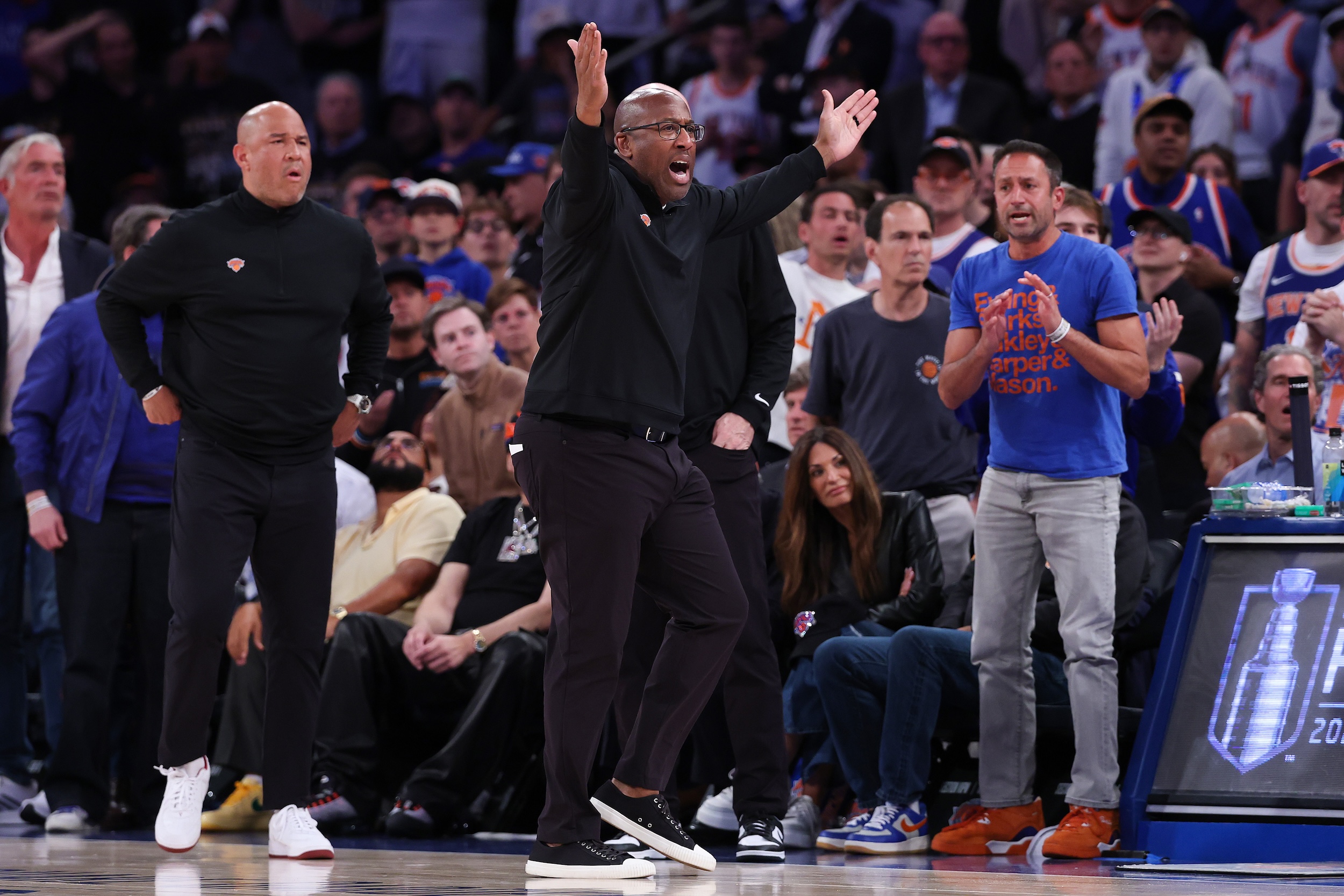
The same crew that borked this murder of Brunson later declined to dish a flagrant foul to Stephon Castle for trucking the same Knick—a decision that divided ABC's broadcast crew. The refs also had such a flimsy handle on the flow of action that the Spurs at one point put six men on the floor following a confused and rushed dead-ball sequence, and all the referees could manage was a timid-seeming and morally unsatisfying do-over. The narrative is thus established—and it has been building since the first quarter of Game 2—that the Knicks are getting cheated by the whistle, a view that was not helped by San Antonio holding a mighty 24-8 advantage in second-half free throws Monday night. As a metric for referee performance, the distribution of free throws is worse than worthless, but it makes for eye-popping rosettes on a cake that was already baked and iced. Knicks head coach Mike Brown zeroed in on this hyper-digestible free-throw disparity following his team's Game 3 loss.
If you care about things like this, Brown's complaints might come across as weak and loser-y, and in fact his postgame performance inspired a hilariously huffy scolding from veteran columnist Ian O'Connor, who in The Athletic mounted a bizarre say-their-names defense of the poor maligned officiating crew's professional dignity.
Brown essentially blamed the second-half officiating for the end of his team’s historic 13-game postseason winning streak, and that was hardly fair to the refs working Game 3 in Madison Square Garden.
Of greater consequence, it wasn’t fair to the San Antonio Spurs, who beat the Knicks 115-111 on Monday night and did not deserve to hear from Brown that the impartial arbiters of the court screwed the home team.
Their names are Marc Davis, John Goble and Curtis Blair, though Brown didn’t identify them in his postgame news conference.
Worse even than succumbing to the tedium and futility of an argument over fairness in officiating is allowing yourself to care for even one instant of your life about the look of having done so, how such an indignity might resonate and reverberate among so boomed and beshitted a demographic as sports fans. So long as we are having this circus, we might as well be honest about its roles and arcs: Brown's job, as noted by ESPN's Brian Windhorst, includes the humiliating duty of working the refs. He chose for this grim undertaking a cheesy stat, but it's useful to remember that the thing Brown wants, directly and explicitly, is more free throws.
All of this now moves the subject of bias and influence in officiating uncomfortably near to the foreground of what is left of the series. There is a blank space on the NBA's website where officials for Wednesday night's Game 4 would be listed. Whoever has the assignment, they will contend with the stuff that is true and immutable, and also the agendas and grievances of the participants. Wembanyama presents a genuinely novel challenge for any working NBA official, and has ascended too quickly for the league to get a grip on how he is handled and manhandled by opponents. Also, these are two distinctly rough and physical teams who will not draw boundaries around their own aggression without strict and consistent officiating. The referees cannot win, nor can they any longer hope to do what we mostly want from referees, which is disappear into the background. No one is going to remember what Mike Brown said from the podium following a Game 3 that had in attendance the President of the United States, but the distraction is likely here to stay.
You—you there, yes, the person reading this blog—you are going to have an eye on the free-throw count tonight. It is a consequence of referee performance, of fan angst, of social media, of Brown's angle of approach, and of the strategic designs of whoever instructed him to pull that lever. "Most certainly, advocating for a team is part of a coach's role, and I don't begrudge anyone that," McCutchen said of Brown's complaints. "But fair and equitable are not the same thing." Fair, as McCutchen explained and as should be obvious to a sober hoops observer, will not necessarily mean an equal distribution of free throws. But, as was observed Tuesday by a certain two-time O. Henry Award winner, once officials have stumbled into the spotlight, it can become impossible to ignore their influence, or to avoid reading motive into their performance. And, in any case, by June there is no such thing as a sober hoops observer.