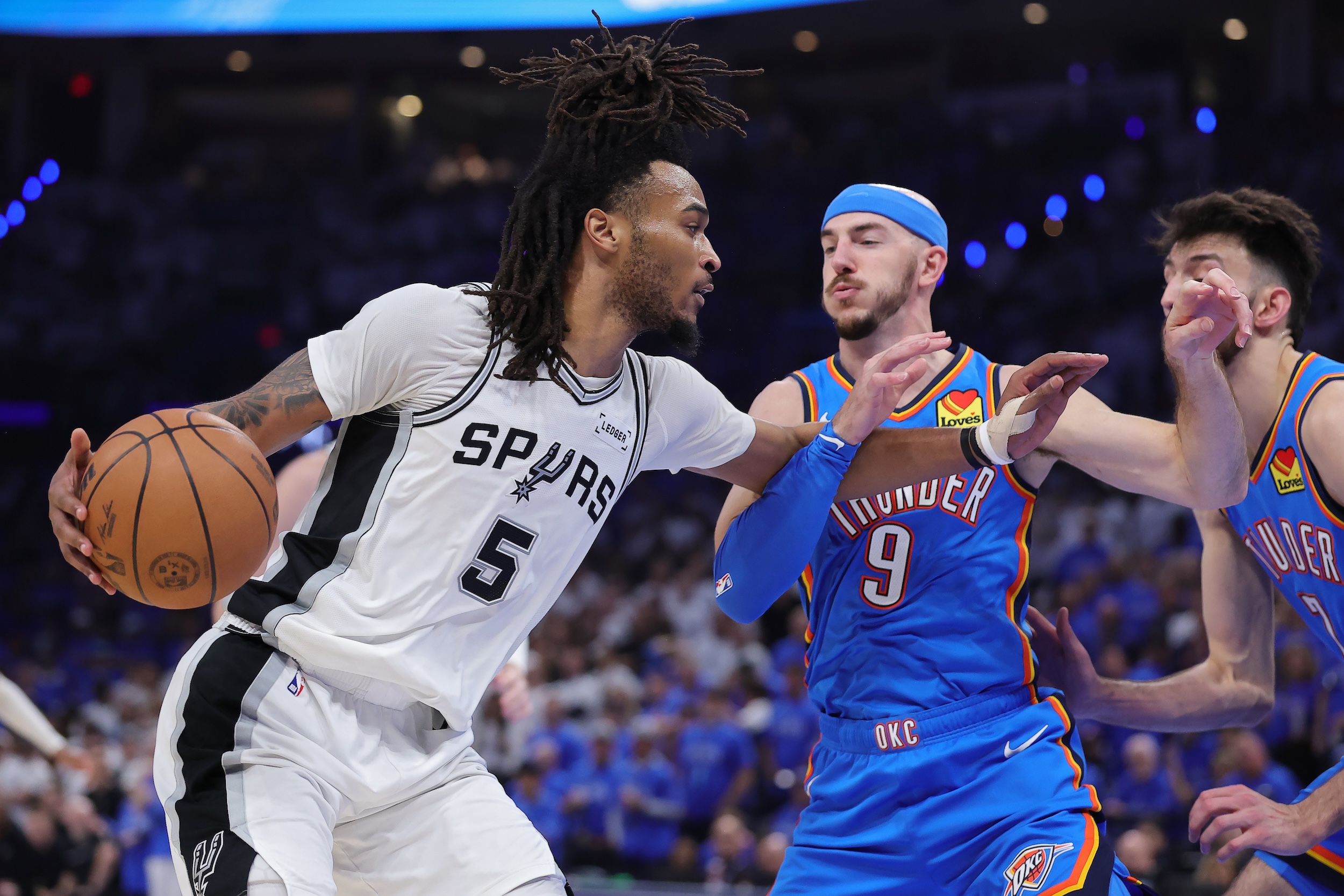
The Spurs have a ball-security problem. It was possible to overlook it in Game 1 because of Victor Wembanyama, and because Dylan Harper had a breakthrough performance, and because they won, but it was there: The Spurs turned the ball over 21 times in the victory, and the Thunder scored a whopping 28 points off those turnovers, including 16 fast-break points. The Spurs were even looser with the ball Wednesday night in Game 2, turning it over another 21 times and allowing another 27 points off turnovers, but in 10 fewer minutes of basketball. Wembanyama was less amazing, Harper looked more like the rookie that he is, and the Thunder evened the series with a 122–113 victory.
That's the whole blog. Good day to you.
Well, OK, it's not quite so simple. San Antonio was down an important ball-handler in the first two games of this series. De'Aaron Fox can be a bit zany as a lead guard, but he enjoys game-breaking athletic advantages over many of the only people remotely qualified to guard him, and he is in fact not really a big turnover guy. Would it fuck you up pretty good, would it singe your ear hairs to be told that Fox has averaged fewer turnovers per game in his career (2.7) than John Stockton did in his (2.8), and while using a lot more of his team's possessions (28 percent usage to 18.9)?
Without Fox to really scramble Oklahoma City's point-of-attack defense, the Spurs have had to shift more of their initiation and playmaking duties over to Harper and Stephon Castle. Harper is a tremendously skilled ball-handler and an incredible layup artist, but his routes to the cup tend to be more zig-zagging, exposing him to more of Oklahoma City's long swiping arms, and he is not yet a Fox-level passer. Castle is unbelievably strong and explosive, but he's a bit of a slob with the ball. Both of these guys will refine their floor games in the years to come, but for now it's a lot to ask them to run clean offense for consecutive games against these mauling Thunder.
It was especially a lot Wednesday—or, rather, the difficulties experienced by San Antonio's guards were especially problematic—because of the way Oklahoma City adjusted its defense after Game 1. Mark Daigneault tried out his sturdy wing guys on Wembanyama in Monday's loss, and that gave Harper and Castle opportunities to drive at the occasional positional mismatch. It also allowed Wembanyama to snag nine offensive rebounds, and to convert alley-oops in situations where he was closely guarded but by guys who would need a trampoline to get a good view of his armpits. For Game 2, Daigneault assigned Wemby duties to Isaiah Hartenstein. I wish this had been a more honorable affair, but it was typical Oklahoma City shit: Hartenstein's job was to mangle Wembanyama, to hook his elbows, yank on his wrists, club his shoulders, shove him, twist him, and in all ways simply abuse him, away from the ball, until the refs stepped in.
This was nasty stuff, but it worked: Wembanyama got up only 16 shots in the game, and though the Spurs won his 37 minutes, it was only by a single point. With San Antonio's related struggles, they could not build out enough of an advantage to survive the Luke Kornet experience.
Castle, for all of his valiant attacking and sturdy, committed defense, has been a mess. He was credited with 11 turnovers in Game 1, a shocking number, a whopping nine of which were live-ball giveaways. That number understates the problem somewhat, because it fails to tally the tipped or errant passes or lost dribbles that were recovered by teammates, or by Castle himself. Oklahoma City's perimeter guys are the best in the business at poking their hands in when an opposing ball-handler attempts a move in traffic, and at swarming an overcommitted driver at precisely the moment when he realizes he is not in shooting position. Castle seems to want to brute-force his way into the paint, but too often he is hurrying himself into deep shit. He turned the ball over another nine times Wednesday night, but I would swear it could've been 14: There was a sequence in the first half where he and his teammates scrambled to prevent him from turning the ball over like three times in a single possession. Castle's 20 turnovers through two games are the most ever for a single player in consecutive playoff games.
"It's more personal on my end, just really speeding myself up, not allowing our screeners to get hits," Castle said after Wednesday's loss, noting that he is having a hard time getting into a rhythm in the pick-and-roll. "I'm putting us at a disadvantage to start the game with those."
There's plenty of good to go with Castle's bad. He scored efficiently last night—in those rare times when he turned his possessions into shots instead of turnovers—and he's able and willing to take tough shots to salvage busted possessions, and his sheer physical strength is a vital asset against Oklahoma City's brutal wings. Also, he threw down one of the handful of greatest in-game dunks I have ever seen:
But the Spurs are using Castle to lead their non-Wemby lineups, and those groups are even less able to survive his slob tendencies. It's not just the run-outs, it's the times when a Spurs possession has to frantically reset after Castle wedges himself in a trap, or crashes to the floor to recover his own lost dribble. Wemby can make a shot out of a lot of those messes, by just being so much taller than everyone else, but he can't help from the bench: San Antonio's offense in these playoffs is about seven points worse per 100 possessions with Wembanyama on the bench, which is about what you'd expect. What you would not expect is that their offense is a solid two points better with Castle on the pine.
The job is not about to get any easier. Fox may return for Game 3, but nothing is certain. Spurs head coach Mitch Johnson said Wednesday that his star guard will be evaluated day-to-day "moving forward," and did not want to commit to any sort of timeline. Harper, meanwhile, pulled up with pain in his right hamstring in the third quarter of last night's loss, was subbed out, did not return, and will be MRI'd before Game 3. It's hard to imagine how the Spurs will get better at dribbling and passing if two of their three rotation-grade playmakers are out. San Antonio's guard depth is one of its great strengths: This season, each of those three guys has been the Main Guy in a victory over these Thunder. In this series, the Spurs have already had to shift occasional attacking duties to guys who might not otherwise be trusted to possess the ball while moving against so fearsome an opposing defense. Jordan McLaughlin played six minutes a game as a deep reserve this regular season, but there he was in the first half of Game 2, bringing the ball up the court and trying to initiate offense. I do not expect McLaughlin or [searching San Antonio's deep bench] Lindy Waters III to emerge as a Conference Finals-grade lead guard.
Since 1971, 150 teams have turned the ball over at least 20 times in a conference finals game, per Stathead, and those teams have lost 100 of those games. It's not that 20 is a magic number, but you only get so many possessions, and the more of them you turn into possessions for your opponent, the harder it is to, you know, outscore those guys. "Obviously, OKC is as good as anybody at turning you over," Johnson said after the loss. "So when you’re down some of your primary creators and initiators, it causes a little bit of an extra strain." Against the defending champs, a little is all it takes.