
Welcome to Listening Habits, a column where I share the music and musical topics I’ve been fixated on recently.
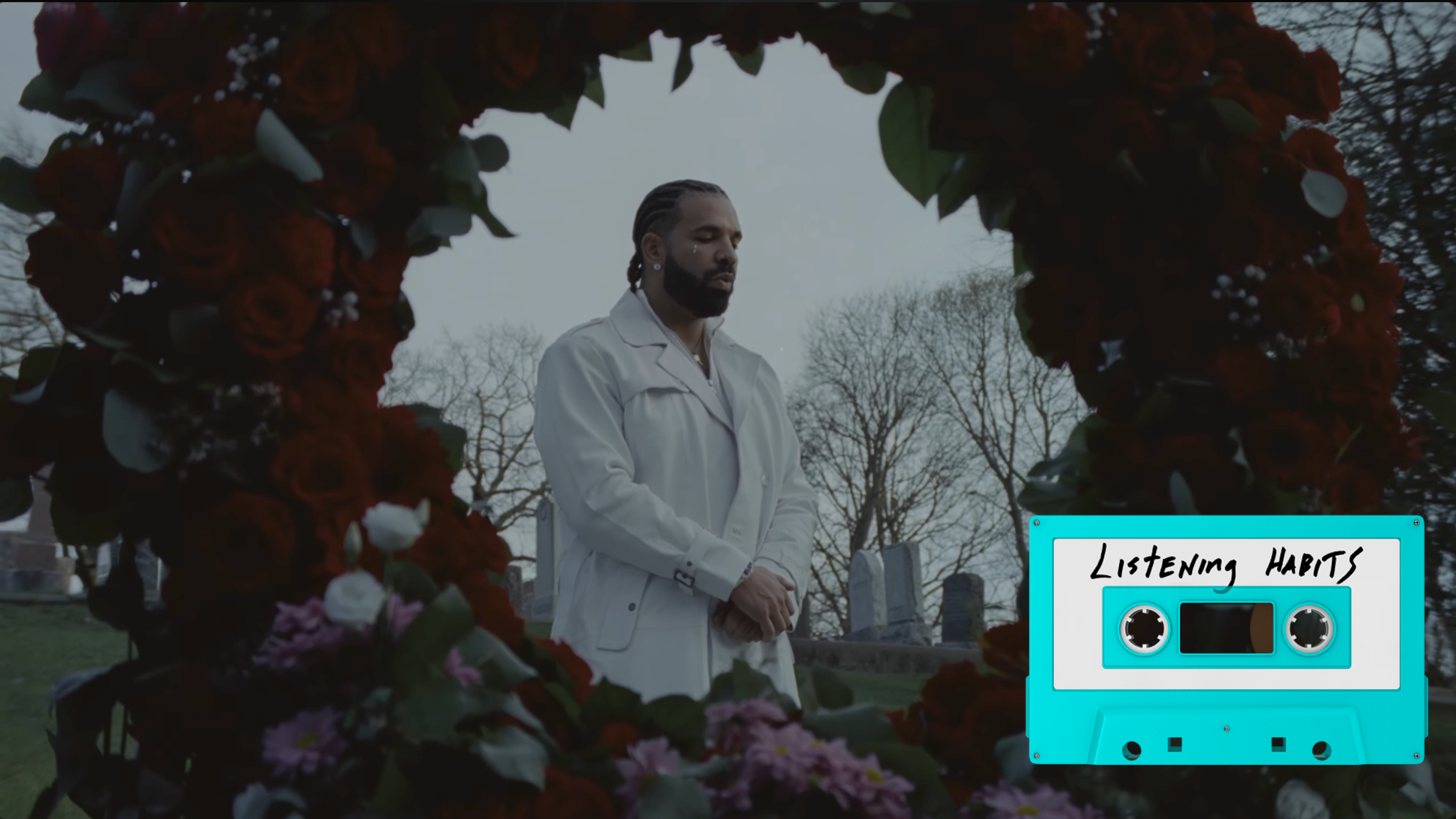
Have you heard the bad news? Drake has been forsaken: by his rap peers, by his label bosses, and worst of all by the listening public. He has been strung up and nailed to the cross. He has been stabbed in the back by all parties. And yet he has risen once again, bearing three tablets—er, albums—to let us know that we must pay for the sin of not liking him enough. After two years of stewing over losing a rap beef with Kendrick Lamar, being aired out by seemingly the entire rap industry (which had clearly been sick of his shit for quite some), suing his own record label, and getting sued for his shady involvements with his gambling-company sponsor, Drake has made a splashy return with not only his long-awaited album Iceman, but two more bonus albums, Habibti and Maid of Honour. All in total we have 43 tracks, two hours and 30 minutes of music, all essentially based around the same theme: “How DARE You?!?!”
Perhaps this is a fair question. Has Drake not given you everything that could be asked of an artist? Has he not soundtracked your summers, spring breaks, and heartbreaks? Has he not given you music to ride around to, to party to, and to sit around moodily in the dark, smoking hookah and moping? Is our 6 God not an awesome God?
No one can deny that Drake has for some 15 years now been the top dog of mainstream rap music, and arguably of pop music in general (alongside Queen Taylor Swift). But that’s part of the problem: He’s been on top for so long that he’s become a mad king like Aerys. The throne has left scratches all over him and he’s losing his grip on reality. There’s a reason superstar rappers' runs used to last for only like seven years. Healthy cultures move forward, get newer and fresher, and leave behind the leaders of old the second they start to stagnate. But our culture is anything but healthy, and is defined by stagnation. And so Drake has ruled over an increasingly stale empire, lording over subjects who increasingly resent him for his status and for their inability to overthrow him. A big part of the appeal of watching Drake again lose a beef in such vivid, undeniable fashion was the way it scratched that deep desire to see the culture finally move on.
But there is nowhere else to go. No bubbling, undiscovered music scene to turn to. No escape from the culture of stagnation that both Drake and Kendrick represent. No reinvention of a music industry that is collapsing, has forgotten or is no longer interested in minting new stars, unless it's through bot farms and astroturfed marketing campaigns. The snake has eaten its own tail and shat out DJ Akademiks, who is now considered the most important man in rap media. If this is The Culture™️, then Drake deserves to be its biggest star.
But I’m getting ahead of myself. Let’s talk about Drake’s three new albums. Slogging your way through it all, it is certainly evident that Drake was out to prove a few points, settle a few scores, and air out a lot of grievances Frank Costanza–style. Whether or not Drake could’ve done all that more effectively with a single, cohesive project instead of three sprawling ones is beside the point for him. Drake wanted to flood the zone, take over the whole Billboard chart, become inescapable. Will it work? Maybe. Drake’s popularity is no longer really tied to the actual quality of his music. Even when he fails, he's too big to fail. As far as that actual music goes, he does some interesting things … sometimes.
Iceman is the main record here, the one people have been waiting for. And it is the one where he spews all his vitriol and petty anger and hurt feelings. The most surprising thing about Drake in the midst of this whole ordeal is that he genuinely did not foresee any of this coming. This is fascinating to anyone who has seen how unlikable he's become or heard the rumors about how poorly he is regarded in the industry. But Drake, whether from a lack of self-awareness or the distorting, siloing effects of fame madness, comes across as someone who could not imagine actually being hated. (As he puts it on "Make Them Pay": "I need compliments 'cause lately, it's just falling-outs and disagreements, industry is really evil / And I faced the way they paint me, but it hurts just like the Philly Eagles.") Throughout Iceman, he spills all of his hurt and anger about everyone, not just Kendrick but also J. Cole, A$AP Rocky, Jay-Z, DJ Mustard, DJ Khaled, and even DeMar DeRozan and LeBron James.
It’s all juicy and melodramatic and great for repeated streams and lyrical breakdowns, but ultimately it all feels like empty posturing. Furthering that impression is the fact that Future appears on the album, on the “cleverly” titled “Ran To Atlanta.” Future, along with Metro Boomin, was the inciting agent of the whole beef. It was their project We Don’t Trust You (and the follow-up We Still Don’t Trust You) that not only featured Kendrick Lamar’s first fired shot, but also Drake disses from The Weeknd and Rocky. It’s pretty cheap for Future to now try to hide his hand, and it makes Drake's tough talk even more suspect when he's now forgiving the instigator and putting him on his comeback project. Also, the song sucks.
I have never agreed with the sentiment that Drake needs to rap more, or that somehow if he did rap more, then he could finally win over the rap purists. Rap purists need no good reason to hate things. They hated Kanye for making their favorite backpack rappers obsolete by mainstreaming their sound. They hated Nas and Jay-Z for running to Bad Boy and The Hitmen to help them go pop. We just like hating things, it's fun! Instead of courting that fickle crowd, Drake is always on firmest ground when he sticks to his true superpower: his ability to do any musical style and to do it seamlessly and successfully. The biggest problem with these three projects is that Drake takes his main skills—rapping, singing, and taste-making—and gives each one its own album, resulting in three half-assed projects where instead he could've made one fully realized thing that showcased how good he is at all three.
Iceman is the rap album, and despite a few flashes of greatness, it mostly exists to give bloggers and streamers something to talk about. And while Drake is a much better singer than he is a rapper, his R&B album Habibti feels just as uninspired as Iceman, but without all the subliminal disses to drum up attention. Habibti is basically a rehash of his joint album with Partynextdoor, Some Sexy Songs 4 U, but without Party (save one track) to even out all of Drake's whining.
Maid of Honour comes the closest to being an actual engaging album, especially if you are someone like me who believes Honestly, Nevermind is the only great Drake project released this decade. Maid of Honour is the more experimental, taste-making project. It is Drake trying to forecast what the next club music will be. At its best, on songs like "Hoe Phase," "Road Trips," and "Stuck," he effectively brings together electro-house records, early '90s new jack R&B, and New Orleans bounce in seductive, exciting ways.
But unlike Honestly, Nevermind, not all the experiments fully come off here, and the album loses momentum quickly. Plus, it feels like Drake is spinning his wheels a lot more in trying to dictate where party music should head next. Much of Maid of Honour seems to be trying to push forward a sound that Beyonce did effectively in one song a few years back. But all told, Maid of Honour is the one I’m most likely to return to, mainly because it feels like Drake the artist trying something new rather than a star twirling his crown and making his subjects kiss the ring.
Here's the thing with Drake, and I mean this in the most objective, journalistic, impersonal, clear-eyed way: He is a loser. I don’t mean from a success standpoint, obviously. I mean that the essence of his personality is that of the dweeb, the dork, the loser. He is a mess of insecurities and sensitivity and grievances, and no amount of money or fame or strip club visits will change this. It is that loserdom that makes him flock to coolness shields like Future or 21 Savage, but it is also what attracts him to streamers like Akademiks or Adin Ross and rappers like Tory Lanez, kindred spirits in loserdom. It's that loser essence that gives these albums whatever pathos they achieve.
People think Drake has struggled to grow up with his original millennial audience, but in reality Drake has no interest in growing up. He wants to cater to the next youth audience that is being ushered in—or to paraphrase someone who was talking about something completely and totally unrelated, Drake gets older, but the audience stays the same age. It's a smart way to maintain relevance, but that mentality bleeds into real life and suddenly you’re in a stasis of arrested development, unable to become an adult, while time marches forward anyway.
Drake is too disconnected from everything and everyone to do anything but what he’s doing. He can’t fall in love because he can’t trust a woman to actually like him for anything other than his money and fame. (“Big crib, but I feel like no one's home / Will I find love or will I stay alone / Damn, come on, must be someone in my phone / That loves me just for me, I don't know” on “Slap The City.”) He can't really trust his friends to actually value his friendship. (“Our brother sold his chain the other day and said that someone snatched it / I'm still processing that shit, it got me so distracted / I think he's so desperate and our life is goin' fantastic / He don't have the heart to come and tell us he pawned it for cash” on “Make Them Cry.”) He can't rely on his parents and actual family. (“I have to father my mother and treat my son's grandfather like my older brother” on “Make Them Cry.”) He feels betrayed by his record label. (“They riggin' the game, because you fightin' the biggest artist / They tryna have me stuck in this position like rigor mortis” on “Make Them Remember.”) And of course he’s full of racial insecurity, a big trigger that both Pusha T and Kendrick pounced on. (“Is it the fair skin or the Jewish roots / Why people wanna not see me on top of the mountain like I do the Dew” on “Make Them Remember.”)
He is a loser. He cannot help himself. Despite this reputation of him as the woman-friendly, sensitive rapper, he was actually the exemplar of the manosphere before the manosphere was a big deal. It is a big part of his shamelessness. His desperation to prove all things to all people, so much so that he’ll make a song like “2 Hard 4 The Radio,” a Mac Dre–inspired West Coast record that sounds a whole lot like another recently popular West Coast rap record. The fact that he has the gall to even go for it is what makes him a singular artist, and is also what has driven him mad and made everyone hate him. On the one hand, for there's something commendable about a loser achieving all this success. On the other hand, his inability to escape this core is why he will never really grow. He is just Drake, never more and never less, and we must praise his name regardless.
The Best Non-Drake Song Of The Moment
I cannot share the actual video on this blog, so enjoy the On The Radar performance of Yung Miami's latest.
If you would like to contribute a song, a suggestion, or ask a question for future installments, email me at israel@defector.com.