

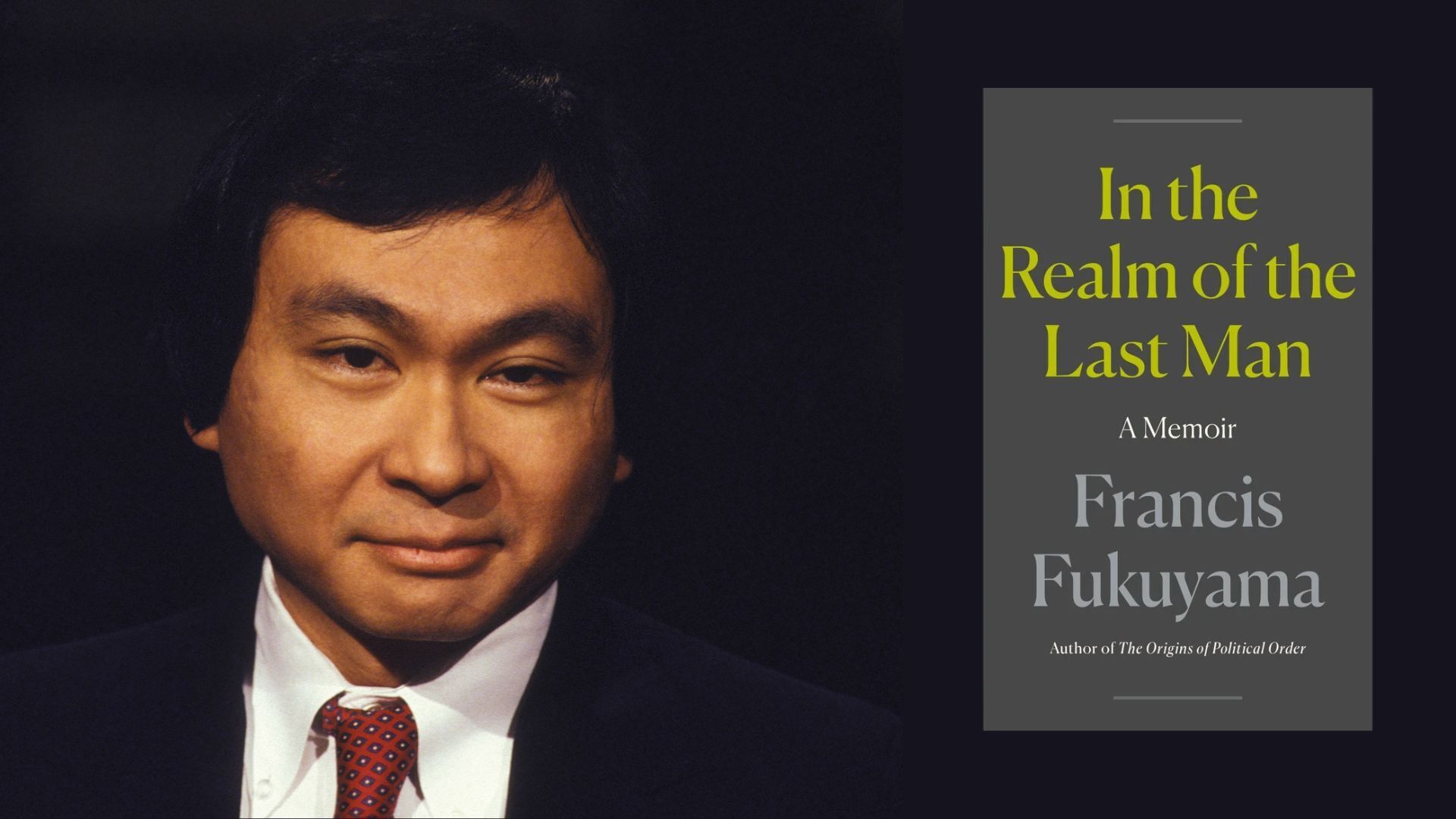
If you’re not following Francis Fukuyama on Instagram, you’re missing out. His posts exemplify a Boomer picaresque aesthetic: the occasional typo in his captions, pictures of electronic parts that he’s fiddling with, a linear algebra textbook, a landscape shot of the Danube, mysterious but alluring architectural highlights of various European cities, and unsmiling selfies while wearing a ballcap. It’s all charming, yet interspersed within the grid are more eyebrow-raising indications: a debate with Peter Thiel at the Aspen Ideas Festival; pictures of meetings with various political figures, including a former PM of Turkey and Alexei Navalny; highlights of conferences and summits featuring a program he runs at Stanford University, the Leadership Academy for Development; and giving a talk to an organization called the Chicago Council on Global Affairs. How did he get here? Fukuyama’s memoir In the Realm of the Last Man offers a kind of answer, though perhaps not in the way that he intended.
The title of Fukuyama’s memoir references the 1992 book that made his reputation. Long after Fukuyama is dead, and the rest of his work is gathering dust in libraries, The End of History and the Last Man will remain a point of reference. The book was an expansion of an earlier 1989 article he wrote as a first attempt to historicize the meaning of the end of the Cold War. Fukuyama in the book took a particular interpretation of Hegel as propounded by the Russian-French philosopher and civil servant Alexandre Kojève. Given Marx’s line that he stood Hegel right side up, Fukuyama can be said to have turned Hegel sideways: History has a kind of structural developmental logic to it, as determined by the human drive for recognition and respect, encapsulated by the Greek term thymos. Iterations of the demand for thymos have created conflict and change throughout history, determining the form of the state through time. For Fukuyama, the liberal capitalist order that won the Cold War, as led by the US, was the end of history, in that there would be no further political developments towards new kinds of state orders. This is not a triumphant vision, however, as at the end of the book he theorized the Last Man, a product of this world capitalist order, whose needs would be easily met and who would have no desire to strive for achievement or greatness, as his thymos would be so easily assuaged. This Last Man would be a pathetic figure, a mere passive consumer and the society that created him would stagnant culturally and politically. Eventually this society would collapse, as the Last Man would himself destroy it out of boredom. History itself for Fukuyama then is a process that can never satisfy humanity, and his Hegelian inspired theory of structural historical development at the end reveals itself to be another high-level cyclical interpretation of history as eternal conflict. Fukuyama notes at the beginning of the memoir that “I have been asked several times a week over the past three decades whether I wished to recant my argument.” In sum, no, Fukuyama sticks to his guns, but clarifies that his suggestion was more “that History, rather than ending, had simply paused on its way to an uncertain future.”
So, what is life like in the realm of the Last Man? As a memoir it is less the story of a life than a narrative of intellectual development. The incidents and chapters have no discernible order, Fukuyama simply plucks things from his mind and memories at random to stage out. It makes for oddly compelling reading, mixing anecdotes with study guide-esque write-ups of various intellectuals and books. Fukuyama's life is full of improbable connections and moments, with his family background ensconced in elite academic and political circles. His maternal grandfather was Shiro Kawata, an academic agricultural economist who was part of Japan's modernization drive. Kawata studied in imperial Germany before WWI, where he was somehow able to gain access to parts of the personal library of the economic historian and theorist Werner Sombart. Sombart, alongside Max Weber, was one of the great intellectuals of late-imperial Germany, before supporting the Nazis in the 1930s. Sombart's work influenced generations of German-speaking academics, which was then translated and widely disseminated in English among American academics, and thereby influencing Anglosphere scholarship as a whole. Sombart is widely credited as having developed the term and theory of “late capitalism.” Fukuyama notes that from his grandfather's portion of Sombart's library, he inherited a first edition copy of Das Kapital.
Fukuyama's father was a Christian missionary with the Protestant denomination of the United Church of Christ (UCC), eventually earning a PhD in sociology and working on the national board of the UCC. His paternal uncle, Hiroo, was a failed businessman who became estranged from the broader family, but his life story is complicated by his activities in WWII. Uncle Hiroo was interned in a camp like most Japanese-Americans after the US declaration of war against Japan, but freed himself from internment by enlisting in the Army. Hiroo, with his native fluency in Japanese, was assigned to an intelligence unit in East Asia around Myanmar, from there ending up in Chongqing, the wartime Chinese capital of the Kuomintang, where he appears to have continued his intelligence work. While in Chongqing Hiroo formed a relationship with Soong Ching-ling, the widow of Sun Yat-sen, the revolutionary founder of modern China revered in both the PRC and Taiwan. Soong Ching-ling was also the sister of Soong Mei-ling, the wife of Chiang Kai-shek, the leader of the Kuomintang and later of Taiwan until his death in 1975. Uncle Hiroo and Soong Ching-ling exchanged letters for a little while after Hiroo left Chongqing, which are in Fukuyama's possession. He speculates, or at least expresses his wish to believe, that his uncle and Soong Ching-ling were lovers.
Fukuyama, just by dint of his family then, already had secondary connections to Japanese modernization, the highest levels of the Kuomintang and the Chinese Civil War, and the currents of modern German thought. While a graduate student Fukuyama forged connections with the men who would become the leading neocons and boosters for the invasion of Iraq. He took courses with Derrida in Paris and met Foucault at Cornell in the 1970s. He crafted policy during the early Reagan administration under Paul Wolfowitz, the latter the policy point man for then Secretary of State Alexander Haig. In his days of political consulting he met Muammar Gaddafi and a top member of the CCP, Wang Qishan, who headed the anti-corruption campaign under Xi Jinping. Fukuyama might just be one of the most well-connected men in the world. But what does all this experience and personal ties amount to? Much of the memoir functions as a Six Degrees of Fukuyama, in which we find that he knows someone who knows someone involved at the highest levels of 20th and 21st-century politics. Fukuyama did his undergraduate in Classics at Cornell, then began a PhD in comparative literature at Yale, before undergoing a disillusionment with French theory and postmodernism, a quite influential break in Fukuyama's mind, as he references it often in the memoir. Fukuyama dropped the comp lit program and then began a PhD in political science at Harvard, achieving his degree in 1981. By the late 1970s Fukuyama was already writing reports for RAND, the influential think tank. In the early 1980s he became involved in government work and then expanded his consulting and think tank credentials throughout the decade, branding himself a Soviet expert. He published his essay “The End of History?” in 1989 in the neoconservative magazine The National Interest, then expanded into the 1992 book. The rest was, as they say, history.
There's a quality of perpetual naiveté to Fukuyama, the American innocent abroad par excellence. The trouble is that in the era of American dominance in the wake of its Cold War victory, Fukuyama's naiveté became mistaken for wisdom, tentative generalizations taken as succinct insights. A more simple formula can capture his position: Francis Gump/Forrest Fukuyama. As the memoir shows, somehow Fukuyama kept turning up at the right place at the right time, meeting the right people. If we wish to engage in a form of vulgar Hegelianism, Fukuyama represents the American world spirit of the era of neoliberal globalization. Fukuyama throughout his life found himself in improbable situations, interacting with prominent intellectuals and influencing famous politicians. Yet, he is incurious about why it is that his life has followed the trajectory that it has, how he became entangled at such a high level.
Fukuyama's naiveté could function as gentle self-irony, if not for him portraying it genuinely. A particularly unintentionally funny section that serves as an example is Fukuyama describing his relationship to, and memories of, Allan Bloom, the philosopher famous for his 1987 book The Closing of the American Mind. Fukuyama lists Bloom's habit of creating a cult-like circle with his male students, his tendency to be a diva, his dismissive attitude to women, his inability to drive, his undisciplined and extreme spending habits, with Fukuyama concluding on how shocked he was to learn that Bloom was gay, in the aftermath of the latter's death from AIDS. A more serious example is his chapter on his travels in South America starting in the late 1980s. Fukuyama became a high-status intellectual consultant at this time, particularly after the success of his “Last Man” essay, being invited on various speaking tours to convey his American wisdom. Fukuyama writes of being invited to Colombia “sometime in the mid- to late 1990s” to give a talk on Latin American geopolitics to ANDI, “the Colombian employers' federation.” In the same remembrance, Fukuyama mentions that when he came to Colombia, he was “only dimly aware of” the FARC and the Medellin cartel in the country, political forces that one would think a man giving a speech on geopolitics involving that very country would know about. During his talk, Fukuyama expressed criticism of the Colombian government, unaware that the president of Colombia was sitting in the first row of the audience, presumably being unable to identify him by sight! Fukuyama plays off this faux pas by noting that the group that sponsored his visit and talk were "delighted," as they were opposed to the president and his corruption. “They were quite happy to see him humiliated by a gringo.”
What does it say about the nature of American power and its intelligentsia during the period of its most unchallenged hegemony that one of its greatest figures could claim expertise with so little actual knowledge and credentials? Who needs detailed regional knowledge when we have an all-encompassing theory of modernity and history itself? Fukuyama is at his worst when he is at his most structural, feeding everything into his neo-Hegelian model, which ends up becoming a way of justifying American power. He is best representative of a kind of American greenhornism, in the realm of intellectual theory. Ironically then, Fukuyama himself also best represents the figure of the Last Man on which he made his career—his intellectual development is always ongoing but never seems to go anywhere, his greatest passions are forms of collecting and furniture making, and a lot of his supposed wisdom comes across as very banal and dated at this point, regarding his commitment to liberalism and his ignorance of politics outside of the US and Europe. The tragedy of Fukuyama is that what diminishes him from true intellectual greatness is his lack of irony, but what also ensures his appeal is his earnestness.
Fukuyama's prose is simple and straightforward, effective at summary and condensation, taking more complex ideas and events and making them palatable for a quick read. In this, he perfects the skill of his first job and what set him toward intellectual superstardom—writing policy reports for RAND in the 1970s and 1980s. The crafting of a report bears similarities to scholarship, engaging with analyzing events and ideas, but is a fundamentally different endeavor, trading out empirical rigor for a compact political conclusion. Fukuyama's best writing, even his reputation defining essay “The End of History?” simply replicate the winning formula of the report. There is almost no mention of Fukuyama's personal life in the memoir. The usual events that a memoirist deems worthy of interest are swapped out. Fukuyama devotes more attention to woodworking, computer building, amateur coding, and his camera collection than to his personal relationships. These sections express real passion, as well as Fukuyama's true prose talent—he could have had a brilliant career as a writer of manuals, how-to guides, technical product descriptions, and advertising reports. His philosophical and political work follows the same formula, describing complex intellectual systems for an unfamiliar reader, unboxing Hegel and Leo Strauss and various political theories like fancy new gadgets, explaining their components and functions for the refined collector and connoisseur. The memoir is Fukuyama's popularization of his own career, providing summaries of all of his works, condensing his life's work into 250-something pages. If you have a shelf of Fukuyama's books, you can get rid of them, as he has now distilled everything down even further to this one volume.
Fukuyama is most interesting in terms of his status as a popularizer of a popularizer of a popularizer, taking Allan Bloom's interpretation of the philosopher Alexandre Kojève, who in turn developed his own more condensed version of Hegel's philosophy of history. Fukuyama can be seen as a counterpart figure to Kojève himself. Kojève, a peripatetic figure, moved from the early Soviet Union to Germany and then to France, where he would deliver his famous lectures on Hegel's Phenomenology of Spirit in the 1930s, which would influence generations of French intellectuals. He also developed a career as a civil servant and bureaucrat, through which he would help create the European Economic Community, a foundational organizational precursor to the modern European Union. Kojève's life is a key example of Hegel's own idea of the cunning of history and of world historical personalities, one of his master students and interpreters being a member of the Russian aristocracy who left the revolutionary state that overthrew that very aristocratic social class, ending up in the heartland of revolutionary modernity, and there crafting policy within the bowels of bureaucracy that would ultimately change the political economic fate of the European continent. If Kojève is the European intellectual world historical personality, as engaged in political action through the bureaucracy, then Fukuyama is the American version—the child of an interned ethnic minority during the world war becoming one of the nation's most respected intellectuals. Fukuyama himself near the end of the memoir praises Antonio Gramsci and Gramsci's theory of the "long march through the institutions" to both gain and wield power to effect change on the world. Yet while Kojève's real existing Hegelianism resulted in him being a founding father of the EU, what has Fukuyama's own long march through the institutions and his own real existing Hegelianism resulted in? The legacy is quite dismal; by Fukuyama's own measure the liberal democracy he devoted his life to is under threat across the world, his neoconservative compatriots all promoted expansive wars and military interventions and invasions under W. Bush, and the American led world order seems to be on the edge of terminal long-term decline.
Fukuyama's concerns about liberal internationalism and the distribution of political respect on the international stage sound today as antediluvian cries, a political theory from the Stone Age, in the face of the current crises of climate change, great power competition between the US and China, and the Greater Middle East War as fueled by the de facto American-Israeli geopolitical murder-suicide pact. Whenever Fukuyama appears to be on verge of breaking through the Cold War and 1990s liberal orthodoxies, he slips and retreats back to comforting and banal conservative myopias, such as opining that student protesters against the Israeli genocide in Gaza were merely engaging in political action “to experience danger and risk in pursuit of a just cause that has never previously been a major part of their lives.” There are also the occasional discussions of multiculturalism, DEI, identity politics, and postmodernism that are excellent material as sleep aids.
Fukuyama ends his memoir on a bittersweet insight: “No one to date has come up with a novel architecture to house the Last Man at the end of history, but that aspiration inevitably remains.” Yet, Fukuyama seems to have found his own personal architecture as a Last Man, crafting furniture and computers in his workshop. Fukuyama's thought stalled many years ago, and now he tinkers with old material he has on hand, much like his material hobbies. It seems to keep him happy, which is no small thing. It's hard to dislike Fukuyama though. I for one like him. Perhaps he may never gain the critical self-awareness to see the irony of his own position in history. That's ok. I wish he was my grandpa. Maybe he would make a chair for me.