If one wanted to understand the alarming state of international politics in the Western Hemisphere through a single story, it'd be hard to beat Jose Antonio Kast visiting CECOT this past January.
Kast spent nearly 20 years at the extreme right fringe of Chilean politics, mostly crusading against women's rights. His father was a Nazi, and not in any sort of metaphorical sense: He served as an Oberleutnant in the Wehrmacht in World War II. Various members of the Kast family also worked for the Pinochet dictatorship and have dedicated their lives to revanche. Last December, Kast won Chile's presidential election thanks in part to Donald Trump throwing his weight around, and before he took office, he went up to El Salvador to visit its notorious CECOT prison. Kast said he was interested in how to "import good ideas and proposals," such as the mass torture compound, in his quest to militarize Chile against the specter of narcoterrorists and illegal immigrants, and in doing so bring it into close collaboration with the Trump administration.
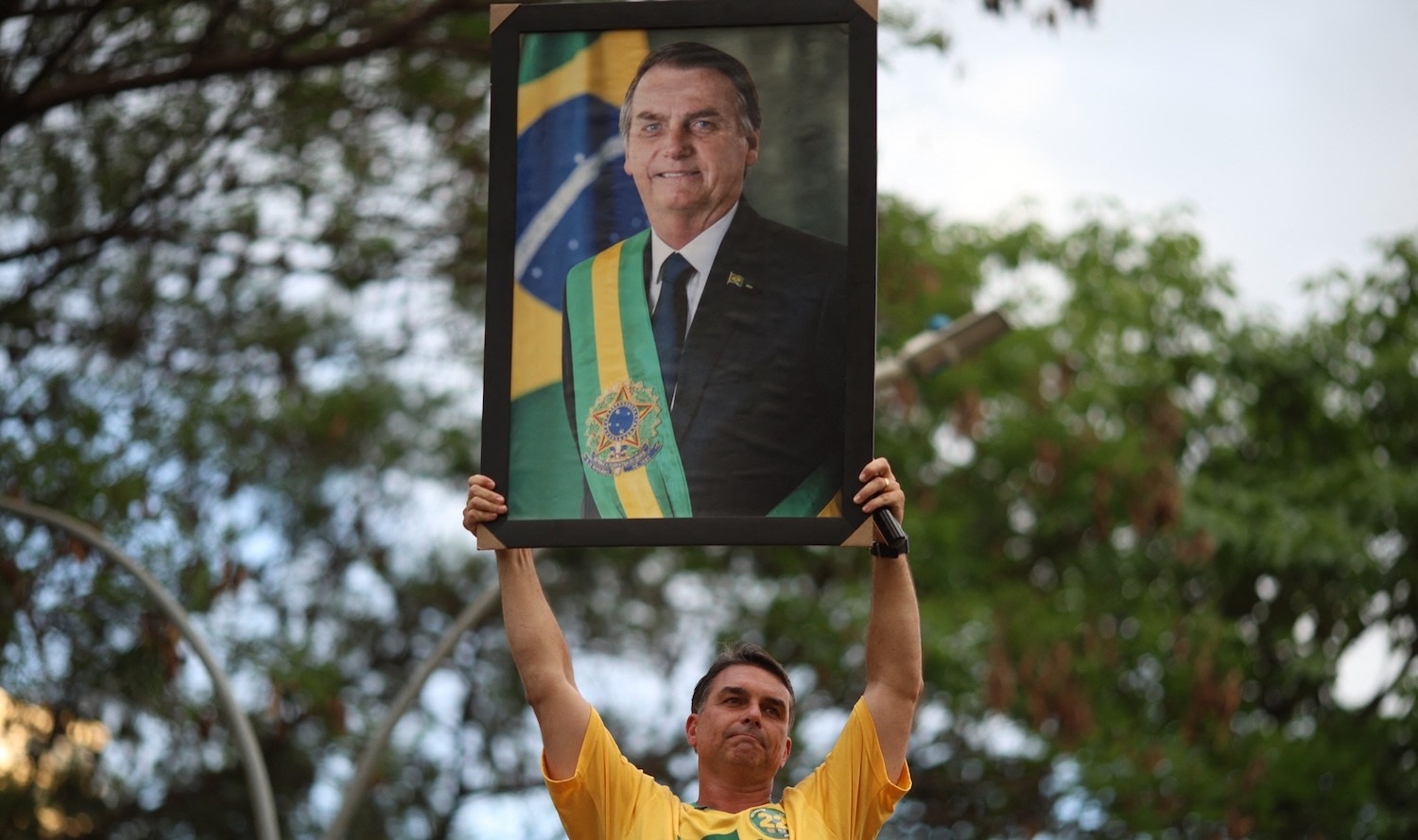
This sort of thing has been happening all across Latin America since Trump strode back into power, with a rapidly dwindling handful of notable exceptions. The two most-populated countries cling to leftist rule, for now anyway. Claudia Sheinbaum's government is quite popular in Mexico and has managed to keep the U.S. relatively at bay, while Luiz Inácio Lula da Silva is still in charge of Brazil. However, Lula underperformed in the first round of Brazilian elections this past Sunday, and Brazil is on the verge of electing Flavio Bolsonaro. The eldest son of the currently jailed and constantly leaking fascist former president assuming office of the second-most populous country in the Western Hemisphere would represent a total victory for the Trump-aligned right-wing movement in South America, and would by extension be a disaster for the country, the hemisphere, and the planet. How did we get here, and what tensions animate this broad coalition?
A little over one year ago, Jair Bolsonaro was sentenced to 27 years in prison for trying and failing to do a Brazilian January 6th. At that point, Lula was three years into his third presidential term, most of which he'd spent battling an extremely pugnacious right-wing congress ruled by the police, agriculture, and religious lobbies. Absent both a signature policy achievement and a coherent right-wing challenge to his government, his position heading into the 2026 elections seemed decent though tenuous. This was in part because of the uneven dismantling of Bolsonarismo, and that movement's inability to cohere around a single figure.
Instead it offered up two potential figureheads: 45-year-old senator Flavio Bolsonaro, and his 44-year-old stepmother Michelle Bolsonaro. Though Michelle lacked any of Flavio's political experience, she led the Liberal party's extremely influential women's wing, espousing a sort of muscular Evangelicalism that was very popular with voters. She and Flavio spent the summer locked in an internal power struggle, which became a matter of public intrigue when she started going after him on Instagram. They eventually brokered a deal to have Flavio stand in as the presidential candidate, a decision that was announced by an AI-generated Jair Bolsonaro at the PL conference in July.
Flavio's involvement in oafish corruption schemes is as defining as his alignment with the Trump administration. I first learned of him in 2016, when he pretended to faint onstage during a debate while running for mayor of Rio de Janeiro. The main scandal Flavio has been involved in has been the Banco Master Ponzi scheme. BM's owner, Daniel Vorcaro, is currently jailed for doing classic Ponzi stuff, and over the summer, the Intercept Brazil published several voice memos and text messages detailing how Flavio was repeatedly hitting up Vorcaro for tens of millions of dollars, nominally to fund a biopic about his father starring wackadoo movie star Jim Caviezel. The destruction of Banco Master has spiraled into a sweeping political scandal, highlighted by one Supreme Court Justice leaking WhatsApp messages from Vorcaro to Supreme Court Justice Alexandre de Moraes, showing the two coordinating their corrupt efforts to keep Vorcaro's sentence light.
In May, Flavio lobbied the Trump administration to label several Brazilian gangs as Foreign Terrorist Organizations, and they granted his wish within a day. Before the first round of elections, Flavio got some more help from his friends in Washington, with the implementation of new tariffs aimed at harming Lula's government, and Meta doing everything in their power to help Bolsonaro get elected. The election interference was so brazen that 31 U.S. lawmakers sent a letter to Marco Rubio in September, decrying his boss's attempts to fix the election for Bolsonaro. Rubio and co.'s efforts have been very successful, with the PL doubling its share of congress and several outer Bolsonaros, including Michelle, winning their races.
In addition to being a buffoon, Flavio's also dedicated to the hypermilitarization of his country's already notoriously brutal police force, the further injection of Evangelical Christianity into the country's political fabric, and the destruction of the Amazon rainforest. As to the latter, Brazilian agribusiness is the country's single largest industry, and it's been booming over the last few years thanks in part to Lula prioritizing exports to the Chinese market. All those guys are backing Bolsonaro to the hilt, as he's sure to let them destroy the forest in order to grow the country's already huge cattle herd. Flavio has campaigned on trying children as young as 14 as adults in criminal trials, and chemically castrating people convicted of a variety of crimes. He's also campaigning on creating a network of CECOT-style mega-prisons, including a sprawling complex called treva, which means "darkness" in Brazilian Portuguese.
This brings us back to the broader right-wing movement across Latin America, which is characterized by every single elected head of state campaigning on a militaristic tough-on-crime platform. Costa Rica's CECOT analog, CCCAO, will open next week. Peruvian President Keiko Fujimori campaigned on building five mega-prisons, and is scheduled to visit CECOT later this month. Ecuadorian President Daniel Noboa is perhaps the epitome of this movement. He and Rubio are extremely tight, with Rubio praising Noboa for his crackdowns on drug gangs and his willingness to let the U.S. use the country as a base of operations. Noboa knows all about the drug trade, as he's been a gleeful participant in the war on drugs, on the side of drugs. Noboa's family business is bananas, and the Noboa Corporation is one of the biggest exporters of bananas in the world. Contained inside the skin of Noboa bananas is not only fruit but also cocaine. Noboa has of course built several mega-prisons, where thousands of inmates have been tortured or killed.
I'd like to note here the degree to which the Western press has covered the right-wing tide, primarily as a sincere movement of concerned citizens who have had it with violent drug gangs ruining their lives. In, say, the New York Times' narrativizing of events, cartels are eternal organizations who happen to exist, absent material forces and without any relationship to either U.S. hegemony or their own state's power. Developments such as a trafficker like Noboa being given the full support of the U.S. and Trump pardoning former Honduran president and prolific drug trafficker Juan Orlando Hernandez show the rhetorical subjectivity and power dynamics behind who gets termed a drug cartel and who gets protected.
Colombia was one of the last holdouts against the right-wing tide, with Gustavo Petro serving as a leftist president and agitating (often quite forcefully) against Trump. The U.S. helped Abelardo de la Espriella, who led the prison-promise race with a whopping 10, win a razor-thin election against Petro by having ICE arrest an influential lefty content creator at Rubio's express request, threatening military action against the country if they reelected Petro, and pulling off the classic move of congratulating de la Espriella on his win before the election results were finalized.
If Flavio Bolsonaro wins the final round of voting later this month, every country south of the U.S. besides Mexico will be governed by a right-wing leader. Not all of them are as closely aligned with the explicit goals of the Trump administration as Nayib Bukele's El Salvador or Noboa's Ecuador, and if there is an element of internal division, it's the degree to which any given country's electorate is willing to let the U.S. use them as military outposts. In March, Trump announced the formation of the Shield of the Americas, which is an agreement between the many right-wing states in the Americas and the U.S. to use U.S. military force to kill a bunch of people in Central and South America, under the broad aegis of security against drug gangs.
Signing up involves ceding some degree of sovereignty, and so far people in Kast's Chile haven't been happy with the tradeoffs, especially since everyone is still subject to the Trump administration's bizarre tariff regime. The popularity of authoritarian leaders is internally unstable, motivated as it is primarily by the fear of a repeat of what the U.S. did to Nicolas Maduro in Venezuela. The result of that coup has not been better conditions for Venezuelans, but rather the large-scale plunder of Venezuelan oil. The U.S.'s only offer is help with killing some guys, not any sort of economic benefits package, and certainly not any actions against the many right-wing militias (including Brazil's notorious and esoterically Zionist narco-pentecostalists) trafficking drugs and ruining people's lives.
Bolsonaro has promised that he'd make his country a member of SoA if he were to win, which would be an alarming development for fans of democracy and human rights in South America. That's but one of many reasons to pay very close attention to what's happening in Brazil over the next month. The presidential election is extremely important—I recommend this recent symposium from North South Notes for even more context—not just for Brazil and for the region, but for the future of life on Earth. Under Lula, deforestation of the Amazon slowed drastically. Under Bolsonaro, it would surely surge, especially given the centrality of agriculture to his campaign. The stakes couldn't be higher.