

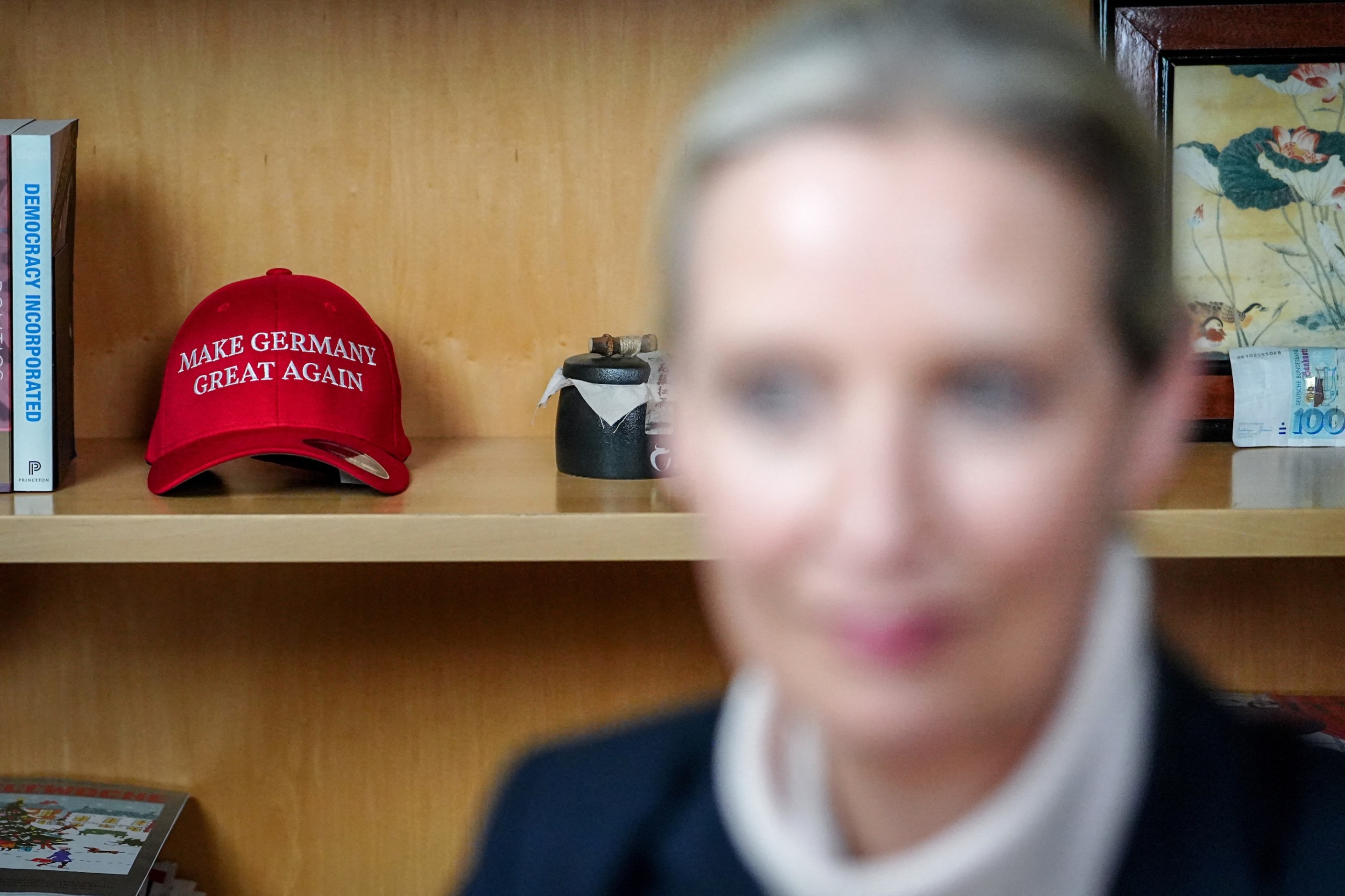
Elon Musk loves them. Donald Trump thinks they’re “the best hope for Germany” and that they’ll “MGGA” (Make Germany Great Again). They’re an existential threat for fact-based reasoning, democracy, human rights, and multiculturalism. And they're in position to become the first far-right party to lead a German state since 1945.
Over 77 percent of the eligible population of the German state of Saxony-Anhalt went to the polls on Sept. 6 in order to vote for their new state government. Alternative für Deutschland (AfD) was able to cruise to victory with a plurality 43.8 percent of the vote, slightly outperforming their polling. While the composition of the government has yet to be ironed out, it’s an unprecedented win for a party whose entire platform is based on hating immigrants and non-white Germans.
For anti-right activists in Saxony-Anhalt, the weeks and days leading up to the election had been marked by a mix of anxiety, defiance, and energy, as organizations set up pro-democracy rallies and events throughout the state. Bettina Wiengarn is a board member and spokesperson of the Zerbster Bündnis für Demokratie, a local association based in Zerbst, a small town in eastern Saxony-Anhalt. She and others had gathered to watch the results roll in.
“We had an election-night watch party, so to speak, and we were all shocked, because we hadn't expected this result,” Wiengarn said. “The fact that it would be this massive really just completely knocked us over.”
After the collective political hangover started lifting, the question across Germany and Europe was: What happens now? In order to understand what’s at stake over the next few weeks, a quick overview of Germany’s rather convoluted state election process is necessary.
The election may be over, but the composition of the government is still wide open, though a government without AfD in it looks increasingly unlikely. AfD came up just short of the seats needed for an outright majority. The Landtag (state parliament) must hold its first session within 30 days, meaning by early October at the latest, after which it elects a Ministerpräsident (the state's head of government) through a three-round vote. The first two rounds require an absolute majority, but the third goes to whoever gets the most votes, a mechanism that could hand AfD the top job even without a majority behind it.
Blocking the AfD entirely would require the other five parties in parliament, the center-left SPD and the center-right CDU (who form Germany's deeply unpopular federal governing coalition), the Greens, the Left, and the new-ish Bündnis Sahra Wagenknecht (BSW), a populist party combining left-wing economics with socially conservative, migration-skeptical, Russia-friendly politics, to work together. That's widely seen as improbable, since the CDU generally refuses to work with the Left. AfD has already invited every other party to exploratory talks, and BSW is the only one that's agreed, and has said it would rather abstain in a decisive vote than join a "firewall coalition" against AfD. That alone could be enough to clear AfD's path to power.
“People must understand that this is a true turning point,” Wiengarn said. The AfD chapter in Saxony-Anhalt has been classified as "confirmed right-wing extremist" by Germany's domestic intelligence agencies. If one keeps in mind that the AfD’s high results are not merely one of its best results in Saxony-Anhalt, but the party’s best result in any German state election to date, the implications are worrying. Eighty-three-year-old Eva Umlauf, a Holocaust survivor and president of the International Auschwitz Committee, underscored the impact of these results. "We as survivors of the Holocaust never thought this possible,” she said. “What path is Germany on? The path it has taken before?”
While many of the AfD’s stated plans for Saxony-Anhalt are not feasible, since they clash with federal or European Union law, they can still do more than enough damage. They can influence educational policy in Saxony-Anhalt, and have announced their plans to end compulsory school education and instead allow parents to homeschool their children (if implemented, this would be the first German state to do so). They can cut funding for arts and cultural institutions, as well as direct the focus of policing, which would directly affect migrants and non-white Germans through more aggressive deportation proceedings and a crackdown on legally gray practices like church asylum.
Even a short reign could have long-lasting effects. A 2026 study from the Leibniz Institute for Economic Research Halle found that the economic consequences of an anti-immigration political climate of the kind associated with the AfD’s program could increase the state’s projected labor shortage by around 14,000 workers by 2031. The resulting loss of economic output could reach €1.8–3.2 billion over the next legislative period. But the prospect of cutting off one’s nose to spite one’s face has never stopped the far right before.
Above all, this win has set a precedent that’s hard to turn back. Local elections in Berlin and Mecklenburg-Vorpommern later this month have the AfD performing strongly in the polls, with the Saxony-Anhalt results bolstering the far-right party in Mecklenburg-Western Pomerania significantly. With federal elections looming in 2029, the stakes are towering.
It’s tempting to dismiss Saxony-Anhalt, and indeed most of the former East German states, as a hopeless cesspool where everyone’s a raging racist at worst and an impressionable TikTok victim at best. That’s a pervasive prejudice that’s defined most of (western) Germany’s attitude toward its eastern states during the division of Germany and well past reunification. It’s true that the former East German states tend to struggle more than their western counterparts in just about every quality-of-life metric, especially economically. Since reunification in 1990, Saxony-Anhalt has weathered mass deindustrialization, population loss as younger residents moved west for work, and a persistent income and wealth gap. The AfD has capitalized on those systematic issues. But the stereotype of a monolithic AfD voting block does a massive injustice to the region’s immigrants, non-white Germans, queer people, anti-right activists, and the vast number of people who, regardless of their political views, refuse to vote for an openly racist far-right party. Forty-four percent voted for the AfD, and that’s terrifying, but it’s unhelpful to lose sight of the fact that this means 56 percent did not.
"There are many incredibly, deeply engaged people here,” Wiengarn said. “Treating Saxony-Anhalt as just a dull brown wasteland where everyone's about to die, or is too old and weak and stupid, that's wrong. There are plenty of German news reporters too that arrive like astronauts, landing right before elections, filming a few people who drink a lot of beer and talk nonsense, then flying off again.”
Christiane Lähnemann, a member and speaker for the Saxony-Anhalt chapter of Omas Gegen Rechts (Grandmas against the Right), was deeply shocked by the election results of that Sunday night. But on Monday, it was time to get back to work: “On Monday afternoon, we met with the others from Omas Gegen Rechts, we talked through everything and expressed our grief, but of course we keep going, we keep fighting."
She noted that the most important thing was to show others that they’re not alone in their fear and their grief, especially those from marginalized communities who are particularly vulnerable to the hate and vitriol of the AfD and their supporters. “We're worried about the international and queer community, they’re vulnerable groups who are threatened by the right, often in public,” she said.
The AfD traffic in emotions. They capitalize on people’s fear of being left behind economically and socially, of the violent foreigner coming and taking that which is rightfully yours while the state overrides the decisions you make for your children and your home. These are familiar tactics, in use on the right from Germany to Chile to Argentina, and of course the United States. Lähnemann, whose husband lived in the United States for a while, explained the parallels that he observed: “[The Saxony-Anhalt AfD candidate] Ulrich Siegmund operates exactly like Trump. [Siegmund] has a bachelor's in business psychology, he used to sell fragrances, now he sells the AfD. In American English they'd call Trump a 'snake oil salesman,' and it's the same here. He promises all sorts of things, but it's pure populism; he can't really say anything substantive."
The thing about emotions is that they’re hard to beat with facts. "It's incredibly difficult to approach this with rational arguments,” Lähnemann said. “It all runs on emotion. If you tell people this is literally in the AfD's platform, they say, ‘We don't believe that.’”
But experiencing solidarity, knowing that you’re not alone or outnumbered, and knowing that your efforts are helping others feel less alone are also powerful emotions that can shift tides. Both Wiengarn and Lähnemann were part of a “Festival for Democracy” that was set up before the election, and both emphasized the positive resonance the event had among the community. Offering a path of resistance and a celebration of diversity, capitalizing on that momentum is key. “Right now there's a window where people want to get involved,” Lähnemann said. “Now is the time we need to bring them in."
Part of the outreach strategy also includes speaking to a younger demographic, among whom the AfD is one of the quickest-growing parties. “We have a group of Omas who go into schools, not as Omas Gegen Rechts, because that would be too political, but as living witnesses to GDR history,” Lähnemann said. “We talk about life under the GDR and just get into conversation with young people and show them why democracy matters. Of course, you only reach a small share of young people this way, but it's an approach."
Above all, these kinds of organizations—from small local volunteer-run operations to large groups with a presence across the country—have emphasized that in order to continue building a network of resistance, visibility is key. “It matters to us that we get support from outside,” Lähnemann said. “It’s important that people in other German states demonstrate. We also need attention from abroad. Right now everyone's looking at Saxony-Anhalt, right now there's a lot of attention, but how will that be in two weeks? We need this attention to continue."
Both Lähnemann and Wiengarn’s organizations are volunteer-run, so they don’t depend on public funds and aren’t as vulnerable to cuts from a potential AfD government. But other bigger groups, such as Saxony-Anhalt’s Refugee Council and Miteinander e.V., could face crippling cuts.
Above all other reasons to keep fighting, the threats are too serious to succumb to despair. “Our attitude now—and among many people here—is that it’s now more than ever,” Wiengarn said. “We’re not going to fall into a depression. We know that we need to carry on. But we also know that this is a real turning point.”