
After listening to a critique of the Miss America pageant on a public radio station, Barbara Hammer declared herself a feminist. Then she left her husband. Then she became a lesbian. This was the early 1970s, and it wasn’t long before someone gifted baby gay Hammer a Super-8 and she commenced pointing it—lovingly, relentlessly—at every human crease and crevice in her life. Around this time, Hammer started writing down her name and address and placing them in balloons for others to find. “Otherwise I’d be lost in the world,” she said of the practice in an “exit interview,” given just before she died in 2019.
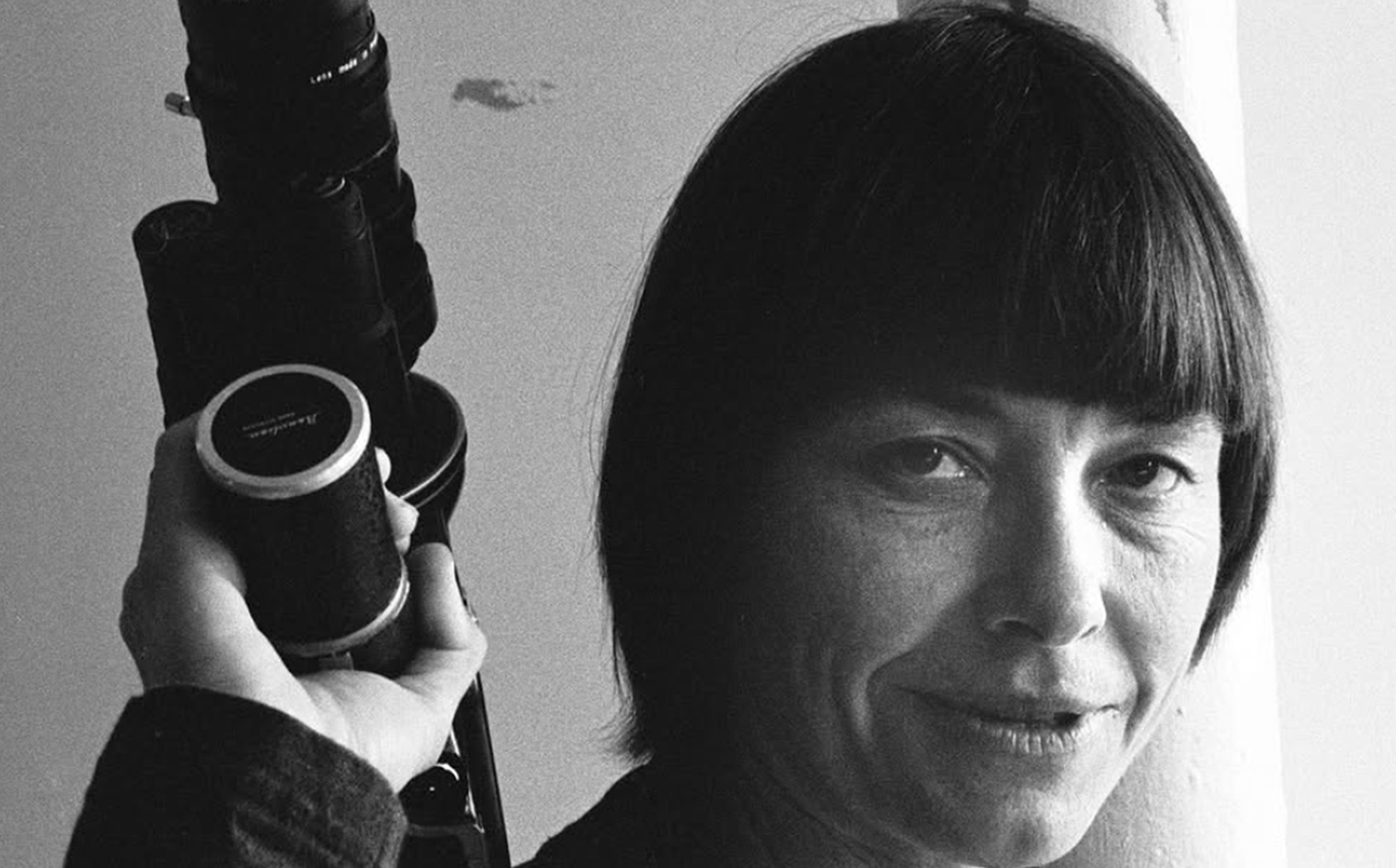
Brydie O’Connor’s Barbara Forever is one of these balloons; a documentary worthy of its iconic subject, that captures and arranges fragments of Barbara for us to turn over in our hands. It’s a devoted, sincere ode to the avant-garde artist, who, as she put it, made movies out of sex and life. More than 80 of them, to be a little more precise, over the course of half a century. Hammer filmed herself and her personal relationships obsessively, creating the vast archive that serves as the basis of Barbara Forever. At the beginning of the film, there’s a series of images of Hammer pointing a camera into a passing window, or the rearview mirror of a car or motorcycle, her left eye squinting, her right looking into a viewfinder. We often see Barbara holding and speaking directly to the camera in the documentary, creating the uncanny sense that she made it herself, from beyond the grave.
Though Hammer narrates the entire documentary, the narrative is pieced together from various sources. Babara’s voice will sound effortful and aged at one moment, then youthful and mischievous in the next. O’Connor also replicates her subject’s love of a match-cut, folding together images from throughout Hammer’s career. The result is not the chronology of a life, but the story of a filmmaker—starting when Barbara first picked up a camera, and ending with who she became to others. It’s a story of self-creation and self-plunder, of Barbara inventing herself and using her life as the raw material of her artistry.
The film briefly introduces us to Hammer’s earliest work, which makes for a romantic, tactile, lesbian hippie romp. In the short film Dyketactics (1974), naked women gather and play in a field, a lesbian La Danse. Hypnotic, fairy-like ice cream truck music floats about as women touch women in a serene creek, at times superimposed with the bluish image of bushy crotch, or Barbara filming. This early, groundbreaking work is often the first and last thing people hear about Hammer—some version of “the first lesbian to make an erotic film about lesbians.”
Thankfully, Barbara Forever pushes past the instinct to celebrate Hammer’s life as an accumulation of history-making firsts. At a September screening of the film in New York, O’Connor joked that she had to withstand market pressure to feature Ellen Degeneres speaking straight to camera, explaining what Hammer meant to her (and, therefore, why you should care about her.) Save for a few interview scenes with Florrie Burke, Hammer’s widow and partner of 31 years, no one expounds straight to camera at all.
This makes the documentary more spacious, leaving room for ample encounters with the arresting, captivating images made by Hammer. In a section about the film Double Strength (1978), which Hammer made about her relationship with trapeze artist Terry Sendgraff after they broke up, there’s a scene of Hammer’s bare legs and feet standing on a trapeze. They frame the face of Terry, looking up at Barbara from below, holding her feet and gently twirling her. The moment, cast in a grainy black and white, is memorable for its strange familiarity. On the one hand, who has stood naked on a trapeze and been twirled by their equally naked girlfriend, who happens to be the founder of modern aerial dance? On the other, haven’t you, vulnerable and dizzy, looked upon the face of your lover framed between your legs?
In another scene, Hammer visits an elementary school class and asks the students if they’ve ever heard of experimental film. “Nooooo,” they answer shyly. In a snippet of the movie she screens, pink hands, seemingly illuminated by the light of a projector, paw at a distorted hillscape. A flat rectangle appears in the middle of the screen like a great big trunk. Suddenly the hands become texturized and honeycomb-like; they pick up the trunk and move it across the landscape, breaking the barrier between dimensions. The kids are in a visible state of excitement and agitation after watching. They call it strange, dizzying, sudden. One boy keeps it simple: “I liked the movie.”
That there’s something for everyone in her work went unacknowledged for most of Hammer’s life—a source of frustration and pain that Barbara Forever contemplates in depth. Lesbian moviegoers wanted realism, and the avant-garde scene wasn’t particularly interested in lesbianism. Barbara refused to compromise on either, even though doing so may have made her more successful. She took the art world by storm in her last few years on Earth, when she contemplated something more mainstream than her lesbian life: death. Before then, she was consumed by the fear that her work would never achieve widespread recognition, and would thus be forgotten and discarded. Nitrate Kisses (1992), Hammer’s first feature film, focuses on early 20th-century queer history, disappeared from view. It opens with an Adrienne Rich quote:
Whatever is unnamed, undepicted in images, whatever is omitted from biography, censored in collections of letters, whatever is misnamed as something else, made difficult-to-come-by, whatever is buried in the memory by the collapse of meaning under an inadequate or lying language—this will become, not merely unspoken, but unspeakable.
In Nitrate Kisses’s most memorable scene, the Hays Code scrolls over one naked man straddling another, massaging him, dick hanging temptingly above hole. Hammer says it presents a challenge to the viewer: you can read the code, or you can defy it and look at the gay sex. Your view might be occluded, but not enough to stop you from seeing what’s happening. Later in the film, an older woman cautions Barbara that if she does not record her own life, history will “eat” her. “When you die,” she warns, “they do what they want with you.”
Is it queer history that Barbara worries will be forgotten, or herself? Does one exist without the other? Hammer’s films, as Ira Sachs described them, “are collectively a narrative history of Barbara as well as the culture that she is intimately a part of, both in reaction against the dominating forces of that culture, and also celebrating the possibility that artists have to re-define those boundaries and norms.” Barbara’s stories—of the first woman she ever slept with being the lover of the person who taught her the word ‘lesbian’; of returning to the home she once shared with her husband to demand her half of their marital property and seeing her picture being used as a dartboard pierced by more than a dozen knives; of scattering her mother’s ashes out of a helicopter, only for them to fly back into her face—are our stories. The history of her life is queer history. She simply had the nerve to recognize this fact as she was living it, instead of waiting for it to be acknowledged after she was gone.
Diligently recording these personal and collective histories came at a cost. Barbara Forever is frank in its assessment of how these excavations could wound anyone caught by Hammer’s totalizing vision. In one scene, Barbara asks a woman for permission to use her picture and voice in a film. They’re lounging nude by a hot tub; the woman says she’d like to see it and say yes or no to it before it’s released. Hammer becomes petulant, says that means she can’t edit it or do what she wants with it, and eventually manages to get her way. In the following scene, Barbara asks “So the question to the camera is, can you tell, at this time, whether we’ve slept together or not?” They’re inside the hot tub now. The woman responds by asking a question of her own. What’s going to mean more to Barbara, her or the film? When Barbara says “you,” neither of them are convinced. The woman insists that more than anything, Barbara needs to make this film. Barbara says that’s not true. “I will be working on the subject. But whether it’s with you or someone else is not crucial to me.” Ouch.
Hammer dedicated her life to documenting lesbian feeling and exchange, to bring her viewers inside the lesbian experience. Barbara Forever is a testament to how she succeeded. An earlier moment in the documentary, when an ex of Barbara says she treated her like an object, like a chair you sit on, is made more real and meaningful by that hot tub exchange. It’s one thing to hear someone described, it’s another to see her for yourself. In this way, Barbara Forever sketches out the whole of Hammer, and the bounty of seemingly irreconcilable contradictions she embodies. Her art opens the most private, intimate moments to public view and inquiry. By using her singular life to do so, she reveals something universal and human, something collectively queer. And the only reason she can tell the rest of us so much about ourselves is precisely because she’s not like us—preternaturally talented and masterful at her craft, sure, but also uniquely hellbent on giving her life to this one purpose. The documentary communicates all of this, Barbara’s genius alongside her self-obsession, her tenderness alongside her naked ambition.
The frankness is particularly noteworthy given how the movie was made. An email O’Connor sent to Burke in 2019 blossomed into an extremely close friendship, one that O’Connor describes as among the most important in her life. Burke trusted O’Connor to make something worthwhile, and so granted her access to 400 hours-worth of archival material.
Had it not been for this friendship, the documentary may never have featured the footage of Burke curled up in bed on the last day of 1988. Hammer asks her about her New Year’s resolutions, and Burke realizes she’s being recorded. She’s briefly annoyed, but she still welcomes Barbara into bed and shares: “To love you as much as I can, to let that develop and unfold in new ways, to be mindful of it and thoughtful about it.” It’s one of the most intimate scenes in the whole documentary. “Your eyes are watering now,” Hammer offers to the camera, because Burke’s face is turned toward her own, out of view.
Barbara wants you to know what happened, and she especially wants you to know her. But isn’t that all of us? Like Barbara herself, Barbara Forever captures the exquisite and the mundane, often at the same time, told through the most human thing of all—a singular, inimitable life.