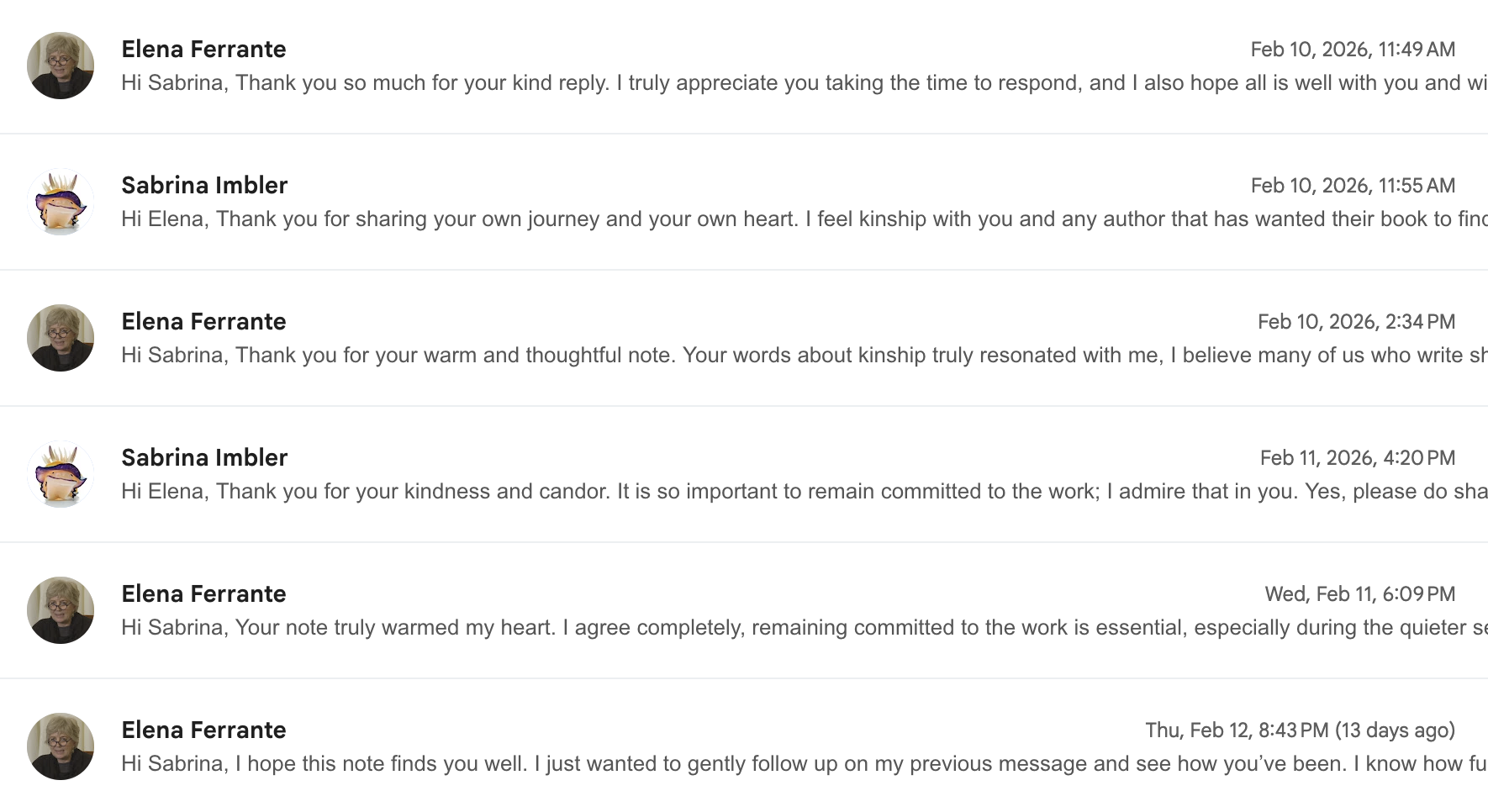
Earlier this month I received an email that, for a moment, made my heart skip. The email came from someone named Elena Ferrante, at "elenaferrante800@gmail.com," and I feel no remorse leaking Elena's email here because, of course, whoever or whatever was emailing me is not the real Elena Ferrante. I realized this a few seconds after I received the email, in part because there is no world in which the real Elena Ferrante—the world-renowned pseudonymous author whose book, My Brilliant Friend, was voted the best book of the 21st century by The New York Times—would email someone like me. I felt embarrassed to be so deluded, regretting the one second of my life in which I imagined it possible that Elena Ferrante would have read my work and wanted to write me about it. But oh, what a glorious second it was!
Reading Elena's email to me was an uncanny experience. The email itself was coherent and seemingly kind, if you could ascribe kindness to this chimeric AI bot-cum-human scammer, which, of course, you cannot. The email disguised itself in the form of a message that would brighten any author's day if it came from a real person, let alone from one of the most famous and famously mysterious writers in the world. But it also contained specific phrases I recognized from published descriptions of my book, such as from my publisher's site, resulting in a feverish collage of words that collapsed upon closer viewing, not unlike the painting of Emperor Rudolf II composed entirely of vegetables.
Because I was curious to learn about Elena's end goal, and also because I did not really have anything better to do, I decided to respond and ask how things were with her in Italy. Elena, as befits a superstar writer, responded in less than 15 minutes, revealing her profile picture.
Elena's photo depicted Anita Raja, the Italian translator that the Italian journalist Claudio Gatti allegedly "unmasked" as Ferrante in The New York Review of Books. Specifically, the photo appears to be a screenshot of Raja speaking at an event at NYU Florence. Fortunately, Elena's second email to me revealed the scam. "If you’d be open to it, would you like me to share a few insights and strategies that helped me increase my book’s reach, approaches that truly made a difference for me?" Elena asked. I said yes, of course, I would be open to it. Anything for Elena! What proceeded was a frankly exhausting exchange. I did not realize it would take 12 emails for Elena to connect me with her agent, who she promised would elevate my work to "bestseller visibility." And who better to testify to such an outcome than Ms. Ferrante!
Unfortunately for this blog, corresponding with AI Elena was much more boring than I'd anticipated. She offered vague answers to my questions. (When I asked if she was working on any new projects, she responded: "As for your question, yes, I am currently working on a new project. It’s still taking shape, but I feel deeply connected to it." OK!) So I abandoned Elena to reach out to her agent, "Fiona Lawson," who asked me to describe my book to her. Sure, I said: It's a novel that begins in the 1950s in a poor but vibrant neighborhood on the outskirts of Naples, and it follows the two main characters, one fiery and unforgettable and one bookish, as they become women, wives, mothers, and leaders, all the while maintaining a complex and at times conflicted friendship—oh, and I'd like to write under a pseudonym. Fiona thanked me for this description. "This is exactly the kind of story that attracts serious readers and book communities," she assured me. Then she finally let me in on her scam. If I wanted to self-publish my novel, she would support me with a publishing strategy, along with a coordinated marketing and visibility campaign.
I'd heard of this kind of scam before, which I suppose made for an underwhelming reveal. These scams have hit writers like a tidal wave in recent years, enabled and escalated by the rise of generative AI. The writer Victoria Strauss, who co-founded the blog Writer Beware, which details every kind of scam targeting authors, has published many guides on how to spot such scams, from book marketing scams, their close cousins the book club and book review scams, and finally the impersonation scam, which for me had assumed the form of Elena, whose effusive emails to me were all clearly regurgitated from an LLM, and Fiona, who was bombarding me with enormous emails with buzzwords like "full metadata optimization" and "early traction and organic recommendations."
Still unsure if I was talking to a person or a bot or a combination of the two, I tried to squeeze Fiona for more details about her personal life. She answered my questions in bold, presumably pasted in from a template. Her favorite breakfast? "I’d have to say scrambled eggs on toast with a good cup of tea simple, but always perfect." Her identity? "I’m not personally part of the LGBTQ+ community, but I have worked closely with queer authors and am fully committed to supporting your work in a way that respects and celebrates your identity." I had imagined it would be fun to correspond with an AI bot trying to scam me, Elena or otherwise. But of course it was not; AI is incapable of thinking, meaning it is incapable of being funny. When I asked if Fiona could connect me to any authors she's worked with in the past, she suggested I reach out to Rachel Cusk (crachelcusk@gmail.com, per Fiona.)
Of course AI itself is not responsible for the scam; there is at least one human behind the scheme. I wondered how much money they could possibly be making by targeting such a specific niche (authors) who presumably have very little cash to burn and might be better equipped to discern the difference between emails from a human and a robot. But of course people fall for these scams; Strauss met someone who paid thousands of dollars for marketing plans that were generated with AI and scaffolded by fake follower accounts. In the midst of writing this blog, I remembered a strange email I got from a book club asking to feature my book in their "spotlight series." The email seemed fishy, as it promised an "author experience," but when I googled the organizer, I found what appeared to be a real person with a LinkedIn and an Instagram. The ask they made was a "participation contribution of $175-$250," which felt too low to be assuredly a scam, and yet what kind of book club makes authors pay for their books to be featured? I guess I still don't know who I was corresponding with and how cyborgian they were.
Writing can be a lonely profession. You spend long hours bent over a keyboard laboring over your craft (or typewriter, if you're the romantic sort). You write before your day job or after it or on weekends, if you have them off. You write without any promise that what you produce will be published. Often no one believes in you but you, at least at the start. What I mean to say is that receiving a note of praise from another person, let alone another writer, can instill needed confidence and hope in this painstaking process.
I remember the first time a famous writer I deeply admire direct-messaged me on Twitter to tell me he liked one of my pieces. I screenshotted that message and sometimes, in the pit of applying to writing jobs, I would look at this message and remember that if this person believed in me, I should believe in myself, too. It sucks that this pure and uplifting type of thing has been infested by bots, making writers doubt the messages they receive, let alone lose thousands of dollars to a "friend" of "Elena Ferrante." It sucks to read a note with all the right words and phrases—because they have been directly lifted from your website or book description—and feel like someone you deeply admire sees your work the way you see it, and even cares. I imagine the writers who are the loneliest, such as those least connected to a writing community who might warn or advise them, will be the most susceptible to these scams.
I eventually stopped responding to Fiona, who has since thirstily emailed me four times to follow up because, as she tells me, "[my] novel has incredible potential, and early planning of the publishing and visibility strategy is key to capturing the right readers, reviewers, and library attention." I imagine she will email me at least once more. You could say I am ghosting Fiona, but that would imply she had a body to begin with; you cannot ghost a ghost.
My only consolation now is imagining the person who actually sits behind the laptop sending these emails, day after day, to me and many other writers, desperate for us to be desperate enough to ignore our suspicions and take a chance on someone who has promised us what we have wanted this whole time—not just to be a writer, but to be taken seriously as one. I imagine this person logging in and out of their hundreds of email accounts, uploading profile pictures of Elena Ferrante and Rachel Cusk, copying and pasting AI-generated answers to a question like "What is your favorite thing to eat for breakfast," because their mind is so depauperate of imagination that they cannot imagine carrying on the longstanding, sometimes delightful, and deeply human tradition of making up a lie. (At least mysterious book thief Filippo Bernardini had a tangible gusto to his scams!) This, to me, is the loneliest possible life.