It is impossible for Brazil, the most iconic team in the world's biggest sporting event, to have anything resembling a quiet tournament, but the Seleção managed to float through the first two matches of this World Cup a little under the radar. Part of that is because it takes a lot to stand out in a 48-team tournament, but the other part has to do with meeting lowered expectations and little more.
Brazil drew its first match 1-1 against a very good Moroccan side, then beat up on Haiti 3-0 in the second. Even heading into Wednesday's Scotland match, the intrigue around Brazil was less about how it would perform on the field and more on whether Neymar, finally healthy enough to play, would get a late cameo appearance. (He did.) Because of that, it has maybe slipped the collective awareness that Vinícius now has four goals and has been Brazil's best weapon, at long last fully and vibrantly realizing his massive talent in a national team jersey.
It's worth admitting this upfront: Scotland gifted Vinícius both of his goals on Wednesday. The first was the more egregious Scottish error. In the seventh minute, center back Scott McKenna and winger Rayan met inside the penalty box, where one of the players tried to dribble past the other. Unfortunately for Scotland, the roles in that scenario were the opposite of what you might imagine. McKenna's ill-considered jink inside his own area did not come off, which allowed Rayan to deflect the ball into the path of Vinícius, where a simple cut-back touch presented the Real Madrid star with a wide-open net to roll the ball into:
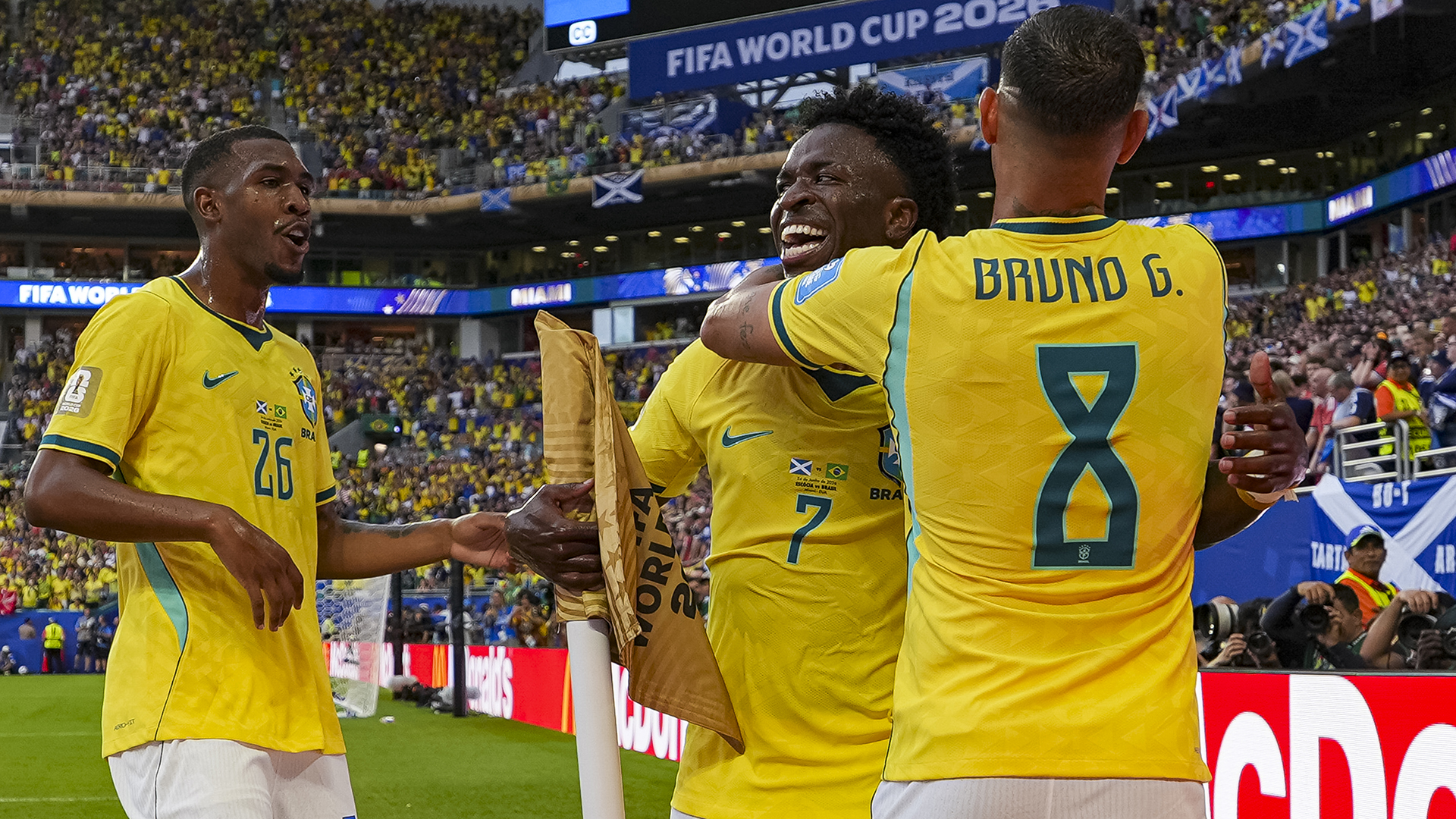
Brazil's front three of Vinícius, Matheus Cunha, and Rayan had Scotland's backline in a tizzy for most of the opening half, and the Scots were lucky that another buildup mistake that led to a goal was annulled for a foul in the 22nd minute. They were not as lucky right before halftime, though, as again Brazil's press in the Scotland box forced a multitude of errors leading to a wide-open Vini goal. After multiple Scotland defenders failed to get the ball out of their own area, it bounced to Bruno Guimarães, who lifted a far-post cross to Vinícius, detached from his Scottish defender and open for what had to be just about the easiest headed goal of his career:
Neither of those two goals speak too much to Vinícius's quality, but the reality of their existence, and the way he has scored four of Brazil's seven goals (Cunha has the other three) and assisted another (Cunha's second versus Haiti), has cemented that this team belongs to Vini. In fairness, this was always going to be the way at this World Cup. Brazil is in a bit of a down period as a team, only making it through CONMEBOL qualifying in fifth place, and lacking the kind of star power they have historically always been able to rely on. Coming into the tournament, it was easier to imagine Brazil stumbling out of the competition early than to picture them winning it. The opening match mostly confirmed the low expectations, as the Brazilians looked remarkably unimpressive against Morocco—the lone exception being Vinícius himself, who scored a great equalizer that earned his team a draw and a chance to build some momentum going forward.
The subsequent matches against Haiti and Scotland didn't make for the toughest of tests, but Brazil's pair of comprehensive victories have demonstrated the kind of steady improvements fans would've wanted to see. In many ways, this has been a workmanlike Brazilian group performance, rigid in defense and relying on the magic of Vinícius to carry the attack. He has been up to the task, and now he joins illustrious company as one of only five Brazilians to score in every group stage match at a World Cup. The others? Jairzinho, Romário, Ronaldo, and Rivaldo. Not bad company at all.
The road will get harder starting in the round of 32, where Brazil will face whoever comes out of the Japan-Sweden-Netherlands trio in second place, before a meeting with most likely Ivory Coast or Norway in the round of 16. That I can call those nations hard opponents for Brazil, of all teams, speaks to how pessimistic the outlook has been for Brazil (and, to be fair, to the increased level of national teams around the world). But it would be worth elevating those expectations a bit after seeing just how dialed in Vinícius is in his second World Cup, and his first as the national team's leading figure. Though Brazil manager Carlo Ancelotti said recently that he doesn't think this World Cup will be defined by stars, we've already seen just how important the game's biggest and best players have been to their team's success. Brazil fans should hope Ancelotti is wrong and that the stars really will carry the day, because the Seleção's best hopes for nabbing that sixth trophy will depend on Vinícius continuing to light the way.