CEDAR RAPIDS, Iowa — In the quarter-century that I’ve been playing and writing about Scrabble—a game in which greatness requires that rare matrix of biological gift, yeoman preparation, preternatural vision, marathon endurance, and blind luck—I’ve never witnessed anything as shocking and painful as the end of the 2026 North American championship here in July. The moment was right up there with any agony-of-defeat ending in any sport: After 3,700 games, thousands of moves, and millions of points scored by more than 200 players, the title was decided by a word that wasn’t a word at all.
On one side of the board: No. 1 seed Mack Meller of Lexington, Ky., a 26-year-old onetime child prodigy and current Scrabble grandmaster, content creator, teacher, and puzzle constructor. On the other: No. 5 seed Orry Swift of Winnie, Texas, a 39-year-old accounting professor and five-tool gamer—he’s been a top player in World of Warcraft and Magic: The Gathering; he’s about halfway through a quest to play and review every Super Nintendo game (about 880 in all); and, under his username Sheex, he recently completed a charity speedrun of Ogre Battle: The March of the Black Queen. “Coming off a high like that into making the finals at Scrabble nationals was crazytown,” he told me.
Swift entered his first Scrabble tournament in 2004 and has been among the highest-rated players for more than 15 years. Meller began playing competitively at age 10. He became the youngest player to achieve an expert rating, at 11, and cracked the Top 10 at 13. At the Scrabble Players Championship, held over five days in a football field-sized convention-center ballroom here, they topped a field of 51 players in the top North American-lexicon division (out of 242 overall) with identical 20-8 records to qualify for a best-of-five finals and a shot at the $10,000 first prize. (An additional 38 players competed using an international-English word list; it’s complicated.)
It was Meller’s third straight finals appearance (he won in 2024 and lost last year) and Swift’s second (he lost in 2022). In a recap video on his popular YouTube channel, former champ Will Anderson labeled the showdown “one of the best and most compelling matches we’ve seen yet in Scrabble.” I’ll put it another way: There’s a reason the subtitle of my book about competitive Scrabble includes the words heartbreak, triumph, and genius.
I interviewed Meller and Swift about what went down. Our written conversation has been edited for length and clarity.
Fatsis: Mack takes Game 1 of the finals, 383-326, and opens Game 2 with the delightful three-B, rack-clearing “bingo” ABUbbLE (lowercase denotes a blank) en route to a 528-321 blowout. Advantage, Mack.
Swift: After losing the first two, I was pretty down. It just didn’t seem like I would ever draw any good letters in the finals. I went out for lunch with three other top players—Jason Li, Carl Johnson, and Rafi Stern—and they talked me through it. I think it helped to have people at the table who have deserved a championship but haven’t quite pulled it off. I suddenly didn’t mind the outcome, win or lose.
Fatsis: Mack, we ate together and you seemed pretty chill, even encouraging the counter staff at Snack Wellness Cafe to tune into the tournament livestream for the afternoon games. But the tiles don’t care about momentum.
Meller: I was trying extremely hard to not feel overconfident. Having come back from down 0-2 to win in 2024, I knew the match was far from over. Like you said, Stefan, how I drew in Games 1 and 2 would have no bearing on how the tiles shook out in the afternoon, and I knew Orry was more than capable of making the comeback.
Fatsis: Orry, after the break, the tile gods smile down on you. You “bag” Mack twice in a row, that is, draw synergistic tiles allowing high-scoring plays turn after turn. In Game 3, you drop four bingos—EVERTING, OVERTAKE, OUTSERT, and ANNEALS—plus a 61-point ZEDA, a Yiddish-derived word meaning grandfather, for a 536-364 win. And in Game 4, you post an even bigger win, 584-367, slapping down five bingos—INVENTS, INVADER, GAMBLER, PICTURED, and FLECTION (an alt spelling of flexion).
You’re definitely having a good time. At one point you nearly draw the Scrabble meme OLEICAT—from a video by Will Anderson in which ChatGPT insists that OLEICAT is a valid word—and line it up for the rack camera.
According to the analyzer Macondo, Orry, in Game 3 you throw a perfect game, posting an Average Mistake Index of 0.0. (Scrabble, like every other sport, has an array of acronymic analytics.) Mack is close behind at 0.6. I’m a low expert, and my MiAV is around 3.5 per game. Your numbers reflect your skill and, in Mack’s case here, the fact that in Scrabble you can play nearly flawlessly and still get whomped.
Swift: But I almost play the nonword VERGENT, falling into a trap where something scores a kazillion points so you talk yourself into it. And I would have let Mack play OVERTAKER, which also isn’t a word, because he’s Mack and I have easily drained 40 percent of my word knowledge by playing on the livestream. I definitely get nervous when the cameras are rolling.
Fatsis: Like patrons at Centre Court at Wimbledon in England, the 100 of us players and staff in a nearby room at the Alliant Energy PowerHouse Convention Center attached to the DoubleTree Hotel in Cedar Rapids—and hundreds more watching online—are psyched the match is going the distance. And it does not disappoint. Game 5 will go down as an all-timer, for both its nonstop action and bonkers ending.
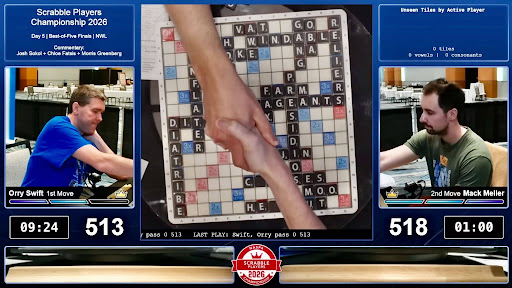
After Orry’s opening play of EX for 18 points, four straight bingos hit the board in rapid succession: PAGEANT for 76 (Mack), RELIERS for 85 (Orry), PRESIDIO for 94 (Mack), and WINDABLE for 82 (Orry). To give a sense of how quickly your brains are processing, before Mack even straightens his new tiles—an R and S are sideways, a D and P upside down—he picks them up and lays down PRESIDIO, covering two double-word-score squares. Incredible.
You’ve played four bingos in the first five moves, the score is 185-170, and you’ve each used less than two of the allotted 25 minutes on your clocks. I love it when a game goes off the rails.
Swift: This is one of those openers where you really want to go second. With my opening rack of EEEIRSX, EXERCISE through a C or HEXEREIS from an H could generate a massive lead, whereas EX usually gives back more points than it scores. Luckily, I draw a bingo immediately. I’m trying to play fast on turns that have an obvious play. On the WINDABLE turn, after hitting my clock, my heart skips a beat. Is WINDABLE actually a word? Did I just miss WINDSLAB somewhere for more points?
Fatsis: Like every top expert, you’ve drilled more than 25,000 seven-letter words and 31,000 eight-letter words over and over for years. But it’s one thing to solve a flashcard anagram and another to find a word over the board under time pressure, let alone with hundreds of people watching and commenting.
Mack, holding a rack of ACGNTV and a blank, you’ve got a fifth straight playable bingo, VaCATING through the second I in PRESIDIO for 63 points. Instead you play VAT atop the first two letters of WINDABLE for 35, keeping C, G, N, and the blank. Why?
Meller: Continuing the bingo train with VaCATING is tempting, but I have to recognize the danger of the hotspot Orry’s last bingo created. He’ll score 50-plus points there very often, so I decide to take 35 for VAT, blocking the spot and saving the blank to give myself great chances at bingoing with a seven-letter word ending in G under PE in the middle of the board, or an eight through the open vowels in PRESIDIO. If I didn’t have a blank, I’d slam down the bingo and hope for the best. But with blank in hand, sometimes you can forgo weak bingos in favor of a strong non-bingo.
Fatsis: Computer simulations back up your decision, and in fact Orry would have played INVOKE for 62 points on top. Instead, he has to settle for the same word for 42 two rows below. Orry, on your next turn you have three places for HOTLY—through the O in INVOKE; to the left of PRESIDIO, simultaneously forming HI, OD, TI, and LO; and next to EX, making HEX. Each score well but are strategically different. You choose the one that keeps the board the most “open”—leaving access to potential horizontal bingos through or hooking PRESIDIO and creating a new vertical lane parallel to the Y in HOTLY.
Swift: I wasn’t confident in my ability to keep the board shut down. I felt like the “leave” of L, O, and T on my rack and the positioning of HOTLY was going to give me a better chance to race. As it turns out, this is just objectively wrong and starts a skid of nervousness for me. I somehow don’t even see HOLY down to the right of the O in PRESIDIO for 11 additional points, the obvious hotspot. I also have an inkling that PRESIDIOS isn’t a word. I eventually realize that it’s PRESIDIA that doesn’t take the S. My brain is starting to filter out things it shouldn’t.
Fatsis: Mack, you don’t draw any vowels and you’re forced to play three consonants twice in a row, making GANG for just 16 points and DJIN for 12. You also burn some time on your clock. Patience is crucial when you’re nursing a blank. Still, are you getting frustrated?
Meller: The second all-consonant draw is a bit frustrating, especially when I pull the annoying-to-use J, so I have to remind myself that the tile pool is now trending vowel-heavy. The chances of pulling more consonants are low, so rather than exchanging tiles out of frustration, I make a disciplined decision to play DJIN through the second I in PRESIDIO. This has the added benefit of protecting the S hook on PRESIDIO for me, since it makes it hard for Orry to overlap on either side of the word in a way that blocks the hook. With both of the last S’s and a blank in hand, having this spot to bingo feels essential.
Fatsis: Orry, you’ve got the opposite problem: too many vowels. You dump a couple, also for less than 20 points, and lead, 271-233. We’re halfway through the game. What are you inferring from Mack’s consonant dumps?
Swift: After GANG, I don’t really have a sense that he has the blank or a killer leave. It’s the kind of play you make with a bunch of other one-point consonants on your rack. After DJIN, though, alarm bells are going off. This isn’t just a Bad Luck Brian rack. I have him on S, blank, consonant, consonant, which turns out to be correct. However, I’m thinking now that his most likely bingo is in the middle of the board, making PES/AXE or something of that ilk. I figure if I can keep AELRT on my rack, I can bingo through whatever he plays. Leaning on my prior assumption of PRESIDIOS not being good, I don’t really revisit the word knowledge error here and pay for it.
Fatsis: Our bingo-less stretch of six turns—you guys are such slackers—finally ends when Mack pulls two vowels, plus a W, and plays ChOWSES for 92 points, pluralizing PRESIDIO. Obviously, this is not a common word—it’s an alternate spelling of CHOUSE, which means to swindle and dates to at least 1654. (“You shall chouse him of Horses, Cloaths, and Mony," John Dryden wrote.) But commonness is irrelevant in Scrabble. CHOWSES is the 22,550th most-probable seven-letter word based on the likelihood it’ll be pulled from a full bag of 100 tiles. So it’s low-prob, as we say. Mack, did you hesitate on the word at all?
Meller: I saw ChOWSES immediately, which is usually a good sign that I’m not making it up, but given the importance of the situation I did stop more than usual to reassure myself it was valid. I remembered that CHOWSED is 100 percent good because I know that CHOWSED and COWSHED are an anagram pair. That was enough to get me to play it without wasting too much additional time.
Fatsis: Orry bingos back with INFLATER—the game’s sixth rack-clearing play—and retakes the lead, 334-325. Nail-biting time. Mack plays off duplicate letters with FARM for 33 points, simultaneously forming FAX, AG, and MA. Orry, you pull the 10-point Z—almost always a welcome sight late in a game—and have DITZ through the T in INFLATER for a whopping 72. I would have dropped it in a nanosecond. But you pause to assess—you count the tiles left in the bag, you line up other possible moves on your rack. What are you thinking?
Swift: INFLATER? Or is it just INFLATOR? INFLATOR/FLATIRON. The lexicon is entirely leaving my brain at this point, and the nerves are setting in. DITZ gives me pause for two reasons: It’s horrifying to keep four vowels going into the final stretch, especially when Mack has just drawn seven fresh tiles and the second blank is lurking—the D will be a fruitful bingo lane. I consider ZINE down through the N in INVOKE for 22 fewer points, keeping the much more comfortable DEEO, which in theory I can still bingo with. Ultimately I decide that ZINE can give a boatload right back on the triple lane, and DITZ is just too many points to pass up.
Fatsis: Mack, you pick the Q but can’t score well with it despite holding a U, and you’re trailing by almost 50 points. We see you set up MONO through one of the N’s in the upper-left quadrant for 22 points. The computer suggests dumping the Q on the right side with TOQUE for 16. On the livestream, though, 2023 champ and lead commentator Josh Sokol says, “Is it time for Mack to be more desperate?”
Meller: The more I think about my position, the more I don’t like it. Fifty points might not seem like a massive deficit, but with tiles and bingo lanes rapidly disappearing, and without any good spots for my Q-U, I no longer feel being patient is an option. TOQUE scores weakly, and then if Orry blocks the D in DITZ, I have nowhere to bingo and I just don’t see myself making up the deficit. MONO has the same problem: If Orry blocks the D, I’m left with little chance for a comeback, and he’s going to be careful not to open a big Q spot.
Fatsis: You decide to play MOO below ChOWSES, making EM and SO and “forking the board,” that is, opening two potentially high-scoring lanes, one on the bottom row and one on the rightmost column. Gutsy!
Meller: MOO looks a bit crazy, and obviously there are some cases where Orry slams the door shut with a 100-point bingo there. But when you’re already in a bad position, you can’t live in fear—I don’t want to die a slow death on a closed board without giving myself a chance. After MOO, my leave of AEQU suddenly becomes way more potent, with a strong threat of 50-point plays like QUARE or QUATE, either on the bottom making EME or on the right making MOOR or MOOT.
Also, from my perspective, bingos like ACQUIRE or BAROQUE on the bottom aren’t out of the question, and if Orry blocks there I have some draws at massive bingos to the D of DITZ, such as ACQUIRED and QUARRIED. I’m not loving my chances after MOO, but that’s the precise reason I feel the need to make the play.
Fatsis: Orry, you draw two vowels—now you have six, gulp—but also the blank. Mack’s new openings are volatile. Do you try to block one or both? Do you exchange some of your vowels? Do you try to play through this mess?
Swift: Before Mack’s play, I was dead set on playing VEE from the V in INVOKE, trying to score decently and maintain a lead in case we don’t play to a bingo finish. After Mack’s play, my thought process goes a bit too fast and I ignore some possibilities. I immediately consider EmEU for 23 under Mack’s MOO, making EME, SOM, and OE and closing everything he just opened. Burning the blank for 23 is not appealing, and I would have slammed it down if the D wasn’t there, but I have to leave both bingo lanes open in case he gets one down first. Hoisted by my own petard. I don’t see any profitable blocks, so I default back to my prior play, failing to recognize the value of exchanging now that there are two bingo lanes. Definitely a mistake here.
Fatsis: Mack, you’re trailing 424-374 and you’re under time pressure now. You draw two I’s and a T, and have QUITE or QUATE at either of the openings you’ve created for 51 points and a one-point lead. Instead, you play QUAI for 36 ending above the D in DJIN. The play seems wildly counterintuitive; you’re passing up a lot of points. Unbeknownst to you, Orry has drawn two consonants, and his rack is EEHOTU and the second and last blank. QUAI stops Orry from playing HEREUnTO through the R in INFLATER, which would have been GG. “As if he has eyes in the front of Orry Swift’s head,” Josh Sokol says on the stream. Did you see it as a possibility?
Meller: QUAI had absolutely zero to do with blocking HEREUnTO. There were still 10 tiles left in the bag, and much stronger bingo threats using the bottom or the D of DITZ, so trying to home in on a specific bingo Orry might have through the R would be infeasible and, frankly, illogical. Blocking is also the last thing on my mind; on the contrary, my position is still poor, so I actually want to leave more threats open. The fact that I block HEREUnTO is just one of many coincidental lucky breaks I got this tournament.
Fatsis: So what does lead you to QUAI?
Meller: The biggest factor is my read on Orry’s range after VEE. First, Orry played off two E’s in a pool with only two more left. E’s are by far the best vowels in Scrabble, and there’s no way Orry plays two of them for just 18 points without at least one and quite possibly both in his leave. Second, despite having a decent lead, Orry doesn’t block the hotspots on the bottom right that I just created with MOO. This leads me to believe he doesn’t have a good way to do so, which means he likely has tons of vowels. But his rack can’t be so bad that he’d exchange over playing VEE, and he must’ve had enough confidence in its future to fight fire with fire by leaving the bottom open.
Fatsis: Still, QUITE for 51 points is a lot to pass up.
Meller: It would get me basically even on the scoreboard, but I’m behind in every other aspect. After QUITE, I’d be left with two vowels—drawing into a vowel-heavy bag, that’s terrible. Plus, Orry has tempo, meaning it’s his turn next, a huge advantage in a close late-game position. I feel like I have to gun for a bingo. The biggest advantage of QUAI in that respect is that it keeps my E and my T. I’ll need the E for any chance to bingo with the D in DITZ. And the T is a great consonant for bingoing. In some ways, the logic of QUAI is the same as the logic of MOO: The more intuitive, passive play doesn’t feel like it has realistic winning chances, so keep the volatility as high as possible and hope for the best.
Fatsis: Orry, you’re now ahead by just 14. This position is terrifically complicated. Do you knock out the bottom triple-word lane? Do you play off one or two more vowels and hope to bingo after that? Do you block the open D in DITZ? My brain would have exploded.
Swift: A lot of things are going through my mind here, the foremost of which is: Am I missing an obvious seven-letter word? HEREUnTO is sadly gone. I immediately see TOUcHEE but am quite sure I have wanted this to be good before, and it was not. I settle on the non-bingo TOUcHE as a candidate play on the bottom. Then I look at the pool for possible bingos from Mack. I immediately see DIATRIBE, DIABETIC, and BRUCITE, so then I stop looking. That’s enough. There’s bingos in both spots.
Fatsis: Meaning you can’t block one for a few points and leave the other open for Mack. If he bingos and you don’t have anywhere to counter-bingo, it’s over.
Swift: It seems that starting with a D is more likely than ending with a D for him. Ending with a D or hitting a seven for myself seems plausible. I could potentially block bingos starting with a D and fish, preserving both lanes—down to the D and under EM—with a play like ER alongside the R in INFLATER for four points. I consider this for a bit but need to see how often I hit a bingo from the bag. I go through all the tiles unseen to me. A rough estimate is bingoing somewhere between 30 and 40 percent with a one-tile fish. However, whatever bingo I hit has the potential of being blocked, and Mack could outrun me. He could play a four-letter word making MOOT or MOOR and easily take the lead if I don’t score.
Fatsis: Let me interrupt to say that the ability to conduct this sort of multilayered positional analysis in a matter of seconds is what separates top players from the rest of us patzers shuffling tiles in the lower divisions. Back in the 1930s, Alfred Butts had no idea how complex the family game he invented would turn out to be.
Swift: After thinking about all of this, I then see the possibility of fishing the E to make OE and NEEM in the lower right. This seems to do everything I want: It scores points (16), sets up my blank to use as an S, and keeps a decent leave. However, I realize that it actually makes it harder for me to bingo on the next turn—because the newly created NEEM only takes an S, while EM takes the E, O, and U, too. Back to the drawing board. Sadly, I don’t consider fishing the E to make EXES/AGE. More important, I don’t consider fishing more than one tile with something like DUE from the D in PRESIDIOS. I think if this had crossed my brain, I would have played it.
Fatsis: Yeah, based on the unseen tiles, Macondo, the computer engine, gives you an 86 percent chance of bingoing after playing off the E and U, and a 63 percent chance after dumping just the E.
Swift: After all of this consideration, I finally see HErEOUT. I’m pretty unsure, but my brain has been playing tricks on me throughout this game. WINDABLE? INFLATER? PRESIDIOS? Those were all words. It’s just the nerves. THEREOUT is good. Yes! HEREOUT takes a T, of course it does! Cue the sad trombone.
Fatsis: HEREOUT is not a valid word. You can drop the T from the front of every seven-letter word starting with THERE—THEREAT, THEREBY, THEREIN, THEREOF, THEREON, THERETO—but you can’t do the same with the eight-letter THEREOUT. Even for the very best, the dictionary can be confusing, and the impact of that confusion unforgiving.
While Orry is deliberating, Mack, your replenished tiles are ABEIIRT. You place the new ones on your rack and don’t touch them—ITEI on the left and ABR on the right. I imagine you’ve instantly spotted DIATRIBE from that D in DITZ.
Meller: Yeah, I see DIATRIBE immediately, and the biggest challenge is trying not to give any sort of tell to Orry that I have a bingo. That’s why I keep the tiles apart: Putting them all together can sometimes indicate you’ve got a bingo lined up.
I know if the D stays open, I have to bingo with DIATRIBE no matter what. I’m actually hoping he bingos on the bottom because that would empty the bag and then I’ll play DIATRIBE, ending the game and maybe eking out a close win. If he fishes off one or two tiles, I’ll have to play it and pray he doesn’t draw a walk-off bingo—a terrifying prospect given my read on him having the blank.
If he bingos with the D, I’m dead and that’s that. If he blocks the D for a small score, I’m prepared to play on the bottom right, blocking both the bottom row and rightmost column. We’d then go into a tense endgame, and the outcome would depend on what we each draw on our subsequent turns.
Fatsis: After six minutes of deliberation, Orry, you make your move. “He is playing HEREOUT! This is not a word!” a shocked Josh Sokol says. “If he plays this, he will lose the game on the spot!”
HErEOUT scores 89 points, putting you up 513-410, and you draw the last six tiles from the bag. Mack is confident the word isn’t acceptable. But he doesn’t challenge, which would result in your removing the play and losing your turn. That’s because Mack realizes that he wins whether or not it’s good. DIATRIBE scores 86 and, per tournament Scrabble rules, Mack gets double the combined value of the tiles on Orry’s rack, CORUUY, which is 22 points. Eighty-six plus 22 is 108. Final score: Mack 518, Orry 513.
When you realize what’s happening, Orry, even before Mack makes the play, you pull your T-shirt over your head. The livestream commentators are stunned—”so brutal,” says my 24-year-old daughter, Chloe, who’s on the mic after finishing 14th in Division 1. In the convention-center viewing room, there are gasps and ohmigods.
Orry, we talked a couple days after the tournament and you told me you’ll never watch Game 5. So thanks for your willingness to relive the moment here.
Swift: Having seen DIATRIBE as one of the first considerations on that long turn, I knew it was possible. I knew if I burned the blank on the bottom row, I’d basically be banking on him missing a counter-bingo. I do the math and hide from reality. Obviously, in retrospect, I should have fished off one or two tiles instead of rolling the dice on a word I wasn’t sure of and risking an instant loss. Not much else to say.
Fatsis: It was a gutting way for such a brilliant match to end—a “phony” followed by a walk-off. Mack, on the overhead camera, we hear you say, “I’m sorry, man. I was really lucky.” Leaving the playing room, you’re both in tears and you gesture to the rest of us to back away and give Orry space. Mack, you’re one of the best to ever play the game—now just the sixth player with multiple North American championships—but your compassion in your own moment of triumph turned a Scrabble game into something bigger, an example of sportsmanship, grace, and humanity.
Meller: My initial emotions were relief and shock. But as someone who understands the thousands of hours needed to reach this level of Scrabble and the disappointment of falling short on big stages, my thoughts quickly turned to my friend on the other side of the table. I’d like to give major props to Orry for the class he showed afterward toward me and others. It couldn’t have been easy.
Swift: There was a small ax-throwing station in the staff room at the convention center, which turned out to be very therapeutic. Mack was a gentleman and spent much of the rest of the evening with me, buying me drinks at dinner, too. Pickle beer, Mack? Turns out it wasn’t as great as either of us thought it would be. I actually had a blast that night.
Fatsis: By 11:00, you were back in the hotel, Scrabbling with me and some young players. As Jim Bouton wrote in Ball Four, “You spend a good piece of your life gripping a baseball and in the end it turns out that it was the other way around all the time." No matter what, there’s always seven more tiles waiting to be drawn from the bag.