

Sometime in the late 1990s, an adult ribbon worm was scooped up from the murk in the waters off the San Juan Islands, in the Pacific Northwest. He was moved to a tank along with a smattering of other invertebrates, including two vermilion bat stars and approximately 30 beige peanut worms. In the years since, the worm has been transported across the country to Virginia, where he lives now. The bat stars died after a couple of decades, and the peanut worms have largely vanished. But the ribbon worm lives on, buried in the tank's mud. Although his exact birthday is unknown, the ribbon worm is at least 26 years old, and probably around 30.
The ribbon worm—recently dubbed Baseodiscus the Eldest, or B for short—was just confirmed to be the longest-lived ribbon worm in the world. His persistence extends the previously known maximum lifespan of such worms (three years) by an order of magnitude, per a short communication in the Journal of Experimental Zoology Part A: Ecological and Integrative Physiology. (Ribbon worms have separate sexes, and although B has not been definitively tested, researchers suspect the worm is male due to what appear to be numerous testes.)
Such a superlative is certainly impressive for any worm, but the discovery is not necessarily a surprise for scientists who work with marine invertebrates. "We tend to be kind of biased towards like things with bones and things that look like us in terms of complexity in different ways," said Chloe Goodsell, a PhD student at UC Irvine and an author on the paper. "Most of the extremely long-lived organisms on Earth are invertebrates," she added, pointing to giant clams, which can reach 100 years, and tube worms, which can reach 250 years. Ribbon worms are among the longest animals on the planet—one bootlace worm found in Scotland allegedly reached 180 feet—and scientists had long ago hypothesized the creatures lived for many years.
So B is the first ribbon worm to go on record as being this old, and as such has certainly earned his distinguished appellation. But he is probably not unusually old, and there are likely even older ribbon worms out there in the wild. "It's probably the case that this is just a very normal worm," Goodsell said.
B would have escaped the limelight that comes with appearing in the pages of the Journal of Experimental Zoology Part A: Ecological and Integrative Physiology if it weren't for his longtime companion, Jonathan Allen, a marine invertebrate biologist at William & Mary. Allen first met B when he arrived at the University of North Carolina at Chapel Hill in 1998 as a graduate student. The labs in a building called Wilson Hall held a teaching tank of animals collected from the San Juan Islands, which Allen tended to for about six or seven years.
As Allen was about to graduate, he learned that Wilson Hall would be renovated and the tank would no longer have a home. When the faculty asked Allen if he wanted the tank, he accepted. He was heading to Maine to start a position at Bowdoin College, so he transferred the inhabitants of the tank into buckets, stowed them and all his worldly belongings in the back of his Subaru Baja and drove north. "I drove to New York, where I grew up, they came with me. I went to Maine for three years, they came with me. I came back to Virginia, they came down with me," Allen said.
B and his tankmates are relatively low-maintenance companions. When Allen took apart the tank once a year for cleaning, he noticed the number of peanut worms dwindled each year. Allen now suspects the predatory ribbon worm was eating the peanut worms. Just a couple peanut worms survive from the tank's original community, "so I put a bunch in there this year in hopes that they'll go for another 25 years," he said. The water in B's tank is chilly, hovering at around 53 degrees Fahrenheit, meaning the worm's metabolic rate is likely low. So an annual peanut worm dinner might do the trick.
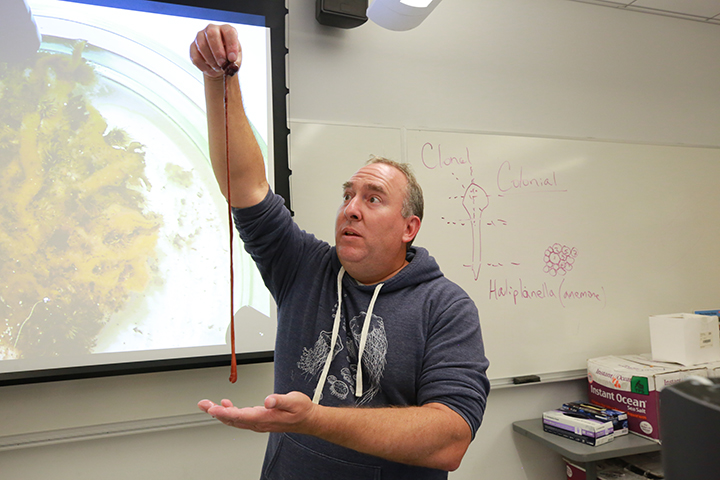
At William & Mary, Goodsell, then one of Allen's undergraduate students, was tasked with maintaining B's tank. She changed the water and hand-fed shrimp to the tank's anemones, never realizing that B was also there, lurking quietly in the mud. A year later, Allen dismantled the tank to extricate B for a show-and-tell with a biology class. In these demonstrations, Allen removes the worm from the water quickly to prevent B from making a mucus cocoon, and then drapes him along the length of his arm. (He says B is "stickier than you'd expect.") After class, Allen invited other students to drop by his office to see the worm. "I was like, OK, I'll go see the worm," Goodsell said.
There in the bowl, B didn't make a big impression, his meter-long body scrunched up like a hair-tie and garlanded in mucus. "It's not necessarily a super impressive creature in and of itself," Goodsell said. But when Allen mentioned he'd had the worm for 20-something years, her curiosity was piqued. She reached out to Svetlana Maslakova, a researcher at the University of Oregon who studies ribbon worms, who told her that no one had any records of a ribbon worm living this long. So the trio decided to collect a tiny sliver of tissue near the worm's rear end, which confirmed the worm belonged to the species Baseodiscus punnetti and was officially the oldest recorded ribbon worm.
B is roughly the same size as he was back in the 1990s and shows no signs of aging. When the researchers collected the worm's tissue for the biopsy, his tissue seemed as taut as it gets for an extremely stretchable worm. Whenever Allen cleans the tank, he worries B will be gone. But the worm is always there, bright red, spry, and writhing in the mud. "He's very active," Allen said. "He doesn't show any signs of slowing down." Although the researchers estimate B is 30 years old, the worm could be much older, and there is no way of knowing how long ribbon worms might live. "He might be 30. He might be 130 to be honest," Allen said. "Maybe it's even older than Jon," Goodsell said.
Goodsell joked that the most surprising takeaway from the paper is the reason they knew how old the worm was in the first place: "Jon was crazy enough to pal around with a worm for decades," she said. Allen has no plans to stop. "I got to keep him as long as I can," Allen said. "At this point, I'm stuck with him. He's stuck with me." Allen isn't close to retirement, but if B is still lounging in the mud when the time comes, he'll make plans to bequeath him to a former student, maybe Goodsell. He wants to make sure B will be taken care of. "You have to put it in your will," he said. "You've got to have some designation of who gets the worm."
B is older than both of Allen's kids. He is older than Goodsell. He is even older than Allen's marriage, although Allen met his wife Margaret Pizer around the same time he met B. Allen and Pizer actually met in the San Juan Islands, where B lived for an unknown number of years before he was collected. At the time, Allen had no idea that the islands would be a matchmaker for two of the longest relationships in his life. "It was not a planned thing, like, 'Oh, this is the person I'm going to marry,'" he said. "Or, 'Oh, I'm going to keep this worm around for the next 25 or 30 years. Or longer.'" After all these years, Allen added, he no longer sees B as a specimen. Now he considers the worm a colleague.