
Earlier this week, the Defector staff was chatting about Joel Embiid. Watching him give the business to the Boston Celtics in Game 5 of that series, with a vintage 33 points in a 113-97 road win for the 76ers, had been fun and surprisingly ... stirring? Not just because it came against the hated Celtics, but because the former MVP pretty plainly doesn't have much left. One of the things he no longer has, to cite an example, is "jumping." Another is "running."
This got me thinking about what an utter mutant Shaquille O'Neal was.
This is Embiid's age-31 season. In his NBA career, regular season and playoffs combined, Embiid has played 551 games, and he wears them like Jacob Marley's chains and money boxes. He has not played in over half of any regular season since 2022–23, and over his career he has missed 30 or more games in more seasons than not. O'Neal—taller and heavier than Embiid, but also playing a more rugged style in a more violent era, having played more than three times as much college basketball as Embiid, infamously never doing anything to stay in shape between seasons—played his 551st NBA game somewhere in the middle of his age-27 season. He won the MVP award that year. He played in 79 games that regular season (plus 23 playoff games on the way to his first championship and Finals MVP award) and averaged 40 minutes per game.
It was the first season of O'Neal's prime. By the end of his age-31 season, he had played 967 pro games. That's nearly five full regular seasons more NBA basketball than Embiid will have played by the end of this, his own age-31 season. The minutes disparity is even crazier. Embiid averaged a career-high 34.6 minutes a game in 2022–23, the season he won MVP. O'Neal averaged more minutes than that in each of the first 12 seasons of his career. By the end of his age-31 season, Shaq had logged 36,875 total minutes of NBA play. If Embiid plays all 48 minutes of every game the 76ers can play between now and the end of the Finals—as of this writing, the Sixers have won Game 6 of their series against the Celtics, and Embiid played 34 minutes in it—he will have played 18,854 total NBA minutes, 18,021 fewer than O'Neal. That is to say, by the end of his age-31 season, Shaquille O'Neal had played roughly Joel Embiid's entire career twice over.
This is not meant as any kind of dig at Embiid, a sublime athlete whom I have loved watching and will mourn when he retires. If anything, Embiid has proven far more resilient than similarly sized guys like Michael Olowokandi, Bryant Reeves, and Greg Oden, whose athletic primes basically never happened due to leg problems. With his three-point range and general dependability at the free-throw line, Embiid is a more well-rounded player than O'Neal ever became. It makes sense that a guy would be worn down and wrung out by lugging a body that size up and down a basketball court at NBA levels of intensity, superstar levels of usage, and smaller-guy levels of athleticism for 551 games. What has happened to Embiid's body is what is expected to happen to a guy who does that. That it never happened to O'Neal is what makes him such a bizarre phenomenon in the history of sports.
This is also not meant to vindicate an earlier era of basketball, or argue that the players back then were tougher. Simply being gigantic wrecked the legs of plenty of 7-footers before and during Shaq's career; none of them ever played a more kinetic or physically punishing brand of basketball. The point, which is hardly novel or counterintuitive but nonetheless fun to take stock of, is that Shaquille O'Neal was a zillion-carat diamond of a physical specimen. That his body ever existed in the first place, and could do what it did in a qualitative sense, is astounding. That it was also durable enough to do it at such volumes without crumbling more or less like Embiid's seems utterly impossible.
When Shaq came to the NBA in 1992, I was a kid who thought he was extremely cool—the huge guy who shatters backboards!—but had no ability to place him in any kind of context. (Also, I was not yet aware of what an uncool, tedious dullard he would turn out to be as a broadcast analyst.) By the time he left the Orlando Magic for the Los Angeles Lakers after his fourth NBA season, his skills and playing style had solidified into those of a center as they existed at the time, albeit a uniquely physically dominant one. His body had settled (and broadened) into a roundness of form that he'd never again lose. That's largely how his playing career is remembered. But before that ... what the hell was he? With decades of hindsight and generations of NBA big men for me to compare him to, if anything Young Shaq makes less sense to me than he did then, when I had no real idea what an anomaly he was.
Yes, sure: In 1992, there had never been anybody in the NBA like 20-year-old Shaquille O'Neal. In 2026, there has still never been anybody in the NBA like 20-year-old Shaquille O'Neal. The player his rookie clips most remind me of isn't Embiid, or friggin' Eddy Curry, or Dwight Howard, or any of the various "Baby Shaq" guys from over the years, but rather Miami Heat–era LeBron James, a player who at his bulkiest was to Young Shaq, in size terms, roughly what my minivan is to a dump truck. Or maybe the comp is Giannis Antetokounmpo, although Rookie Shaq was two inches taller than Antetokounmpo, 55 pounds heavier than the latter's most recent official weight, and in predraft workouts posted a then-record 12-foot-5-inch maximum vertical reach—three inches higher than Antetokounmpo's.
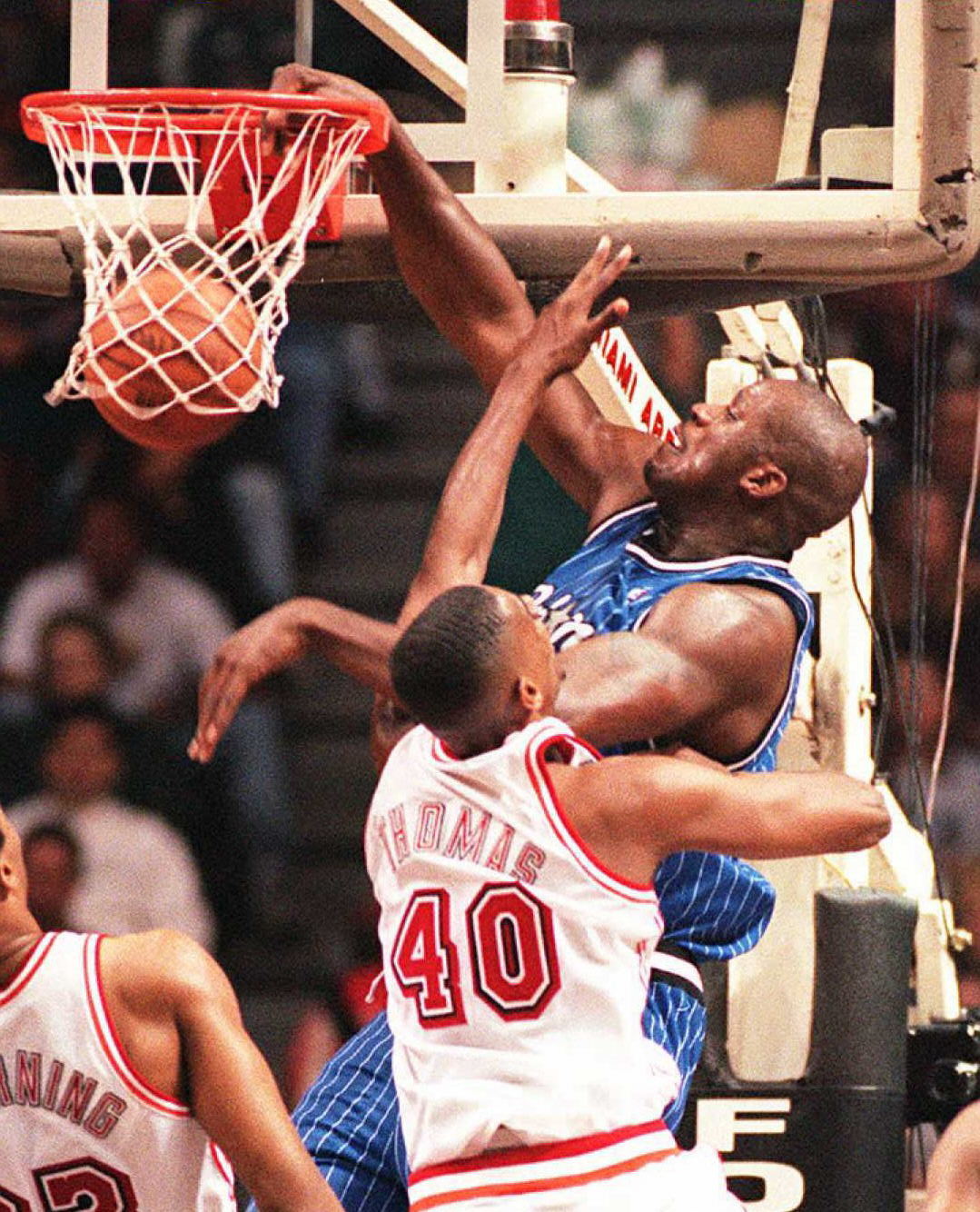
Watching highlights from O'Neal's 1992–93 rookie season today is dizzying and hilarious; I laugh at them precisely as though stoned. Your brain can hold together at one time any two facts of the reality of Young Shaq, but never all of them at once; the effect is like when your perception gets all fucked up looking through a chain-link fence, and your eyes can't tell what's close and what's far away for a second. He pulls down a defensive rebound and dribbles coast to coast, outrunning everybody else on the floor, then drops a no-look dime to a teammate for a layup, and your eyes impose a kind of sense onto this image—Ah, that's LeBron James—that is shattered a few plays later, when you can see that he's also nearly half a foot taller than most of the guys on the court, and thicker around the bicep than the guards are at the crown of their skulls. He relocates an opposing 7-footer like he's brushing aside a shower curtain, and your mind goes Ah, OK, like Nikola Jokic, and then with a shiver of his Achilles tendons he sproings off the floor as through tethered to the rafters by a taut bungee cord, and swats a high-arcing floater at the peak of its trajectory. After a couple relatively mundane catch-and-dunk clips, you find your poor beleaguered brain settling into the idea that he is more or less like great-but-normal 1990s big men Patrick Ewing and David Robinson—and oh look, now he's nearly killed himself on live TV by literally tearing the backboard off the basket stanchion.
Young Shaq was what people hoped Zion Williamson could be when they watched Williamson at Duke, barreling through defenders to the bucket like a horse charging through tall grass and making plays at the top of the backboard as though exempt from gravity. Except Young Shaq was roughly the size of Zion Williamson giving Dwyane Wade a piggyback ride.
There's an argument that Young Shaq would be a lesser player in today's game: that his utter lack of shooting range would fuck up his team's spacing; that his lousy free-throw shooting (52.7 percent on the fourth-most attempts in league history) would make him a liability late in close games, as it did at times during his career; that his combo of size and athleticism would stand out somewhat less against today's longer and more explosive athletes; that today's changed rules would make double-teaming and ball denial easier for opposing defenses. Certainly Young Shaq would have to run around a lot more on defense than he did in the 1990s, as opposing teams would use screens to force him onto killer guards with endless shooting range. Maybe that would translate to more fatigue, more injuries, or somewhat less playing time. (It's very easy to imagine enjoying the sight of it, given what a smug dick Shaq, as a studio commentator, tends to be.)
Then again, most teams today do not have even a Dwayne Schintzius– or Jon Koncak–sized player on the roster, nor anyone else who could dream of keeping Young Shaq away from the rim without waking up in an ambulance. The NBA ecosystem's principal evolutionary response to Shaq arriving in it was to create, for most of 19 years, a professional lane for huge beefy guys with virtually no basketball skills, whose entire job was to spend six fouls on the effort to transform Shaq's dunks into free throws. Sheer bulk, and the corresponding physical power to foul O'Neal in such a way as to prevent him from raising his arms above his head, skyrocketed in value. Most teams hired at least one of them, and some hired multiple. Bozos like Jim McIlvaine and Greg Ostertag even got big contracts out of it. It worked so well that, in combination with his famous career-long disinterest in working to stay in shape, O'Neal only won four rings and two scoring titles, plus an MVP award and three Finals MVPs, made eight All-NBA first teams (plus two second and four third teams), and retired having scored more points, at that time, than all but four other players in history.
Newly crowned Defensive Player of the Year Victor Wembanyama, whom I adore, would be little more than a complementary necktie for Young Shaq, who had nearly 70 pounds on Wemby's official listed weight and made his bones smashing through and dunking over guys built like two Victor Wembanyamas duct-taped to one another. Moreover, the playoffs happening right now have prominently featured Rudy Gobert—a stiff, the French Jim McIlvaine, a four-time DPOY in an era when a tall guy can wall off the rim and contend for DPOYs by standing in the paint and raising his arms over his head, precisely because there are no Shaqs around—giving (relative) fits to Jokic, the modernest of modern bigs, the three-time MVP, the greatest passing and shooting big man of all time.
That's all conjecture in any case, unfalsifiable and not nearly as fun as just watching great players play basketball here and now. Nostalgia can be intoxicating, and so in a different way can the related experience of looking back at something you'd witnessed in real time and discovering that you'd failed to grasp just how astounding and special it was in the moment—that in a meaningful way, you'd sorta missed what was right in front of you.
Somebody is watching Victor Wembanyama in these playoffs and situating him in a silly, transient debate over who's the best player in the NBA right now, overlooking the sheer impossibility and likely irreplicability of a 7-foot-4 noodle-shaped hyper-athlete with the skills and shooting range of a guard who also happens to be the best rim-protector and shot-blocker in the sport. Since his arrival, it's been exciting and tempting to imagine that Wembanyama is a herald, the first of many, a prototype of a future filled with guys like him. What old videos of young Shaquille O'Neal make me aware of, in a way that watching him in the moment never did, is that sometimes what you are seeing, and have a chance to appreciate in the present, is one of one.
Correction (1:00 p.m. ET): This blog initially miscalculated the total number of career minutes Joel Embiid can possibly have played by the end of this postseason. It is 18,854, not 18,868.