
NEW YORK — “I don’t think that bitch looks fit,” a woman next to me murmurs. She’s carrying a Louis Vuitton bag, wearing Hermes riding boots, and speaking, of course, about one of the three female Cane Corsos still in the ring.
It’s not exactly an unwarranted thing for her to say; she does have a dog in this fight. Two, to be precise. The two fitter bitches both belong to her. With the way the judge has physically sorted the field, it’s clear that a male is about to be picked Best of Breed, and that means the likelihood of one of her dogs winning Best of Opposite (the award given to the best dog of the opposite sex) is pretty high.
Like many of the women around me, the Cane Corso owner is wearing a tweed suit. As I’ve learned from many handlers over the course of two days, those suits speak to the prestige, perfectionism, and traditionalism of the Westminster Kennel Club Dog Show. It matters if the bitch is fit because that’s the name of the game. Sure, many of these dogs are born perfect; high-level breeders can often tell from puppyhood if a dog has potential to become show ready. They have to be champions just to get to Westminster. But in order to stand out here, at the “Super Bowl of Dog Shows,” the dogs need every edge they can get: a freshly cleaned coat that is maintained every few minutes, flawless posture, and, yes, a handler that has strategized their outfit around the canine they’ll be presenting.
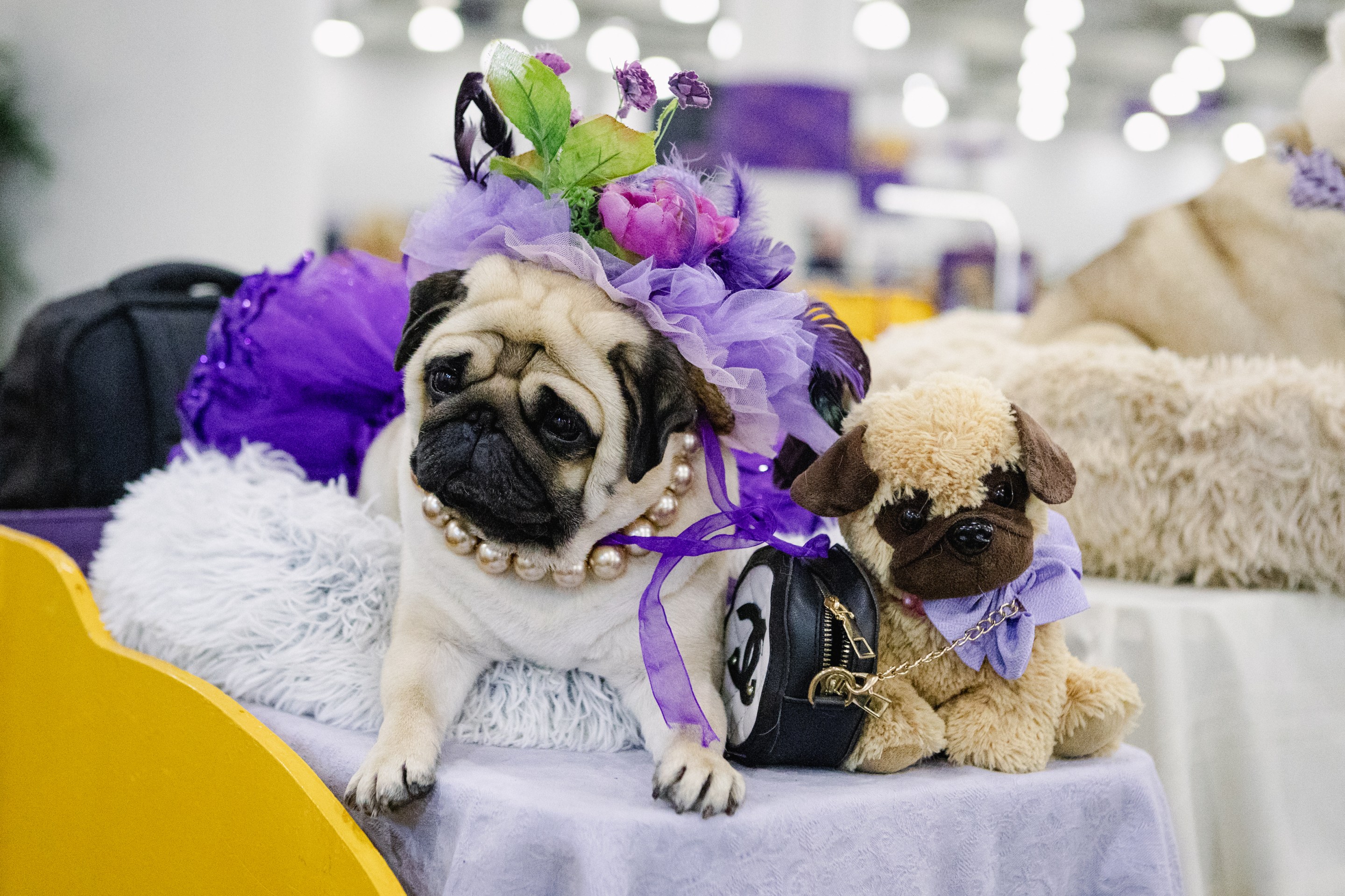
At any given moment, hundreds of dogs are being prepped in the backstage benching area. The grooming never stops. Between barks and the occasional howl, there are suits being steamed, fur being straightened, black noses being buffed. This is the pinnacle of human obsession with the pursuit of aesthetics, channeled through man’s best friend. Dog shows are simultaneously about individuality and conformity. Breeds are trying to meet written aesthetic standards, but they are also trying to be singular. In many ways, the humans are no different. As one exhibitor tells me, “It’s the Dance Moms of dog shows.”
At Westminster, you’ll find hundreds of dog handlers who worship at the altar of St. John. “St. John” doesn’t refer to St. John’s men’s basketball, or noted local Episcopal cathedral St. John the Divine, or Saint John the Apostle himself. Instead, their devotion is to the American luxury knitwear brand St. John, founded in 1962 and known for its Chanel-like knit suits and skirts. The 19-year-old handler with the longhaired dachshund is wearing a cream-colored St. John suit. That Pomeranian owner’s sparkly red two-piece? St. John. The rhinestone-encrusted skirt? St. John. I stop to ask two women in the benches where their monochrome suits are from. They say in unison, “St. John.”
“I had an unfortunate experience [with a St. John suit] at Westminster a few years ago,” says Charlotte Wagner, who is showing her American Staffordshire Terrier. Wagner is the first woman I’ve spoken to who is wearing something other than St. John. “It was my first year attending as an exhibitor, not a spectator. And I ordered a beautifully made St. John dress. … It arrived the day before Westminster, and it was way too big. So I never understood the trend, because it’s not for my shape.”
This is Wagner's first year at Westminster as a U.S. citizen, although she’s lived here for 38 years. Her outfit—from Tommy Hilfiger, Ralph Lauren, and other American designers—is a tribute to the dog, who is American and named “Ralph” for Ralph Lauren (although his registered name is “Carmichael Dressed to Impress”). Below us, Ralph pants. Most of the time, he’s an Appalachian farm dog, but this week he’s a star.
“You’ll need to clean your lens,” Wagner warns me. “Ralph just licked your camera.”
As for the men, the options for creativity are limited only by your imagination—as long as it’s within the confines of a suit. Andrew Webber, who got his first show dog two years ago, has a light brown German Pinscher named Gravy. “As much as your dog looks nice, you want to look nice as well,” Webber tells me. To pair with Gravy, he wears a lot of blue and greens, and mixes patterns to add a little fun.
I ask another handler, Ashley Wilkerson, where her suit is from. “I’m wearing a St. John suit, lots of glitter, lots of sparkle. My dog is black, so I want him to stand out as much as I do, and have a contrast,” Wilkerson says. As for the St. John suits, she tells me that they’re comfortable, professional-looking, and a status symbol.
There’s a St. John booth in the vendors section at Westminster. A glance at the tags will give you sticker shock—even on sale, these suits are well over a thousand dollars. It’s the first time St. John has had a booth at Westminster, the attendants tell me, a response to the immense popularity of the brand among dog handlers. They’ve been getting a lot of purchasers whose dogs won Best in Breed. Since their dogs have advanced to the next round of competition at Madison Square Garden, they’re looking to debut a new suit.
But for the most part, the suits at Westminster are secondhand. Multiple women tell me that they bought their suits off their friends, or somebody they met at a dog show. Many are wearing suits from the 1970s. The Facebook group “St John Dog Show Outfits” has over 13,000 members, and the secondhand suit sets are typically priced at a few hundred dollars.
“This originally was probably a suit I couldn’t afford, and I bought this suit for $90,” Teena Uyeno, dog owner and handler, tells me. She’s sitting with her friend, Ava Hata, who’s also an owner and handler. Asked why the St. John suits are so great, Uyeno tells me that they’re fairly stretchy, and mobility is extremely important when you’re running and moving with a dog.
I soon learn how important it is to dress for movement and comfort. In the Samoyed ring, a handler wipes out when their dog starts running too fast. The heels she’s wearing were a last-minute decision, and she couldn’t move well enough with them.
Two hours after I take a poodle’s picture in the benching area, I circle back to find the same woman still fussing with its fur. Thus is the life of a longhaired show dog—endless primping, and a little less petting. Uyeno tells me some show dog owners will pay something like $5,000 a month just for hair maintenance on their dogs. “It’s crazy,” she says.
Out in the rings, I see two convention-goers petting a fluffy Alaskan Malamute. The handler tenses. “Please don’t touch, because once you start petting him, he likes to go on his back, and I just worked up all that volume.”
There are steel dog combs everywhere, occasionally tucked in the updos of handlers, other times held between human teeth when hands are occupied with leashes. Every few seconds, someone is stopping to brush out their dog again. Sometimes, they’ll mist them with antistatic spray.
The shorthaired dogs can’t get away with relaxing either. Handlers rush around to take their dogs for practice laps—they’ll be evaluated on how “nicely” they move, so they need to be limbered up. Outside the ring where boxers are being judged, I hear some remark on the musculature of one of the dogs. As we’ve established, it’s important to be fit.
Back in the benches, I see a spaniel being blown dry with a Dyson Supersonic. Around the corner, a precious West Highland White Terrier is being bathed in a tub of white powder to enhance its brightness. A woman is spritzing her Maltese with (human) salon-grade leave-in product. I’m starting to think these dogs have better hair than I could ever hope for. There’s bottles and bottles of Tresemmé extra hold hair spray wherever I look. What is that man doing to that big old Tibetan Mastiff? “Red light therapy,” the man tells me.