
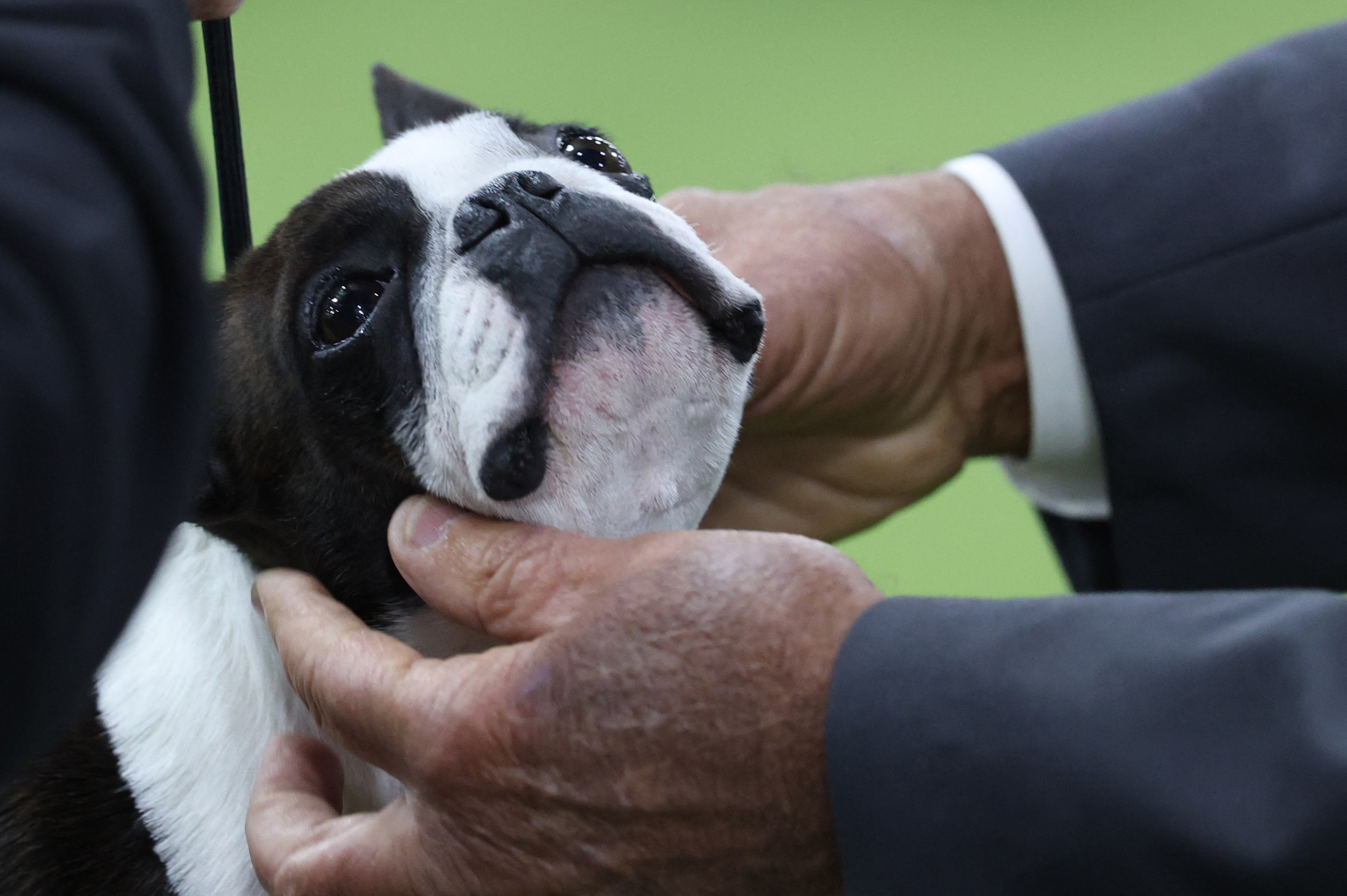
NEW YORK — On day one of the Westminster Dog Show, the Westminster Kennel Club hosted a Judging Insider program, where longtime judge Michael Faulkner helpfully pulled back the curtain on what actually goes into judging dogs and bitches (a strict technical term in the dog show world, and one which is used with a regularity that is startling if you're not used to it). How do you decide which of 33 seemingly identical Pomeranians is the best Pomeranian?
Faulkner emphasized that the dogs in the Best in Group or Best in Show categories, which feature multiple breeds, are not judged against each other, but are judged on which dog comes closest to its individual breed standard on that day. Barring disqualification for flaws such as signs of aggression or incorrect size or coloring, judging should always be on the positives of the dog, rather than the negatives.
In order for a breeder to become a judge, the American Kennel Club requires 12 years of experience in the sport at all levels, and at least four champions bred across five litters. As Faulkner, who breeds Golden Retrievers, riffed, "it takes longer to become a dog judge than a brain surgeon." But for all of the education and the standards and the rigamarole, the supposed quality of a dog is undoubtedly subjective. Faulkner’s descriptions of dog standards conveyed the idiomatic importance of, say, an Australian Cattle Dog’s head and jaw shape for surviving the potential consequences of "get[ting] kicked by a cow." He offered rapturous remembrances of the dogs that spoke to him in the ring, like a German Shepherd that "gave me goosebumps; when she went around the ring, I felt every muscle in her heart pound." It's an art and a science.
It was useful insight into the dreams and nightmares of someone who has dedicated their entire life to a very specific and specialized craft. Faulker offered an account of a mistake he once made judging a show in Indiana when he was 34 years old, in the bitter cold. There was, from a "gestalt perspective," one dog that offered nothing bad, but nothing great, and then an English Setter who was "oozing with virtues, from the tip of its nose, all the way down to the base of the tail"—but when the English Setter paraded around the ring, its tail was a little higher than Faulkner liked. Faulkner wound up selecting the first dog, and realized later that he had fault-judged—judged not, as he had said, on the positives of the dog, but on the negative. He later found the phone number of the breeder of the English Setter via some friends with English Setters, and called her to apologize, because "we have to take responsibility for our own crap. We do make mistakes. Not often, but we do make mistakes."
I caught Faulkner for a quick interview. The following has been edited for clarity.
Can you explain a little bit about your background?
I'm third-generation in the sport. I've been breeding, showing, and competing my entire life. I started showing at 14, got my judge's license at age 34, and I’m now 65, so that'll tell you how many years I've been judging. I've been competing at Westminster for decades and judging many times. And now I'm a member of the Westminster Kennel Club. I'm a delegate on the Board of Governors. So Westminster's been an intricate part of my life, my whole life.
You say third-generation. Can you go into what your family did?
My grandfather was a Great Dane and German Shepherd breeder. My aunt was a very well-known Collie breeder. My mother bred Field Spaniels, my father bred Black and Tan Coonhounds and Blueticks, and my godmother was a pioneer in the gun-dog breeds in England, and she was a mentor and a force in my education. So I spent half of my formative years going back and forth learning with the great gun-dog people, so I started in 1969. I purchased my first Golden Retriever; I was nine years old. So that was my breed. I chose Golden Retrievers.
What was the process like, going from showing when you were 14 to going professional?
What does it look like from a training perspective? It’s just something that gradually evolves based on [the fact that] it was my passion. I never thought of it as progress, it was my life. Does that make sense? It was seamless. It was like, all of the progressions were natural to me because it was something that brought me such immense joy that the trajectory was just smooth.
Were there any formal processes you had to go through to become a judge?
Oh, yeah. Oh, absolutely. So in order to become a judge—it’s an arduous process, and back in the day it was even harder. So I had to take exams on every breed, closed book, and if I missed a disqualification, then I failed it, and I had to wait to retake the exam. And so examination, in-ring evaluation—you had to go in with dogs and judge them on a provisional level, and if you mess up, they can pull your license away from you, from a provisional standpoint. And every time you apply for new breeds, you have to go through that same process.
So in order to be able to judge a breed, you have to first pass the examination for them, right?
Correct. And in order to get one breed, your original breed, you have to prove multiple years of experience. You have to produce champions, and finish them, and have active experience in the sport. And then once you get one breed, then you can apply for a second breed, and then advance to get multiple breeds. But based on my family involvement, and all of the dogs I bred and showed, when I applied for the first time, I was given the privilege of judging the entire sporting group, not just one breed, but 20-something breeds.
You mentioned you breed Golden Retrievers. Is there any breed you particularly enjoy judging, separate from Golden Retrievers?
I enjoy judging every breed if they’re good. A good dog of any breed is wonderful to judge.
Is there any breed that you never considered that much, but then you saw a dog, and you were like, This is the dog.
Let me think—this is a good question. Yes, yeah. There was an Azawakh bitch that was imported to this country from Italy. And I was at my home show, sitting, working, so I wasn’t judging. And this gentleman walked by with this young Azawakh. And I literally was sitting, and I got up out of my chair, and—"Whoa, that is beautiful." And it's not a breed that I knew a whole lot about.
[A brief digression as we discussed the spelling of Azawakh.]
And I was like, "Oh my God. She looks like a porcelain statue." She was—I mean, I was that captivated. So then I made a mental note, and I followed her career. I said, "You know what—" In my mind, I didn't verbally speak it, I said, "I could give that a Best In Show, it's so beautiful." She wasn't even a champion at the time.
Move forward a year’s time. I'm doing Best In Show in South Carolina, and who walks into my Best In Show ring?
The Azawakh?
The Azawakh. I gave her Best in Show so fast it'll make your head spin. But I never shared that story with her, but in my mind, that was the breed that, number one, I didn't know anything about, I had to educate myself. And then that solidified my first impression, knowing that I did my due diligence to learn about Azawakhs and that she was as good as I thought she was. And then to put it to the universe internally, "Boy, I would love to someday give that a Best in Show." It's a very innocuous, rare breed, it's not something that wins a lot. And then she showed up in my ring, I was like—[gasps dramatically].
What are you judging this year at Westminster?
The only thing I'm judging—it's not the "only" thing, I'm very proud—I'm selecting the Best Junior Handler. So on Tuesday night, before the group judging at 7 p.m. All of the Juniors—there’s over 100 that had to qualify for the show Monday and Tuesday. So there's two judges that will send me eight finalists, and on Tuesday night, at 7 p.m., I'll go in to start the show and select the winner of Best Junior Handler at the 150th anniversary show.
Last question: What do you think motivates you the most doing all of this?
[Takes some time to think.] It gives me immense pride and joy to judge at the breed level and find the next great one. A young dog that just came out of nowhere, and I go, "That is just beautiful," and endorse it, and see that dog go on and do great things. So finding the next great thing.