The first line in a Min Jin Lee novel gives you the whole story. In Free Food For Millionaires, it’s “Competence can be a curse.” In her follow-up, Pachinko, it’s “History has failed us, but no matter.” Both establish the thesis and themes of the novels, and of her larger project of writing about the Korean diasporic experience.
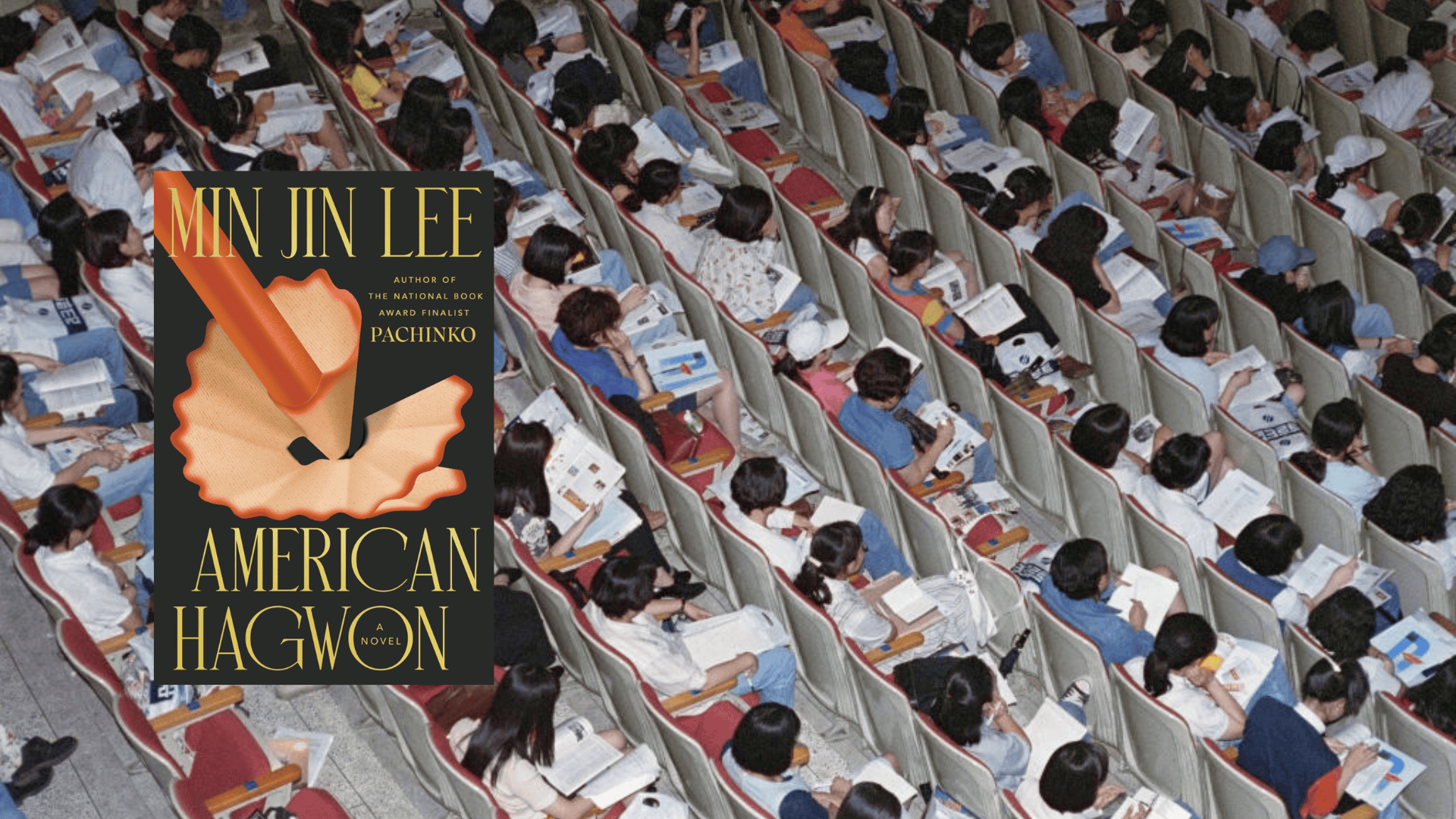
The first line of Lee’s latest novel, American Hagwon, does the same: “The rules of engagement have changed already.” The novel, which came out last week nearly a decade after Pachinko was published, situates her characters—and by extension, the Korean diaspora—at a point of transition where they must adapt. Ever concerned with the financial realities of Korean families, in American Hagwon, Lee considers the cost, both economic and human, of a people striving to elevate itself.
American Hagwon tells the story of a community centered around a hagwon founded in Los Angeles by Korean immigrants. Hagwons are cram schools that are incredibly popular in South Korea, and in the U.S. among Korean communities. They exist to supplement the day-to-day education students get at school. Students often attend them every day after school and late into the night, doing extra work to get ahead academically and to prepare for the highly competitive exams required for admission to the top Korean universities, as well as elite American universities.
The novel follows the Koh family: John and Helen; their three children, Bo, DH, and Mido; and the community they build between Seoul, Sydney, and Los Angeles. The three siblings are children at the beginning of the novel, students at an American-run hagwon in Seoul, and the novel follows their adolescence and young adulthood as they all eventually end up in the U.S.; Bo and Mido work together in a new hagwon and DH becomes a lawyer. But to say that American Hagwon is simply a story about a family reduces the scope of the narrative, which sprawls outward from the Koh family to encompass three generations of Koreans and Korean immigrants who are connected to, and affected by, the ambitions that drive the founding of this new American hagwon.
There’s a scene early on where a pastor at a Seoul church delivers a sermon comparing parents’ high expectations of their children to the child sacrifice required by Molech in the book of Leviticus: “Cross-culturally and throughout time, we have had reprehensible practices to appease the idols we created and propped up from our own minds and hands [...] To what gods do we sacrifice our children? To which gods do we sacrifice our most prized ideals—and why?” In pursuit of the opportunities and status that come from an elite education for their family members, Lee’s characters forfeit prestigious careers, send their children abroad to abusive living situations, lie to each other, forego their artistic passions in favor of lucrative but prosaic jobs, sacrifice their own educations, trade sexual favors, and even commit white-collar crime that lands them in prison.
The novel critiques what one of Lee’s characters calls Korea’s “endless culture of striving and cutthroat competition in a nation that has an inferiority complex.” The striving has not been for nothing: Over just 75 years, South Korea has evolved from an impoverished agrarian society to a major economic power, and a widespread emphasis on academic achievement, both at home and abroad, has been a major contributing factor to this growth. But the growth is not all positive, and Lee questions what a “culture of hyper competition and status mania” does to its people. Since the early 2000s, when American Hagwon is set, suicide rates in South Korea have skyrocketed. In 2021, it was the leading cause of death for Koreans between the ages of 10 and 39. Through character monologues, Lee argues that the flip side of the “striving Korean” who works to improve their family’s status through academic excellence is a hollow existence stripped of humanity, and even life itself. But she also makes this argument implicitly by allowing characters to experience the consequences of their unfettered ambition. These lofty plans typically don’t work out for her characters, who find themselves destitute, or more often trapped in untenable situations like unhappy marriages or precarious kiting schemes. When things do work out, it’s usually the product of family—blood and chosen—coming together to make it possible.
Exceptionalism is a theme throughout the novel, typified by the repeated invocation of the Korean myth of Hong Gildong, who overcomes his illegitimate paternity by wielding his incredible gifts of intellect and magic to gather a “band of outlaws,” the hwalbindang, to steal money from aristocrats and redistribute it to the poor. In one monologue, Lion Han, the founder of the eponymous American hagwon, argues that the lesson that has resonated most strongly through Korean culture is that one’s station can be overcome with hard work and academic achievement. “That’s the reason Koreans are so messed up,” he says. “Hong Gildong is a character from a fable, and he cannot serve as our role model [...] Rather, use and nurture the talents you have. [...] Avoid comparisons.”
The solution is not as simple as just opting out of striving, though. There are the economic realities of life to contend with: the cost of housing, of healthcare, of feeding one’s family. That is the bind Lee’s characters find themselves in, with each of them searching for an acceptable way out that would allow them to live with themselves. Lion starts the hagwon in Los Angeles that is more affordable than its competitors, because he wants to make the academic support more accessible to the poor immigrants in his community. He repeatedly questions the motives of the Korean parents who want their children to attend Ivy League schools: “Was it possible to think you’d won when no one said you had?” he wonders. “What was winning anyway?”
Even as he skewers what he calls “the genesis of all this madness,” Lion is a Hong Gildong character himself. He is intellectually gifted, called “the Oracle of Orange County,” and is appointed to a prestigious leadership role as an elder in their church. Other characters are also exceptional in ways that both conform to and conflict with standard narratives of academic success. What can one make in life, for example, out of a prodigious ability to wield one’s own body and seduce romantic partners? Could that be as valuable as a perfect SAT score?
Rather than cast their striving as a virtue, Lee places her Hong Gildong characters in situations that test their integrity and pride, then allows the consequences to follow. Perhaps more importantly, Lee focuses on the latter part of the Hong Gildong story, the hwalbindang that Hong gathers to create a new world. The sprawling community around the Koh family is its hwalbindang, and when its members find success, it is through unconventional means facilitated by community rather than straightforward striving and achievement.
Lee doesn’t offer a solution in American Hagwon, but rather a reflection, one which countless children of the Korean diaspora have contended with themselves: In an unequal, capitalist society, how far can you go to secure a future for your family without sacrificing your soul? And at what point should you reconsider the game you are playing? As the opening line reminds readers, “the rules of engagement have changed already.” What new rules are to replace the old ones?
Lee’s characters cannot be read in isolation; similarly, all of her novels exist in conversation with each other. American Hagwon is the third in what will become “The Diaspora Quartet,” and her previous two novels, Free Food for Millionaires (2007) and Pachinko (2017), also documented the economic striving of Korean immigrant communities. Pachinko, which told the story of a Korean family that immigrated to Japan during its 35-year colonization of Korea, got adapted into an Apple+ show and was a finalist for the National Book Award in 2017. It also ranked No. 15 on the New York Times’ list of 100 best books of the 21st century.
Millionaires has the most straightforward narrative voice of the three, with the perspective forming a tight spiral around its protagonist. Pachinko loosens the spiral slightly, but still circles around a couple of primary characters. American Hagwon, on the other hand, has no single protagonist. The loosest of the three, it forces the reader to stay nimble, with the perspective jumping at a frenetic, almost disorienting rate between more than a dozen characters. It's an ambitious swing at honoring the multiplicity of experiences inside a single community, but it often felt like the different narrative voices lacked distinction. I had to draw a complicated chart to keep track of everyone. Sometimes, jumps in perspective seemed driven more by a necessity to move the plot forward than the need to truly be inside that character’s head.
When her previous novels were published, Lee was one of only a handful of Korean-American novelists, and the scarcity of those narratives made criticism among other Korean Americans and Asian Americans fraught. In 2015, Jenny Yang coined the term "rep sweats" to refer to the anxiety that people of marginalized groups experienced, both as creators and consumers, when a singular piece of art is tasked with representing the multiplicity of their experiences. This hesitation, born out of solidarity, weakens the cultural ecosystem such that true criticism is washed away with sentimental paeans to the political power of representation.
In the nearly 20 years since Lee published Millionaires, Korean culture has exploded globally as the result of concerted efforts by the South Korean government to support cultural production and exports known as hallyu, or the Korean Wave. Lee’s novels, while not Korean exports—Lee immigrated to the U.S. as a child and grew up in Queens—have nevertheless served as crucial pillars in the development and popularization of Korean-American narratives in American fiction. The culture is in a much different place than it was even 10 years ago, and the abundance of Korean-American art that is available in the mainstream makes it more possible to engage critically with Lee’s work.
Even now, I struggle not to drift into a scarcity-based appraisal of the representative work Lee’s prior novels have done. You can draw a straight line through Lee’s novels from the beginning of Japanese colonization in 1910 to today. Pachinko lays out the origins of Korea’s “inferiority complex” with its impoverished and colonized origins in the early 20th century, while Free Food for Millionaires shows how second-generation Korean Americans metabolized that insecurity into ambition for wealth and social capital. Millionaires helped me understand the implicit motivations that governed much of my own ambition, while Pachinko allowed me to understand the bitterness toward Japan and pride in Koreanness that older generations in my family have held my whole life. That is the impact that resonates most noticeably to me in the 15 years since I first encountered Lee’s writing. But to return to the opening line of American Hagwon, “the rules of engagement have changed already.” Today, I feel free to say that American Hagwon isn’t my favorite Lee novel and will likely not rank among the top books I read this year. Still, it’s a strong contribution to the quartet that places Korea’s last hundred years in a context of global culture, economics, and politics. The quartet, and this novel in particular, will serve as the record for how and why the Korean people staked a claim on the global stage.
A leitmotif in American Hagwon is the conflict between the desire to create art and the economic realities of a life as an artist. Lee herself had a former career as a lawyer and has spoken about putting her creative ambitions on hold in pursuit of the good school, good job, and good life. “Art feels impossible,” one of her characters says, both because it doesn’t seem realistic economically and because, for so long, American culture was uninterested in the stories of Koreans and Korean Americans. American Hagwon succeeds as a serviceable contribution to her larger project because of the work Lee has already done. Art no longer feels impossible, and that is perhaps Lee’s greatest legacy.