

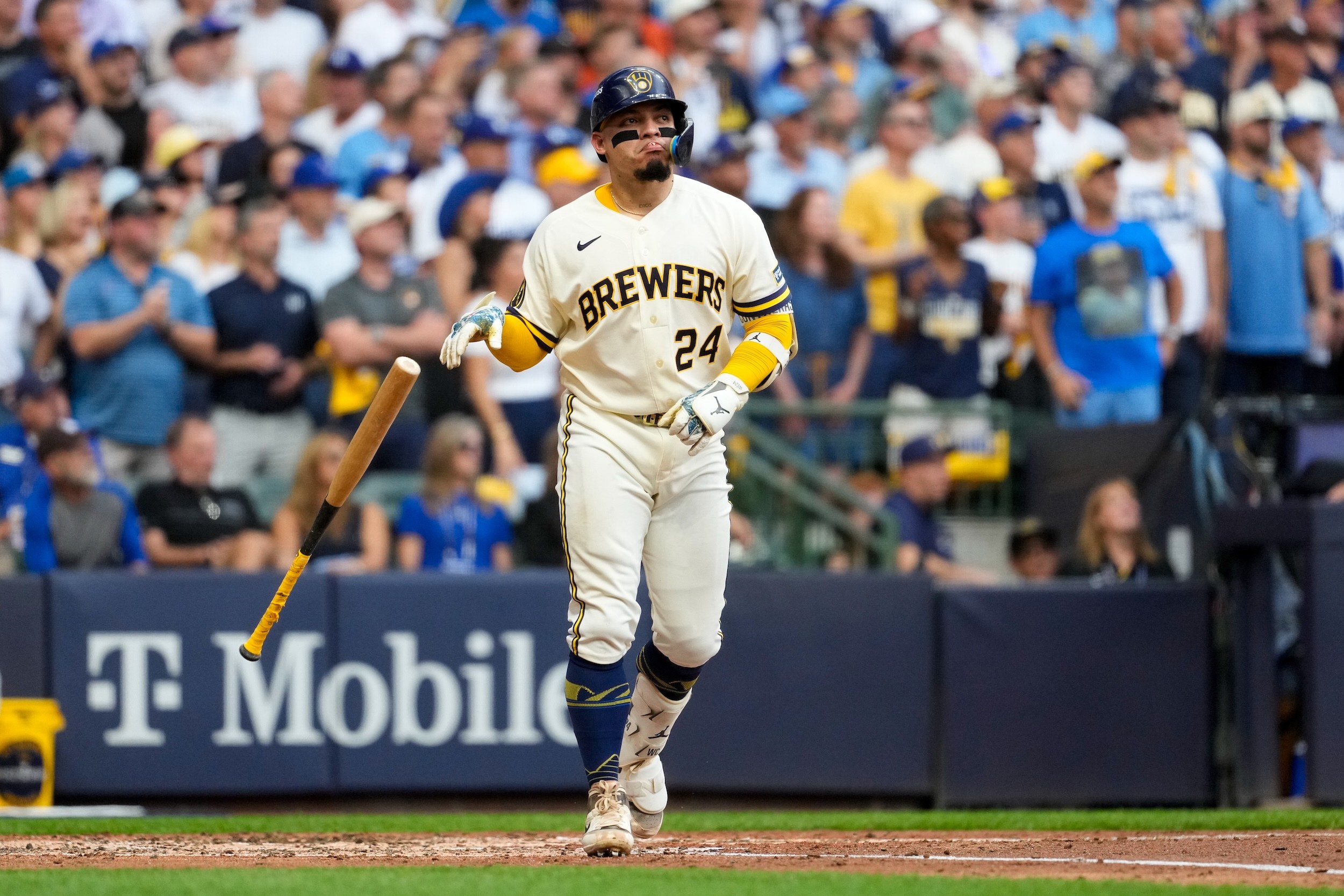
I like to imagine a wised-up contrarian reading Ray Ratto's blog about the Milwaukee Brewers' Game 1 victory over the Los Angeles Dodgers, which identifies a formula in the way the Brew Crew are progressing through the National League playoffs. It's not a vague, vibes-based formula that Ratto describes, either: He says Milwaukee's opponent scores first "but cannot make a big inning out of its opportunity;" he says the Brewers "catch up quickly" and then nose ahead; he says Milwaukee's starter "goes four innings" and then hands it over to Milwaukee's bullpen; he says the bullpen slams the door, making a narrow margin on the scoreboard feel approximately as vast and daunting as a snow-bound glacier-capped mountain range.
I like to think of this hypothetical smirking contrarian—I even have the face and voice of a former shit-eating acquaintance in mind as I type this—rolling their eyes at this so-called "formula." Sure, but this is baseball, and there's too much variance in baseball for formulas, says our contrarian, then somehow wedges the word "orthogonal" and a reference to Ayn Rand into an unwanted sermon on randomness and regression. I like to imagine this contrarian then watching Milwaukee's 7–4 victory in Game 2 and becoming so flustered and irritated by the process and outcome that they call out of work the next two days, just to delay their own reckoning.
It was downright spooky how closely the Brewers followed their formula Monday night. The Dodgers scored runs in the first and third innings, each time to go up a run, but failed in both cases to extend and exploit their opportunities, both times when an observably unwell Shohei Ohtani made the third out. The Brewers answered both runs with runs of their own, yoinking momentum back their way and chipping away at Dodgers starter Yoshinobu Yamamoto, who needed 25 pitches to get out of the first inning and another 22 pitches to record the first two outs of the third. Milwaukee nosed ahead on a two-out, two-run third-inning single to center, and chased a gassed Yamamoto from the game. Milwaukee's own starter, Logan Henderson, completed the requisite four solid innings but gave back the lead at the start of the fifth, and was yanked. The Dodgers again failed to put together a sustained rally, and the Brewers immediately countered with another run of their own.
By this point in the game I was giggling. The Brewers are hilariously, ecstatically Like This. You want to complete that sentence with "for better or worse" but there is absolutely no sign, right now, of the latter. They're baseball's version of persistence hunters: They do not have to be stronger or faster than whatever they're chasing. There was a point in the third inning where Jake Bauers fouled off six straight two-strike pitches from Yamamoto, and even before he'd earned his improbable 12-pitch bases-loading walk, it had become clear that by sheer peskiness Bauers and his like-minded fellows had already grabbed up a crucial advantage over the Dodgers. The rest was just walking them down.
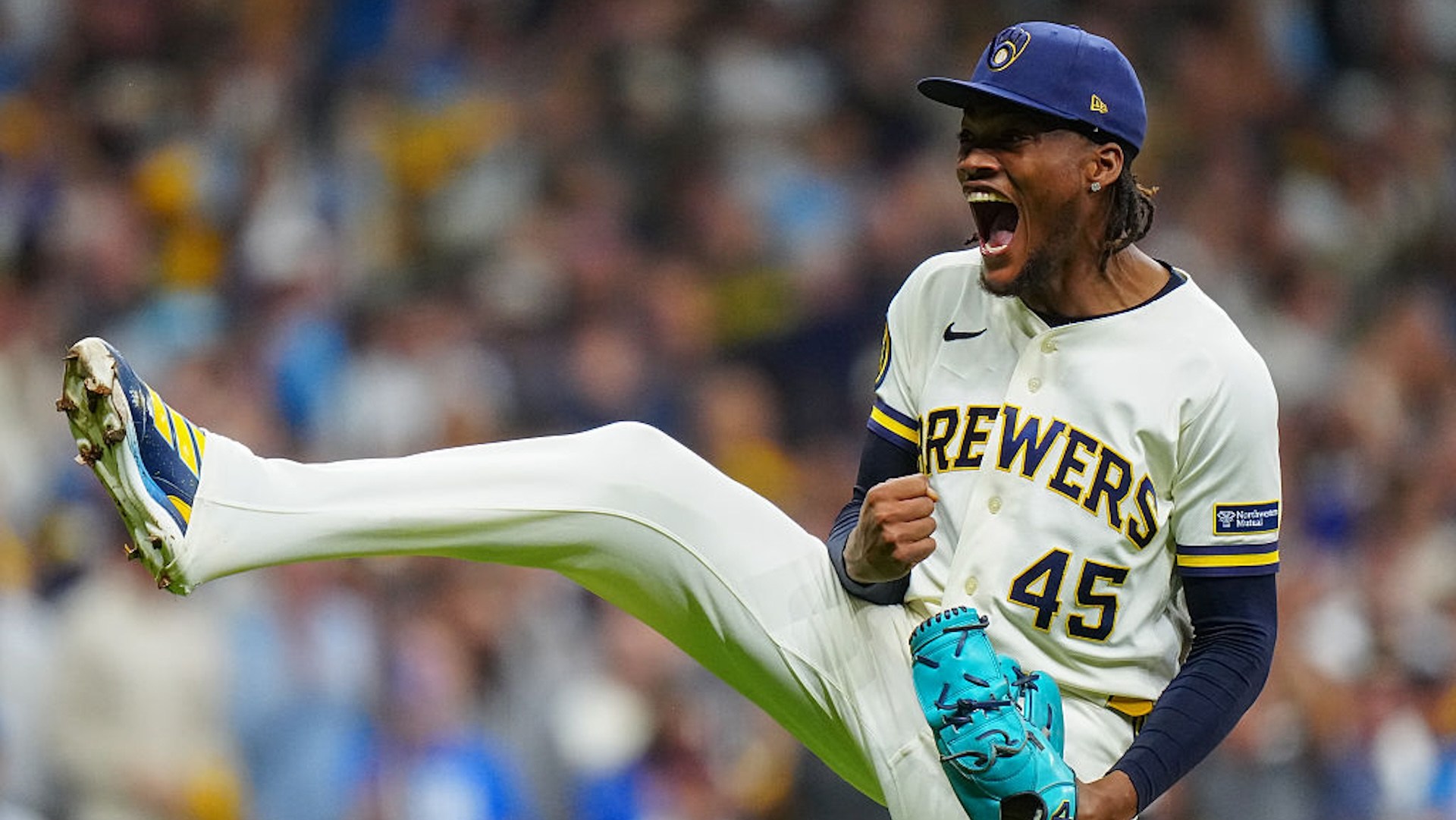
Brewers manager Pat Murphy summoned the first of his untouchable bullpen arms, JoJo Romero, for the sixth inning, and from that point forward the Dodgers did not put a single player on base. Romero retired the side on 13 pitches. In the seventh inning, Abner Uribe retired the side on eight pitches. Uribe and Aaron Ashby retired the side in the eighth on 11 pitches, and then Ashby finished a clean ninth on 15 pitches. Meanwhile, the Brewers got a run-scoring single in the sixth inning and two more in the eighth, each of which felt like a back-breaker. They never had a big rally of their own, but by the time it was over they'd recorded 10 singles and six walks and made Dodgers pitchers throw 172 pitches to record 24 outs*.
"I don't think we play any different than anybody else," said Murphy, before the game, in response to questions about his team's signature style. He's obviously wrong as hell: Murphy's men aren't holding the fat ends of their bats or running the bases in reverse, sure, but by definition the best team in baseball in a given season is doing things most other teams are not. But Murphy's point, I think, is that his team wins in part by doing the same stuff every other team tries to do, all the little controllable things. Some signature component of their success is that they are outrageously disciplined, which is what every baseball manager wants to say about his men. In that sense, the Brewers are just like any other baseball team, only more so. Monday night they ground Yamamoto to dust, swinging and missing at just four of Yamamoto's 75 pitches, and making him throw 5.3 pitches per plate appearance, per ESPN. That's the Milwaukee version of stunting on a fool. They should start bat-flipping on walks and seeing-eye singles.
The Brewers are so persistent that they change the sport's math in surprising ways. Dodgers catcher Will Smith is in a minor crisis this morning because he held onto ABS challenges early in the game, pursuing the best wisdom of the challenge era, and now must face the possibility that his passivity allowed the Brewers to do their thing. Twice in the early going Smith declined to challenge borderline pitches against Brewers second-baseman Brice Turang, and both times Turang subsequently reached base, on a first-inning double and a third-inning walk. Both times, Turang came around to score.
"It was kind of early in the game. We kind of had him on the ropes,” Smith said of Turang, per the Los Angeles Times. “I figured we could get him out there." You figured wrong, man! With Yamamoto a little more scattershot than usual and the Brewers absolutely refusing to give away at-bats, any opportunity allowed to pass un-seized feels like a game-changer. Smith's calm patience with an umpire's unfavorable early strike zone suddenly feels like fatalism. The Dodgers had the lead three times Monday, they squeezed four runs out of just three total hits, and they capitalized on little unlikely openings, and for all their luck and opportunism the second half of the game was a grim march to the gallows. The freakin' Brewers just keep stalking onward, putting men on base and moving them along, and woe unto the opponent that finds itself behind on the scoreboard the moment Murphy makes his first slow walk from the dugout.
"If there is a positive, you can say that a lot of our guys are starting to get looks at their back-end guys," said Max Muncy, casting about for some glimmer of hope his Dodgers can bring back to Los Angeles. "But when they’re as good as they are, I don’t know how much that helps."
Brewer Ball doesn't have to be for everybody, but it works like crazy for these guys. And if it keeps working long enough it might soon be for everybody: Baseball is a copycat business just like the rest of professional team sports. Look out for huge-brained front offices near you reaching for the lowest-hanging facets of Milwaukee's success. Aren't foul balls, in fact, more valuable than dingers?