

It's time for the World Cup. We've been previewing each of the top 15 teams by FIFA rankings that made the tournament. Why the top 15? Because that's how many we needed to do in order for the USMNT to make the cut. You can read all of our previews here.
As the largest event humanity has ever come up with, it's safe to say that the World Cup is a big deal. In some way or other the tournament connects to literally everything, from politics, to culture, to war, to art, to philosophy, to biology, to economics, and on and on. As such, it can sometimes get overlooked that, on its most fundamental level, the World Cup is just a collection of soccer games. And the simplest explanation of a game of soccer is that the team with the best players usually wins. That is why Spain is the clear favorite. At this World Cup, Spain has the best players.
I don't mean to undermine the broader importance or meaning of this Spanish national team. For instance, it matters that this World Cup will be the first one in which Spain, a country with a relationship to its immigrant and ethnic minority populations that counts as notably fraught even by Southern European standards, will have as its face a child of African immigrants—one recently seen celebrating his club team's championship by waving a Palestinian flag. On a separate level, Spain has an opportunity here to conquer the world and reassert itself as the defining dynastic force of the 21st century, something demonstrated not only in international titles but in its unparalleled influence on the way the sport is played and thought about today. But while there are innumerable ways in which La Roja's exploits this summer will mean something, the thing most striking to me on the tournament's outset is how straightforward the case for a Spanish title is.
I also don't mean to belittle Spain's rivals. For instance, it's fair to argue that, across all 26 roster spots, France has the strongest squad in the field. I myself believe that to be true. But where I think even the absurd top-to-bottom depth of France's roster comes up short against Spain's is in top-end quality.
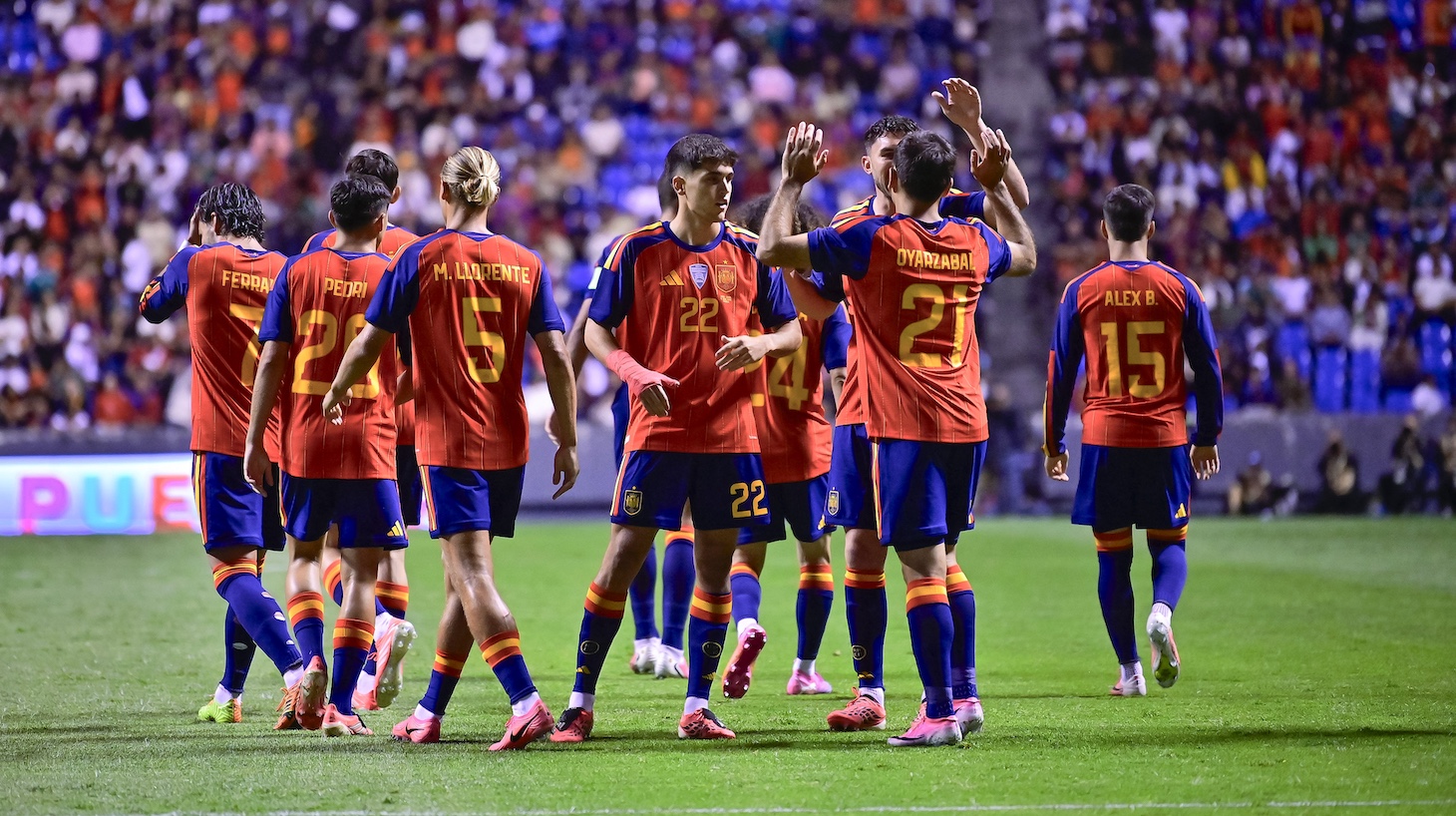
Simply put, Spain's best players are better than everyone else's best players. Lamine Yamal is the best player in the sport today. No one else can match the influence he exerts on every facet of a game, to an extent that is practically impossible to prevent. Accompanying him are Rodri and Pedri, the world's two best midfielders, who in my opinion both stand at least a full head above whoever you'd rank third. (You're awesome, Vitinha, but the Spaniards are better.) And while the rest of Spain's starting lineup doesn't mirror the historic talent of those three, the team is able to surround them with a bevy of perfect compliments, all of whom are expert at getting the best out of their superstar teammates. These are players who think and feel the game in the same way, a shared spirit and sensibility that makes for some of the best soccer you'll see in the international game. If in sheer talent only France can compete with Spain, than the Spaniards' only peers in pure quality of play are the Argentines. It's not for nothing that Spain and Argentina, through the way that each plays, best demonstrate how a team can, in an undefinable but unmistakable way, embody the essence of a given country's soccer identity.
Granted, it is hardly the case that this World Cup is Spain's to lose. As an unpredictable, low-scoring sport, soccer just doesn't work like that, and tons of better teams than this one have failed to win it all. At the same time, I don't see another team in the field that can with more justification consider itself as champions-in-waiting. Spain has the best players and plays the best soccer. Sometimes that's all you need to say.
Who Is Their Main Guy?
When dealing with young players, it's important to remember that development isn't always linear. Just because a putative wonderkid follows a breakout season with a relatively down or disappointing one doesn't mean that the hype was exaggerated or that their ceiling has been permanently lowered. Soccer is hard, and growth usually takes time and patience, as the player suffers through adversity and learns to overcome it.
Now, none of that applies to Lamine Yamal. It's true that his development hasn't been linear, but only because it would be better described as exponential. From his emergence as a scrawny teen three years ago to today, where he is what I guess you'd call a sinewy teen, Lamine hasn't stopped smashing through each successive threshold between callow youth to full-blown, generational superstar.
It was a little over a year ago, during an iconic Champions League semifinal tie between his Barcelona and Inter, when we first got a glimpse of Lamine as world's best player. That month was the first time Lamine truly combined his promise as a dribbler, passer, and scorer to their fullest extent in the most demanding of situations. His next challenge was to prove that that form wasn't just a purple patch, but rather was his new normal, something he could maintain for an entire season. Naturally, at the first possible opportunity he demonstrated just that. After having (what qualifies for him as) a slow start to the 2025-26 season due to a nagging case of pubalgia, once Lamine's hip started feeling better he went right back to crushing everybody and had the best season of his career thus far.
I wouldn't begrudge any Bayern fan who wants to stump for either Michael Olise or Harry Kane as their favorite for the Ballon d'Or, pending of course what happens this summer, and in terms of absolute level I'd still count Kylian Mbappé amongst the best of the best even in (what qualifies for him as) a kind of meh club season. But I can't really conceive of any understanding of excellence in soccer that doesn't position Lamine as the foremost exemplar of it. His impact on matches is legitimately global, to a greater extent than Olise's, which requires more assistance from teammates to come into effect, and Mbappé's, which is too often disconnected from the overall game and instead focused solely on his individual game. Lamine can't really be stopped from taking control of the proceedings, and even if you do manage to limit him, the very act of doing so necessarily leaves you vulnerable elsewhere.
He comes into the tournament a little rusty, having sat out the past month with a hamstring injury. However, I think the time off could prove beneficial. All these players are criminally over-worked already, so him getting to skip the tail end of the Barça season to rest up might be a blessing.
Lamine already showed what he can do at full strength at an international tournament, when he helped lead Spain to the trophy at Euro 2024. The scary thing is that this Lamine is better than that one. And the even scarier thing is that tomorrow's Lamine will surely be even better than today's.
Who Is Their Main Defending Guy?
Though Spain has soccer's best forward, its two best midfielders, and well-suited counterparts in the surrounding positions, its defense is a glaring weakness. Of the likely starters, only one of them (Marc Cucurella) stands out primarily for his defensive skill; the rest are great with the ball, but only solid at best without it. Spain does have three readymade upgrades for two positions, but those players haven't yet had the chance to steal the starting jobs with the kinds of performances that convince a coach to upset the existing hierarchy and put in the better upstart. I'm referring there to David Raya and Joan García, both of whom are better than Unai Simon (though to be fair Simon is also very good and has been great for Spain), and Marc Pubill, a young defender who could and probably should start at either right or center back.
The anchor of the shaky backline as it exists, then, is 32-year-old Aymeric Laporte. Laporte was once one of Spain's biggest competitive certainties in defense, back in his prime at Manchester City, but age and a skill-dulling two-year sojourn in Saudi Arabia have made him merely good, not great. His still-great passing, his left-footedness, and the not-completely-unrealistic chance that the intensity of the tournament will inspire him to defend at a level approaching his prime mean that he will likely start for Spain for the duration of the summer. To be fair, his ability with the ball at his feet does make him a great fit for the style Spain plays, which is why the team is still favorites to win even with that weakness. Laporte's chances of turning back the clock could prove crucial to the Spaniards' ability to make good on that favored status.
Who Is Most Likely To Break Out?
Though the canonical Spanish player is a nimble-footed little creative midfield type, a David Silva, the country also has pumped out its fair share of hard-nosed defenders. Even if most of them were also great with the ball, the likes of Sergio Ramos, Gerard Piqué, Carles Puyol, and Fernando Hierro knew how to clobber the hell out of the ball when it got near their penalty area. Marc Pubill looks to be the next player of that ilk.
Even though Pubill, 22 years old, has only just completed his first season in the elite (he moved to Atlético Madrid from Almería last summer), and has at this point played more games in Spain's second division than its first, it's already evident to anyone who pays attention to La Liga that he's the best Spanish defender out there. This was evident to Atleti manager Diego Simeone too, who signed him as a right back, quickly noticed how awesome he was defending, and thought Hmm, I should probably just put this guy in the middle and see what he can do. Turns out, what Pubill could do is dominate, playing outstanding soccer in his new position right from the outset.
He's close to the inversion of Marc Cubarsí, the teen whose job he could very well take within a week or two: pretty good at passing, an absolute beast defending. Pubill has the athleticism to be formidable when shutting down transitions in space, and has the positional intelligence to also be great at defending inside his own penalty box. His timing, his calmness, the smoothness with which he can accelerate and decelerate and change direction, and his reading of danger make him one of those defenders that's actually fun to watch. He's still green, even as compared to the younger Cubarsí, which is likely why manager Luis de la Fuente hasn't yet put him into the starting lineup. But I think it's only a matter of time before that happens, whether at right or center back, whether at this tournament or the next one.
Who Is Most Likely To Eat Shit?
Marc Cucurella is definitely the least cool of Spain's starters—a major upset considering that locks as flowing as his are such a shortcut to coolness. He has held down a starting position in several good teams, including this one, so there's clearly something there, though I have to admit I have a hard time seeing it.
He got his start as an attacking left back, so much so that he spent much of his early career at Getafe as a wide midfielder. In spite of that offensive past, he produces very little in the final third. Since leaving Getafe for the Premier League, first at Brighton and now at Chelsea, he has transformed into a defensive specialist, sometimes even playing center back in three-man defenses. Cucurella tackles a lot, sure, but he also gets caught out often by lunging into challenges he has no business going for, and is a yellow card magnet. That penchant for bad fouls is what makes him so uncool.
Anyway, red cards are often fatal in knockout games, and it's extremely easy to imagine Cucurella picking up a senseless couple yellows and getting sent off in one. Defense is Spain's weakness, and Cucurella is the link most likely to break, so he is also the best candidate to eat shit.
How Can They Win It All?
Health. As long as Spain gets and stays fully healthy, you have to fancy their chances against anyone. Unfortunately, that can't be taken for granted. As mentioned above, Lamine's first appearance in this tournament will be right around two months since his last one, and hamstrings are notoriously prone to re-aggravation. Rodri and Pedri have had their own injury troubles this year, so they too aren't locks to make it through the dense tournament without pulling up lame at some point. In addition, Nico Williams, who alongside Lamine was part of the thrumming engine that drove Spain to its Euro 2024 victory, is also currently racing to get fit in time for the action this summer, after having his own injury-plagued season. And the player best positioned to step in for Williams, Víctor Muñoz, is himself at the tail end of his recovery for an injury!
Spain's ideal starting XI is incredible, and they also have a handful of strong backups to allow for rotations and game-changing substitutions. However, the squad isn't terribly deep outside of that. If Spain is forced to reach too deep into its roster due to injury troubles, they might not pull this off. But if they stay healthy, look out.