In the hypothetical situation in which a fan is attending a baseball game in person and has to wait for a video review to be completed, what is the length of time the review can last before she might turn murderous? Five minutes? Ten? The umpires in Monday night's game between the Boston Red Sox and Toronto Blue Jays put this to the test with a 15-minute review of a baserunning debacle by the Red Sox that ended with the visiting team being awarded a run in the end.
But let's start from the beginning. In the top of the seventh inning, with two on and no one out, Red Sox shortstop Nick Sogard smoked a 104.9-mph low liner that bounced before entering the glove of Vladimir Guerrero Jr. at first base. Guerrero threw to second for the force out; Red Sox catcher Connor Wong, who'd reached first on a single before Sogard came up to hit, was unhappily stranded between first and second, unclear on whether Guerrero had snagged the ball out of the air (he had not). The play resulted in only one out; Sogard reached first, and the Red Sox had runners on the corners with one out as Ceddanne Rafaela came up to bat.
On the first pitch of the at-bat, Rafaela flicked a ball into semi-deep center field. This is when things began to go very wrong. The Boston baserunners, under the mistaken impression that there were two outs—perhaps because the Toronto stadium scoreboard mistakenly said so—ran on contact. Blue Jays center fielder Brett Bateman easily caught the ball and threw to second as the Red Sox runner on third jogged across home plate. While the Blue Jays pitcher and catcher headed off the field, evidently also under the mistaken impression that there had been two outs, the infield sprung into action, throwing the ball to first for the third out. Toronto appealed the play, which is a form of making an out that is not to be confused with an instant replay review; in situations like a runner failing to tag, the umpire does not make the call at their own discretion and instead requires the defensive team to explicitly appeal when relevant. And then they ran off the field.
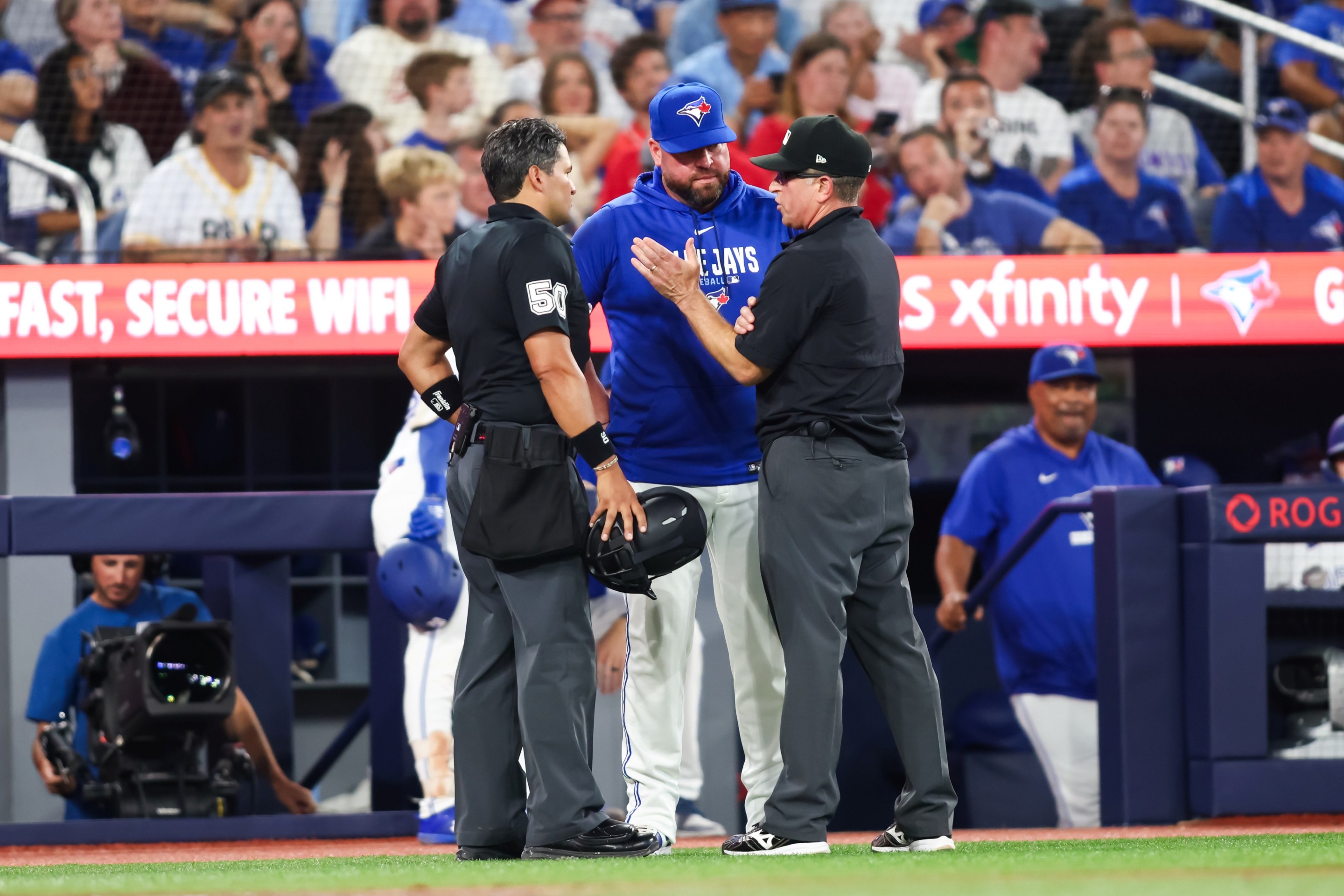
Many people were confused by this, and presumably only became more so during the 15-minute wait. After the Red Sox broadcast came back from the first commercial break, they showed the umpires conferring and then trying to explain their decision to Blue Jays manager John Schneider and Red Sox manager Chad Tracy. This initial phase of the process took several minutes.
Then the umpires had to turn and try to explain to the stadium. Crew chief Chris Guccione put in his earpiece and took a breath. "OK," he began, and paused. Uh-oh! "So what we have here is," he continued, before taking another break. Oh no! "We have a time play, meaning when the third play—when the third out was made at first base with the runner not tagging up, the runner that was on third base also did not tag, but crossed home plate before the third out was made at first base. So, that is a time play. We are going to New York to check—do a rules check." He ended his announcement to a chorus of boos from the Toronto home crowd.
The wait that followed Guccione's explanation stretched on and on. Several more minutes later, the process of talking to the managers began anew. Though Schneider deployed his trademark move of growing more and more red-faced over the course of the discussion, there was no ejection. Guccione once again came out to face the hostile crowd. "All right, after calling New York, getting it all straightened out, the run is going to score," Guccione said. He paused, to an even more aggressive chorus of boos. "End of the inning, two runs for Toronto, one run for Boston."
What happened? Well, first, the initial misunderstanding was likely caused by the Toronto stadium scorer, who should have scored the Sogard play as WW for "wasn't watching." We've all been there, buddy. Then the scoreboard evidently confused the Red Sox baserunners and several of the Blue Jays into believing that there were already two outs in the inning, despite the fact that only three batters had come up and two of them were on base at the time of Rafaela's flyout. Neither runner tagged up, which enabled the Blue Jays to turn Rafaela's would-be sac fly into a double play by throwing to first and appealing.
Whether or not the Blue Jays turned a classic sac-fly double play was not in question; what was in question was whether or not the Red Sox would score a run, as the runner on third had crossed home plate in the time before the Blue Jays had thrown to first and appealed the out there. In the end of a comment on Rule 5.08 in the official 2026 MLB rules, this exact play is referenced as an example:
One out, Jones on third, Smith on first, and Brown flies out to right field. Two outs. Jones tags up and scores after the catch. Smith attempted to return to first but the right fielder’s throw beat him to the base. Three outs. But Jones scored before the throw to catch Smith reached first base, hence Jones’s run counts. It was not a force play.
Rule followers, Cubs fans, and Javier Baez aficionados will note that in the brain-breaking play Baez made against the Pittsburgh Pirates in 2021, the result was even more ludicrous because the run would not have counted had Baez not safely made it to first base, as it would have been an inning-ending force play. Because getting thrown out for failing to tag does not qualify as a force play, that same rule does not apply here.
Of course, the situation with the Red Sox is more complicated because the role of "Jones" in this situation did not actually tag up before he scored. Unfortunately, though the Blue Jays did appeal the third out of the runner failing to tag at first, they did not do the same with the runner failing to tag on third. 5.09(c)(4) on appeal plays states that "appeal plays may require an umpire to recognize an apparent 'fourth out.'" That is, the Blue Jays could have appealed the run but did not, presumably because they already reached three outs, and also everyone was confused as soon as people started walking off the field. What classifies as leaving the field of play? Well, that's "when the pitcher and all infielders have left fair territory on their way to the bench or Clubhouse."
Thus, the situation as outlined in Rule 5.08 effectively plays out as written. The umpires—and their consultation with New York—were correct, and somehow, despite making a terrible baserunning mistake, the Red Sox managed to effectively steal home and come out of the debacle with one run. To make the situation even more beautiful, the Red Sox would go on to lose the game 2-1, thus rendering the play and the 15-minute review and the rage and confusion totally, entirely irrelevant. Baseball!