

On Wednesday, the New York Yankees played the hosting San Francisco Giants in MLB's Opening Night, which was the first of really three Opening Day–esque events to open the season. Today will be the more traditional event of nonstop baseball brain: day baseball into evening baseball into midnight baseball, the Pirates and Mets starting it off with just one ordinary afternoon ballgame and not an overcooked nationalist extravaganza, in what would have been a lovely opening to the season. Tomorrow will service the six sad teams, and fanbases, who will have to wait until day three for their Opening Day. But yesterday was a capital-E event, which naturally made it feel not very much like Opening Day baseball at all.
Here was the one night game, scheduled to start at 8:05 p.m. ET, aired only on Netflix, which made the big event something one would have to pay specifically for, or, hypothetically, borrow a friend's laptop in order to watch. The players ran through a line of yellow taxi cabs (Yankees) or a cable car (Giants) on their way to the field. There was some sweaty, red-faced man who shouted, "This is baseball, this is America, let's go!" There was an American flag in the shape of the United States of America. There were some pyrotechnics in the shape of an American flag (not shaped like the United States of America). The first pitch was thrown at 8:25 p.m. Eastern, 20 minutes late, on a basketball or hockey schedule. It was strike one to Trent Grisham, which was finally a fact insignificant enough to feel real.
The game did not wind up being close enough to sustain any tension or drama; after the pomp of its opening, it registered as an anticlimax. Despite the best efforts of Aaron Judge, who went 0-for-5 with four strikeouts, the Yankees put up five runs in the second inning and two more in the fifth, with Giants starter Logan Webb gallantly soaking up all of the punishment. Meanwhile, Yankees starting pitcher Max Fried threw 6.1 shutout innings, thanks to his full arsenal of, according to Statcast, seven different pitches. The Yankees would win 7-0, without any intrigue.
This turned out to be a blessing, as it is unclear how Netflix would have handled juggling an interesting game with its planned content: advertisements, and self-promotional crossover plugs, and live interviews (with players, managers, and commissioner Rob Manfred), and advertisements, and FanDuel Daily Dinger, and advertisements. Among the self-promotional content was an inning-long undertaking of Jameis Winston, who had a stadium-exploration montage and interview sitting in the stands, while flanked by WWE wrestlers. The advertisements were so central to the broadcast product that they were about the only clearly visible portion of the first few innings, which were broadcast in a haze, as though the game, or at least the center-field camera, was transported into the Tule fog with insufficient color grading to compensate. The discordance was worst with the initial bright red and clearly edited-in advertisement, but the backs of left-handed batters fuzzed continuously throughout the game, no matter what was displayed behind them.
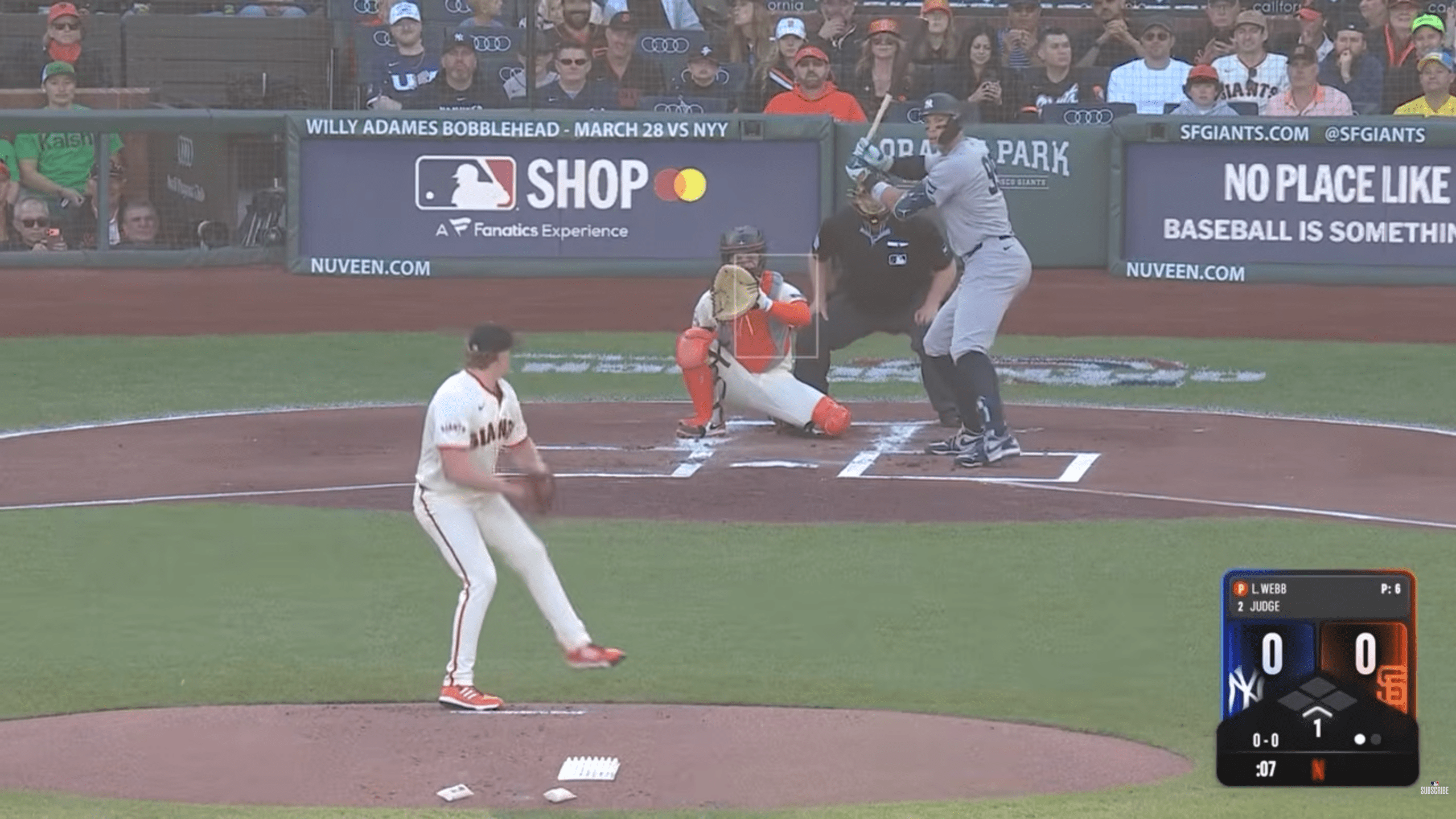
At the very least, the broadcast had coherent theming, as the Netflix scorebug was also mostly illegible. Any text, and the information it wished to convey—pitch count, batter and place in the order, balls and strikes, pitch type, pitch speed—was difficult to impossible to read, particularly on a small screen, to which one may be relegated if again, say, they were watching on a borrowed laptop, and not much better on a 26-inch monitor. Tell you what, however: The scorebug did tell you the score, and also faintly resembled a cat's face.
The Netflix scorebug
— CJ Fogler (@cjzero.bsky.social) 2026-03-26T00:28:41.893Z
I am not someone who believes that in regular-season baseball, things should be small and trivial and necessarily treated as such. A big lead-off to start the season is perfectly fine in principle. I am envious of those who were able to watch the game at the Giants' stadium, such as an unnamed Yankees-fan colleague on the business operations side of things who was present. All the quirks of a capital-E Event, even one that was streamed, would have been forgivable if, putting aside all the pomp and circumstance, the broadcaster had not been actively at war with the concept of showing a baseball game.
It is a shame, because the game delivered in the small, expected ways. There was the first-ever Automated Ball-Strike (ABS) challenge in a proper MLB game, which will be a fun bit of trivia in a couple of years: In the top of the fourth inning, Yankees shortstop José Caballero challenged strike one, an up-and-in fastball that was, in fact, just barely a strike. (The next pitch was a more egregious inside ball that went unchallenged, but it is understandably difficult to challenge immediately after a failed challenge.) The broadcast missed this moment live because it was busy interviewing Giants manager Tony Vitello, and only got around to discussing the matter via replay several pitches later.
At times, the baseball won, mostly in the mundane. Here was the first time I opened Baseball Savant and Gameday to a proper game this season. Here was the first seventh-inning stretch. Here was the first time I briefly left the game running in the background to do some chores because the score did not look like it was going to change meaningfully anytime soon, and when I returned, lo and behold: zero changes.
But the greatest victory of baseball as a sport over Netflix's baseball broadcast came in the bottom of the fifth inning, during the promised and much-dreaded Manfred interview. The most memorable question the booth asked was about when Manfred first fell in love with baseball, as it introduced the unthinkable concepts of Manfred experiencing both "love" and "loving baseball." It turned out to be one of the few questions that the booth got a chance to ask because, thanks to the efforts of Fried, it was an extraordinarily quick nine-pitch inning.
As Manfred was ushered out, the broadcast reassured spectators that the commissioner was a busy man, and he had already offered up so much of his time. Of course, the truth was that here, at least, the broadcast was still beholden to the fundamentally arbitrary tempo that a baseball game plays by. And for all the interviews and advertising and faff, this Netflix game, like many other 7-0 shellackings, will eventually be forgotten. At the end of the day, it was just a regular-season baseball game.