



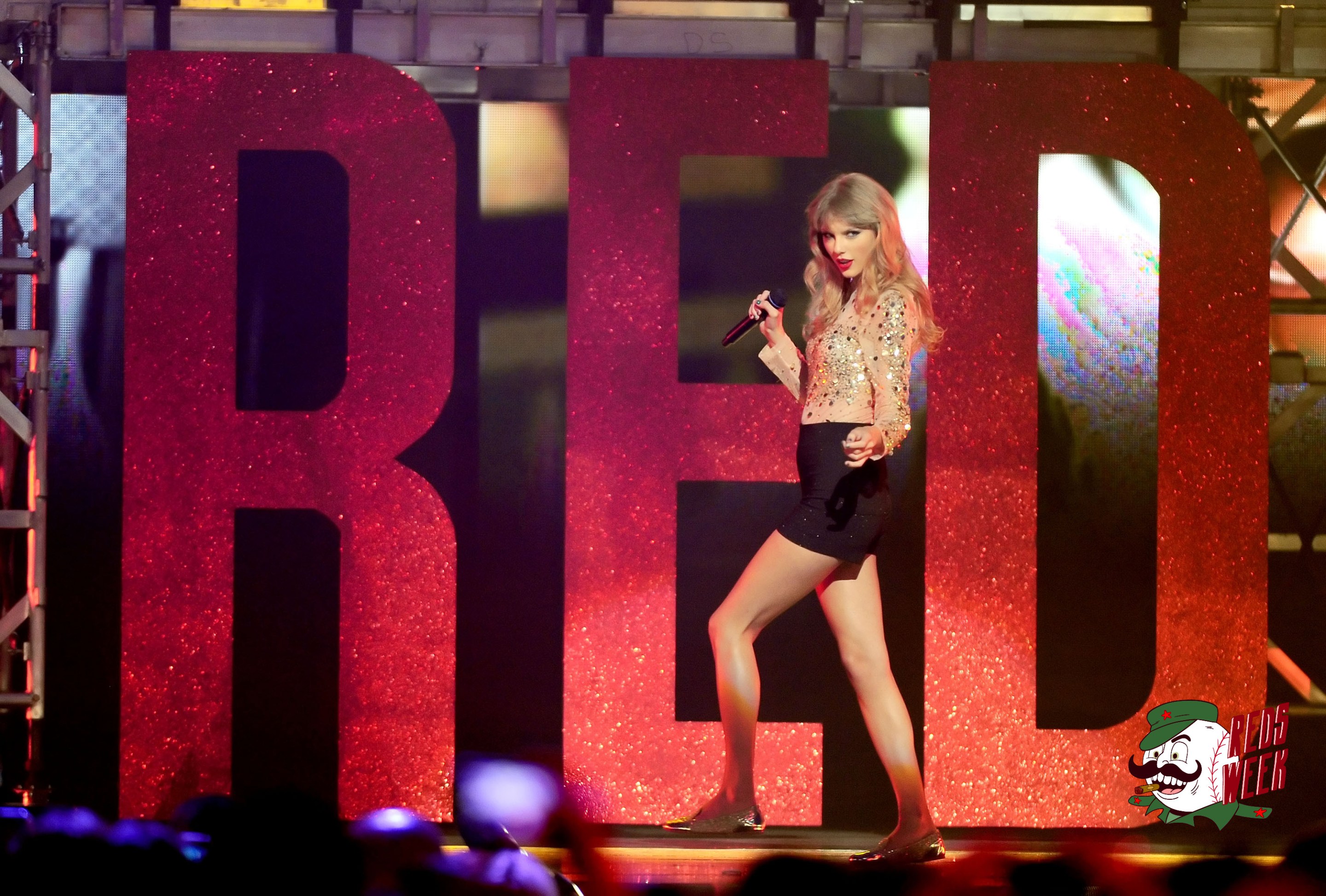
This is Defector Music Club, where a number of our writers get together to dish about an album. In honor of Reds Week, we're discussing Taylor Swift's 2012 pop-rock hit Red.
Patrick Redford: I can’t be the only one whose strongest and first thought about Red is that there’s a sound at the end of the first synth swell in “I Knew You Were Trouble” that sounds just like the jail-cell door slamming closed in Akon’s “Locked Up,” right?
Lauren Theisen: I primarily remember the screaming goat remix.
Alex Sujong Laughlin: I cannot say I relate, but I will be listening for this when we get there. I have to say, I’m so excited to be doing this today, because it’s the first day of school for the college that underwrites my whole life. There’s just the faintest fall coolness in the air, and I’m sitting outside with a kombucha. It’s still a little too warm for a maple latte, but the vibes are right.
Patrick: The vibe note is a good lead-in to my main question about Red. I gather we have several Swift scholars here, so I am curious if you could constellate this album within her oeuvre. My sense is that it marks the hinge point between the early country stuff and the pop stuff, while also reaching new heights in the songwriting-as-songwriting stuff. How does that land?
Alex: Yeah, I would say that’s right. Real heads know she was already in the process of moving away from country (if you listen to Speak Now in the right headspace, it sounds very Avril Lavigne), but this was the big crossover moment, I think mainly because of the electronic production in “I Knew You Were Trouble.” Also, this is the album where she hits what is probably her lyrical high-water mark in “All Too Well,” but we will get there.
I also think this was the first album where she consciously crafted an “era.” People have drawn comparisons between the album art and the cover of Joni Mitchell’s Blue, which obviously also has a single word primary color title. This was the beginning of crafting a whole persona specifically for the narrative of the album. I'd also like to share that when I was in college, I made a playlist called “Purple” that alternated the songs from Red and Blue back and forth. It wasn’t the best listening experience, but I thought it was clever.
Lauren: Yeah, you’re spot on, Patrick. Fearless was a pop-radio juggernaut four years prior to this, at least in my recollection, but Red is her first album that feels pretty much entirely divorced from any kind of Southern country sound. It has more in common with the indie-flavored rock of 2012 than, like, Tim McGraw. I’m curious what people got nostalgic for when they went back to listen to it.
Rachelle Hampton: I think the thing that’s always drawn me to Taylor Swift is her ability to capture those big, sweeping emotions of youth—the ones ultimately complicated by all the extra shit that adulthood brings. Red is probably the album where she gets the closest to perfection in that regard. The further her wealth, fame, and self-obsession take her away from any sort of universal experience, the worse she gets. I think that’s why her pandemic-era albums were so good: She was stuck inside like the rest of us, and it’s almost like she could hear herself again. Listening to Red again made me nostalgic for a version of Swift that wasn’t anywhere near as caught up in her own self-mythology.
Alex: Red came out in the fall of 2012, when I was a junior in college. I have such intense sense memories of parking my car at the Red & Black building at UGA, which was on top of a giant hill, hitting play, and stomping down to class in my new suede Madewell booties (the most expensive item of clothing I’d ever owned!!). The charm of her earlier albums for me was that she documented a specific type of white girlhood and teenagerdom that I aspired to, and I think to Rachelle’s point, Red is one of the last times we got that so thoroughly on an album level. My friends were starting to turn 21, we had cars, we lived off-campus, and we all felt so very grown up. It felt like our parasocial pal Taylor Swift was also growing up, and Red was the soundtrack to that time.
Lauren: I wrote last year about how falling in love and unexpectedly fitting into a very hetero-looking relationship totally recontextualized my relationship to Taylor Swift’s music, and that continues to this day. I remember in freshman year of high school being blasted constantly by “You Belong With Me,” and at the time I was bothered by how harsh she was on the girlfriend in that song. (The meanness toward women she sees as rivals in some of her older tracks doesn’t interfere with my enjoyment today, which makes me wonder if I’ve regressed.) Red passed me by in 2012, when I was a senior in high school mostly obsessed with Kurt Cobain. But I feel grateful that I had not yet turned 22 when “22” came out. Getting to play that song on my and my friends’ 22nd birthdays was a nice treat that year. I’d actually avoided listening to it for a long time since because I figured it would make me feel old, so only this weekend I realized that it’s a song about feeling younger, not about acting more mature than you are.
Patrick: I’m not a nostalgist, generally or in the specific case of this album, which I hadn’t ever listened to in full before this week. It puts me in the somewhat impossible position of judging an album that’s extremely 2012 and performed by an extremely different version of Taylor Swift. I was not 22. I was not there. I do not remember it all too well.
The thing that does stand out is her songwriting, which is also not something I go for all too often. There’s an internally coherent cosmology. I don’t mean this in the sense of how this album fits into the Tolkien-level legendarium of all Taylor Swift songs and all the referentiality built into the broader Eras-style phenomenon. I mean it in a much smaller sense. This is a breakup album, and she hits every facet of what that feels like. What do you think the best-written song on this album is?
Lauren: Probably “All Too Well,” like Alex already hinted at, but to be frank I still feel a visceral exhaustion when I hear the chorus, because when Swift released the 10-minute version it pretty much played nonstop in my then-apartment for weeks (not my choice).
Patrick: And at Defector karaoke nights, thanks to Luis and Kelsey! (“All Too Well” is also my pick.)
Alex: And at one of the first Normal Gossip afterparties (my choice)!
I think “All Too Well” is objectively one of her best songs, lyrically. I mean: “And you call me up again just to break me like a promise / So casually cruel in the name of being honest / I'm a crumpled-up piece of paper lying here / Cause I remember it all, all, all / too well.”
But I’d like to give a shout out to “The Lucky One,” which is one of my sleeper favorites on the album. It might be the first time Swift contends with her ambivalence about fame in her songwriting, and even though we obviously know how this story ends, with Swift literally choosing Madison Square over the rose garden, I am really compelled by the moment captured in this song of someone who knows they’re on the precipice of bigger-than-big. You get lyrical motifs that will come back in future albums, like “You had it figured out since you were in school / everybody loves pretty, everybody loves cool,” which sounds an awful lot like some tracks on Folklore.
This is also one of the first times she plays with what I guess I’d call historical fiction in her songwriting, where the song is based on the life of a real person. “The Lucky One” is about Joni Mitchell, and there’s a song two tracks later called “Starlight” that is about Ethel and Bobby Kennedy. Always an overeager tryhard, I’d say Swift was doing a little too much with both of them in terms of trying to cement herself in a narrative lineage of American pop culture, but these songs set the stage for works like “The Last Great American Dynasty,” which I also loved.
Rachelle: I guess I’m going to be controversial and say that I think the opening track, “State of Grace,” is at the top of my power rankings. I love “All Too Well,” but I also find it slightly too literal. And this is technically cheating, but I think Taylor’s best-written song comes from deep in the bonus tracks on Red (Taylor’s Version); her duet with Phoebe Bridgers on "Nothing New" is one of the smartest tracks in her entire oeuvre. It’s also one of her few duets with a female artist that doesn’t reduce her co-vocalist to some oohs and aahs. Her “collaboration” with the Chicks was, given her country roots, one of her most anticipated, and it's actually criminal how little they contribute to it.
Alex: Ugh, “Nothing New” is just the best. As much as I wish it had been on the original album, it’s so perfect with the Phoebe Bridgers feature.
Lauren: “State of Grace” was by far the non-hit from this album that got me the most energized. To stay on Reds Week theme, it reminded me of the War On Drugs song “Red Eyes”—musically, it captures this feeling of driving to an exciting destination. What a perfect opener!
Let’s talk about the big hits now. My favorite three seconds on this whole album is the way she sings “Trouble, trouble, trouble,” and the four-ish really enduring (to my mind) songs on Red just pop in a way that makes the back-half filler tracks sound unfortunately gray in comparison. (That might also be a reflection of the fact that I really do not like either of the male guest singers: Ed Sheeran and Snow Patrol Guy.)
Alex: Now that you’ve invoked the screaming goats version, it’s all I can hear when I think of this song.
Patrick: You know, now that I think of it, “Locked Up” and “I Knew You Were Trouble”: also quite lyrically similar. “22," “Back Together,” and “Trouble” are all such perfectly spherical objects to me: frictionless, engineered for clean impact, assured of their trajectories. This is what a pop song should be, so even if they don’t have any jaggedness or idiosyncrasies to burr into me, on the level of form, I do appreciate their utter faithfulness.
Lauren: I also enjoy the eye roll of “some indie record that's much cooler than mine” on “We Are Never Ever Getting Back Together,” which is a better and funnier dig than, say, pointing out that a hated bride’s gown is “shaped like a pastry.”
Rachelle: “22” is a perfect pop song. It’s entirely irresistible. I think it does that thing that Swift does so well of turning an entirely unoriginal experience (falling in love, falling out of love, turning 22) into something that feels magical. I remember that for years after Red came out, I’d call my friends on their 22nd birthday to sing this song into their ear.
Lauren: On “22” and “Back Together,” the choruses hit like a sledgehammer, and they’re better for it. A line like “You go talk to your friends, talk to my friends, talk to me” reads as plain and uninspiring on the page, but in the studio there’s a blunt forcefulness to it, like a chant or an invocation. They're superficially shallower than Swift’s best songwriting, but they've got an explosiveness that was powerful enough to help millions of people form an identity that incorporated them.
Alex: I agree with all of this, and yet … I barely ever listen to those songs when I spin through the album. It might be that they were just so inescapable during those years that they don’t bring me to a specific moment the way some of the quieter songs on the album do. It’s worth noting that “22” and “Back Together” are the two songs on this album co-written with Max Martin and Shellback, the producers she would collaborate with on 1989 to make some of her most infectious pop songs.
Lauren: When I want quieter songs from Swift, I tend to fast-forward to the COVID era. If her first couple CDs are sleepover staples, and 1989 through Lover are like her poised, manicured, international pop-star persona, Red stands out to me as a late-puberty classic. It’s a record for screaming about a guy who makes you feel like you’re about to be ripped in half.
Patrick: I wonder how that temporal specificity translated when she redid the album a few years ago. How did the established, world-bestriding version of Swift sound when singing songs about turning 22 while awash in the maelstrom of heartbreak?
Alex: Oh man, I found the re-recording to be so inferior, especially in terms of Swift’s vocals. They’re actually much stronger in the 2021 version, but so much of the charm of the early albums comes from hearing how thin her voice is. You get the vulnerability of being a grownup for the first time so much more viscerally. I will say that the vault tracks from Red (Taylor’s Version) are my favorite vault tracks of any of the re-recordings. We mentioned “Nothing New” already, but getting a Taylor recording of the Little Big Town single “Better Man” (which she wrote) was so fantastic, and “I Bet You Think About Me” is a delicious and spiteful addendum to “Back Together” that works so much better after a decade of fans pestering Jake Gyllenhaal about giving Swift her scarf back.
Lauren: I like listening to the re-recorded Speak Now and Fearless, because they make me feel less like I’m 12 years old. But I agree with Alex that Red didn’t work for me as a redo. I really want to keep it stuck in that cusp-of-adulthood era.
Patrick: I guess you really can only be 22 once!
[Editor's Note: Ray's internet went out right before we did this, so he sent over his thoughts separately.]
Ray Ratto: This marks the first notes we have ever knowingly listened to from Taylor Swift, and as such we do not come here to castigate her skills or the ears of those who find her pleasurable. We could, of course, but that would reveal a level of interest in her work we neither possess nor wish to obtain. Based on the one listening we acceded to, we found that her audience neither includes nor should include the likes of us tin-eared baboons. It would be standard-issue condescension to say things like "She has a decent voice," or "The music seems competent enough," and sentences designed to move her prototypical fan like "Maserati down a dead-end street," or "This slope is treacherous I-I-I-I-I-I-I-I-I like it" hit us like an index card in a gentle breeze.
We did listen to all 16 songs, even the one with Ed Sheeran. The other collaboration, with someone named Gary Lightbody, was even less noteworthy since we had no idea who he was, and a cursory search of him on the demon internet actually revealed a photo of blind comedian Chris McCausland, whose closest brush with Taylor Swift would surely be his 2024 victory in Strictly Come Dancing, which for us is a far greater achievement even though we have also never seen an episode of Strictly.
If we had to pick a song we would consider hearing again, and let us caution you that we almost certainly wouldn't, it would probably be "We Are Never Ever Getting Back Together" for its upbeat contempt that borders on emotional cruelty, two admirable concepts in their own right. We had higher hopes for "22," if only for the repeated phrase "miserable and magical," which we originally took to be a portent of everything to follow. It was neither, but all honor and glory to everyone who enjoyed it and her entire discography, because we negotiate enough arguments without starting one here with people whose only crime seems that they enjoy music. In summation, we invoke the words of David Mitchell, who said when asked about Lady Gaga's hit "Poker Face," "I'm not sorry it stopped."