
I’m a sucker for contrarian tournament picks. Sure, I could spend some time telling you why a one-seed is going to win the title, but who really finds joy in touting the favorite? You’d have to be a heartless sociopath to do that, whereas I am a normal man who spends a lot of his time assessing the relative quality of every college basketball team in Division I. So please indulge me while I tell you why Purdue is going to win the title this year.
Let’s start our journey with a fun fact. If you care about filling out a bracket, this is the time of year when you get inundated with fun facts by engagement farmers. They generally go something like this: "Only these teams can win a title based upon [a very specific set of qualifications], which are [cherry-picked with curiously arbitrary cutoffs]." For instance you may hear that, based on history, a team’s offensive rating has to be in the top 31 to win a title. As if a team ranked 32 has no chance.
The term for this is data dredging. And while it’s a pretty terrible practice if you’re trying to find a cure for cancer, it’s honestly not that big of a deal if you just want to get a few extra eyeballs on your Reddit post. These nuggets of trivia often make use of my own ratings. I disavow all such efforts, but there’s only so much one can do.
The fun-fact trade remains robust despite its diminishing fun and limited factual basis, but there’s one such "rule" that gets far less attention that it should: Of the last 28 champions, just three have entered the tournament with a worse offense than defense. The exceptions have been 1999 UConn, 2013 Louisville, and 2014 UConn. In truth, some of this is an artifact of the natural order of the college basketball world. The top teams usually have a better offense than defense because the best offenses are better than the best defenses.
But this season, things are different. For the first time in the past 30 seasons, each of the top six teams has a better defense than offense entering the tournament. That group includes all four one-seeds as well as two-seeds Houston and Iowa State. Those are considered the six teams with the best chances of winning it all if you look at various statistical models or betting odds; they are also the top six teams in the Net Ratings at KenPom.com.
That brings us back to Purdue, which enters the tourney at eighth in my ratings, and with the best offense in the country. In fact, they have the best offensive rating since I’ve been doing this, and a Maryland team led by Juan Dixon and Lonny Baxter won it all that year. Even accounting for the fact that offense in general is better than ever, Purdue’s offensive rating is the ninth-best over the past 30 years when adjusting for the season average. This is the kind of team that’s usually a serious title contender.
You can probably guess why they’re not. Purdue is not the strongest defensive team, ranking 36th this season; they are barely in the top 1,000 (954th to be exact) over the past 30 years. As such, their ranking violates some of the arbitrary cutoffs people use to identify champions. But the reason I hate fun facts, or one reason anyway, is that arbitrary cutoffs all get violated eventually.
For instance, in 2015, future champion Duke entered the NCAA tournament as the 37th-ranked defense. A team should still have hope even if it carries a mediocre defense into the tournament; Purdue, for its part, also doesn’t have Jahlil Okafor at center.
I can also drum up some convincing excuses for Purdue’s poor defensive numbers. The Boilermakers have endured more bad luck than most teams. In their eight losses this season, opponents have made a staggering 44.9 percent of their three-point attempts. There’s a fairly large body of research to suggest that teams don’t have much control over opponents’ three-point percentage when they play against decent competition.
At some point during the season, most teams suffer losses when their opponent is hot from distance, but Purdue’s results are particularly bad. In the 27 combined losses among the top six teams, opponents shot a pedestrian 36.9 percent from three. This means that, unlike the top six teams, Purdue’s lowest moments have almost exclusively occurred when opponents are lighting it up from long range at an unsustainable and flukish rate.
The most notable example of this was a March 7 loss to Wisconsin in which the Badgers made 18 of their 34 three-point attempts en route to posting a whopping 148 offensive rating. It was the worst offensive rating allowed by a Purdue team in the past 30 years. It was also Wisconsin’s best three-point shooting game all season.
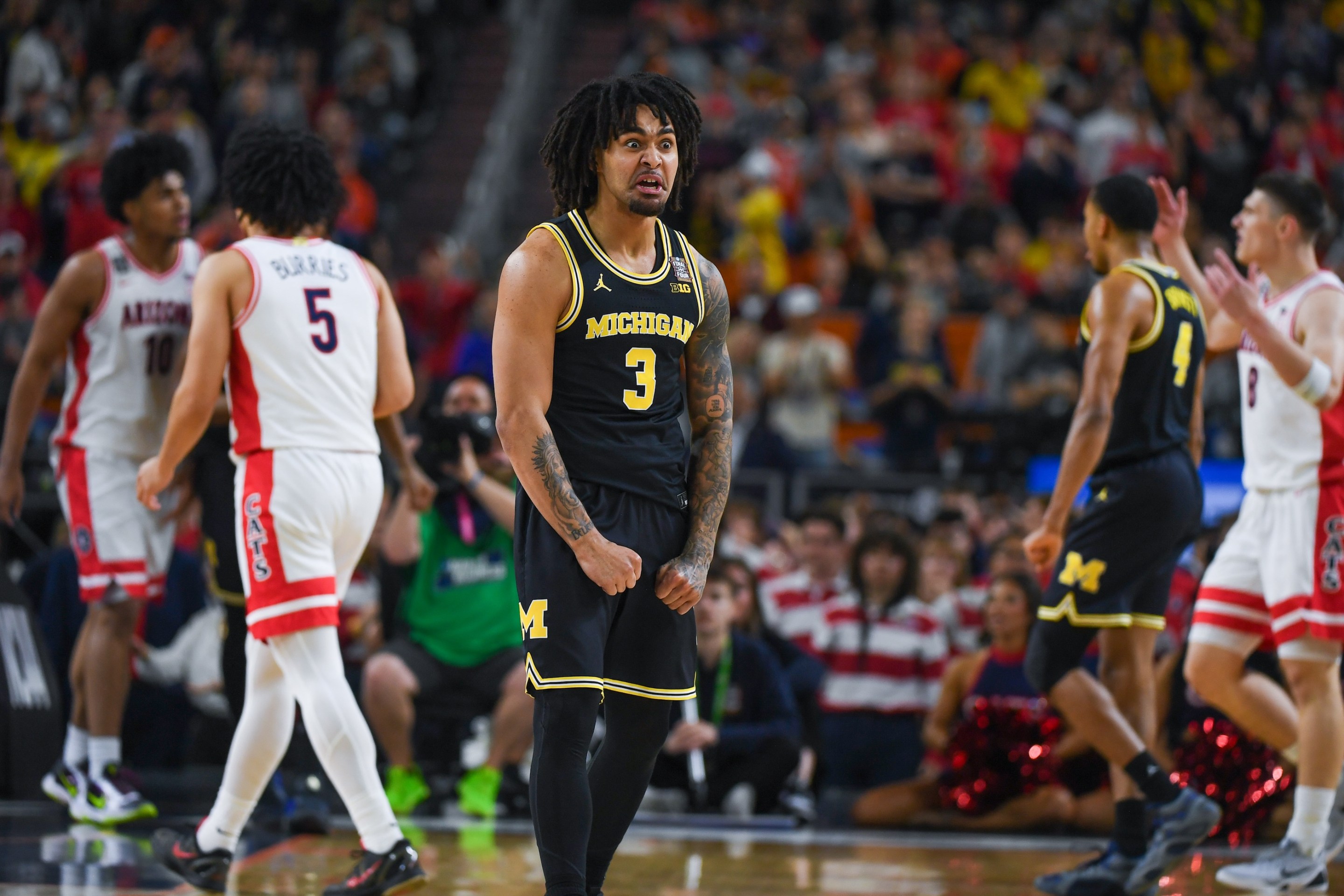
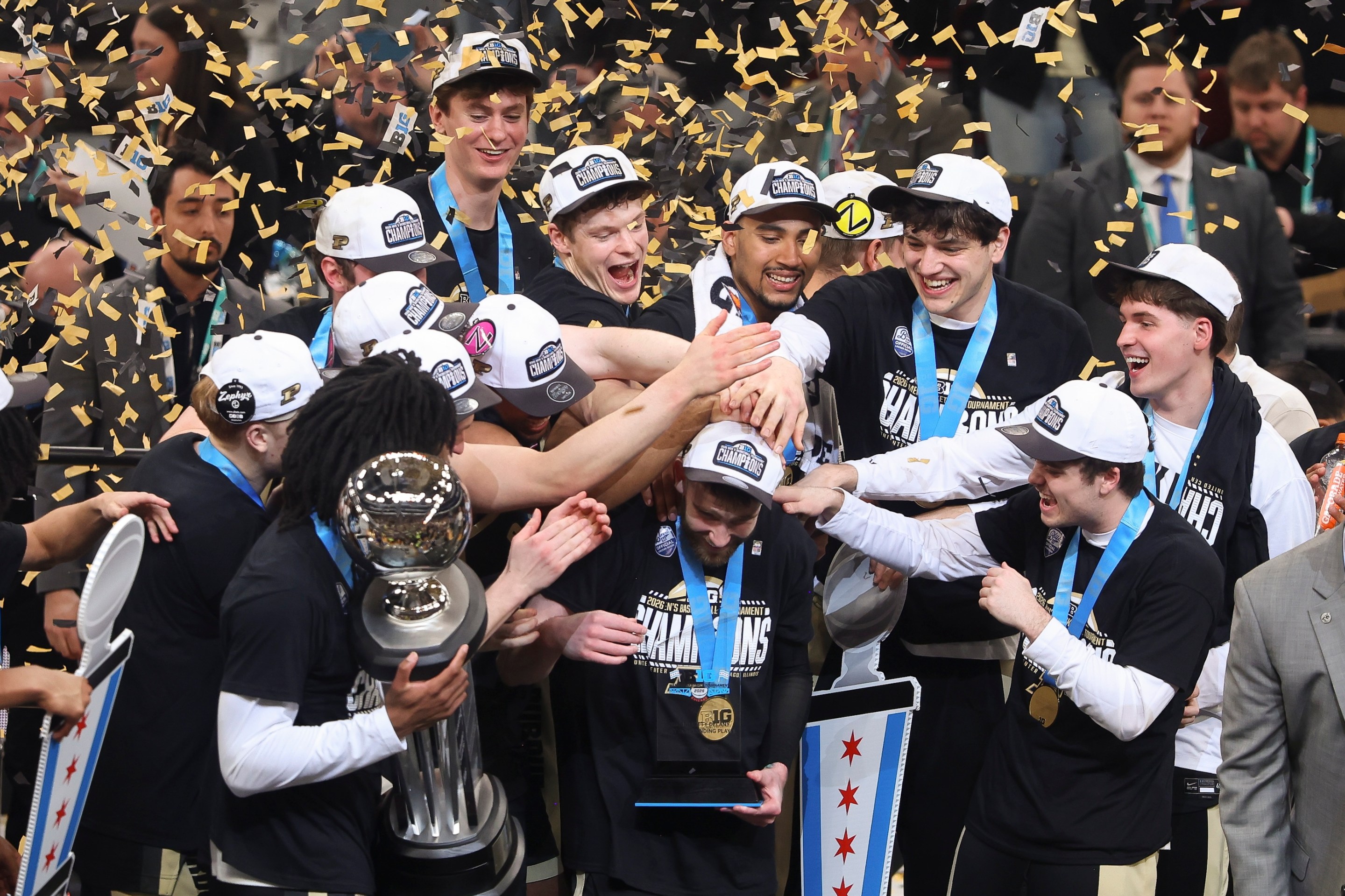
But then Purdue got on a roll in the Big Ten tournament, culminating its title run by beating mighty Michigan. That also avenged an earlier 11-point loss to the Wolverines, a game in which Michigan made an astonishing 57 percent of their 23 three-point attempts, which happened to be Michigan’s second-best shooting performance of the year. In the Big Ten title game, Michigan went just 7-for-24, showing that Purdue can hang with the best teams in the field when their opponent shoots a merely normal percentage from deep. Purdue also managed to post 1.27 points per possession against the nation’s top-rated defense in that game, which was the highest figure allowed by Michigan all season.
Still, I wouldn’t go so far to say that Purdue is a sleeping defensive giant. They don’t have Jahlil Okafor in the middle, but they do have Oscar Cluff, a 6-11 Aussie by way of South Dakota State. Like Okafor, Cluff does not provide rim protection. (He is a tremendously effective offensive rebounder, however.) That’s perhaps part of the reason why Purdue has allowed opponents to make 53.1 percent of their two-point attempts, which ranks 62nd among the 68 tournament teams.
Cluff might not be a total stiff, though. The average two-point attempt distance for Purdue’s opponents has been 7.1 feet this season, which ranks 10th nationally. That’s in line with Purdue’s Zach Edey-era defenses. Oscar Cluff is not secretly Zach Edey—although Cluff’s backup is 7-foot-3 Daniel Jacobsen, who actually does block some shots—but two-point attempt distance tends to predict future two-point percentage. So there's some reason to expect Purdue to overachieve their season-long two-point defense numbers in the tournament.
If I really wanted to stretch my case, I’d point out that Purdue has the most experienced backcourt in the game with Braden Smith and Fletcher Loyer, two seniors that have spent their entire college lives at Purdue. Or that Purdue has the second-best roster continuity in the field. Those are both true things, and nice, but I doubt there’s anything particularly special about either when it comes to predicting tournament success.
We don’t have to go that far, though. The case is simply that, in modern times, college basketball outcomes are dictated by the offense more often than not, and Purdue’s offense is of a title-winning quality. Their defense needs to deliver better results, but some of the Boilermakers’ problems on that end have been due to things that are (mostly) out of their control. The top seeds this year are as dominant as ever, but if a team from outside that cohort is going to crash the party, it would be one with a profile like Purdue’s.