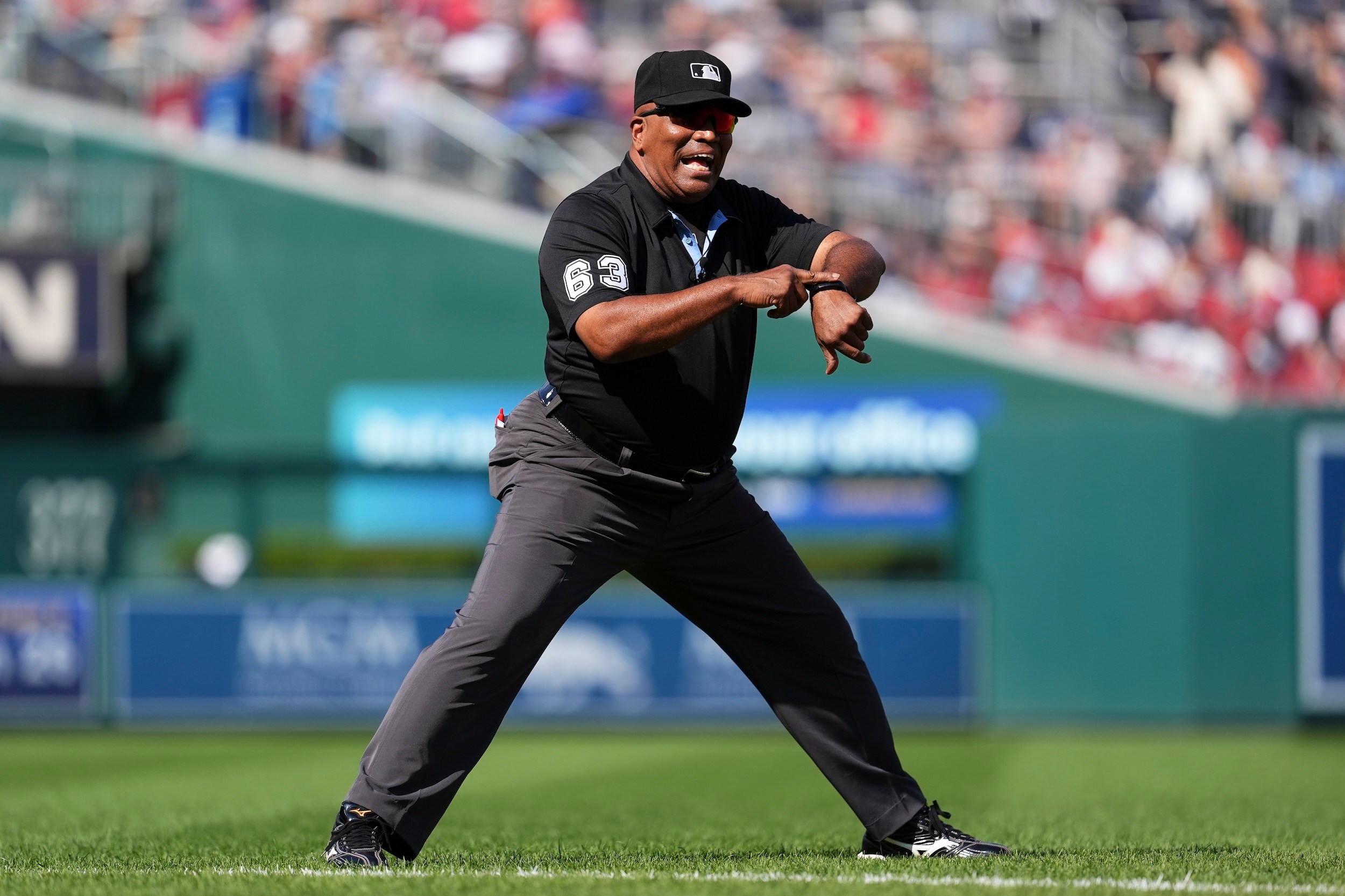
Laz Díaz has had enough of baseball. The veteran umpire will wrap up a three-decade career this week, will hang up the mask and the chest protector, and will bid good riddance to the sport. Major League Baseball offered buyouts to umpires earlier this season, and seven veterans, including Díaz and the dreaded C.B. Bucknor, raised their hands. Bucknor is already missing from the sport, having absorbed a deflected Jacob Misiorowski heater with his facemask back in May, and has not returned since. Díaz, meanwhile, has had the summer to make a farewell tour and reflect on his time in the game. His conclusion, per an interview with Bob Nightengale of USA Today: Baseball stinks now. Díaz will not miss it.
"There’s just so much scrutiny and negative stuff now," Díaz said. "There are a lot of people I’m going to miss, and I made a lot of friends, but what I won’t miss is the game. Not one bit. It’s just changed so much. There’s so much more technical stuff. It’s kind of restricted us. I mean, everything is black and white now. You can’t manage the game."
The not-fond farewell will largely be mutual, at least among the baseball-watching public. In any given era, casual fans might know the names and faces of just a handful of umpires, and never for any happy reason. Díaz is a known guy, and not only because he was the subject of the most theatrical of Aaron Boone's many, many meltdowns. He is not especially pugnacious or hot-headed, but his strike zone is subject to mood and influence. The adoption, in television broadcasts, of K-Zone technology has allowed the tracking and posting of umpire performance for decades now. Whether those efforts are reliable, they are influential, and for years they have said that Díaz has his own interpretive strike zone, which tends to be elastic and pitcher-friendly. The website Ump Scorecards says that Díaz is maybe not a Bucknor-level disaster back there, but that he tends to miss a lot: This season, for instance, Ump Scorecards says Díaz is worst in baseball in the cumulative Correct Calls Above Exp., which they describe as the difference "between actual correct calls and expected correct calls."
I don't think Díaz is talking about this one website when he says to Nightengale that baseball has gotten "nasty" and that there is too much "scrutiny and negative stuff" for the job to be enjoyable. Umpire scrutiny is as old as the game itself, and in some respects the job has almost certainly gotten easier. Hostile brushbacks, retaliatory beanballs, take-out slides, and catcher collisions are all but extinct from the modern game, and thus as far as viewers can tell umpires have much less responsibility nowadays to manage the unwritten parts of the game. Just 10 years ago Tom Hallion had to use his face as a spit shield in the management of a volcanic Terry Collins, in an incident that without leaked audio would've gone down as just a normal day at the office, the likes of which is all but gone from the modern sport. I don't have a stat for this, but my sense is that ejections are at least flat, if not trending gently downward: Per Baseball Reference, MLB has not had a manager hit double-digits in ejections since Bobby Cox did it back in 2007.
On the other hand, dugout challenges and the ABS system have sort of finished what was begun by the spread of ultra-slow-motion replays and killed off what was not very long ago understood and largely accepted as the human element of umpiring a baseball game. If I am sort of rankled by the evident entitlement of a bozo like Díaz imposing an interpretive shape on a given contest, I should probably remind myself more often that for more than a century the strike zone was, both by practical necessity and by popular understanding, subject to manipulation. And I will admit, too, that the K-Zone has had an insidious effect on my own ability to gather and incorporate nuance into my baseball-watching experiences. Every once in a while, the MLB TV broadcast will randomly and inexplicably drop the K-Zone for a couple of pitches, and I am disheartened to discover that I now basically lack all ability to tell for myself a ball from a strike.
When Greg Maddux or Pedro Martínez would use pinpoint command to cleverly chisel a widened zone, they were working their craft on opposing hitters, and the home umpire, and the viewer, all at the same time. Watch a Pedro highlight clip on YouTube and you will see called third strikes that look absurd out of context, and swinging strikes that make the batter seem insane. I assure you, in the moment, the umpire and the hitter and most of the savvier viewers got it. The K-Zone graphic, with its dimensionally correct but inflexible zone, gives the television audience something the other parties lack, a piece of information that might just make them slightly dumber viewers of the sport they're watching, insofar as subtlety and manipulation are still coherent parts of the actual game. The ABS challenge system gives formal preference to the viewer's comprehension of the zone. For better or worse, it introduces a new kind of derision when a pitcher nibbles a couple extra inches onto the corners; it juices up and adds a kind of weird moral edge to the concept of "chase," and turns seduced umpires into incompetent unemployable losers.
I'm not saying that all or any of this is bad, only that it's a big change from the sport that Díaz entered back in 1995. Maybe I'm being generous, but I think that might be what Díaz is getting at when he talks about not being able to manage the game: that there is a growing disconnect between the game as it is being played and the way that it now must be called. Players are still chiseling away at the zone, tugging its edges back and forth. Pitchers still nibble for an extra inch off the plate; hitters still exaggeratedly dodge front-door sliders that nick the inside corner; catchers still frame up anything that comes within a generous double-handbreadth of the zone. Umpires were never supposed to be seduced by any of this stuff, but of course they were, and for most of baseball's history and at least half of Díaz's career that was an acknowledged and accepted part of the sport. Now it is illuminated by a floating television graphic, tracked by sophisticated cameras, measured, collated, and widely distributed by savvy observers, dished by even the very most clueless fans, and referenced by players and managers.
God help me, I have written a defense of Laz Díaz. I will not miss Laz Díaz! When he talks about not being able to manage the game anymore and not getting any recognition, the very first words that jump into my mind are the sorts of thing that would get me deservedly punched in the face. The fact is, I do not want Laz Díaz managing a baseball game that I am watching. He, Bucknor, Hunter Wendelstedt, and Ángel Hernández can go to hell. Therein lies the rub: I sense that something is being lost when replays, the K-Zone, and ABS challenges combine to take umpire management all the way out of professional baseball, but I am absolutely opposed to professional baseball being managed by bozos who stink at it. You think that you want umpires back there whose names you don't know because they never miss, until tech types give you nameless robot umpires who cannot miss, and it turns out the game you're watching is not quite the one being played, and that forcing the game to be played according to the rules of the watcher strips away from the players something artful and nuanced. It's a puzzle.
Here, so that we can all get back on the same page about Laz Díaz, is more of what he said to Nightengale:
"You used to look at the scoreboard, and you’d see a player’s batting average, home runs, RBI and stolen bases. Now, you look up, there’s all kinds of stats up there, exit velocity, launch angle, on-base percentage, OPS. You can’t find anything because it’s all a percentage."
Laz Díaz, per USA Today
Get lost, bozo!