

Even with all the testing data from the minor leagues and spring training, it was hard not to wonder how MLB’s new automated ball-strike challenge system would feel in big league games that count. When would teams use their challenges? Who would use them? How often? Might we see a hotheaded pitcher go rogue, burning his team’s precious challenge in a fit of rage?
The potential entertainment value of ABS, though, was something I didn’t question. For one thing, it ends up being a rather tidy rule change. Unlike, say, basketball reviews that have refs clustered at the monitors for eons, an ABS challenge is resolved in something like 15 seconds max. (MLB’s study of the challenge system in spring training last year showed that it added only about a minute to the average game.) Tennis fans can also attest to the great spectacle that was the old Hawk-Eye challenge system, the crowd slow-clapping in unison as they waited for the animated tennis ball to streak across the rendering on the scoreboard and deliver the result.
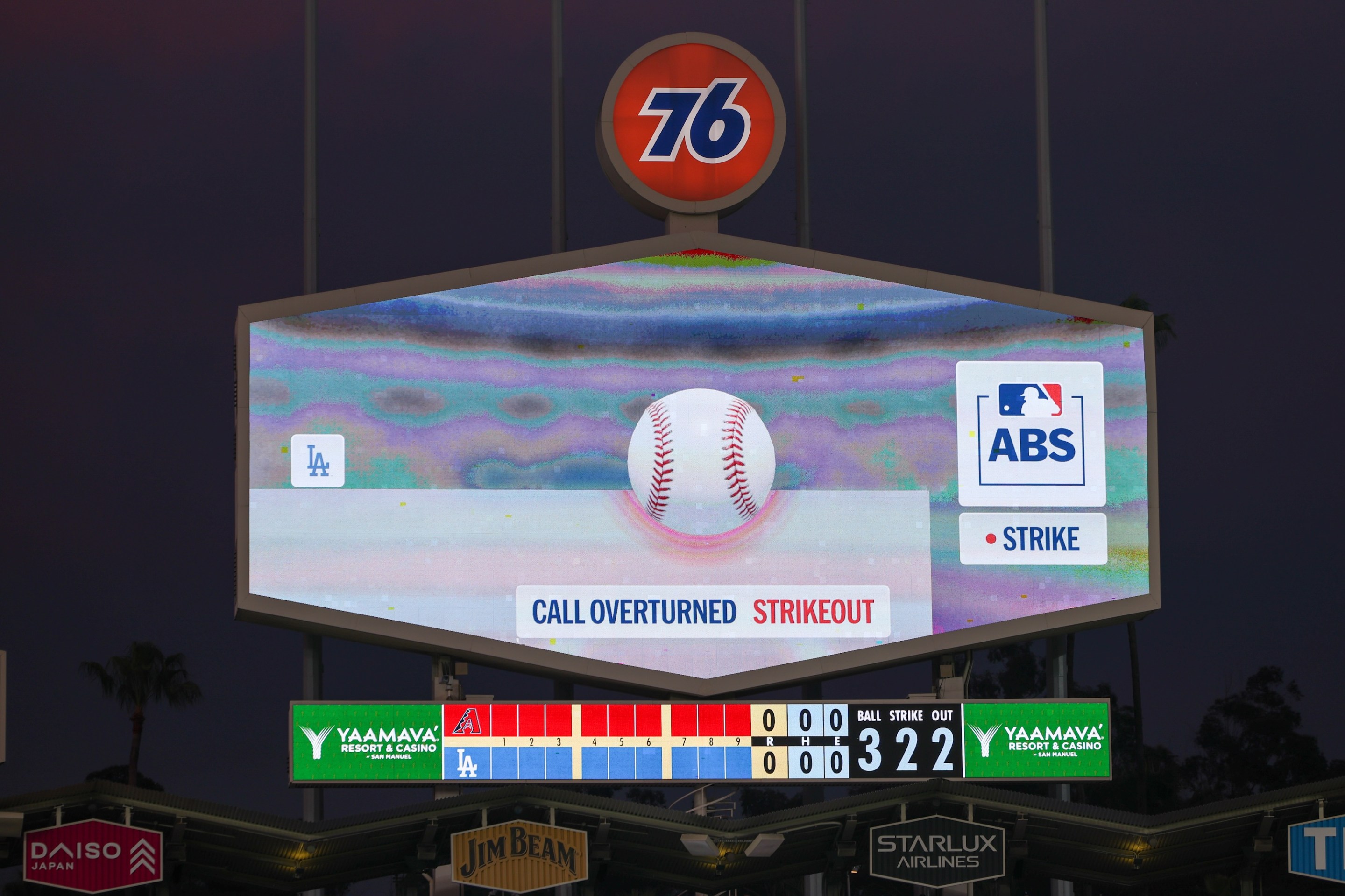
The slow clap hasn’t caught on yet in America’s ballparks, but the crowd is still having some fun with this new addition to the game. Under the ABS challenge system, a team begins each game with two challenges. If a player gets an umpire’s call overturned, their team retains the challenge. In effect, this means a team has unlimited challenges until they get two wrong. So a team on a challenging heater can really show up an umpire who’s off his game. C.B. Bucknor, one of MLB’s longest-tenured umps and one of its least accurate, found this out for himself behind home plate in the sixth inning of Saturday’s altogether weird Red Sox-Reds game, when Eugenio Suárez successfully challenged his way out of two would-be third strikes on back-to-back pitches.
"The loudest cheers of the game—the Reds have hit two homers—come on back-to-back challenges!" a delighted John Sadak bellowed on the Reds TV broadcast.
This power shift could go two ways. Maybe umps should accept public humbling in exchange for a new kind of blamelessness. If an umpire makes an incorrect call, it’s in the wronged team’s power to correct it. And if it no longer is in the wronged team’s power to correct it—that is, if they’ve burned all their challenges—well, skill issue. Now that’s just their own fault. In Triple-A in 2025, almost exactly 50 percent of challenged calls were overturned, which sounds high, but ends up reflecting kind of favorably on today’s umps: Half the time players think they’ve been wronged, they’re actually the wrong ones.
In Saturday’s game, the two teams combined to challenge eight of Bucknor’s calls, the Reds going a perfect five-for-five on theirs and the Red Sox winning one but losing two before the third inning ended. A few were bigger misses, but the first pitch Suárez challenged, for instance, wasn’t egregious. Lest we celebrate the end of the tyrant-umpire, remember that ABS can’t un-eject managers or reverse checked swing calls. (Or at least can’t reverse them yet.) In the top of the eighth, Red Sox manager Alex Cora was tossed for arguing with Bucknor after he rung up Trevor Story without appealing to the third-base ump.
There’s a reason why the tennis slow-clap is no longer. If we’re to accept that human umpiring mistakes can easily be corrected, and that they should be, it figures that we could also just skip the human error part and let ABS do all the work. MLB says that its tests of both the challenge system and full ABS in the minor leagues "revealed a clear preference among fans, players, managers, and other personnel" for this weird in-between.
In the meantime, we can have fun. True losers know the unmatched pleasure of seeing a bright red “NEW” banner advertising a just-released feature on Baseball Savant, and it has been this loser’s delight to poke around the new ABS dashboard, where there are leaderboards, tables, and situational breakdowns galore. (There’s also a rolling trendline, which might be interesting to follow as teams get savvier about their challenge use.) So far the numbers track with MLB’s testing at other levels, which found that batters tend to fare worse than fielders when they challenge pitches. Through Sunday’s games, challenges requested by catchers and pitchers had an overturn rate of 63 percent on 97 attempts, while batters had calls overturned on 42 percent of their 78 challenge attempts.
As for the rogue pitcher rage-challenge possibility, things are actually looking pretty good. In spring training, the Milwaukee Brewers experimented with taping a green index card to the dugout railing, like a "green light" sign to players that the situation was OK to use a challenge. They were shut down pretty quickly by MLB. The rules say a player can’t consult with the dugout or with any other players, and that they have about two seconds to request a challenge, so every challenger is making a spur-of-the-moment decision entirely on his own. From the numbers, it’s clear that teams have decided catchers should be the only fielders to request challenges. But through Sunday’s games, a brave five pitchers had tapped their heads. Thanks to lefty reliever Hogan Harris of the A's and closer Ryan Helsley of the Orioles, these five guys had combined to win two.
Helsley's, a challenge that turned a ninth-inning walk to Josh Bell into a second out against the Twins on Sunday, came with some drama. Twins manager Derek Shelton was furious with the umps—he thought Helsley hadn't signaled his challenge request quickly enough—and got tossed. “He’s arguing with the robots!” Orioles play-by-play guy Kevin Brown cried. “You can’t defeat the robots!”