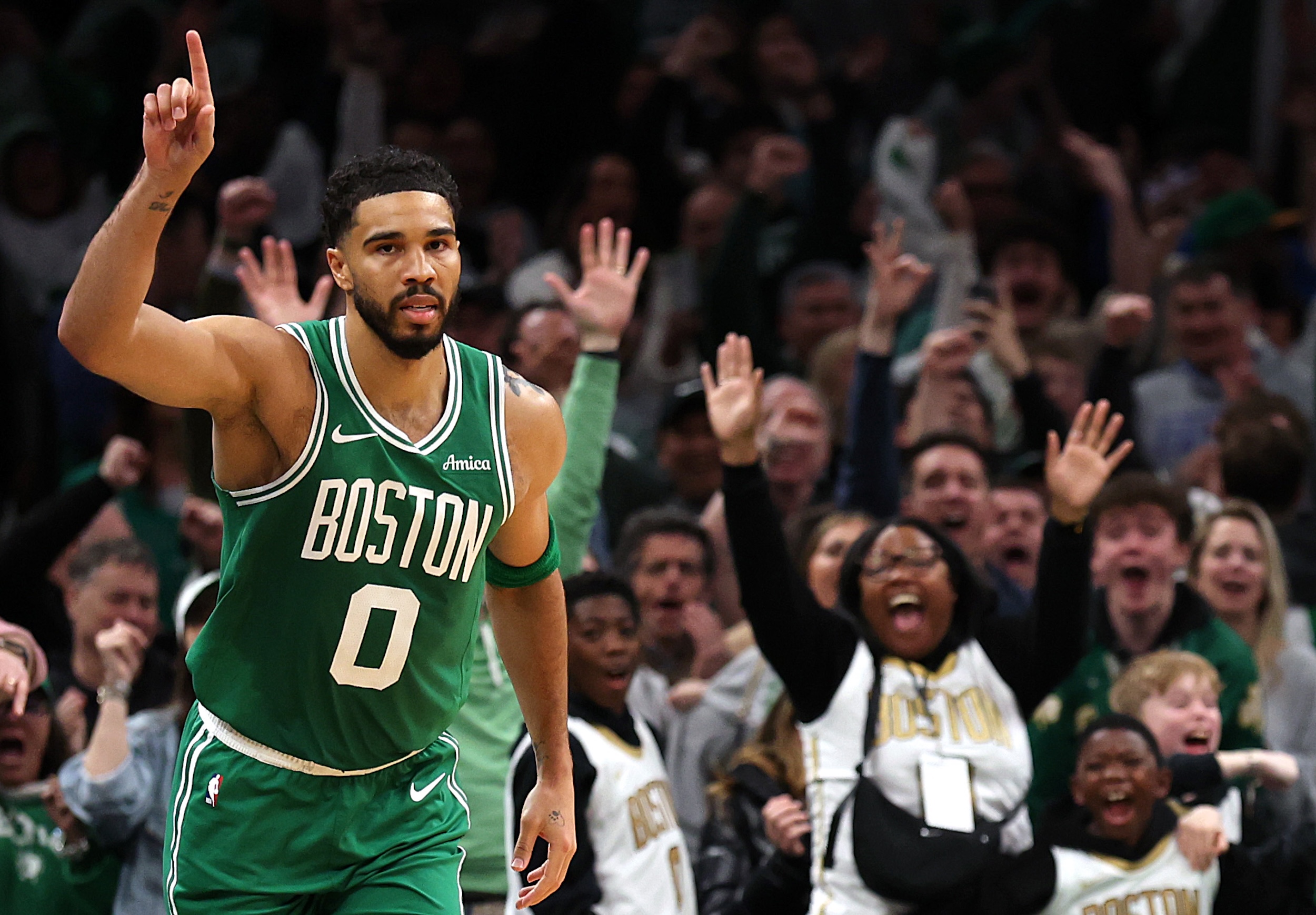
Jayson Tatum played his second game of the season Sunday, after having set what seems like an all-time record for the fastest recovery from a ruptured Achilles tendon. Tatum made his debut Friday at home against the Dallas Mavericks, 298 days from his last appearance, and was somewhat wobbly, but fine; Sunday, on the road against the playoff-bound Cleveland Cavaliers, Tatum looked more confident against a much tougher opponent. In both cases, he was one happy guy, grinning and high-fiving, accepting the congratulations of teammates, opponents, fans, really anyone who crossed his path. "I can't stress it enough," an obviously delighted Tatum said after Sunday's victory. "I'm just happy to be out here, playing on a team with the guys, competing, making plays, making mistakes, you know, just happy to be out here."
Whatever Tatum imagined about his own recovery, back in the miserable aftermath of the injury, he certainly did not expect to be joining a Celtics team actively contending for the top seed in the Eastern Conference. Not only because Boston would be missing his own services: The Celtics dismantled their roster last summer, shipping out three of their top five players by games started and four of their top nine by total minutes, in addition to the loss of Tatum. Anyone might reasonably have expected this season to be devoted to an entirely forgivable tanking operation. Instead, Joe Mazzulla has hit upon a perfectly respectable rotation, Jaylen Brown has emerged as a frontrunner for MVP, and the Celtics are just a couple games back of the sagging Detroit Pistons in an otherwise not-super-impressive conference. Tatum isn't easing back into the relaxed home-stretch of a one-year retooling project; he's dropping into a starter's role in the early crescendo of a title hunt.
There will be pressure with that, which Tatum is sure to feel once the excitement of simply playing basketball in a Celtics uniform wears off a little. In the meantime, his return is all gravy, a terrific gust of good feelings for everyone involved. For as long as he is upright, Tatum is doing more than bolstering Boston's depth: He's rewriting what it means for an in-his-prime NBA player to suffer what has long been considered one of the worst possible basketball injuries.
When Kevin Durant ruptured his Achilles tendon on June 2, 2019, he was pretty sure his career had just ended. Doctors and specialists were administering a test in the visitors locker room in Toronto, and were ashen-faced and silent, and Durant didn't need them to tell him that his tendon was snapped. He figured that was that: In everyone's mind, back then, was the vivid image of a severely diminished Kobe Bryant, who—however his fans might prefer to remember it—was one of the NBA's worst players for the final 107 games of his career, following a lengthy recovery from his own Achilles rupture. An Achilles injury was thought of as a doomsday event for a basketball player.
"That's what I was thinking," Durant told ESPN's Baxter Holmes in 2024, "because that's all I was hearing, that this shit is over."
An Achilles tendon has the same properties as other tendons. The process of recovery is not magic. They go in there surgically and knit the fucker back together, and then it has to heal, and then it has to be strengthened carefully until it can behave more or less like a normal tendon. Bryant, whom Jayson Tatum idolized and after whose game his own is closely modeled, ruptured his Achilles tendon in April of 2013, and by November of that same year, he was practicing with teammates after having doused the reconstructed ligament with platelet-rich plasma. By his own assessment, all that was left was cardiovascular conditioning. "If there was a playoff game tonight, I'd play," Bryant insisted, just seven months removed from surgery. "I don't know how effective I would be but I would play."
There's the rub. Bryant was back on the court for a by-God regular-season basketball game before Christmas, but he fractured his tibia after six games, after then-Lakers coach Mike D'Antoni gave Bryant starter's minutes four times in five nights in just his second week of action. The Achilles tear is the one that gets cited as Bryant's downfall, and that looms monstrously in the imaginations of basketball players. Right or wrong, I'm going to be thinking about that when I watch Tatum play basketball on a freshly reconstructed tendon, how Tatum's basketball idol came back from an Achilles tear in just eight months, and was never the same.
In any case, Durant has long proved that a basketball player can still kick everyone's ass after that awful pop, provided that the body is given all the time it needs for recovery. Durant didn't compete seriously for 552 days, sitting out the entire 2019–20 season. Even then, Durant told Holmes he wasn't sure until the conclusion of the second round of the 2021 playoffs that he'd ever really be himself again. By the time he felt fully recovered, more than two years had passed. Durant played 75 games in the 2022–23 season, and this year, in his age-37 season, he has missed just three games for the Rockets.
Because Durant has always been a freak, it's hard to know whether other NBA players can achieve his same level of post-rupture success. He and Tatum have in common that they both had surgery immediately, and they have in common that people use words like "attack" to describe their approaches to the dismal work of post-surgery rehabilitation. There, their approaches deviate: Durant decided early that he would sit out a year; Tatum seems to have committed himself from the outset to the fastest possible return. Other players are taking the Durant route: Tyrese Haliburton, even before his bout of shingles, appeared resigned from the beginning to at least a full season on the shelf; Damian Lillard, who ruptured his Achilles tendon just about two weeks prior to Tatum's injury, has made no noise whatsoever about returning this season, despite his plucky Trail Blazers holding down a spot in the Western Conference play-in and despite being well enough to compete in the NBA's three-point contest in February.
I'm very happy for Tatum, even as a true Celtics hater. I'm also cautiously optimistic that advances in treatment and recovery have genuinely improved the basketball outlook for sufferers of this particular injury. It's cool to think of a future where an Achilles rupture isn't the catastrophe it's long been considered. On the other hand, I will for sure be thinking about how there's the fastest recovery, and then there's the best recovery, and how history suggests those take different, and maybe even opposing, routes. What happens next for Tatum is going to look like proof of something, one way or another.