

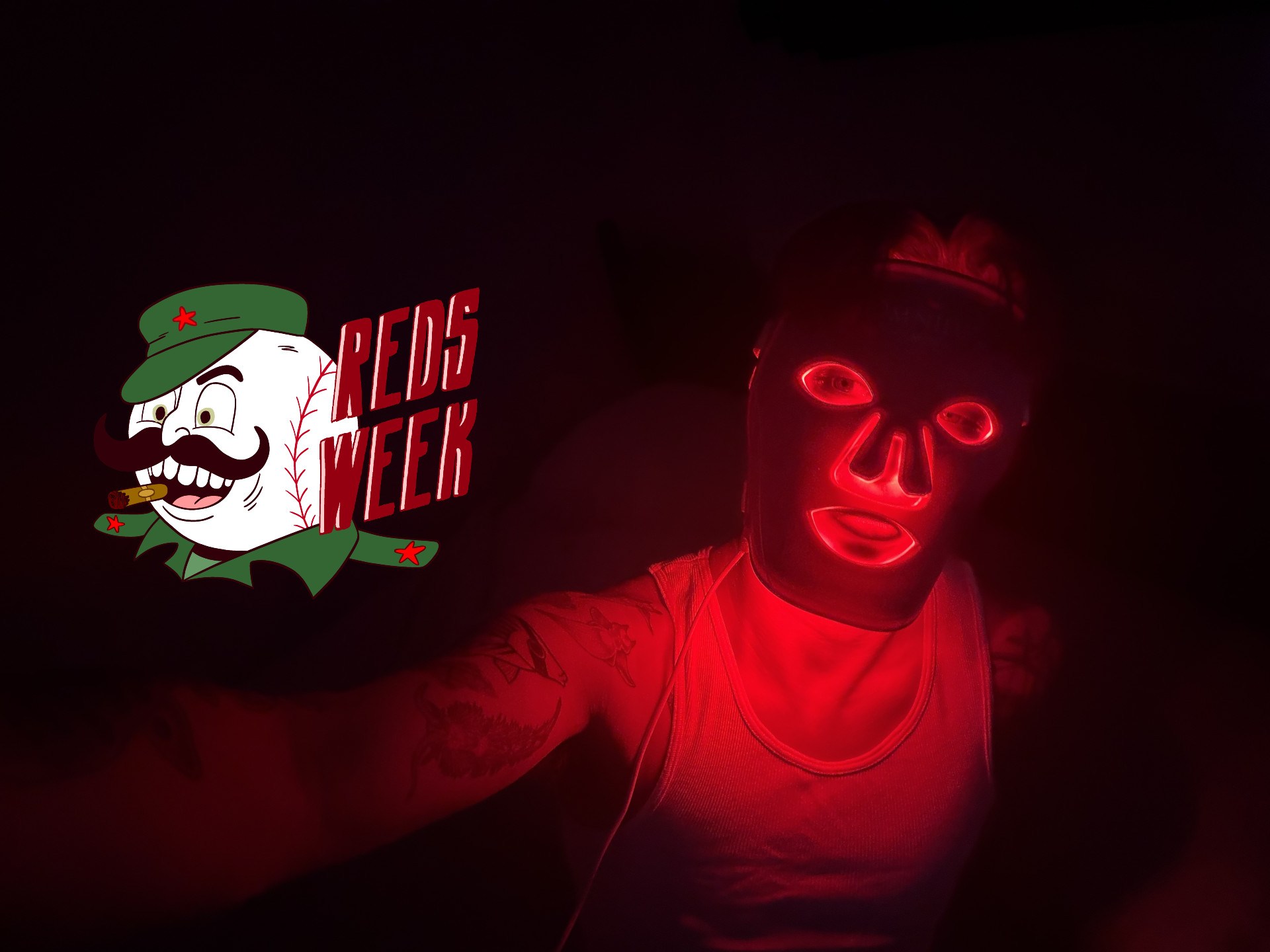
As with some of my best decisions in life, I bought a red light mask because Kelsey McKinney uses one. I saw Kelsey posting Instagram stories with her face illuminated under the mask's sinister, Sith-like glow. I was newly 30, albeit not especially flirty or thriving, and I wondered if the red light mask might be a good salve for my anxious vanity. Like many others, I want to grow old but still look young—sue me! Every morning I dutifully smear sunscreen on my face, and every night I apply my cocktail of arbitrarily chosen unguents. But if there was something else I could be doing more to stave off spots and wrinkles, I wanted to give it a try.
Now that I've had my red light mask for a year, I see that it works, I think? My skin looks good, perhaps even better than it would without the mask. But I sometimes wonder if this is all in my head. Have I convinced myself that red light works simply because I want it to? Every time I put on my mask, strapping my face under its white silhouette like Tom Cruise in Vanilla Sky, I find myself discombobulated, also like Tom Cruise in Vanilla Sky. The logic feels crazy. I understand that light has the power to burn my skin. But the power to preserve it? This wager feels far more fantastical.
Even scientists seemed to agree. In one 1989 paper, the biophysicist Tiina Karu, who studied the cellular mechanics of red light exposure, called the therapy "highly incredible and even mysterious." When I tried to learn about the science behind red light's dermatological dazzle, what I found were mostly affiliate-driven product recommendations, which taught me more about the luxuries of various masks but less about the science behind them. So I reached out to some actual dermatologists to see if they could unmask the secrets of my mask. Here is some of what I learned.
Who invented red light therapy?
I did not actually ask any of the dermatologists this question, because I was able to sleuth some of this out on my own. Red light therapy is just one arm of light therapy, which has been around for thousands of years. The Ebers Papyrus, which dates back to 1550 BCE, recorded treatments in which people applied plant extracts to patches of vitiligo and then exposed their skin to sunlight. Light therapy evolved as scientists learned more about light itself, such as when Isaac Newton split a beam of light through a prism into the seven-color spectrum known as ROYGBIV. In the 19th century, sun-drenched sanatoria reigned supreme as treatments for tuberculosis.
But the field of modern light therapy emerged with the Danish physician Niels Ryberg Finsen. When Finsen received the Nobel Prize for treating lupus vulgaris, a disfiguring tuberculosis infection of the skin, with concentrated light radiation, light therapy cemented its place in evidence-based science. And the technology behind red light therapy was accidentally invented in 1967 by the Hungarian physician Endre Mester. Mester was attempting to replicate an experiment by the American Paul McGuff, who was using a newly invented ruby laser to destroy cancerous tumors implanted in rats. Unfortunately for Mester’s malignant rats, his DIY ruby laser was far weaker. But even though its red light failed to blitz the tumor, it did rapidly heal the rat's wound around the implantation site, as well as cause a flurry of hair growth. This technology, first called low-level laser therapy (LLLT) and now known as photobiomodulation, is what underlies red light therapy.
Scientists soon discovered that photobiomodulation did not require coherent monochromatic lasers such as the ruby laser, meaning lasers that emit a single, highly specific wavelength, to have biological effects. They found light-emitting diodes, or LEDs, could perform photobiomodulation equally well. But the technology was still new, little-understood, and therefore suspect among many researchers. "Only about ten years ago the general consensus was that LLLT was 'snake oil' and only practiced by charlatans," the dermatologist Michael R. Hamblin wrote in a 2016 paper in the Journal of Biophotonics. But the more that scientists such as Tiina Karu published on the mechanics of red light therapy, meaning how exposure to red light can affect an organism on a cellular level, the more credible red light therapy became in the eyes of scientists.
When I put on a red light mask, what is it doing to my skin?
Red light refers to photons with a wavelength between 600 to 700 nanometers and targets your skin on a cellular level. "Red and near-infrared light penetrate the skin and are absorbed by molecules within cells," Michelle Pavlis, a dermatologist at Duke University, wrote in an email. When red light is absorbed by mitochondria, the "batteries" that power your cells, it accelerates the energy those mitochondria are able to produce, which is then used to power cellular function. Red light can also alter cellular signaling pathways involved in inflammation, cell growth, and tissue repair. "In the skin, these effects can influence cells such as fibroblasts and keratinocytes, which may promote collagen remodeling and wound healing and help regulate inflammation," Pavlis said.
Why red light specifically? What about blue light?
"Different wavelengths penetrate tissue differently and therefore interact with different biological targets," Julia Stolyar, a research fellow at SUNY Downstate, wrote in an email. Red light can penetrate tissues more deeply than light with shorter visible wavelengths, such as blue and green light, and it can trigger photobiomodulation without inducing DNA damage associated with ultraviolet radiation.
Blue light, which refers to photons with wavelengths between 400 and 500 nanometers, offers different benefits. The light is absorbed more superficially, only reaching depths of around 1 millimeter under the skin, Stoylar said. But the light has antibacterial properties, which can be useful in treating acne. Specifically, the blue light can damage the Cutibacterium bacteria that live on human skin and cause acne, she added.
OK, so red light is powering up my cells. Does this make my skin better in every way?
In some ways, certainly. In other ways, the evidence is still unclear. In 2025, Pavlis and colleagues published a review of the known and unknown benefits of red-light LED therapy in dermatology. Pavlis wanted to address the wide range of claims about what red light can and can't do, as the at-home masks have become increasingly popular and marketed for acne and anti-aging. "We wanted to step back and examine the clinical literature and ask: Where is there evidence of benefit? Where is the evidence preliminary?" Pavlis said. "And where might consumer enthusiasm or marketing have gotten ahead of the science?"
Pavlis's review found the most clinical evidence in support of red light as a therapy for acne, although the studies all took different approaches to treatment protocol. For claims of anti-aging and skin rejuvenation, however, the evidence is less consistent. Some papers showed improvements in wrinkles and photoaging, which is early aging induced by exposure to the ultraviolet light of the sun and tanning beds. But other papers showed little objective improvement.
What do red light masks definitively not do?
Unsurprisingly, it's not a panacea. Pavlis found papers investigating the effects of red light therapy on psoriasis, eczema, rosacea, and some inflammatory skin conditions had limited or mixed results. "We also found that the evidence for cosmetic uses such as reducing wrinkles and other signs of skin aging was less consistent than many advertised claims," Pavlis said. "I wouldn't say that red light has been proven not to work for these conditions, but there isn't strong evidence to support many of the broader claims being made."
But an absence of strong evidence of benefit "cannot be interpreted as proof of treatment failure," Jared Jagdeo, a dermatologist and director of the Center for Photomedicine at SUNY Downstate Medical Center, wrote in an email. Jagdeo added that research on red light therapy is ever evolving—on a variety of dermatologic conditions including alopecia, rhytids, photoaging, psoriasis, wound healing, hyperpigmentation, skin fibrosis, and photodamage—and new potential uses of red light therapy might be discovered.
Most importantly, Pavlis cautioned that at-home LED masks should not be used to treat a new, changing, or concerning skin lesion, or as a substitute for an appointment with your dermatologist.
So my red light mask is probably improving my acne and might be improving my wrinkles, but perhaps not to the extent that the company that makes my red light mask claims.
Exactly. But is that at all surprising to you?
How do I know which red light mask to buy?
Even if you read every paper published on red light therapy, there would be no guarantee that your red light mask would produce the same results, good or bad. "These devices are not standardized," Pavlis said. Red light masks don't just vary in shape, softness, or strap style—they can vary in wavelength, intensity, total light dose, and treatment time, all of which can produce a different result. "Even two devices that are marketed as red light therapy can deliver very different treatments," Jagdeo said.
In such a flooded market, Pavlis recommends choosing a reputable device that is cleared by the FDA for the intended use. And she recommends following the manufacturer's instructions. "More frequent or longer treatments are not necessarily better, since the effects depend on the dose delivered," she said.
To give your at-home red light mask the best chance at working, use the device consistently. "The biological effects of photobiomodulation accumulate through repeated exposure," Jagdeo said. Following the manufacturer's recommended treatment schedule is far more important than using the device sporadically.
"I think red-light therapy is a good example of a technology where the underlying biology is real, but consumer claims can extend beyond the evidence," Pavlis said. To Pavlis, the question is not if red light works, but rather: "What wavelength and dose work, for which condition, using which device, and in which patients?"
Is my red light mask a substitute for sunscreen?
Obviously not! That's a stupid question and you know it. Sunscreen is more effective at reducing signs of aging, and if you are not putting sunscreen on your face every day, you need not worry yourself with buying a red-light mask.
If the evidence is still unclear around the anti-aging powers of my red light mask, should I keep using it, especially considering how much it scares my cat?
It seems clear that bathing your face in the magmatic glow of an OmniLux Men Light Therapy Mask (finally, a red light mask for "Men's skin"!) will not drastically change your face for better or for worse. But your experience of a red light mask is also valuable evidence. If you believe it makes your skin look better—as I have come to—is this not a form of skincare? Having more confidence in your face and all its wrinkles, even those dubiously diminished, just gives you a different kind of glow.