

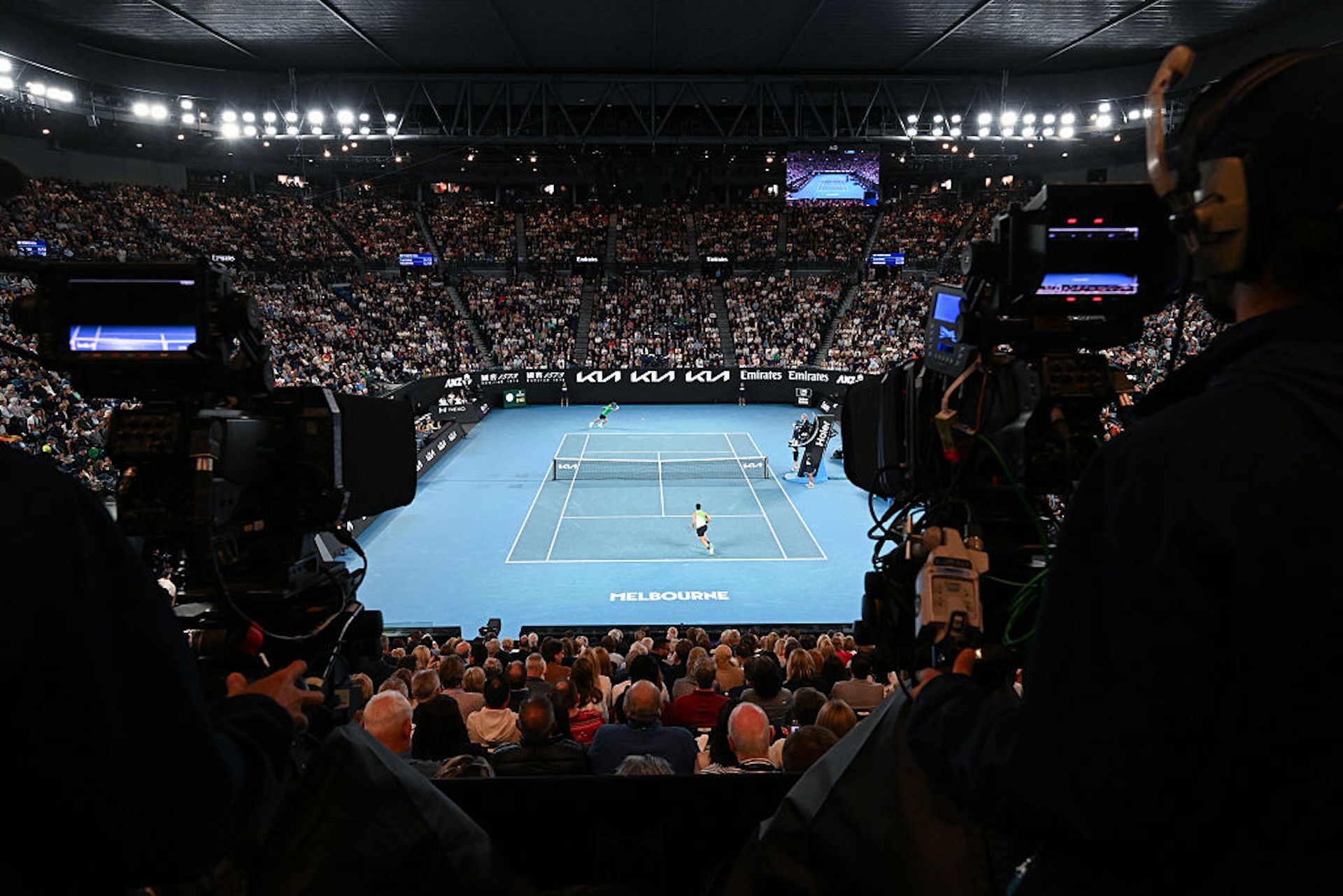
Before I went to Melbourne in January to cover the Australian Open for Defector and a couple other publications, I spent some time in New Zealand with my family. We lived there for five years when I was a child, and ever since we moved back to the United States, where I was born, it’s remained an idyllic place to return to. New Zealand also functions as a nice haven these days from winter in the United States both seasonally (it lasts about four months where I live) and politically (14 months and counting). Headlines about tariffs or Trump falling asleep in meetings land a little more softly from an ocean away. The distance can't cushion every blow, though. The news that the U.S. had ordered a military strike on Venezuela, killing more than 80 innocent people in the process, wouldn’t leave my head. When I read that the ICE agent Jonathan Ross had murdered Renee Nicole Good a few days later, I sat on my bed staring aimlessly at the wall for an hour, stewing in dread. I felt deeply embarrassed to go out to a cafe and order food with my American accent, like I needed to wear a sign reading I am from the United States, but I deeply hate what is going on there to assure baristas or cashiers that they weren't serving a cheerleader of this fucked-up regime.
Few journalists were asking American players about the state of their country at the Australian Open, which felt strange given the avalanche of awful news from it, before and during the tournament. The modern tennis professional, on average, weighs in on politics about as often and as deeply as a fourth grader. Still, when something is happening in the world, players tend to face questions about it. The WTA Finals have taken place in Riyadh, Saudi Arabia, the last two years and will again at the end of this season; the country's Public Investment Fund also gets a namedrop in both the ATP and WTA rankings. Though resistance to jumping in bed with a petrostate liberal in its censorship, sexism, and executions has largely faded, participants in the WTA Finals did talk about weighing the financial gain of the move against the moral pitfalls in 2024. Ukrainian, Russian, and Belarusian players have answered questions aplenty about Russia’s ongoing invasion of Ukraine, some Ukrainian players' decision not to shake hands with Russian and Belarusian players, the latter group's ban from Wimbledon in 2022, and the blank flag that's been put next to their names on scoreboards ever since.
After some encouragement from another journalist, I pitched a piece on how American players were feeling about their country to an editor for The Athletic, for whom I'd been doing some work during the tournament. I began asking players questions, and phrased them nervously and vaguely—it felt like a spined creature was clawing its way into my throat from my stomach as I asked them. My regret from the reporting is that I wasn't more direct. Still, I got a variety of responses from eight players that ranged from thoughtful, to specific, to uninterested, to nothing at all. I felt they were interesting for what they were, but also for what they weren't—I could see the outlines of an agent's helping hand in some answers, the fear of antagonizing a strain of fans in some others.
Along the way, fans and aggregator accounts clipped videos of my questions and the players' answers and circulated them online, presenting me as a target for a modest right-wing hate campaign. They identified the questions as being on behalf of The Athletic, and targeted that publication's writers on social media too. After I'd finished a draft and my editor—who was helpful and supportive throughout the process—had made some tweaks and passed it along to his superiors, it never ran.
Coco Gauff gave a typically thoughtful answer. Gauff is consistently outspoken on social issues; she made a six-figure donation to UNCF's scholarship fund for students at Historically Black Colleges and Universities during the tournament, and talked about it in the same press conference. She cited fatigue over talking about the state of the country, and the outsized burden she bears as a Black woman. That day, people clipped the question and ignited a controversy online: Some felt that Gauff was the only American asked political questions, and that it was indicative of racism. I'd planned to ask as many players as I could from the beginning, and did, so I figured the resulting piece would be its own response to the criticism and kept quiet. Still, it was a bit unnerving that so many were assuming the question was asked for the sake of a one-minute video soundbite, not an article in which multiple other voices would feature.
We have several parties to thank for this. A question about such a sensitive subject would of course be better asked in a one-on-one setting, but access in tennis has largely been obliterated with the rise of social media, player-run podcasts and YouTube channels, and in the aftermath of COVID. In my case, it also would have been difficult to make the time for eight separate sit-downs. It's not that there are no opportunities for freelance tennis writing, but in today's media environment, they pay such that you have to stack up quite a few of them before you can cover the bills. I was representing four different publications at the Australian Open and ended up writing around 11,000 words across eight articles, not including the several match-day summaries and liveblogs I contributed to. Some in the press room worked essentially for free, considering the credential and the ability to watch tennis up close without the price of admission adequate compensation for their labor. The few remaining full-time tennis writers and podcasters worked at a torrid pace to meet the demands of the modern internet's churn. Tumaini Carayol, a sports journalist for The Guardian who covers tennis about as well as it can be covered, wrote more than 40 pieces during the tournament. Players may play every other day, but the media is there for 15 straight days, often working comically long hours around late-night matches. Few publications send more than one journalist to any given tournament. There remain countless talented, hardworking tennis writers, but they have to do their work in a hostile environment.
Press conferences today usually see a mishmash of questions, few of which are about the still-warm match and some of which seem completely irrelevant, which is because the setting is often a journalist's only or most convenient opportunity to get access to the player. When you're working on five things at once and have no hope of getting an exclusive interview with a big star, you'll ask Novak Djokovic why he doesn't think the United States has produced a male major champion in some time, or Aryna Sabalenka about her TikToks. Tournaments release press conferences on YouTube, sometimes within an hour of a completed match. Various engagement-farming accounts like The Tennis Letter—which relentlessly posts quotes, clips, and soundbites from other sources with dubious context and attribution, all while maintaining an emoji quota that would embarrass a 13-year-old—then circulate exchanges immediately, before anybody has a chance to write their piece. "Blame aggregators, clip chimps, and tournaments for not giving reporters a 24-hour window before posting press conferences. The whole system is stacked against those who are trying to do it all the right way," veteran tennis writer Courtney Nguyen emailed me a couple days into the online backlash to the questions I was asking.
In other answers clipped up from the media room, Hailey Baptiste, who lives in Washington, D.C., described seeing federal officers in the city every day. "It literally looks like a war zone," she said. Madison Keys said the United States was a "country of immigrants." Jessica Pegula cited a phenomenon I'd been feeling keenly myself: the constant headlines about new scandals or abuses of power in the U.S., cutting through the airwaves to us even half a world away. A common wish for peace and mended divisions in the U.S. ran through their answers.
It didn't last. Ethan Quinn exercised his right to say "no comment on that," the only one of the eight players who did so in so many words. The moderator in one of Ben Shelton's press conferences wouldn't meet my eye. Given that we were in a small room with only 10 media members, it felt intentional. A few days later, Shelton wrote "USA till its [sic] backwards" on the camera lens after his third-round victory, eventually explaining on his Instagram account that he'd simply wanted to shout out the success of American athletes, not send a political message. I thought of something another tennis writer had texted me in reference to American players' political awareness: "I would be amazed if anybody besides Coco had a single thought in their head."
A clip of Amanda Anisimova caused the next controversy. She seemed to interpret the question as whether she wanted to change her nationality, and said "I don’t think that's relevant" after clarification that the question was about whether or not the last year in America complicated her feelings of pride over her nationality at all. This response earned her some praise via the right wing, though she hadn't intended to express the sentiment they seemed to be celebrating. After her next round, she told another journalist that the question had "obviously" been intended for a clickbait headline, so she'd tried not to answer it.
It wasn't. That Anisimova thought it was is representative of tennis players' general distrust of the media, though. The Tennis Letter is arguably the main context criminal here, but not the only one. Sites like The Tennis Gazette and Sportskeeda excel in sensationalist or misleading headlines, which produce controversies over things a player didn't even say. To some players, the worst of tennis media has come to represent the entire body; anybody asking them a difficult question is somebody who must intend to make them look bad.
Taylor Fritz elected not to answer the question, because, he said, he felt whatever he said would be taken out of context and cause a distraction to his Australian Open campaign. He lost two rounds later, thanks in part to injuries he was already aware of at the time. The day after that press conference, his girlfriend, the tennis influencer Morgan Riddle—who grew up in Minnesota—posted a series of anguished Instagram stories about ICE's rampant deportation campaign. One of the slides appeared to slight Fritz for his non-answer. The bar for American players on political issues is low, to the point that I felt a slight, pathetic thrill when Fritz merely paused to think about his answer.
The next morning, I woke up to an inbox full of bile. Some people do indeed still approve of everything Donald Trump is doing, and I can tell you because I heard from dozens of them that week. Many insisted I shouldn't be asking the questions at all. One of the most frequently found words in these emails was the f-slur. One said everything in the country was going great, one came from an email address that included the word "plantation," and one simply had the subject line "kneepads." Somebody on Twitter started a rumor that I was Canadian, which spread quickly and was taken as fact by at least one media reporter, a fast-food enthusiast from Front Office Sports.
One email was from a tennis coach I'd never contacted; a quick scroll revealed that somebody had entered my email on their contact form and sent a message asking, "I'm curious to know if there are resources a available [sic] for gay tennis players?" During a match, I got several login codes from PayPal when I hadn't tried to sign in, forcing me to change my password before this particularly capitalistic tennis consumer could get access to my account. Awful Announcing, a site I have written three articles for, ran a story including the line, "Amanda Anisimova was forced to give her thoughts on competing in the tournament as an American amid the turbulent political situation in the country," as if the moderator had been holding a gun to her head, and saying "no comment" weren't an option all players are aware of.
John Isner and Tennys Sandgren were among the crowd who took issue with the questions. Some possibly relevant context: Sandgren came under fire for the alt-right content splashed across his Twitter feed in 2018; at the time, he said "absolutely not" when asked if he supported the movement. Last week, he posted a screenshot of this Guardian article with the caption "I want an apology." Presumably he did support that movement the entire time, he just no longer feels that he has to lie about it. Isner once called Colin Kaepernick's refusal to stand for the national anthem "pathetic," and said at Wimbledon in 2018, "I'd love to have Trump come watch me. That would be awesome." Isner recently sparred with the journalist Ben Rothenberg on Twitter over the ban of Russian athletes at the Olympics, eventually deeming Alex Ovechkin's Instagram profile picture with Vladimir Putin as insufficient evidence of Ovi's politics.
There is a particular kind of indignity that comes with being screwed by an account like The Tennis Letter. A friend of mine told me that two of the people running the account once got a media credential at a 500-level event, then "started to hog questions [in a press conference] and went on and on and would ask follow-ups and didn't really respect the guy moderating it. So the next day, the media director said they didn't want them in the main press room area." The account has also drawn multiple players' frustration for its portrayal of their quotes. The Tennis Letter has dabbled in a Substack newsletter (posts since June 2023: one) and a podcast (episodes: two, both in late 2024). Thanks to Elon Musk's Twitter and the large platform The Tennis Letter has built up by scalping and sharing other people's work, the people behind the account presumably make a decent monthly rate for their efforts. Had I been able to report and write without bits of the press conferences circulating wildly every day, I don't think anybody would have batted an eye. That is no longer an available option.
Meanwhile, reporters were asking NBA players similar questions, to no controversy that I could find. Victor Wembanyama, who is 21 years old and from France, offered this quote: "PR has tried, but I'm not going to sit here and be politically correct, you know? Every day I wake up and see the news, and I'm horrified. I think it's crazy that some people might make it sound like the murder of civilians is acceptable. I read the news, and sometimes I'm asking very deep questions about my own life—but I'm conscious also that saying everything that's on my mind would have a cost that's too great for me right now." Wembanyama is in the United States on a visa; it doesn't take much reading between the lines to hazard a guess that said cost is deportation and said questions are whether he'd be willing to ruin his budding legendary career to condemn ICE's murders as strongly as he would like. Tyrese Haliburton posted, simply, "Alex Pretti was murdered." Anthony Edwards, the star of the Minnesota Timberwolves, offered a blander message of support for Minnesota in general; NBA Redditors critiqued him for being vague enough to make it unclear whether he knew what was happening. Breanna Stewart, a WNBA star, held up a sign reading "Abolish ICE" before a game.
During this same Australian Open, the Ukrainian tennis player Oleksandra Oliynykova talked extensively about her experience living in Kyiv as Russia's invasion of Ukraine continues, called out Russian and Belarusian players she believed were supporting the war, and even criticized Gucci for its partnership with Aryna Sabalenka, one such player. In turn, journalists asked Sabalenka if she had a response. All of this was treated as entirely normal, as is the fact that Russian and Belarusian players compete with no flag beside their name. In September, the mere fact of Trump's attendance at the men's U.S. Open final delayed its start time by nearly an hour and kept a long line of ticketed fans waiting outside for longer than that. The United States Tennis Association asked broadcasters not to show the crowd's reaction to Trump (they booed). The latest geopolitical conflict has affected a number of tennis players directly, in Dubai. The notion that athletes shouldn't be asked about politics is insultingly and breathtakingly stupid, and it's usually easy enough to trace the beliefs of those arguing that notion to the administration in power.
Questions about what is going on in America are relevant because American players live there, and any outrage that such questions might engender is entirely manufactured. Questions about issues more important than tennis will remain relevant for as long as humanity lives in a flawed world. The reaction I got for asking what were, in my opinion, pretty soft questions about life in America is emblematic of why America feels closer to civil war than civil discussion these days. And still, if not for a specific set of circumstances having everything to do with the online media environment and nothing to do with the content of my questions, I would have published a story to little fanfare. This was clear a few weeks after the Australian Open, when I saw that the very same publication that had spiked my story published one with the headline, "Coco Gauff says people should not be 'dying in the streets just for existing' in U.S." Gauff, playing at the Dubai Tennis Championships, had been "asked about the experience of being a traveling athlete and waking up to news from her country." Every American can relate to the latter part of that question, and has been able to for the last year, and this was a question that invited a thoughtful answer. Isn't that the point? Those who would rather athletes with platforms not talk about issues that affect millions of people are not really governed by a distaste for "politics," as they would have you believe, but a fundamental uncaringness about how it feels to be alive.


![USA's Ben Shelton celebrates his win against Spain's Carlos Alcaraz during the men's singles quarter-final tennis match on day ten of the US Open tennis tournament at the USTA Billie Jean King National Tennis Center in New York City on September 9, 2026. (Photo by Leonardo MUNOZ / AFP) / “The erroneous mention[s] appearing in the metadata of this photo by Leonardo MUNOZ has been modified in AFP systems in the following manner: [USA's Ben Shelton] instead of [Spain's Carlos Alcaraz]. Please immediately remove the erroneous mention[s] from all your online services and delete it (them) from your servers. If you have been authorized by AFP to distribute it (them) to third parties, please ensure that the same actions are carried out by them. Failure to promptly comply with these instructions will entail liability on your part for any continued or post notification usage. Therefore we thank you very much for all your attention and prompt action. We are sorry for the inconvenience this notification may cause and remain at your disposal for any further information you may require.”](https://lede-admin.defector.com/wp-content/uploads/sites/28/2026/09/GettyImages-2293730421.jpg?resize=2880%2C1920)