
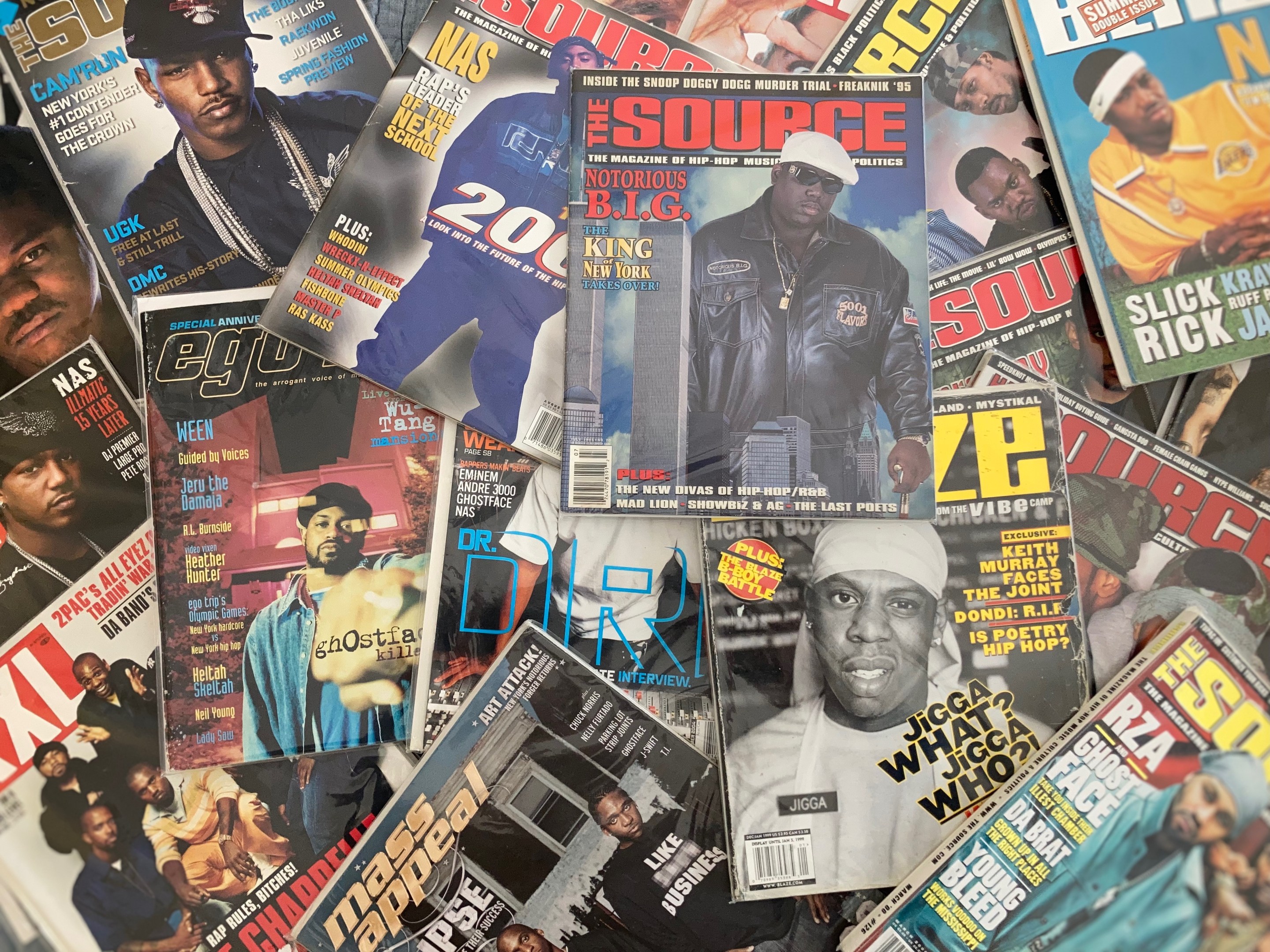
In 1991, Spin magazine took the Compton rap collective N.W.A out to eat for a profile at the Russian Tea Room in Manhattan. The white author presents gangsta rap as a cynical enterprise, no different than escapist, violent popcorn blockbusters. “They’re not stupid, even though you may think so by the time you finish this article,” he writes of one of the greatest groups in the history of recorded American music. The first printed interview question is “Would you consider yourself a professional n****?” (The word was printed without asterisks.) The headline on the article is “N****Z4DINNER."
The author, documentarian, and former photo editor at The Source, dream hampton, remembers that article serving as a rallying cry for the early iteration of The Source’s Mind Squad, including but not limited to the late, great James Bernard, Reginald Dennis, Matteo “Matty C” Capoluongo, Ed Young, Rob Tewlow, Dan Charnas, Kierna Mayo, Chris Wilder, and founders Dave Mays and Jonathan Shecter. “[Spin] were rock journalists thinking they are the punk to Rolling Stone’s mainstream. This type of shit was considered edgy at the time," hampton said. "The Source saw itself as being directly in conversation with that kind of drive-by journalism, with that kind of racist journalism. Because they loved this genre of music, hip hop, they were radicalized a bit around race. They rightly took offense to that kind of shit, and they saw themselves as an antidote to that. They were going to be people who actually understood and loved the music while everyone else was just kind of dabbling.”
The Mind Squad and editorial staff like theirs—people who understood and loved the music—would create a new, vibrant, and deeply informed style of cultural journalism that defined an era. A number of outlets rose up as a corrective to what was then the mainstream’s mistreatment of hip hop, including DIY projects like The Source and Haji Akhigbade and Sacha Jenkins' Beat-Down Newspaper, and institutionally backed outlets from savvy, opportunistic readers of culture like Larry Flynt’s Rap Pages and Quincy Jones’s Vibe. These magazines did far more than take youth culture seriously. They documented and curated stories about rap, R&B, street fashion, film, current events, race, and politics. They employed pedigreed editors, journalists, critics and photographers like George Pitts, Riggs Morales, Scott Poulson-Bryant, Selwyn Seyfu Hinds, Ben Mapp, and Joan Morgan. Much of the staff that put together these publications have gone on to become big names at institutions like The New York Times, in media as on-air talent, in publishing, and at the executive level in the music and entertainment industry. Others never got their due.
For readers like me, these magazines transformed us from mere consumers of rap into obsessives. They represented the pinnacle of culture journalism for approximately 15 years, but you can’t find much of it online. The archives of The New Yorker and Rolling Stone have made the digital transition, and their old articles, interviews and reviews are available in an easily searchable format. The institutional rap titles have not. Their websites are largely an unnavigable mess in which one is more likely to encounter 404 errors than articles. This is annoying, but it’s also a dangerous blind spot in history that could have a profound impact on the way we think, talk, and move forward as a culture. How did this happen? More importantly, is there anything we can do about it?
Syreeta Gates, a young archivist from Jamaica, Queens, founded The Gates Preserve, a digital record of Black youth culture media so complete that the photographers and writers of the pieces in her collection from that era often hit her up to ask for clips of their own work. Gates has dedicated her life to the study and collection of this history, because it introduced her to a perspective she found truer to her experiences than what she encountered elsewhere.
“Oftentimes, when we're thinking about American journalism, we're thinking about Joan Didion, Hunter S. Thompson, or Gay Talese, and they’re important. But we also need to think about Mimi Valdés and Bönz Malone and Bobbito Garcia,” Gates told me. “Hip-hop journalism was responsible for talking about American culture in a way that no one else was at the time. In a Source magazine in ’92, you could read about Palestine, you could read about Nelson Mandela being freed, you could read about a new demo tape on the way from a guy named Biggie Smalls. It showed a people's history of alternative culture that you're not getting from the mainstream publications.”
But the giddy freedom of operating outside of mainstream constraints also comes with a downside. “The problem is, if you're from a culture that was not supposed to last from the jump, you're not thinking about archiving it or preserving it,” Gates said.
Arthur Fournier is a rare-books seller with a business he runs out of an apartment in Crown Heights that includes rap magazines and ephemera. He carved out a niche for himself as a lifelong hip-hop fan who saw there was an entire category of valuable work overlooked by much of his industry. He studied the history of art and philosophy at the University of Chicago, and is no stranger to dealing with museum and academic archives, as well as the hurdles involved in publicly sharing the work that comes into his possession.
In most cases, these magazines were founded in the ’80s and ’90s, before journalism established a real presence on the internet, which means the contracts signed by the contributors to these magazines didn’t have provisions for what would happen to the work in perpetuity. They accounted for print, the only medium they could imagine for the text and images.
“If somebody writes an article for a hip-hop magazine, they're probably selling their copyrights to the publisher, and the publisher may go out of business or may sell their archive to a big conglomerate," Fournier said. "And the question becomes: Who owns what? Ownership might be contested. The creators are out there, so we've got to ask their permission. And particularly with that era of rap media, some of the journalists were real wild characters that have been scattered to the wind, and you need to track them all down.” It’s cumbersome, but Fournier explained that this is what prevents a corporation from buying one of these publications and turning the intellectual property of the contributing writers into a “plagiarism smoothie.”
The writer, historian, and internet rap archivist Evan Auerbach started his curational brand Up North Trips because he felt the “void of digitization of hip-hop media” from the pre-digital era. Auerbach pointed to Vibe’s archive as an example of what may happen when a publication is simply posted online without securing these rights. “Vibe was 100 percent scanned page by page, issue by issue on Google Books. I don't know what happened, but it just disappeared one day," he said. "I don't even know how Google would've had the permission to post them to begin with. When I think about just the advertising that was in it—like if I'm Mark Ronson, I'm going to tell Tommy Hilfiger I'd prefer it if my likeness isn't used in perpetuity.”
If you venture onto The Source’s website today, you will find a graveyard with no headstones. There is no indication this brand was once credibly referred to as “The Bible of Hip Hop,” no archive of articles, interviews, or reviews, just a shoddily designed Wordpress page home to a cluttered screen of shit-out news aggregation posts. At the time of writing, all 13 featured pieces on the home page are credited to just two writers. Ominously, in a vertical column running down the bottom-right corner of the page, multiple additional news hits are credited to “Sourcestaff.”
One would think the co-founder of a magazine would have the ability to at least control the issues of said magazine they worked on, but that's the very dilemma facing Jonathan Shecter, who served as founding editor-in-chief of The Source for its first seven years of operation. Shecter exited the outlet in 1995 and has since amassed a collection of what he ballparks at 95 percent of the issues he was directly involved in producing, which he’d like to share with the world. But his hands are tied because the rights to The Source currently belong to L. Londell McMillan, a lawyer who most famously represented Prince while he was alive, as well as his estate after he died. The journalist, television producer, and former Source music editor Elliott Wilson is blunt in his assessment of McMillan, one shared by several people I spoke to for this piece: “He's a nutjob. He’s gone crazy. We almost fought the last time I saw him.”
“I’ve reached out to Londell many times about digitizing the archive, but he never answers,” Shecter said. “He hasn't proven to be such a great steward of the title. He's not what we would consider a hip-hop guy at all. He's more of a boomer.” It’s what can happen to a magazine after several years of mismanagement. An esteemed publication can fall into the hands of a vulture who made the highest, relatively low bid, then may be content to sit on the faded brand name, as well as its archive, and write off the loss until it's flipped to the next conglomerate hoovering distressed assets kept in a zombified stasis. The new custodians of these brands don’t necessarily have the same connection you probably do if you’ve read this far into this piece.
Part of the problem with having dispassionate owners of these titles is they don’t realize the potential value of their newly acquired property. Due in part to the individual rights-holders issue, the process of moving these archives online will likely be a convoluted nightmare. In many cases, that process never began. The biggest rap magazines were slow to recognize the internet as an existential threat, and made a point of siloing off one arm of the outlet from the other.
“In the beginning, with hip-hop magazines, you put your B-team on the internet side. It would be where the young noobs would get a chance, and we didn't really take it seriously,” Wilson said of his experience at XXL as the digital migration was occurring. “If we had Jay-Z on the cover, there'd be a debate about whether or not we should transcribe the interview and put it on the website so people can read it for free, and in retrospect it should've lived there. But we were very protective of the product because we were still selling hundreds of thousands of magazines, which sounds insane today. People were still about having a tangible product in their hands.”
Shecter recalled this cycle playing out at his magazine: “The Source got left in the internet’s dust early, and never caught up.”
Auerbach believes the lack of an online archive for rap magazines is unfortunate, but not the worst tragedy plaguing the genre's historical record. At the moment, there are still physical copies of most magazines; the rapidly disappearing digital-only record is another story.
“Hip-hop is in what I think of as its ‘404 era,’" Auerbach said. "Like, egotripland was this incredible site, but it’s down now, and the loss of that site and others like it is even more stinging to me, because you could still buy a physical magazine off eBay. I can't find [egotripland’s] first Sean Price post. That shit is just gone. And even in the case of shitty work, what’s lost is the timeline, the macro-contextualization of it all."
Auerbach is referring to Ego Trip, the legendary, limited-run rap magazine founded and operated by a collective of sharp, witty, rap-obsessed dickheads who famously worked at other magazines by day and built their passion project by night. Both their magazine and their once-influential website egotripland, which posted regularly through the 2010s, is currently nearly non-existent online.
The story of egotripland is an example of how easily years of vital work could be lost in the internet during the blog era. “This asshole lawyer was going around and suing websites for reproducing a photograph some artist had taken without permission for a mixtape cover. So he came for us, threatening to sue us for like $30,000,” Ego Trip designer Brent Rollins said. “We had to take the site down for a moment. While we were trying to get our legal stuff sorted out, the domain lapsed and we lost all the data. And now The Wayback Machine has it. It could be kind of retroactively pulled from one and reformatted to another, but that takes weeks if not months of work.”
In order to justify all those weeks and months, you have to value what you’re archiving as a meaningful contribution. I was surprised and somewhat disheartened to learn that many legends may not see their past work as worth the effort. “I'm embarrassed by a lot of my old work. My 2Pac piece for The Source has typos in the first paragraph,” hampton told me. She's not alone. It's a common trait in artists across all disciplines to be reluctant to look at their old shit. It’s hard for many not to cringe when confronted by the writer you were even last year, let alone 30 years ago.
As I told hampton, I think her writing and reporting from that time was brilliant, but let’s pretend for a moment it was bad—if nothing else, that still has value in conveying that history. She acknowledged the truth to that. “Just look at how we wrote about R. Kelly and Puff [Daddy]," she said. "If everyone kind of takes that approach, wiping their hands of their writing, it's bad for history and bad for the music, if not the culture. It's hard for me to read some of this stuff, but it's how we thought. It's how we talked. It's what shaped the narratives. And so it is important.” But conceding a point in the middle of an interview, and a willingness to go out and fight, are two different things.
The polar opposite of amateurish, half-cooked digital rap writing during the blog era was Cocaine Blunts, a site that defined the potential of the rap internet and represented the positive aspects of the democratization of taste. It became an influential space for its proprietor Andrew Nosnitsky, known to his dedicated readers as Noz, to curate his history of hip hop, which cut sharply against the old-head New Yorkist elitism prevalent at the time.
Nosnitsky had a predilection for underappreciated rappers from underappreciated markets, like Z-Ro and Trae tha Truth in Houston, or Roach Gigz and Lil B from the Bay Area. Nosnitsky still is a dedicated, trained archivist who put his education to work at the store he owned for five years, Park Blvd Records and Tapes in Oakland. Online he would regularly post rare interviews from regional radio, live recordings from the ’80s, and random tracks off old limited supply mixtapes he fucked with, all framed with his expert analysis. Cocaine Blunts was a beloved, persuasive outlet, and Nosnitsky was one of the many writers who parlayed their independent blogging success into regular media work, writing reviews and longform profiles for the likes of XXL, Complex, and The Fader.
Today, Cocaine Blunts is gone. When I asked what happened to the content on the site, Nosnitsky echoed hampton in his antipathy toward his old shit. "It was hacked by Russians, and now it lives on my hard drive. To get it back online, it would take some work to do it in a presentable fashion, and it just hasn't happened," he said. "It's not a huge priority. I think in the blog era, a lot of this stuff was designed to be ephemeral. My old stuff, and stuff from that period, a lot of it is kind of bad. I think you can hold both positions where like, this is important and it needs to be archived and also … I don't know. This is something I did for beer money 20 years ago, and I don't even remember writing it."
Nosnitsky downplaying his (tremendous) work is slightly different than hampton's modesty around hers. For magazine writers, their professionally edited words have been committed to paper in thousands of copies, for better or worse. For writers on the internet, this level of permanence is a luxury they weren’t ever afforded. The blog era was the birthplace of a new, exciting level of direct communication, but in the early years there was little filter, little editorial oversight, and a focus on quantity over quality, which was part of its charm but produced a lot of sloppy or regrettable content. Even well-established brands were guilty of this practice.
Complex helped pioneer early rap blogging and has been innovative in the use of social media platforms. Today its thoughtful, constant churn is unmatched for a major rap outlet, but the site is also littered with broken links or old pages that are nearly incomprehensible because of outdated CMS. I asked Rollins, who was Complex’s creative director from 2010 to 2017 and is now back in that role, how this immiseration of the reader experience happens to a major outlet with priceless archives. “It’s just the realities of technology. The content platforms get updated or upgraded, or you change language or you swap to WordPress or something, and then you have to go back and reformat shit,” he said. “They looked at some stories and they said, OK, these are the ones that were successful, so we're going to try to save these or translate them into our new format. And then there's others that were deemed not worth it.”
It's not just about tech; it's about priorities. Rollins is open about this philosophy. "Complex sees itself as a media company and not as a publication of record. So the articles at a certain point just become a means to an end," he said. "There's less of a sense of stewardship, of making sure that there's a place where all our valuable content exists in an easily searchable location, because it's a business and they made a business decision. They have to sustain all these employees, and they have investors."
Nosnitsky has seen this play out at many of the online outlets he was paid to write for. “When they got rid of all the bloggers at XXL, I went into the CMS and deleted everything I ever did for them. Which was great because a few years later, they stripped it of all bylines,” he told me. “It's a question of 'Are they going to be responsible in their preservation of this work?' Other sites have updated things that I wrote, repackaged it and put someone else's byline with it. I'd rather it just go away at that point, if I can't trust that it's going to be preserved in a responsible fashion.”
Fournier sees this as a feature, not a bug. The ownership of intellectual property online is unstable ground, and the corporations controlling it are not to be trusted. "The internet is obviously a place that's bought and sold and owned by private equity and hedge funds and major institutional investors," he said. "Their jobs are to make money for their shareholders. They don't care whether or not a 23-year-old gets good information or gets a bad AI-generated chunk of hot garbage. The digital record is pixie dust. It doesn't really belong to you."
There is a cumulative effect that can explain how many writers of this age feel about the importance and power of their writing and its place in history. When your work is treated carelessly, and you are told over and over again that it doesn’t matter to readers or to the company that has employed you, it’s inevitable that the writer will eventually devalue their own contributions.
Today, if you type “Wu-Tang Enter the 36 Chambers review” into a search bar, the first entry that comes up is a Pitchfork Sunday Review published in 2022. It will likely be the definitive review of Wu-Tang Clan's debut read by young inquisitive fans, in the outlet many online music lovers have been raised to consider the institution of record. The piece was written by Dylan Green, one of Pitchfork’s go-to rap writers for many years. Green was born in 1992, the year before Enter The 36 Chambers was released.
Green explained that for Sunday Reviews, Pitchfork will have an intern or editorial fellow compile research material to aid the writer in their work, which was helpful. But by no fault of the material available on the internet, when it came to writing, they were left wanting. “I really wish I had older magazine sources,” Green said. “To me, the hardest part of that review was definitely learning how Wu-Tang came together, because I'm sure a lot of the more rap-centered publications covered it in a way that would've been—not more legible, but definitely more culturally conscious. It was interesting, because I had enough information. I just didn't have enough of the kind of information I expected.”
Green's experience speaks to the plight of the young contemporary critic in several respects. Semi-complete archives of many of the publications named in this piece exist in person at the Schomburg Center for Research in Black Culture in Harlem, and other similar public institutions. But visiting is only feasible if you live in or near a handful of major cities. And even if you do, it can be hard to justify the time commitment if, like Green, you are writing from five to seven reviews concurrently, all on urgent deadlines—for multiple outlets, in addition to running a podcast—just to scrape together something approaching a living wage.
Another issue is that Green's generation was the first that barely can remember a time pre-internet. "For a lot of people it’s like, if it's not on the internet, did it exist?" Gates said. "And when the answer is no for a lot of your work, say, most of the work before 2000, that's at least 20 years of hip-hop journalism gone for many young people."
Links continue to expire, and Tumblrs disappear. Archival research is not a widely taught skill. “I dig through forums. I try to look through the Internet Archive and the Wayback Machine whenever I'm able, but I haven't gotten to the point where I've decided to go to the library and figure it out from there,” Green said. “I imagine there's obviously an art to digging in archives at the library, but if there's a practice to it, I don't know it. It really is a sense of—we're losing recipes and we don't even realize it, because we never had a taste for it in the first place.”
Black culture has always lagged behind when it comes to institutional support and preservation. By nature and necessity, hip-hop fans are crate diggers, but there are fewer crates to dig through. With every fire, flooded basement, rotted link, corrupted external hard drive, acrimonious divorce, eviction, death, our historical resources are degraded. "The loss of these magazines and posts is the context of the environment and the state of music and the state of journalism and the state of culture, so when those things are gone, context is lost," Auerbach said. "And that context is the ebb and flow of hip hop over the course of the last 50-plus years. When we lose those recipes, it offers the opportunity for revisionist history to come in and change the narrative of what was true. We need a Library of Alexandria."
The Library of Alexandria came up a lot as I was reporting this, but it’s worth noting that it wasn’t actually destroyed in one moment. Julius Caesar may have accidentally set fire to the library during the Alexandrian war, when he burned a harbor fleet during a raid on his enemy Pompey, but it appeared to have been restored and replenished afterward. The library actually ended several generations later in a less poetic fashion. Upkeep and interest waned during the age of the Roman Empire in Egypt, perhaps a casualty of a culture that turned its focus away from the stacks and toward the Coliseum. Membership tailed off, then ceased after a few centuries of neglect. In all likelihood, it merely faded away, exiting civilization as yet another relic, marking the final vestiges of a dying world.
Is it possible to save what we still have? Each person I talked to had a theory, or several, as to how the record could be preserved. Many wondered if the custodians of these brands might wake up and see the money they’re leaving on the table. There was more than one suggestion along the lines of a bundled subscription model that would feature as many digital scans of as many rap magazines as this hypothetical digital publisher could get its hands on, giving the user the equivalent of rap’s greatest library card for something like $5 a month. As an example, Rollins brought up his father, who once worked for a publication called Soul Illustrated in the ’70s, which saw a sudden resurgence when its archives were uploaded and made available under a subscription model.
Wilson believes we could be one altruistic person away from a solution. "We're in America, which is a capitalistic society, and the problem is that nobody with money has put it behind this side of the industry," he said. "No one sees or is willing to invest in the value of this stuff. So if someone with the passion and knowledge of it comes along, then that could clean a lot of shit up and get things on a course. But right now, we're fighting for people to view the work as valuable, to see that journalism has value."
Fournier and hampton look to history for lessons, and find optimism for the future. "What we’re talking about is bigger than hip hop," hampton said. "It’s Ida B. Wells, Dudley Moore, Linda Goode Bryant. It’s Crisis magazine, it’s the Panther papers, it’s Final Call. It’s all of that shit, Black presses that rose to meet their moment. One of the mistakes we make in this country is we begin a story where we enter it. We have some vague memories of the ’80s, and we think that’s going back far enough. I hope that kids find a space and make a way whether they have access to this shit or not. That’s what we’ve always done."
"We have to remember archival time is long durational," Fournier said. "Archival time extends as far into the future as we like to imagine human civilizational effort on Earth. So we're getting it, we're doing that work. I know we want it all now. And we're sad that we can't get it immediately on our phones for free. But this sort of retrieval project, in a fairly new medium of the digital space—it's reasonable to say this might not be accessible the moment you snap your fingers, but it will be a process of decades. Take this as a call to arms. We don't just throw up our hands and say the battle is lost. You have an opportunity to become a general in the struggle to preserve a culture."
Fournier reminded me of when I asked Gates how she first came into her purpose. What made her dedicate her life to the preservation of old rap magazines? "I was in a Black Pop Culture class at NYU, and Greg Tate came to speak to us," Gates said. "So I asked him this question that I had been pondering: Who will tell the story of these journalists when they're the ones telling everyone else's story? And he told me, 'You will.'"