
More than a century ago, the Chinese paleontologist and archaeologist Pei Wenzhong found an unusual trove in the same cave near Beijing where he found the skulls of the early hominin Peking Man. Along with the remains of a 700,000-year-old Homo erectus, Wenzhong unearthed a collection of 20 quartz crystals, one of which was a "perfectly faceted, smoky quartz crystal," the researcher Juan Manuel García-Ruiz wrote in a 2018 paper. In 1931, Wenzhong brought the quartz back to Beijing. "After washing and displaying them, I invited my colleagues to observe them," Wenzhong wrote in an article. "One colleague seemed very angry after examining them, picked up a piece straight away, hit it hard on the other stone fragments, and exclaimed, 'These kinds of broken stones can be seen everywhere on the road!'" But later that fall, the French archaeologist Henri Breuil examined the crystals and agreed with Wenzhong: The crystals were not just stones, but artifacts collected by the early humans who lived in the cave.
Since Wenzhong's discovery, archaeologists elsewhere in Asia, Africa, and Europe have excavated quartz crystals from sites occupied by early humans. It's clear that Homo erectus and Homo sapiens collected crystals that were too small to be tools. Rather, these early hominins were attracted to the stones for some other reason. García-Ruiz, who studies crystallography at the Donostia International Physics Center in San Sebastián, Spain, has hypothesized that crystals were an early catalyst of abstract thinking, symbolism, and consciousness in hominins. Such a hypothesis would seem impossible to empirically test, given the extinction of Homo erectus and other early humans. So García-Ruiz turned to our closest living relatives, chimpanzees, to see if they, too, experience what he's dubbed the "crystal allure."
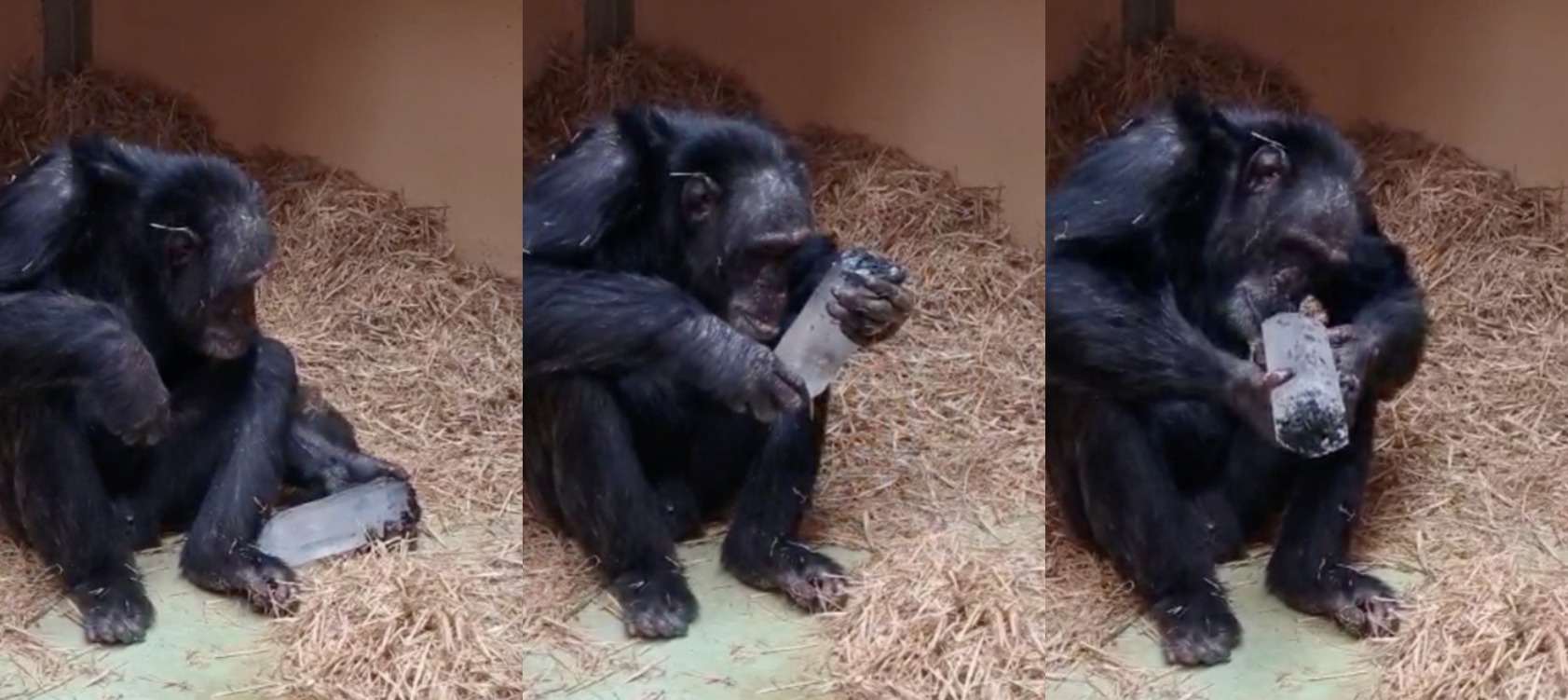
In a paper published today in Frontiers in Psychology, García-Ruiz and colleagues prove without a doubt that chimpanzees are drawn to crystals. The researchers offered crystals to nine chimpanzees living in two groups at a rehabilitation center in Spain. (The chimps, many of whom came from circuses, are all familiar with humans.) In one experiment, the researchers placed a clear quartz crystal and a voluptuous slab of sandstone, each larger than a human hand, on two pedestals. Via a feed from a video camera, the researchers observed the chimps approaching the pedestals, noting when the chimps interacted with either the crystal or the rock. In another experiment, the researchers offered the chimpanzees a scattering of stones and crystals in the grass to see which ones they picked up and examined.
The chimps easily distinguished between crystals and ordinary stones. But they also chose to study the crystals, examining their shape and transparency for hours at a time. This crystal obsession is probably not surprising, given all the culture we share with chimpanzees. But it does raise an important question that García-Ruiz and his team did not include in their research: Which chimpanzee has the best potential to unlock the healing powers of crystals? Let's discuss.
Manuela
Manuela, a 19-year-old chimp, is the alpha female of her group. She is sociable, curious, and not very aggressive. Manuela is the only chimp born at the rehabilitation center. She is the strongest female in her group and uses some sign language to communicate.
When Manuela's group encountered the large quartz crystal and sandstone on pedestals in their enclosure, all the chimps were drawn to both objects. (The pedestals had been placed in the enclosure months prior to ensure the chimps would be accustomed to the structures.) No chimp spent more than two minutes with the sandstone. Everyone was much more interested in the crystal. Manuela, as the strongest of the group, successfully pulled the crystal off its pedestal to the ground. Soon, Guillermo, a chimp who is very fearful and blind in one eye, approached her slowly while looking at the crystal. Manuela snatched the crystal and carried it to the second floor of a platform, where she played with it briefly and then left it.
While Manuela certainly displayed an affinity toward crystals, the fact that she would abandon such a prized possession so quickly makes me suspect that she exhibits roughly average crystal allure—Manuela is as attracted to crystals as the average chimp or human, but she does not have what it takes to become a true crystal practitioner. This is probably a blessing, considering her busy schedule as an alpha.
Yvan
Yvan, a 50-year-old living in the group run by alpha Manuela, is a pretty well-adjusted chimp. He's playful, careful, and sociable. He is not aggressive or fearful of others. He often comforts other chimps in his group and shows reciprocity with them. He has a protruding mouth and is emotionally dependent on Manuela. When Manuela abandoned the crystal on the second platform of the platform, Yvan approached the crystal, carefully handling it and examining it. Although another chimp, the 33-year-old sociable and arthritic Yaki, examined the crystal here, Yvan would eventually take the crystal and bring it back to his group's indoor dormitory.
The crystal remained there for a couple of days, where Manuela, Yvan, Yaki, and another chimp named Toti examined it before the researchers could retrieve it. In fact, the researchers could only retrieve the crystal after bartering with the chimps in an exchange of the valuable goods of bananas and yogurt, "which are known from daily observations to be highly appreciated by the chimpanzees," the researchers write. Such a princely sum suggests the crystal was highly valued among the chimps.
Yvan clearly exhibits higher crystal allure than Manuela, as he took it upon himself to lug the shard back to his home. When Yvan was given a pile of crystals mixed in with pebbles, he picked up one transparent piece of quartz and held it close to his eye, examining it for more than 15 minutes. "Since
Yvan is not myopic, this behavior suggests a focused and genuine
interest, particularly in crystal transparency," the researchers write. Yvan held the quartz up to his eye for as long as a full minute.
Does Yvan have the crystal allure needed to become a crystal healer? He certainly has crystal curiosity. Let's consider the other chimps in contention.
Toti
Toti, a 40-year-old chimp with honey-colored eyes, a hairless shoulder, and arthritis in his legs, belongs to Manuela's group. He is often found crawling on the floor. Toti interacted with the crystal in all the ways a chimp can interact with a crystal. He was also observed engaging in the innovative practice of hitting the pyramidal tip of the big crystal against another crystal. These hits were delicate, seemingly without the intention of breaking the crystal. This kind of crystal-on-crystal action, also exhibited by Sandy, is by far the most convincing evidence we've seen so far of a primate's potential for crystal healing. What vibrational qualities might be sussed out by touching the tip of one crystal to another? What might the crystals be saying to each other, or to Toti?
When Yvan brought the big crystal back to the dorms, Manuela, Yvan, Toti, and Yaki were observed inspecting the crystal, even sitting by the window in order to watch it gleam in the light. But Toti paid particular attention to the big crystal. He rotated it in his hand and tilted his head to see it from different angles. He was particularly interested in looking at the crystal's tip. In this way, it seems that Toti appreciated the movement of light through the crystal, noting its transparency and luster. Such a high exhibition of crystal allure means Toti has made a name for himself as a true crystal appreciator. He certainly remains in contention.
Guillermo
Remember Guillermo, the 28-year-old chimp who is blind in one eye? He is a pretty fearful chimp who avoids contact, lacks curiosity, and sways when he is nervous. When Guillermo approached the pile of crystals and pebbles, he sorted through the pile within seconds, selecting the quartz and calcite crystals. While speed is certainly an achievement, this feels more like an indication of a predisposition to pattern-matching than any predilection towards crystals and the manifold mysteries they hold. Low crystal allure, out of contention.
Yaki, Gombe, Lulú, and Pascual
Alpha male Gombe leads a group of three other chimps including Lulú, Pascual, and Sandy. Although Gombe, Lulú, and Pascual—as well as Yaki, from Manuela's group—certainly have redeeming qualities as chimps, they were barely mentioned in the paper and therefore exhibit low crystal allure. Out of contention!
Sandy
Sandy, a 31-year-old chimp in Gombe's group, has dark hair and is decisive. She is highly sociable and curious and not at all fearful. She often acts maternal with her objects, protecting them from others. When the researchers introduced Gombe's group to the two pedestals, they were not able to collect any data on the chimps' interactions because Sandy immediately picked up both crystal and sandstone and brought them back to the dormitory. Like Toti, Sandy knew to touch the tip of one crystal to another. In fact, when she hit the crystals together, she cracked the tip of the big crystal. Was this an accident, or an intentional crystal refashioning? Only Sandy knows.
When Sandy was presented with a pile of crystals and pebbles, she carefully analyzed each crystal and pebble. Although she picked up all the crystals and pebbles and carried them to a wooden structure, the researchers later found she had separated them into piles: one of pebbles, and others representing each type of crystal in the pile: calcite, quartz, and pyrite. So Sandy was able to distinguish between the crystals based on their transparency, symmetry, luster, and shape, a sign of high crystal allure.
While examining the pile of pebbles and crystals, some other chimps, including Guillermo, also sorted through the pile. But only Sandy used her mouth to carry the crystals from the pile to a wooden structure, where she could pick them up and examine them. Furthermore, for the rest of the day, the researchers observed Sandy carrying crystals in her mouth. This kind of prolonged, intimate crystal contact is unprecedented among the chimpanzees at the rehabilitation center. What is to be learned from a crystal's mouthfeel? Surely a great deal. Chimps do not often carry things in their mouths, so the researchers suggest that Sandy hiding them in her mouth could indicate how valuable she found the quartz. The researchers suggested that the chimps may have been interested in smelling or tasting the crystals to ascertain if they were edible, and this certainly could be the case for Sandy.
But another, still plausible hypothesis is that Sandy has that special touch that blesses only some humans, such as new age-y cafe owners and TikTok witches, that allows her to convene with the crystals on a different plane. Perhaps Sandy knew that to truly know a crystal, you must taste it. You must bring the crystal into your mouth to let it open your mind. To me, Sandy is the clear frontrunner of the chimps in crystal allure. Take my word for it: If ever a chimp were to heal someone with a crystal, it would be Sandy. If Toti and Yaki are suddenly cured of their arthritis and if Guillermo regains vision in his bad eye, there's only one chimp to thank.