The end of the 1970s seemed to be a moment of uncertainty for Don DeLillo, creatively speaking. The previous decade had seen him become a rather important American author, enough so that he had left his job producing advertising copy for Ogilvy & Mather. Writing was his only game now. Beginning with Americana and continuing through End Zone, Great Jones Street, Ratner’s Star, Players, and Running Dog, he had proven himself a shrewd, somber, grimly oracular chronicler of an uneasy period bookended by Nixon and Reagan, with Vietnam, Watergate, and other sundry grime in between. A true historical shit sandwich. DeLillo used things like college football, rock stars, aliens, and rumored Hitler sex movies as points of entry. As befitting a former ad man, DeLillo sold it, or rather sold a picture of the world munching blithely on various shit sandwiches in nice packaging.
"For many of us, Don DeLillo has been the most interesting and talented of American post-modernist novelists (which is to say finally, I suppose, of current white man novelists…)," the late Fredric Jameson wrote in a review of The Names, (technically) DeLillo’s first book of the 1980s. A haunting meditation on language dressed up as an international murder mystery, it’s a solemn, ruminative book even by DeLillo’s standards, and the start of a significant shift in tone and scope. By the end of the decade, he would be in the midst of a three-book run—Libra, Mao II, and Underworld—that I and many others would argue is as formidable and ferocious a creative tear as any American writer has ever had. Together they comprise an epitaph for the American Century, and look knowingly at the decline that was already heavy on the horizon. The André Kertész photograph of the World Trade Center on the cover of Underworld, published in 1997, has somehow never seemed fully coincidental. Of course it is, but books this good encourage a certain amount of reverse-engineering in readers; there is the sense that DeLillo was working backward from answers that were available to him alone.
But let’s back up. There’s still that pivot moment, and that (technically) from earlier. So: The guy from the Bronx has gone to Greece, ostensibly to work on The Names. He has documented the hollow anomie of the 1970s. He’s about to square up with some true heavyweights: language and history themselves. Things are starting to feel severe. In such a situation, any writer might find himself feeling constrained. Weighed down. In need of an outlet to be unserious.
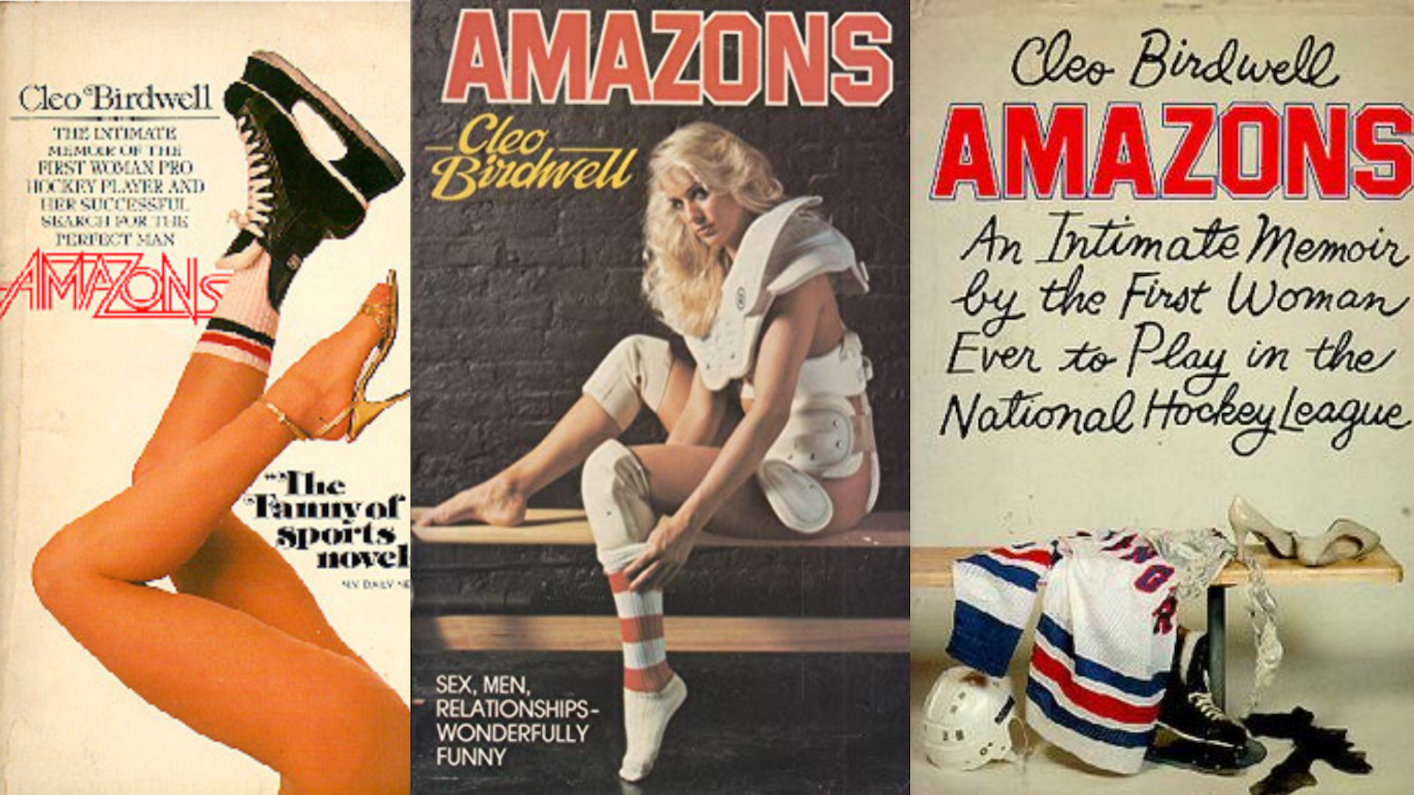
Forgive a bit of speculating, but I think this is why, in 1980, DeLillo published a hockey sex novel under a woman’s name.
Amazons is "by Cleo Birdwell." Its subtitle is An Intimate Memoir by the First Woman Ever to Play in the National Hockey League. The front cover features assorted pieces of hockey equipment—helmet, skates, New York Rangers road jersey—strewn with high heels, a bra, a slip, and tights. The back cover is given over to a blonde who I guess you’d call lissome, kitted up in full Rangers gear, skates knotted together and draped over her left shoulder. This, in some epistemological sense, is Cleo Birdwell. The publishing house Holt, Rinehart and Winston sent her to publicity events to promote the book (wearing her Rangers jersey, natch). You can find copies inscribed by Cleo for sale online.
You won’t find any copies inscribed by DeLillo. It was only in 2020, 40 years after the book had been published, that he publicly acknowledged having written it. You won’t find many copies of the book, period. DeLillo has refused to allow it to be reprinted, and buying one now will cost you roughly what I’m being paid to write this. There’s a strong chance I got this assignment for the simple reason that I am the only person Defector knows who already owns it. I bought my copy 25 years ago, when I was in grad school. Did you know DeLillo wrote a book about hockey under a fake name… had that kind of lore-ish quality back then. I don’t remember how much it cost me, maybe $50 on eBay. That was a ton for a grad student, but I was living on the dime of a private foundation and the taxpayers of a small Midwestern state. Their money has been spent on far worse things.
Though Christopher Lehmann-Haupt revealed Birdwell's true identity in his New York Times review upon the book’s release, DeLillo was keen on keeping the thing stowed in the attic where no one could set eyes on it. As Gerald Howard wrote in Bookforum in 2008: "In the late ’80s, when I briefly served as his editor, DeLillo adamantly refused my keening requests to reissue it (it was hard enough as it was to get him to let us republish his terrific first novel, Americana [1971]); later, he prevailed on the editor of the Viking critical edition of White Noise (1985) to delete Amazons from the list of his publications." In a 2020 interview with the Times, DeLillo semi-accidentally copped to having written it. When asked if that was his first confession, he pulled the novelist’s version of a Robert Durst hiccup-and-confession fit: "I probably did, somewhere or other," he laughed. "Maybe to an interviewer from Thailand." It’s not quite "wrote them all, of course," but it’s closer than he’d come before or since. (The surname “DeLillo” is also hidden in “Cleo Birdwell.” What the leftover letters might mean, apart from nothing at all, is a mystery.)
All of this suggests that we’ll likely never get a clear answer of why DeLillo has buried Amazons, although it’s easy enough to guess. Despite a few melancholic moments spent ruminating on the existence of athletes as commodity fetishes, Amazons is an exercise in concentrated silliness. It’s a writer, who happens to be one of the titans of his era, fucking around on paper, either to work things out or just because he thought it might be fun to do it. Even having it published was a prank. So what if it’s his funniest book? (It is.) Some things you just have to do and then work at forgetting about them. If the book proves or means anything, it’s that even big important novelists get the literary zoomies.
Calling Amazons a novel doesn’t feel quite right, but until Catalog of Encounters with Odd, Damaged Men is recognized as an established literary form, it’ll have to do. The book begins with Birdwell being signed by the Rangers. At that point she starts bumping into weirdo after weirdo, stunted men who wear their neuroses like extra limbs, and more or less never stops bumping into them. Many of these men, she also sleeps with.
Basically, that’s the book. All that propels things along is that there is another game in a day or two. Speaking of which, there is hardly any hockey in the book. If you’re expecting the baseball vortex at the Polo Grounds of "The Triumph of Death" in Underworld or the bombastic, Wagnerian football spectacles of End Zone, you are in for a letdown. The sports content is best summed up by the character of Murray Jay Siskind, who also shows up in White Noise (not the tidiest bit of disposing of the evidence, so to speak): "I’ll say this about sports…Athletes are people with bodies. That’s the bottom line on athletes."
There is a decent amount of sex, though, if you like reading sex. Here’s a sampler, in case you’re curious:
- "[H]e entered, entered, entered, and we did a wild sort of rolling hoop routine that would have been impossible if we’d thought about it for so much as two seconds."
- "Obviously he’d done this stuff four thousand times, and after a while it began to seem he was more or less performing a gall bladder operation for all the personal interest involved."
- "'Sanders, are you telling me that just because I said the word Watergate, you’re not going to be able to function?'"
- "I don’t know whether it was the idea of writing to Santa, or just the mention of the coal furnace, but Murray grabbed one of my legs, and hoisted it…"
- "We were all over each other, clutching and moaning. We each had a hand between the other person’s legs. We were not checking for deformities, I don’t think, as much as simply grabbing what was there."
Grabbing what was there. Aren’t we all?
It’s not just that the sex in Amazons is silly and toweringly unerotic. It could hardly be otherwise; hurt people hurt people and weird fucks fuck weird. Birdwell is horny in an understated way, but her seductions are almost anthropological. It’s as if she is seeking the closest vantage point imaginable to study these human oddities DeLillo has cooked up. There’s a steady thrum of bewilderment running through Birdwell’s narration—it’s clear-eyed and removed in a way that few of DeLillo’s narrators are. It’s almost like he is trying to grasp the extent of his own authorial weirdness, either to find his range or just for yuks:
"…you are inside yourself, and I am nowhere, I am wandering."
Nod, nod, nod, nod.
I haven’t even gotten to the set pieces that DeLillo wedges the dirty parts between, a non-exhaustive list of which includes: an argument over a spoon in a piece of modern art; an extended game of strip Monopoly; a gathering in the South Bronx of people suffering from a (real!) reflex disorder called Jumping Frenchmen; a shoot for a commercial featuring women and girls on skates, basking in the delight of a new line of "crackle-snacker" junk food for women (which gives the book its title); a man in in-home cryostasis as a cure for Jumping Frenchmen; and the disclosure of the Mafia’s control of the snowmobile business. None of these merit delving into, really; there’s no need to dissect the fun. Later in the book, the Rangers are bought by Saudi Arabians. When an American sports team finally, inevitably becomes the property of a sovereign wealth fund, we can say DeLillo called it, even if he himself would be less willing to accept the credit.
Is it worth shelling out hundreds of dollars for a copy of Amazons? Absolutely not. Is it worth hunting down a PDF or some other version disseminated without the express written consent of Holt, Rinehart and Winston? With the understanding that the following is not reflective of the advice of Defector’s Standards & Practices folks, the answer is yes.
"We desperately need pseudo profundity," someone muses near the end of Amazons. "Much, much more of it. Beg, borrow, or steal. It’s the only comfort left to us." It’s hard to argue with that.