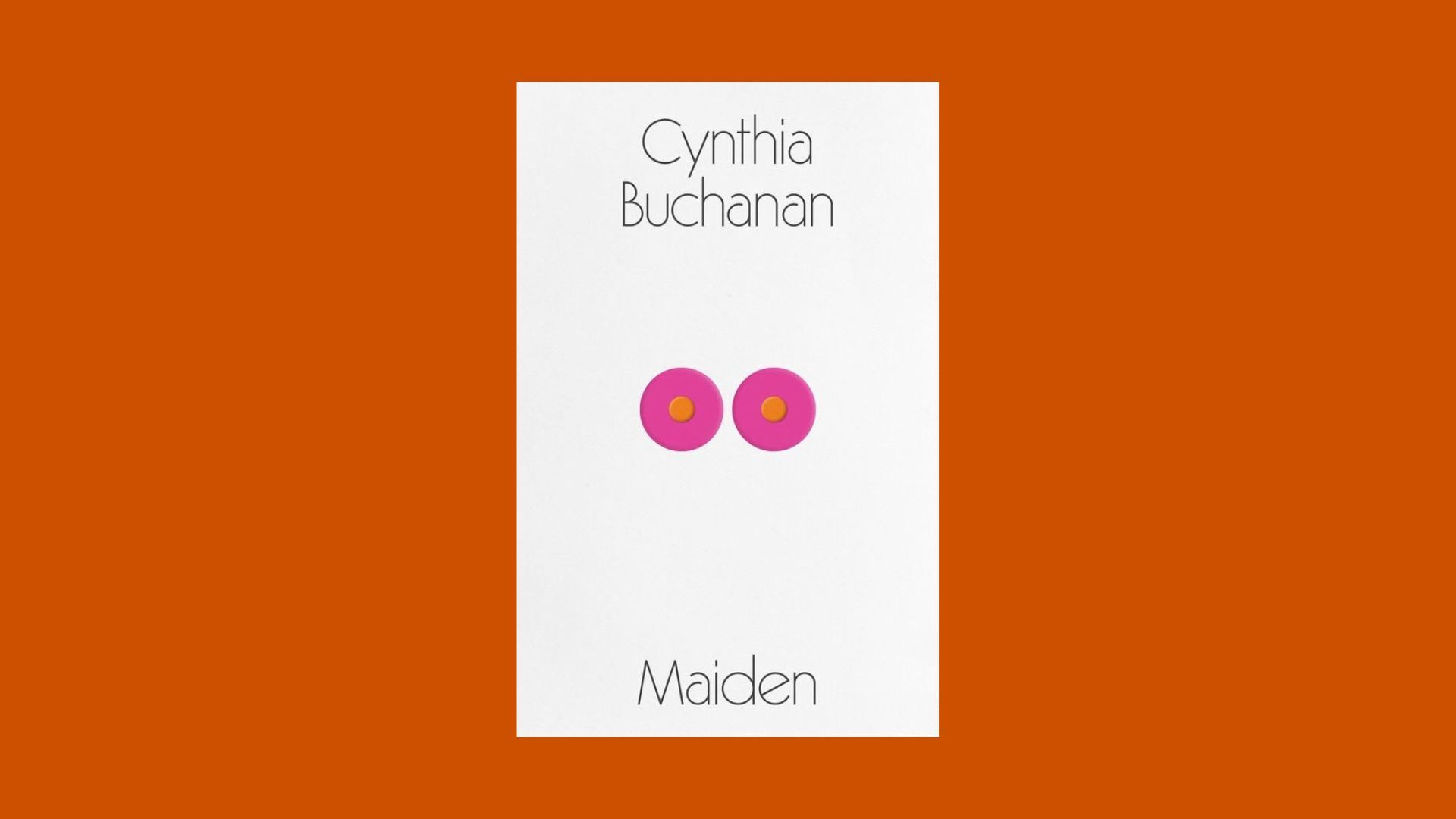
Names, the heroine of Cynthia Buchanan’s 1972 debut novel, Maiden, thinks to herself, “are so vital.” And with a name like Fortune, you’d have to try your luck in California. Although she prefers Fortunée: She calls this a “higher-type pronunciation,” though this also marks it as a maiden name. She’s never gotten lucky. At 30, Fortune is still a virgin, “and her virginity had burrowed in.” “Would life forget about her?” runs her inner monologue. “Overlook her? Pass her by? Misdial? Anxiety became a lifestyle.” Perhaps, as Fortune later comes to believe, names are “not all they’re cracked up to be.”
In the tour de force of an opening chapter, Fortune emerges as a postmodern pastiche of a girl; we know little about her background, other than that she’s poorly educated, from somewhere in the South, and has a brother and a small handful of romantic disappointments whose impact she tries to suppress. She’s papered over the void of her virginity and her background like a teenager decorating a bedroom wall. She is a woman putting herself together from the spare parts of mass culture, a collage of magazine clippings, ’50s movie stars, and dating how-to guides, trying to form herself into someone a man might want—and the book itself is composed of, among other things, an advertisement for a dating service, a reality show audition transcript, court documents, and personal ads. It’s an allegory for America, its manufactured, impossible dreams, its naivete and excess, its delusional self-mythologizing.
On publication, the New York Times grouped Maiden with Sylvia Plath's The Bell Jar and Joan Didion's Play It as It Lays, calling the three "a natural trilogy," and going so far as to suggest that Maiden might be "the best of the three." The novel’s precise, timestamped detail may explain why it faded from view while Play It as It Lays and The Bell Jar became modern classics (though all three feature some attitudes and language that now reads as offensively outdated). But Maiden’s specific concerns are also what make it feel, if not exactly timely, like a premonition or a warning. “Language,” for instance, “haunted [Fortune]. The advertised word … the ‘you’ in advertising, the impossible ‘you’ spoke to her.” Fortune is, like many a chick-lit heroine, constantly in search of a job and a boyfriend, but Buchanan is keenly aware of the lonely logic of commodification that links her two pursuits. Now being reissued by Hagfish and read in a contemporary context, Maiden looks just as much like a funhouse mirror for our own times as it is an artifact of its own, presaging the dating apps, the endless scroll, the conspicuous consumption and pastiched personalities of our era, as it does a reflection of its own.
In her head, Fortune is Miss America, or at least a contender. She regularly imagines conversations with Bert Parks, the contest’s emcee. To her, Bert “stood for any emcee, any interrogator, any reporter, any judge or juryman, any person or thing whose sole interest was her,” the voice of her narcissism and her self-doubt. She is an idealist, until reality comes rushing in.
Fortune fills out a questionnaire for a mail-in dating service called DATAMATE, “the first and foremost Blah Blah Blah in California,” an early effort at treating the mysteries of the human heart as a question of data analytics, which uses “the IBM 360 For Our Guaranteed Blah Blah Blah.” In a move that will be familiar to anyone on the apps, Fortune lies on the questionnaire, shaving inches off her height and padding her résumé. She also argues with the algorithm, sending in a detailed, punctuation-free response to a question about past sexual experience. The narration swerves between the first person and Fortune’s inner monologue, her conversations with Bert in imaginary courtrooms or under imaginary stage lights, and an only slightly more distanced third-person narration; the effect is of a slightly schizophrenic stream-of-consumer-consciousness. It includes fragments of Fortune’s responses to the DATAMATE questionnaire, letters to a lonely-hearts column (seeking advice for her “sister”), self-help pamphlets, pop songs, and advertisements.
She soon receives a brochure in the mail, from the founders of DATAMATE, for a “‘singles’ club for people over twenty-five,” called Villa Dionysus, and without a second thought, she signs up. She moves in with Beverly “Biscuit” Besqueth, a divorcée, who is dating a fellow Dionysid, Milo Campbell (think Warhol’s soup cans). The characters are pop art creations, products—and products of their time. Campbell is, of course, an ad exec. Buchanan mines the shiny surfaces of her characters for comedy. “Finesse in the world of business: this was one of her ideas,” the narrator explains. “Sparkle was marketable! Employers knew this.” But Buchanan is just as attuned to the hollow loneliness underneath, and the novel’s sex comedy has an undercurrent of sadness and death. Biscuit, for instance, tells Fortune, ahead of an abortive effort to lose her ingrained virginity, “It’ll hurt if he doesn’t tell you he loves you. If he tells you he loves you, you won’t feel a thing.”
Despite this, Fortune is an ebullient oddball. Her naive sensibility is evident in her arrestingly un-erotic observations of others’ bodies. When Fortune sees some Dionysids hanging around in the Villa’s lounge, she observes that “[t]he crotches of the men straddling the chairs bulged rudely. The bulges seemed to be protesting: Freedom! I am trapped in here like something limp and puzzling. I am like the dead bait, mollusks, maybe, on the damp, slimy docks by the ocean.” The women, meanwhile, have “tired banana breasts,” or “breasts hanging like hounds’ ears.” She has a knack for making a fool of herself: At her first outing to the Dionysus pool, the Kleenex stuffed into her bikini top come out in the water, forming wet, damning clumps. She accidentally goes on a date with a lesbian, in an episode that retains some of its humor despite its now-apparent homophobia. Later, as an audience member for a TV dating show, she announces her virginity to the whole world. At one point, to avoid a man she likes, she climbs inside a dryer, only for him to open it moments later. (“He said, ‘Are you dry?’ and left.”) She would be pitiable were she not so irrepressible.
At her first Dionysus dance, a Fourth of July party, Fortune meets Samuel “Skip” Fritchey, a dentist with an office in the Villa and Biscuit’s ex-husband. Our heroine sets her heart on this dentist. From their first meeting, she loves him for his faults and that tenderness on her part is charming, though his appeal is never quite clear. One senses it might have to do with his obvious sexual experience and somewhat menacing air. He stands her up for their first date and doesn’t much improve—one chapter recounts a particularly chilling interaction in his office, which smells “like death and unkindness”—but he seems like her inevitable match: Skip and our Miss, two people who never quite realize the American Dream.
The novel is partly the story of their uneven courtship, but it is also the story of Fortune and her fall—as in the hairpiece she begins wearing when forced to cut her hair for one of her many jobs, but also as in Adam and Eve. That first couple is a costume idea Biscuit and Campbell consider for the Villa’s Fourth of July party, but they reject it for being not Americana enough. Fortune, for her part, finds the Bible too bossy, though the novel has its share of Biblical references, and Skip at one point recites a verse from memory. Maiden, with its twinned thematic concern with American myths of manifest destiny and narrative concern with virginity, toys with the idea of states of innocence and states of nature, untouched territory and corrupted utopias.
Maiden is, in many ways, a satirical portrait of its era; it was a critical hit when it was first published. A contemporaneous novel when it was written, it takes place in the long national hangover that followed the radical idealism of the ’60s. Fortune is glancingly aware of politics but, in her self-absorption, world affairs are no more important than her own. Her lack of experience makes sex feel as remote to her “as Communism or cancer,” and at one point, she remarks to Bert, “Down with Reagan, Nixon, Agnew, hemorrhoids, yellow teeth, bad English, war, peace, blackheads, pimples, and trusses!”
It is in its concern with the inner life of its female protagonist against a bleak American backdrop that Maiden compares with Didion and Plath. But Fortune is not Maria Wyeth or Esther Greenwood—despite the novel’s underlying association of sex and death, Fortune is eager for life. And Buchanan’s writing lacks the cool control of Didion’s or the bleak lyricism of Plath’s. Instead, her style, even at its most sardonic, is full of verve. It can be a bit uneven; the dialogue in particular often rings a bit false, though Buchanan’s are phony people. Fortune notes of one of her suitors that he “had a thousand stock phrases. Only 10 minutes had passed, but Phil had shown himself to be a ‘Sorry about that’ and a ‘Would you believe?’ man.” Not promising. Fortune, for her part, puts her own “special touch” on stock phrases, speaking in charming malapropisms. For Fortune, things are “simple as taking pie from a baby,” and “the sky is the oyster!” In language as in life, Fortune has taken bits and pieces of received wisdom and put them together slightly askew.
Maiden is a novel about the impossible demands of womanhood, and the things people fake in the pursuit of real love. The novel builds to a shocking ending, a sudden outburst of violence recontextualizing the courtroom dramas Fortune stages in her head and piercing the illusion of the slick surfaces of civilization. But the violence of this novel is not turned inward. Fortune never gets lucky, but she is, until the end, full of life.