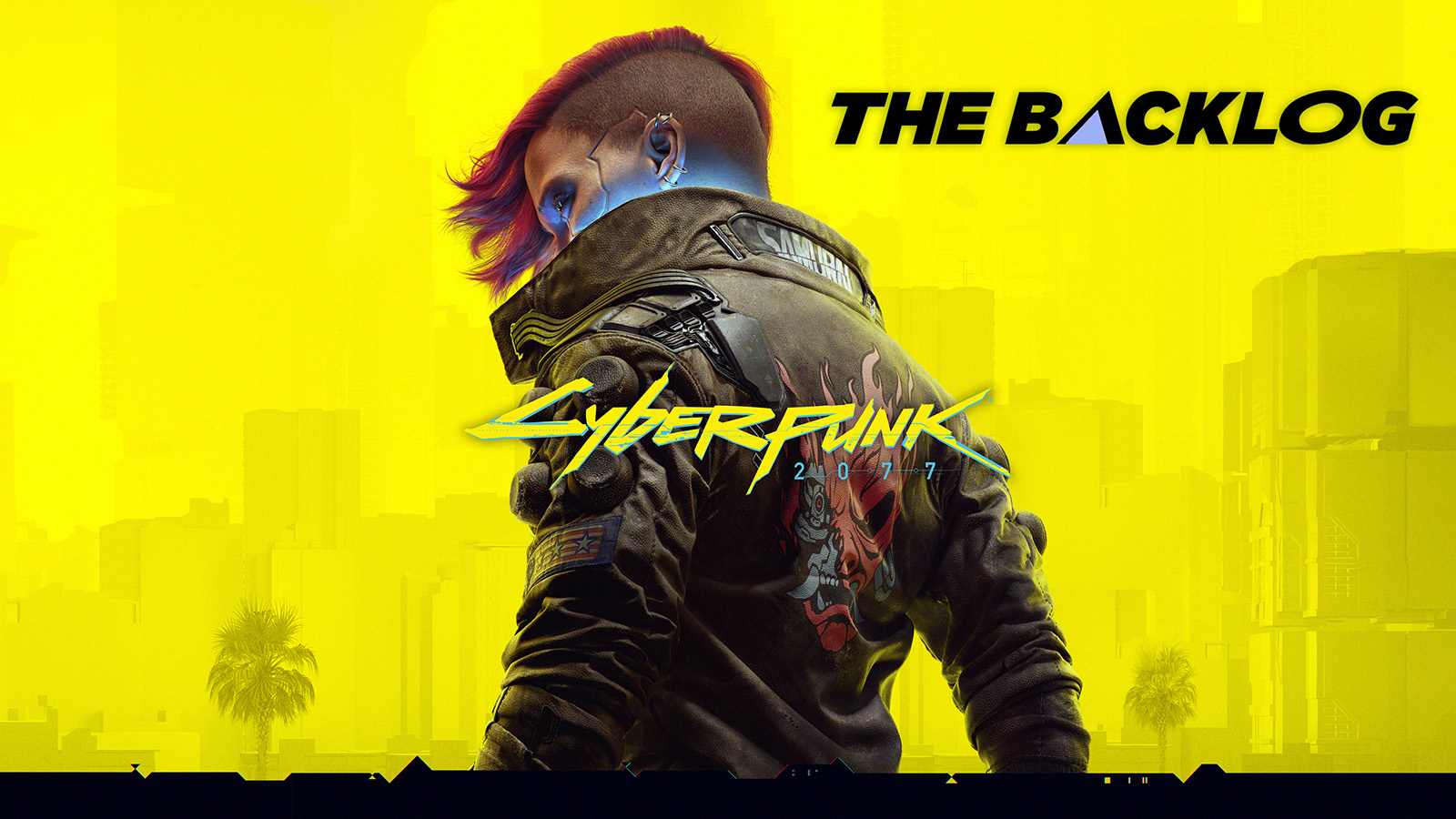
Welcome to The Backlog, a series in which we will take a look back at 12 games from 2020 that, in one way or another, had a lasting impact on the video game industry.
When I first started ruminating on a video game series for Defector, I was playing Cyberpunk 2077. This wasn't a departure from my usual habits or some great coincidence, because I'd been returning to the game often since its 2020 release. (At the time of writing this, I am almost done with what will be my fourth lengthy playthrough of the game.) I have been fascinated with CD Projekt Red's follow-up to the world-conquering The Witcher III: The Wild Hunt since before it even existed. Given all of the hype, the delays, the embarrassing launch, and how much I'm still playing it deep into 2025, I think Cyberpunk 2077 has been the game I have thought about the most this decade.
Five years is a long time in gaming, as I hope I have adequately made clear throughout this series. Opinions about games can change a lot over that period of time, as can the games themselves, thanks to patches and post-release updates. The story of Cyberpunk 2077 is about just how long and winding a game's five-year journey can be. At the end of it all is a stylish, confounding, exhilarating, masterpiece.
What Is It?
Cyberpunk 2077 is an open-world role-playing game that takes place in the titular year, with the titular aesthetic, in a futuristic megacity called Night City. The player takes over the mercenary V and guides them through a story of mortal danger. The player is able to customize their own version of V, and is offered a few backstories for the character to choose from. V can be a "nomad" moving into the city for the first time, a "street kid" that grew up in Night City, or a "corpo," my favorite origin story, which sees V leave the game's biggest corporation after they are betrayed—V has turned into a low-grade mercenary and outlaw, alongside their buddy Jackie.
The pair is recruited into a heist for a microchip that turns out to have the full consciousness of Johnny Silverhand, played by Keanu Reeves. Events transpire during the heist, Jackie dies, and at the end of it, V has to insert the chip into their own brain, where it slowly but surely begins to override V's personality. The clock starts ticking, as V attempts to find a way to remove the chip before their person-hood is completely devoured by the dickish Silverhand.
As for the gameplay itself, Cyberpunk 2077 has a lot of flexibility. V can be a gun-toting merc, a melee savant (wielding katanas, hammers, bats, and even giant dildos), or, as I did my first two playthroughs, V can be a "netrunner," the game's version of a hacker.
In between a main storyline that's tightly paced and plenty exciting, V can do many of the open world activities that have become staples of the genre. There are larger side quests and also quicker "gigs" from fixers around Night City, which usually involve going into a location, extracting a piece of information, and getting out. Cyberpunk 2077 lets you decide how to complete every mission, though, and you can play V as a stealthy infiltrator or just go in guns blazing and annihilate everyone. (There are some required stealth segments, but for the most part, stealth is optional, which is a boon to me, a stealth hater.)
Throw in a lot of outfits to collect, cars to buy, gear to upgrade, and graffiti to scan, and it adds up to a lot of shit to do. Unlike most open-world games, though, I never felt like Cyberpunk 2077 was padding its runtime with these activities. Part of this is due to CD Projekt Red's penchant for engaging side quests; Witcher III has some of the best random storylines in gaming, and while Cyberpunk 2077 doesn't quite hit the highest highs of that game, there are some side quests that have stuck with me in the years since I first played them.
I'll highlight two specifically. "Sinnerman" has V following a convicted murderer who has found religion and wants to crucify himself on live TV in order to spur the masses into religious fervor. The climax of that quest shows the crucifixion in full, which is gnarly enough, but if V performs certain actions in the build-up, they are actually recruited to do the crucifixion themselves, hammering nails into the convict's hands and feet. I have done that quest four times now, and have always needed a walk after.
Elsewhere, "The Hunt" has V helping a cop who is trying to find his kidnapped nephew. This one is even more disturbing, and I will only summarize it briefly: The kidnapper is a man in arrested development who is obsessed both with a very creepy children's cartoon and with pumping young men full of hormones that he used to give cows in his youth as a farmer's abused son. It's horrifying, truly, and though there is a "good" ending to the quest, where V helps rescue the missing nephew, there's a whole lot of disquieting imagery along the way, and plenty of dead bodies.
What Went Right?
It's fair to say that, at launch, very little went right with Cyberpunk 2077. But there was always a great game hiding behind all the game-breaking bugs. I already praised the quests and the open-world balance of activities-versus-fun, but I also have to say that the combat in this game is phenomenal. All of the different ways to play V are strong—maybe the game is too easy, even on Very Hard, but I like the power progression, from early game struggles into near-godhood by the end—and most of them are very fun.
The characters V meets also have rich personalities, even if at times the game can veer too close to Grand Theft Auto-style raunch for little reason. Every main character shines, from the gregarious Jackie, to the brusque fixer Rogue, and the nomad loner Panam. The voice performances are fantastic as well, though I go back and forth on Reeves as Johnny Silverhand; I know monotone is his calling card, but at times it feels a bit too much like he read his whole script in one day. As for the main storyline, the ticking time bomb aspect of V's quest lends every mission a sense of urgency, and CD Projekt Red crafted some of the best set pieces in gaming; the game's opening heist is a blast, and that thrill is matched when V infiltrates a gang-infested mall, stalks a corporate parade, and storms an downed airship in the Badlands. If one follows the main storyline through to its completion without much dilly-dallying, the pacing is flawless.
That dilly-dallying, when it worked without bugs, also has a lot to offer. Just driving around Night City in the many vehicles V can steal, earn, or buy is a lot of fun. The city itself is a gorgeous kaleidoscope of neon and grit, as close to a Blade Runner video game setting as I've ever played. Exploring the many streets and alleys of Night City becomes its own entertainment, because there are gangs of enemies to take out, gear to collect, and Easter eggs to find seemingly around every inch of its massive square footage.
What Went Wrong?
All that being said, woof, the launch was truly a travesty. For a long time, even on a pretty good computer, I ran into game-breaking bugs and visual glitches that made the game unplayable. A lot of these issues were covered on this very website, and as I played more and more, the bugs got to such a frustrating point that I gave up my first playthrough without finishing it. There was always a great game below the mess, and I wanted to enjoy it, but even I have my limits, and Cyberpunk 2077 reached them very quickly.
Even without bugs, there were missteps throughout the game. Reeves's performance often falls flat, which is rough for a game that banks so much on his star power. The initial gear set up was also a mess; cosmetic items gave armor, which meant that the player had to look real silly in order to have the best stats. Initial character upgrades felt minuscule, which made progression a slog. And the aforementioned GTA-esque childishness robbed the game of a sense of maturity that it clearly strives for when asking existential questions about identity and the nature of the soul.
All of these negatives combined to create an experience that just was not up to CD Projekt Red's high standards, and the game landed with a thud once people started encountering all that was wrong in Night City. Sure, it sold a lot, and was played by a lot of people, but Cyberpunk 2077 was as good of an example for why rushing games to market is almost always a detriment to the experience. The good thing, in the long run, is that most of these issues were solved in the years since launch.
Were People Normal About This Game?
No, but for good reason. Given the almost unbearable levels of hype that Cyberpunk 2077 had coming off of the back of The Witcher III, and the long, long, loooooong development cycle, people were correctly disappointed with the game's release. The biggest complaints came from anyone playing on a PS4 or Xbox One, where the game was actually unplayable; it got so bad that Sony removed the game from its online store and Microsoft offered refunds. But even players like myself, who had computers that could run the game well enough to get past the bugs with some torturous fiddling and reloading of saves, the reaction was furious. Here's a game that had been hyped for so long, with marketing out the wazoo, that delivered none of the polish that one could and should expect from a game of this magnitude.
While the game had defenders, I feel confident in saying I've never seen this type of unified fury towards a game and a beloved game studio. It's one thing when, say, Electronic Arts takes the rightful brunt of gamers' ire, but CD Projekt Red had a sterling track record prior to Cyberpunk 2077, which I thought would buy them some goodwill, even if it wasn't earned. But no, this was a near-universal dismay over what could have been and what had been promised. Cyberpunk 2077 was a revealing moment for the video game industry, and specifically the lengths that executives go to make a dollar at the expense of quality.
What's Happened Since?
If Cyberpunk 2077's failure at launch was unprecedented, then so too was the process of reinvention that took place over the next five years. I am confident in saying that if the Cyberpunk 2077 that exists today had been the launch version, the game would be spoken about in the same reverent tones as Baldur's Gate 3 and Elden Ring, the best games of this decade.
First and foremost, CD Projekt Red fixed the bugs. There were so many of them that my first playthrough was frustration after frustration, but I can happily say that every subsequent playthrough has been, for the most part and certainly within acceptable levels, bug-free. Cars no longer fall from the sky like meteors, quests don't get locked out for no reason, and the visual glitches have all but disappeared. So, that's great.
Bigger than that, though, was the dual release of Patch 2.0 and the expansion Phantom Liberty in August and September of 2023. With the patch, Cyberpunk 2077 sanded down a lot of its edges, introduced more satisfying progression systems, and detached stats from cosmetic items, allowing you to create the netrunner of your dreams without nerfing your own power level. That feels like a small change, but for a game as slick as this, not being able to look exactly how you want to because of stats was an unnecessary roadblock.
Elsewhere, the perks tree in the game was completely redone; gone were small, unnoticeable upgrades, replaced by beefier increases to player power. Combat, too, was redone; the AI got smarter, more satisfying gameplay options opened up for the player—I highly recommend doing a katana build, it's a lot of fast-paced fun—and the addition of enemy scaling to player level meant that the challenge was always consistent. Overnight, Cyberpunk 2077 became infinitely more fun to play and tinker with, which is what I would call a major success for just one patch.
The release of Phantom Liberty a month later only improved on what Patch 2.0 had laid out. The expansion's story, set in the previously inaccessible warzone of Dogtown, is high-stakes and full of adrenaline-pumping moments: The opening set piece, in which V has to rescue the President after her aircraft is shot down over Dogtown, is all propulsion and fireworks, and Idris Elba's turn as an undercover agent who V teams up with is more natural than Reeves's oftentimes wooden Johnny Silverhand performance. The way that Phantom Liberty also connects to the main game's storyline, rather than serving as a pure add-on, is also welcome. Given that V has a ticking time bomb in their head for most of the game, it would feel strange if they went into Dogtown just to do the expansion without looking for a solution to their crisis.
The post-Patch 2.0/Phantom Liberty version of Cyberpunk 2077 is so improved that it almost does feel like a new game. Sure, the story stayed mostly the same, and the general gameplay loop—do a main story mission, do some side quests, roam around Night City doing gigs—didn't change, but the way that the game feels in the player's hands is improved tenfold. If there's a better argument for game developers to take their time before release, it's Cyberpunk 2077. Some of the launch stink will rightfully never go away, and I am confident that there is a significant segment of gamers that will never take a spin in Night City because of how the game launched. If only they knew how good Cyberpunk 2077 is now, they'd know that it's something everyone should experience for themselves.
Is It Worth Playing In 2025?
The beautiful thing about the rocky journey of Cyberpunk 2077 is that there's no reason to play the broken version that launched five years ago. If CD Projekt Red hadn't fixed its own fuck-up, then this would be a near-impossible game to recommend. It was that bad of an experience at launch, and I think I would have given it the only 0.0 of the series. However, whether one wants to give credit or not for how well the game has progressed since, the reality is that it has progressed, and into a masterpiece.
I have no qualms about recommending it now, even if I have to couch that opinion with a qualifier: "I know it sucked, but it's really good now, I swear!" There have been other comeback stories in gaming worth celebrating—for my money, No Man's Sky is the standard-bearer for post-launch fixes, but that's a story for a different day—but what Cyberpunk 2077 accomplished over the last five years has turned a calamity into something that has earned at least one playthrough. For that reason, Cyberpunk 2077 gets a 10.0 on the Defector Replayability Ability Scale.