
Basketball has been a key part of my life since I was a little kid, both as entertainment and, very briefly, a possible career. I played school and club ball and participated in numerous expensive training camps knowing that my parents, both of whom played in high school, felt strongly that the world of professional sports might be a viable means of making a living. I never connected with that dream and ditched basketball the second I had the option.
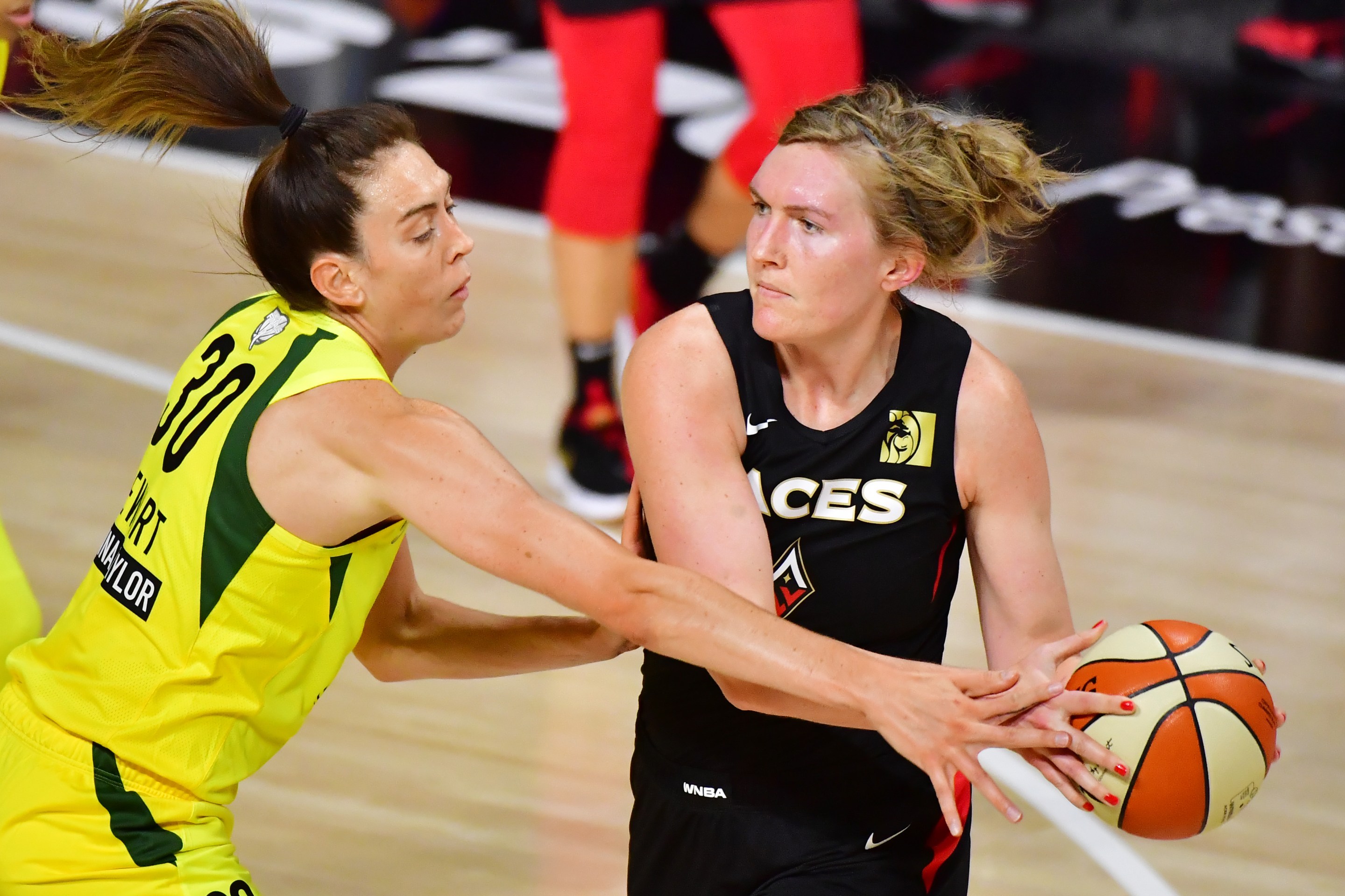
It wasn’t until I started attending Aces games here in Las Vegas that I began to fully appreciate the possibilities of the sport, as a game of finesse and skill and a stage for organized labor. Nascent but scrappy, the Aces were an expansion team created in a city that lacked a cohesive sports identity. The Aces have become a dynastic power in the WNBA, winning three of the last four titles, and their rise has come at a time attention and scrutiny on the league has dramatically increased. My family got a more intimate glimpse of these developments when we became friends with veteran journeyman Carolyn Swords, who played for the Seattle Storm, the New York Liberty, the Chicago Sky, and overseas teams during her career before dedicating her last years to the Aces.
I reached out to Carolyn while the new WNBA collective bargaining agreement was still being litigated to chat about her playing years, her time on the executive committee of the 2020 CBA, and what the future of the league holds when athletes continue to advocate for each other. Our conversation has been edited for clarity.
We have more exciting things to talk about because the deal has been signed!
Definitely! I was looking forward to our conversation because you were playing at a very interesting time, both before and just a little bit after the 2020 CBA. I’m curious what your perspective is on things in your retirement.
I loved my playing career, both in the WNBA and overseas. It changed my life and shaped who I am and took me all over the world. And in doing so, that helped me learn all sorts of things, things that you learn through playing: skills and knowledge and teamwork, but also resilience and courage. You see what you're made of when you have to grocery shop in another language and you can't call anyone for help because of the time difference.
I also really loved being part of the Players Association. I was a player rep for many years and then, in my final years, was part of the executive committee that helped to negotiate the 2020 CBA, an incredible group of women: Nneka Ogwumike, Layshia Clarendon, Sue Bird, Elena Delle Donne, Elizabeth Williams, and myself. The conversations we were having were inspiring. It's hard because you're trying to make change, but hard in a good way, and I feel like trying to solve those problems and thinking about the business in the league and making sure that my teammates and other players felt heard helped me to feel ready to retire. My career was possible because of the players and women who came before me.
I'm curious if you had any experience with collective organizing before the WNBA.
That's a great question. I think the W was really my first time. I was part of our student athlete advisory committee at Boston College. It was on a smaller scale, discussing what it is that the student athletes needed and then thinking about certain programs and initiatives.
But I really learned from the other women in the league. I think it was 2016 when the Minnesota Lynx held a press conference talking about police brutality, and then we at the New York Liberty did the same thing. Talking about what's happening in the world and what we can do about it. I think that's something that WNBA athletes do exceptionally well. We think beyond ourselves and what it is we can do with our platform. So 2016 was really an inflection point for me.
When you were coming up, including in college, what was your sense of women's basketball? I'm trying to find a better way of phrasing that question. What I mean is, was the gendered divide between men’s and women’s sports something you thought about much? Did it affect what careers you thought were possible?
So, two parts.
It always felt possible because the WNBA was established in ‘96 when I was still young. ‘96 was also the kick-off to this epic Olympic run for the women's USA Basketball team. I was maybe seven or eight years old. So as I'm old enough to start playing organized basketball, professional women's basketball is now happening. As a tall girl, you see these other tall women out on the court like Lisa Leslie, Rebecca Lobo. I had female role models to look at just as my brothers had male role models, so that felt possible to me. It’s incredible because that wasn't always the case.
I think I really started to focus on it a little bit later in my playing career. I played basketball because it was fun and I enjoyed the competition. I played all sports. It was after my freshman year where I went to Boston College. I played for the late incredible Cathy Inglese. She really valued and focused on our game preparation. Teaching skills and knowledge of the game, watching film on both ourselves and our opponent. I really enjoyed strategy sessions as a team and I was like, "Oh, this is now fun for me on a whole new level. I want to keep doing this as long as possible." I don't ever remember feeling like it wasn’t viable.
My freshman year was when Candace Parker and Sylvia Fowles were like the senior class. So I experienced a lot of excitement and momentum even if it was on a different scale than what we're experiencing today.
You played a very intense and full career, including overseas in Italy and Australia. I remember when I was young, we always thought of the international leagues as workhorse leagues, or a consolation to not making it in America, which is obviously a juvenile mindset. What was your experience like?
In order to make basketball a livelihood, I had to play year-round. There was a financial component, but also as somebody who is excited about traveling and trying new things, even if it was scary, the opportunity to play in different countries, learn different styles of play, new languages to communicate with teammates and get around, that fueled my curiosity. Both components helped make me feel there was a wholeness to my ability to play professionally, and also pay bills.
How did you end up playing for the international teams you did?
So I played for Spain, Turkey, Italy, Australia, and Poland. My agent worked on my NBA contracts and my overseas contracts. Through his network of agents and team relationships, he would figure out who's in need of a center and then who's in need of a center like me and then provide those options. I had an opportunity to choose and decide like, "OK, I'm going to go play in Italy next season."
I knew that most of the WNBA players who we watched every summer then went overseas, but it used to be very difficult to actually view those games. It might be a little bit more available with YouTube now, but that wasn't necessarily something you could tune into. So, I didn't know a lot. I didn't talk to any of the players who were doing it. I just knew that it was an option and part of being professional on the women's side at the time. It took a lot of research and relying on what my agent was telling me and then taking the leap. My first time overseas, I was in Spain for half the year and then Turkey, and I hadn't been to either before. But I just figured it out and relied on my teammates and the other American veterans who'd been doing it for a little while.
Having played for a variety of teams across your career, did you feel like you could apply your skills on the court easily at each place? Or was there a bit of an adjustment?
It was a little bit of both. It's great when you land in a place that needs you and needs your skill set. I'm a traditional post player, very solid by the rim, high post shot. If you look at my stats, I never shot a three [laughs] but my role was as a presence on the inside on offense and especially defense. The additional benefit of playing overseas was that I was able to continue to work on my game in a competitive setting with a new group of women and potentially a different style of play, and then come back and feel like I'd elevated my game in real time.
The downside of that is never really having an off-season, and that takes a toll on your body after a while. Whereas now, it's been great to see athletes playing the WNBA and then resting after a very competitive season. Plus, these leagues like Unrivaled and Athletes Unlimited, which are not only exceptional competition but very creative leagues in how they're operated and very player-focused.
How did you become a player rep?
I think some of it is my student-athlete advisory committee roots. It's very student council vibes. When we would have discussions with the staff of the union and then veterans like Swin Cash, Ruth Riley, Ticha Penicheiro, Tanisha Wright, they were exceptional on the court and super engaged with what the state of affairs was in the W. This thing is happening. A team is having an issue with the flight. How are we handling it?
At some point, basketball goes from a hobby in your youth to your business. It means thinking about the game in a professional way, not just because you're getting paid to play, but because you are labor. That was really exciting to me. I think maybe in my third year I volunteered to be a rep. Every time CBA negotiation time came around, I enjoyed being part of those conversations and trying to hear from my teammates and pass that information along. How can we be improving everything from compensation to player experience to health and wellness? Those were sort of our buckets back in 2020, trying to ensure that the voices of my teammates were being heard.
I’d love for you to talk about your retirement and then brief return to playing with the Aces in 2020.
I sort of retired and unretired within the same offseason. Coming back in 2020 was my version of the pandemic curveball, in that I got one more year as a professional athlete and we went to the WNBA Finals.
At first, I was excited to be joining the front office of the Aces. Both in New York and Las Vegas, Bill Laimbeer was my coach. I learned so much from him both on and off the court. I think I played for him about half of my career. He always emphasized that there will be life after basketball and was very supportive in helping athletes figure out what that was. I was drawn to the business side rather than full-time coaching and had an opportunity to essentially do an internship with the Aces front office. I worked mostly with the community manager, but really the entire business operations staff. That was the first offseason after our inaugural season.
Did you feel ready to retire at that point?
It was a bittersweet decision. I love basketball, and I was excited to maybe solve some different problems around the game and serve the players in a different way and think about what it is that I'm working toward. After the 2019 season felt like a good time which, in retrospect, sounds so funny. Because then the pandemic happened and everything shut down. We all had a change of plans. That was an interesting time because the Players Association was still negotiating what a season would look like and, that year, Vegas had two international post players: Park Ji-su and Liz Cambage.
I think also the Olympics were still planned for 2020, so Ji-su stayed in South Korea. At that point I was furloughed, and we didn't know what the state of the season might be, but I got a call from Dan [Padover], our GM. He's like, "I know you just made this big life decision." But I was like, "Actually, yeah. Let's do it. I have so much training to do.” Luckily, it was within the same offseason. You stay sharpest in basketball by playing basketball and doing your workouts. So luckily, I'd been running and doing Pilates, but I had to get back to the gym. So it was a decision I didn't think was coming, but I'm thrilled that I had the opportunity, and that ended up being a very unexpected but wonderful season.
How are you feeling about the future of the W? Each CBA builds off the gains of the previous one, and when you were involved in 2020 seems like a real inflection point for how the league has evolved.
Expansion was something that, as I was retiring, was a sort of fingers-crossed-one-day thing. At that time, there were 144 players. That's such a small percentage, that's so few roster spots for professional women. Last year's addition of the Valkyries is an incredible example of how a team and its players just continue to redefine what excellence looks like on the court and off the court.
And I'm really excited that in this new CBA, with compensation and benefits, these numbers are life-changing. This executive committee put in standards saying, “This is what it means to be a professional team and what practice facilities should look and feel like, and these are the resources available to the team.” That being solidified in a deal ensures this additional growth in an upward trajectory. It’s about letting the players be exceptional on the court, which they are, night after night.