The importance of black literature in America has turned on its relation to the canon, and its proximity to political usefulness. The art and biographies of groundbreaking black figures are often turned into blunt tools with which anodyne lessons about equality and acceptance are fashioned. When I first read the works of James Baldwin, Maya Angelou, Malcolm X, and Martin Luther King Jr., it was often presented as a lesson. Teachers, sympathetic non-black readers, and American culture at large would remind me, explicitly and implicitly, that these were first and foremost well-written and historically significant PSAs relegated to a narrow experience of life. In other words, black writing was rarely more than a category of moving, powerful, but crucially inoffensive examples of speaking truth to power. The not-so-subtle emphasis: that black literature is more useful for a very specific political purpose than as art.
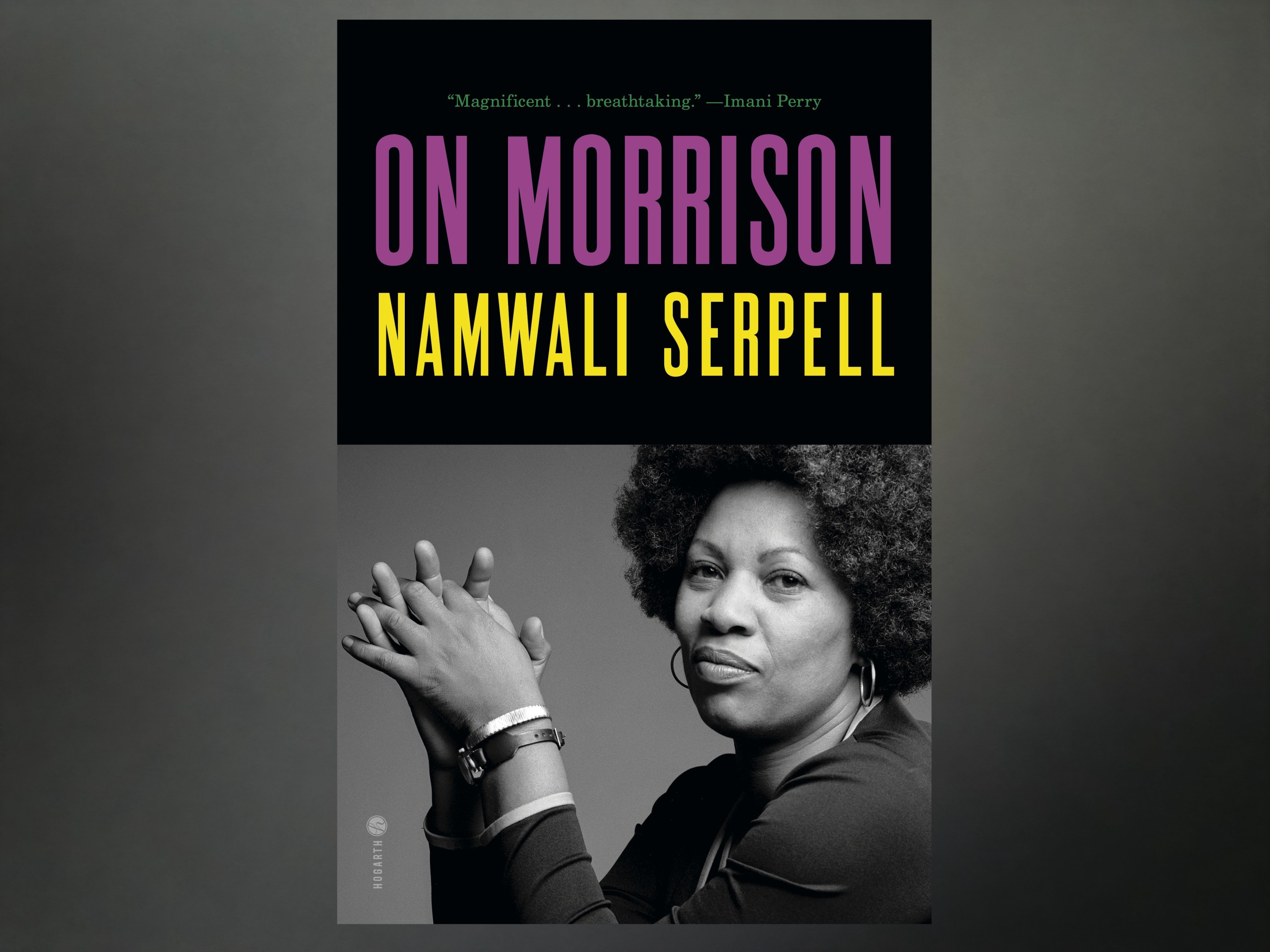
Namwali Serpell’s On Morrison is an intervention into this literary siloing, a work of bracing, rigorous, and thrilling critical appraisal not just of Toni Morrison’s evolution as a writer of fiction, but of the richness and complexity of the black literary tradition. While she is a professor of English at Harvard and an accomplished critic, I knew Serpell first as a novelist and, later, as my workshop mentor. Her epic speculative debut, The Old Drift, blends historical fiction with science fiction, stretching from the Zambezi River to outer space. Her follow-up, The Furrows, charts a family’s grief through the seductive slippage of broken time. With On Morrison, Serpell marshals both her fictive imagination and her critical acumen to bring forth knotted, uncompromising, and often surprising aspects of Morrison’s work.
Over the phone, we spoke about the capaciousness, and frustrations, of the archive, the centrality of Morrison’s difficulty both as a writer and a public figure, Serpell’s focus on the work of the artist over the biography, and how empathy shapes American political thinking. Our conversation has been lightly edited.
I've been a bookseller for a decade now, and in the last couple years I've only seen more and more books about Toni Morrison. You reference some of them, including Toni at Random, about her time as an editor. Her novels are also being republished with new covers. I wonder what you think is going on with this concerted push.
I think it's very much part of the gradual transformation of Morrison into a monument. It's a monumentalization, but it's also an institutionalization. It's funny, I was just thinking about a pun that I think she would have enjoyed, which is: Toni Morrison™. There's a real desire for the kind of clarity, intelligence, beauty of her commentary as a public intellectual. Our desire for that means we are turning to the books to extract quotable, memeable lines. There's also a real desire to look at her career outside of the writing, like her editorial work and her work as an academic. It's easier to process in our attention-starved world than it is to sit down with a Toni Morrison novel and go through that experience. I don't think it's a bad thing for us to be thinking about Morrison, reading her, watching videos of her interviews. It's wonderful, and it's something she merits. My book really is thinking about her as an artist and thinking about the particular experiments and developments, refinements, that she was doing with the novel form, with fiction. I feel that might fall by the wayside if we pay too much attention to her as an icon of black excellence.
I’d love for you to talk about why you started this book with a chapter on difficulty. On Morrison’s difficulty as a writer, her interpersonal difficulties with others, how her status as an icon obscures the complexities and uncomfortable elements of her work. This defanging happens with almost every prominent black figure, from James Baldwin to Octavia Butler, this sense of pre-digestion of the idea of a person.
The reason that marginalized writers, in particular women and black people, get overwhelmed or occluded by their own stature is traceable to the origins of their writing, their literature. What you find is a lot of people have trouble reading Virginia Woolf because they're coming to her with the sense that she's this incredible feminist icon. They’re very troubled by what they actually have to read and try to reconcile that with the words on the page. The same thing is true for black literature, in part, because those writers who were able to break through the hegemony or dominance of white literature, and present their work for the first time, were doing so in a mode of political representation.
In particular with black literature. The slave narrative is the origin of African American literature. In the African context, the decolonial novel is the origin of African literature as it is understood by the West. Of course, there's a much longer tradition of storytelling and art-making that precedes that. But when you enter the realm of the public sphere and you're saying as Henry Louis Gates Jr. puts it, "I write, therefore I am," there's an immediate tying together, almost inextricably, of the question of politics and the question of the literary. So the very fact of the book, the very fact of the work of literature comes to stand in for something.
And it makes it really hard to actually take the text on its own terms. For Morrison, what this resulted in is a kind of sociological way of reading black literature. How well does this represent blackness? Is this a respectable portrait of blackness? These were accusations that hounded her own work, that she was telling secrets that were supposed to stay within the community. She was airing our dirty laundry. She was presenting a bad picture, particularly of black men. She thought this was absolutely absurd that these were the grounds on which literature is being judged. In some ways, it's an inescapable bind for anyone who's trying to write from a so-called marginal position. One of the ways that Morrison resisted that was through this difficulty that she would manifest unpredictably. Sometimes she would be really sweet and polite and engaged with her interviewers, and sometimes she would be quite hostile. It didn't really matter what their identity was, it had much more to do with the kinds of questions that she was being asked.
I reread Faces at the Bottom of the Well by Derrick Bell as I finished On Morrison. Bell and Morrison present very different but congruent forms of thinking about blackness, with an equally full and almost scholarly understanding of whiteness. There's a parallel there. It's not specific to Morrison, it's not specific to Bell. In Morrison’s Paris Review interview, she encapsulates the project of Playing in the Dark by talking about Faulkner and how Faulkner understands and is talking about blackness in a way that is never acknowledged, because people assume he was just a racist white Southern writer. There's something so interesting about the almost childish narrative people continue to have for black writers and how they approach their understanding of the world.
It's remarkable to me the extent to which her statements like, “When I say people, I mean black people,” or when she says, “I don't mind the labels because being a black woman is an incredibly rich place to write from, a richer place, in fact, than being a white man,” these get construed as kind of self-segregating tokenistic monetizing of the self rather than what she's doing, which is actually re-establishing what the human is from the black center. She was always aware that we have to know both sides. This is Du Bois and double consciousness to the nth. Morrison says the role of the black critic is to be able to have that double vision. I think there's a lot of resistance to seeing blackness or brownness as central, even though we are the global majority. It’s almost a kind of epistemic shift that she's asking you to make. What's really interesting to me is the extent to which this gets misread as anti-white or even as a kind of elision of whiteness as opposed to an incorporation of whiteness, but at the margins.
Morrison often got asked, “Why don't you write about white people?” She was asked so many times that it's actually funny to trace the evolution of her responses because sometimes she would say the same things. There's a point where you can tell she's bored of repeating herself, so she starts saying other things. The best answer she ever gave to that really remarkable question, and it was a shocking question to her when she first heard it, she said, "I do. I have written about white people. What are you talking about?" Look at the work. There are major characters in Tar Baby who are white. Throughout the other novels, there are many, many minor characters who are white. It's not that they're not there, it's just that they're minor characters. Just that is enough to get read as erasure or invisibility.
It parallels when she's talking about Poe or Hemingway or these white writers who seemingly have no black characters. She says, “Blackness is there but it's at the margins.” I can imagine people thought she was being ridiculous, that she was reaching.
Again, she got it from both sides. She says, “The white critics were upset that I was talking about race in their white authors because they thought I was accusing them of racism. And they laughed. The black critics were upset because they thought, ‘Why would you waste your time talking about this when we need to actually be talking about black literature?’” One of the most incredible instances of exactly this is in an interview with Charlie Rose. He's asking her about this project and she's, at that point, developing Playing in the Dark. She says, “You know, these 19th-century writers, the way that they dealt with race…” and Rose responds, "Well, they didn't. They didn't write about race.” Morrison’s like, "What are you talking about?" and then she just lists off the ways that race has appeared in Hawthorne, in Poe, and in Melville.
What's incredible about her reading of Melville in her speech, “Unspeakable Things Unspoken,” is the way that she is able to see what has been there all along: the whiteness of the whale.
It’s an entire chapter!
This is why I think psychoanalytic language is so useful for her in Playing in the Dark.
She talks about blind spots and repressions and pathologies. When you look at it, it really does feel a little baffling that people would ignore or pretend or pass over these moments that are incredibly racialized even if they don't feature raced characters. There's a critic, Shelley Fisher Fishkin, for whom Morrison's work was so important in saying basically, “Look again. Let's notice what's happening here.”
I found it so revelatory that it's almost impossible for me to watch a movie like Pixar's Soul and not see the racial tropes that are being deployed. They seem to go right over the heads of most Americans. When I watched the film, I thought it's almost too obvious for me to point out these things. But when I published a review, which was very inspired by Morrison's work, people were furious with me and they kept telling me that I was seeing things that weren't there.
Let’s talk about reading, shade, being read, being clocked. I love your invocation and reiteration of what I feel has become a very diluted term from black culture.
Yes! I got interested in the curious omission of the black queer sense of reading from our scholarly conversations about how we read now, which has pervaded our discourse in the discipline of English literature, and literary studies, and critical studies. There have been so many issues and books and debates about what we call, for a shorthand, “the method wars” over the last few decades. I was teaching Paris Is Burning, Jennie Livingston's documentary about queer, black, and Hispanic ball club culture in New York City. There are these huge title cards to explain the topics that are going to come up. And there was a huge title card that said, “Reading.” I thought, "Wait, I use this word all the time." We all know from RuPaul’s Drag Race that reading is fundamental. But just the word “reading,” why aren't we talking about this? So I wrote a piece called “Notes on Shade”—originally it was called “Notes on Reading”—that was an examination of how this particular practice that we call reading happens to embrace many of the methods that were being pitted against each other in English departments. Symptomatic reading, where you're reading beyond the surface looking at the symptoms of the text to read what's going on underneath, which is what Morrison does in Playing in the Dark. But also, reading the surface of somebody, staying completely on the outer appearance and not speculating about their psychology, reading that outer appearance and focusing on the details of what someone's wearing or what their makeup looks like.
Zora Neale Hurston has some wonderful definitions and even scenes of reading. But I found myself going back to certain works of Morrison's, in particular her essay on Huckleberry Finn, where she is looking at the text very closely and she's seeing something that most people wouldn't notice, which is one definition of black queer reading. In this case, with her own panache and with her own style and with her own rhetorical flair, the fact that Jim is a father figure. It's not about accusing Mark Twain of being a racist. In fact, she's very clear that that's not the purpose of this exercise. But it is this attempt to capture the ambivalence that she feels as she both takes great delight in reading the text and can also see what's missing, what's flawed in it. To me that doubleness of a kind of aggression and a kind of pleasure in the fact of your noticing is so characteristic of shade. When I came to teach the course that became On Morrison, I thought I needed to reread these texts with an eye to this critical method that Morrison is using.
There’s a part in On Morrison where you quote her frustration with discourse about the canon: “Ad hominem and unwarranted speculation on the personal habits of artists, specious and silly arguments about politics,” which obviously has not gone away. Can you talk a little bit about that, specifically in the case of your writing about Toni Morrison? I wrote down in my notes “ambivalence about the life in full,” but maybe ambivalence is the wrong word. You just don't ever go into any specious conjecture about her life and, if you do speculate, it's usually through a personal lens.
There are a few reasons I do that. One is that it's my own tendency. I've never been a biographical critic, and for much of my career I wasn't even really a historian. I was not that interested in connecting the work to the life of the writer or to the world in which they were creating their art. I think it's partly because I was trained as a formalist. I was trained really to focus on form. Also, because the reason I'm reading the thing is not to understand how things used to be. The fact that the work has transcended history or come to me already in this form is much more interesting, what’s on the page that has lasted, that has gone beyond and exceeds the life of the author. Morrison herself has a similar bent.
So when she's writing about critics, or when she's writing about the canon, for example, she will have a couple of sentences about the fact that Melville had a particular nickname, or about the fact that Willa Cather had a particular relationship to her mother, and these will inform her readings. But she's really not interested in the personal, biographical elements of writers. In her master's thesis on Woolf and Faulkner, she barely talks about their lives or the context of their writing. She was much more of a formalist as well as a critic. As a writer, she really disdained biography. She didn't want her papers to be put, as she said to her son, in some place where someone could write some stupid biography. She wanted to maintain an air of mystery. She refused to go on Finding Your Roots. She signed a contract to write a memoir then cancelled it. She said, “I don't find my life interesting.” Other people did, but she didn't care.
I never met Morrison. I think there's a weird way that that gives me a kind of distance and detachment from that sense of her as a person. There are a lot of people who want to talk to me about the time they met Toni Morrison and what she said and how it was. I love hearing those stories. But to me, I actually think not meeting her allows me to have a certain intimacy with the work. Because that's the only way that I know her, is through the work and through the words and that specific literary, or let's just say linguistic, intimacy of language, what she called “one's mind dancing with another's.” It’s something I don't believe we have enough robust, compelling articulations or enactments of. There are a lot of people who write books about their personal relationship with Proust or their personal relationship with Jane Austen and that's a particular kind of fandom. But I think the model that Morrison herself set, how she read those authors that she believed were her peers, is something I find very moving and also something that I really wanted to try to do myself.
There's also grounds for me to do it insofar as Toni Morrison was born Chloe Anthony Wofford. She kept those two identities very separate. Toni is the shortening of her baptismal name, Anthony. She chose to convert to Catholicism when she was a teenager. Morrison is from her ex-husband whom she divorced before she published her first book. The fact that she saw them as these two figures—she actually said she felt like Chloe was always walking behind Toni, watching her back.
She didn’t completely reject the biographical, but it came from a different emphasis.
She said, “I used some autobiographical elements in my first novel.” In interviews, she'll say, “There's a particular image of this woman that my mother knew and that the neighborhood women knew that became really important to Sula.” Or she'll say, "I knew a girl who had this horrible experience with her father,” in her introduction to Love. She talks about how important her father was to Song of Solomon. It's not that there's no autobiography. What's interesting to me is when she talks to her students at Princeton about writing fiction. She says, "I don't want to hear about your little lives. I want you to write something that is about other people." And what's really telling is at the end of that, which is a kind of explanation of her pedagogy. She says, "Even if they do end up writing a memoir, at least they'll be thinking of themselves as strangers.”
I think that is really important to how we consider how Morrison uses her own life in her work, and other people in her work. But it's also really important for us, even as we analyze things like autofiction, to keep in mind that there is an estrangement happening purely through the process of writing. You are already othering yourself when you write, “I am,” because you are putting down a voice that is distinct from you.
This might be a bit passé, but can you talk about your use of the lowercase for “black”? It’s something I’m compelled by. The relatively recent house style of capital-B Black has always made a very narrow kind of sense to me.
It’s my insistence that I not capitalize “black.” In part, I’m following Morrison's lead. The only novel where she capitalizes “black” is in Tar Baby and she capitalizes it in a very particular context. Which is to say, she's writing about black Americans in the Caribbean, so she's, in some ways, using it to distinguish between different black ethnicities, or cultures. But also I think she's playing with dimension, with big and little B in terms of adjectives and nouns in that novel. So it becomes a useful aesthetic gambit for her. You'll find occasionally some of her earlier essays and some of her earlier interviews around this time, the ’70s and early ’80s, she's doing some capitalizing of “black,” but it's inconsistent. It's inconsistent even in her drafts. I think it's very telling that, in all of the other books up to God Help the Child, she doesn't capitalize “black.”
For me, it speaks to the kind of richness that's available if you don't capitalize “black,” because then you can be using “black” to refer to the color, to people. There's this wonderful line in Song of Solomon where someone is talking about the different shades of black and night and a character says, “Black may as well be a rainbow.” The internal contradictions and multiple meanings of black are more available to you if you don't capitalize it. As I say in my introduction, I think it concedes too much because it’s basically saying this imposition of race onto a multi-various people is something that we now accept. It protests too much. It insists on itself in a way that doesn't correspond to the eternal variety of blackness. Samuel R. Delany has a similar feeling about it. He talks about he and his friends running through the library and lowercasing the capital B's because there's this sense that it can be more revolutionary if it is not institutionalized.
Before I let you go, I want to bring up your New York Review of Books essay “The Banality of Empathy.” It’s one of the best pieces of criticism I’ve ever read. Provocative, challenging, and I think of it often during moments like now, moments of heightened political or social unrest. I'm curious if your feelings about the thesis of that essay have shifted since you've written it.
They have in certain ways. I became aware of earlier antecedent work that had very strong resonance with the argument I made in that essay. One was James Baldwin on Native Son in “Everybody's Protest Novel.” The term that he's using is “sentimentality.” It's not anti-empathy but it's anti-sentimentality. Also Saidiya Hartman's work in Scenes of Subjection does a really incredible job of showing how the desire to put yourself in the body of the suffering, even from the perspective of an abolitionist, can take on a kind of prurience and delight in the fact that you don't ever actually have to experience that suffering. It really casts some skepticism on our motivation behind this sympathy-empathy model. Those are going to end up in the longer version of the essay, which I'm hoping to republish as part of a collection. The title of the collection of essays was going to be after a different essay, but the more I think about it, the more I want to call the collection The Banality of Empathy and Other Essays.
I see confirmation of my sense that the empathy model is a ventilation of political feeling, a distraction from genuine political action, every day. The most recent example was Hillary Clinton’s piece from January called “MAGA’s War on Empathy: This crisis in Minneapolis reveals a deep moral rot at the heart of Trump's movement.” I don't subscribe to The Atlantic, so I haven't read the entire thing, but what I know is that at one point, at the very end of the essay, she talks about whether she can find it in her heart to empathize with ICE agents. For me, that feels very parallel to Karl Ove Knausgaard’s speech where he talks about empathizing with Hitler. The reductio ad absurdum of that move, which does have a Christian logic behind it. Love thy enemy. But it's much less politically useful than other models from Christ such as overturning the tables outside the temple, the righteous political and, in my mind, proto-socialist theory.
We have seen a rise in right-wing Christians talking about the sin of empathy, how it’s being weaponized by the left. It’s a kind of anti-solidarity stance, very un-Christ-like of them.
Parul Sehgal wrote a long piece in the Times a few months ago about the resurgence of the word “solidarity” across one person's new book. I read it and I was like, "Oh, I didn't realize that solidarity was having a moment.” But by the end of the essay, the word feels like it's kind of emptied in the way that empathy has been, by overuse. One of the things I've been noticing in myself is that I'm increasingly thinking about politics as being divorced from emotional or affective relations. I understand that communal feeling and concern for others is an important affect of the political and of the social. But for me, the idea that you have to like someone or care about someone in a genuine way in order to share interests with them, to have material interests and shared stakes in how we build a world—I just feel like I don't actually have to like you, or I don't even need you to like me or care about how I feel on a day-to-day basis. What I need you to do is recognize that we're both human beings who want to be able to live in the world. But we're so addicted to feeling that it's hard to think about politics in that way without sounding really cold and detached.
One of the things I'm trying to figure out for myself is how the project of literature in particular doesn't require relatability, but it does require some version of experiential learning about others. A way that allows for politics to happen that doesn't rely on empathy. There’s a fake dialogue that Bertolt Brecht wrote about empathy. Brecht famously wanted to make sure that his audiences did not get subsumed in emotion, that they were able to think rather than just feel. It’s called “Conversation about being forced into empathy.” He says, “The object is to fob us off with some kind of portable anguish. That is to say, anguish that can be detached from its cause transferred and lent to some other cause.” At the very end, and I love this, he says, “Suppose a sister is mourning for her brother's departure for the war and it is the peasant war. He is a peasant off to join the peasants. Are we to surrender to her sorrow completely or not at all? We must be able to surrender to her sorrow and, at the same time, not to. Our actual emotion will come from recognizing and feeling the incident's double aspect.”
That to me seems like a really fascinating possible path for my argument to take in this new version of the essay.
Editor's note: An earlier version of this article contained several questions and answers that were removed post-publication by request of the interviewee.