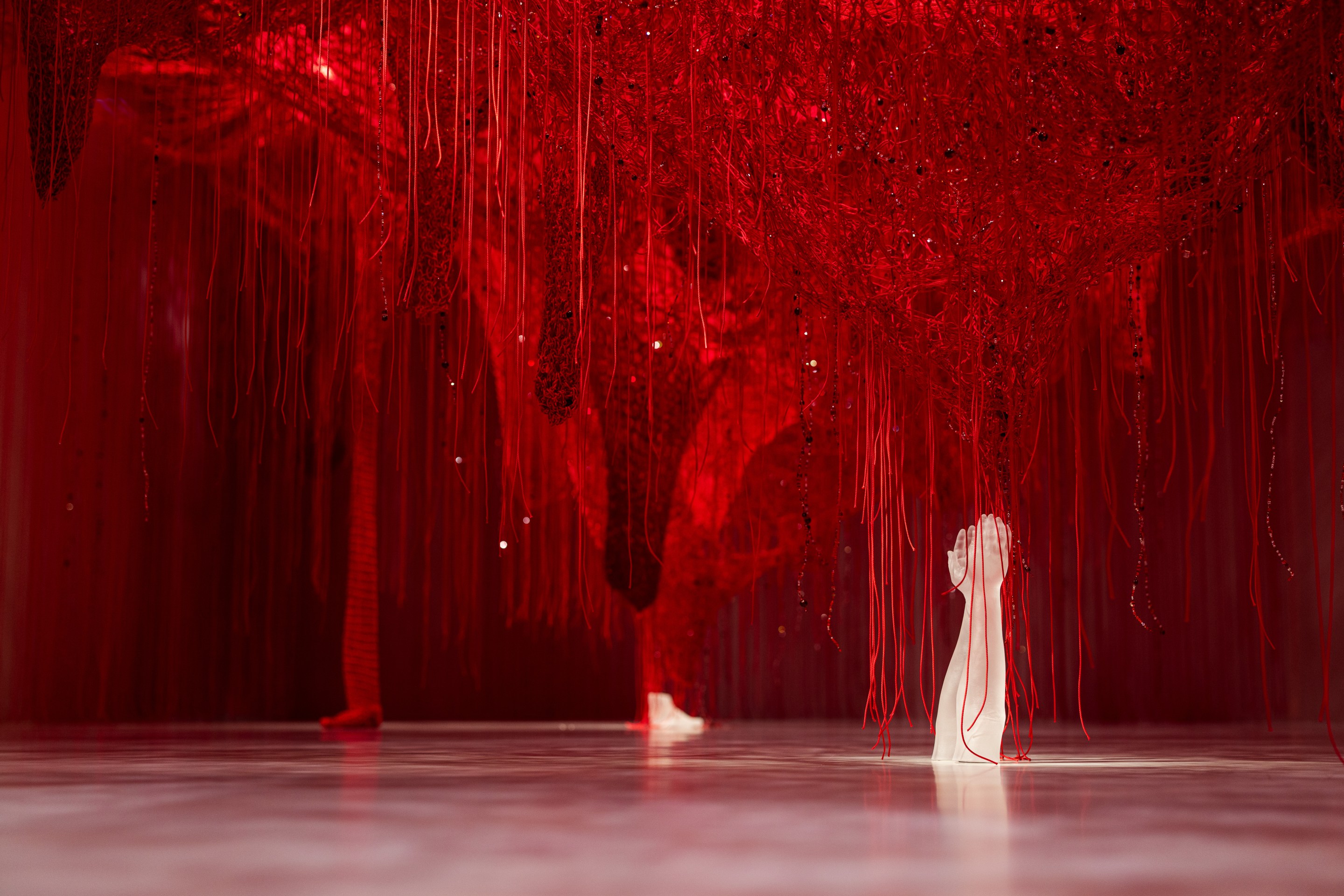

The first time I consciously contemplated a museum’s installation-specific smell was in Fernando Romero’s “El Sol” at Kristallwelten in Innsbruck, Austria. Viewers stand in a cave-like, red-lit room under a Swarovski crystal sphere exactly one-billionth the size of the sun. It even sounds like the sun—the University of Birmingham’s School of Physics and Astronomy spent 30 years recording solar acoustic wave data, which has been sped up about 100,000 times to create the installation’s soundscape.
Standing in the room is somehow both soothing and disconcerting. If you don’t read the informational display or listen to the audio tour, you might feel like you’re just standing under a particularly fancy disco ball, listening to a higher-pitched edit of dry wind across an empty plain. But it was the scent of the room that struck me: a blend of thyme, black juniper, moss, and gunpowder, inching the red cave toward the realm of the uncanny with the combination of color, sound, and scent, making it easy to envision yourself in the isolation of space or a very high-concept haunted house where that staticky pulsing wind might start saying your name.
Many of Kristallwelten’s other rooms (Chambers of Wonder, as they call them) have scent concepts as well, though less distinct. The rooms smell pleasant, usually lightly herbaceous. There’s a lot of pine and mint to go with all that glittering crystal. It makes sense for a museum that’s essentially a very lovely Swarovski advertisement.
Kristallwelten isn’t the only museum in which one can find distinct scents, and once you start looking for these exhibits, they start popping up everywhere, an aromatic Baader–Meinhof. At the Ullens Center for Contemporary Art in Beijing, an Anicka Yi exhibition had tempura-fried flowers sitting behind glass in a hallway that smelled (to me) of oily seaweed, while a room away, sheets of kombucha leather were sweetly decaying. The Detroit Institute of Arts allowed visitors to “The Art of Dining: Food Culture in the Islamic World” to sniff boxes scented with coffee or floral scents that might have been present at centuries-old dinner parties. Over in neighboring Wisconsin, Emily Endo develops individual fragrances for their sculptural installations, which delicately circulate marine and orchid scents through systems of tubes in “Estuary” at the John Michael Kohler Arts Center; an accompanying fragrance-making workshop speedily sold out. Across the pond, high-end perfumer Maison Francis Kurkdjian created custom scents to accompany a mixed-reality piano performance by Yuja Wang at Cannes.
The scents don’t always quite match the art, though. Alexis Hyde, executive director of the Quinn Emanuel Arts Foundation, remembers going to see a Bruce LaBruce work in a hotel room in 2007. The installation was supposed to look like a murder scene, but the fake blood was all made out of corn syrup, leaving the room with an unforgettable breakfast aura. “My friend and I were so excited to see this really raw and invigorating exhibit and then walked in and were like ‘So, IHOP next?’” she said.
How specific scents end up in certain parts of a museum is rarely an accident, and often they are themselves the main attraction. Olfactory artists, who use scent as their primary medium, have long built entire exhibitions around scent. More subtle incursions can be whiffed in exhibitions and other public spaces all around the world, thanks to the work of perfumers and other professionals who can help turn an artist’s intention into scent.
Whatever their intent, olfactory artists and dabblers alike must tread with precision. While the visceral nature of smell opens up wider possibilities for artistic expression, it also brings new risks. Curate your scents just right, and visitors can experience a whole new emotional reaction to the art they are seeing. Get it wrong, though, and you might send them running for the door.
Saskia Wilson-Brown, founder and executive director of the Institute of Art and Olfaction, points out the key distinction that separates olfactory artists from artists who just happen to incorporate scent: “Is the smell the work, or is it in support of the work?” And the list of olfactory artists, once one starts looking for them, seems endless.
Peter Decupere, who is apocryphally believed to have coined the term “olfactory art,” has been working in the space for 25 years, with projects including the “Olfactiano” scent piano and a work called “PTDB - Tree Virus” that included a scent specifically designed to make visitors cry. Equally established artist Sissel Tolaas is currently working on creating a “language of smells” called Nasalo and analyzing the smell molecules present at the ruins of Pompeii. Maki Ueda created a series of “Olfactory Labyrinths” that visitors navigate exclusively by smell. And those are just a few of the biggest names.
“Scent is having a moment like craft beer did 20 years ago,” said Wilson-Brown. On a consumer level, indie fragrance brands are growing rapidly and getting increasingly niche. Culturally, the IAO is seeing more and more artists incorporating scent into their work as well.
Not every artist wants their installations to smell what we traditionally think of as “good.”
It’s nearly impossible to start digging into olfactory elements in art and not encounter Anicka Yi. The subject of at least three separate New York Times profiles, writer of her own New Yorker essay, and featured in countless other publications, Yi is one of the best-known olfactory artists working today. One of her early exhibitions, “You Can Call Me F,” featured a scent created with bacterial samples from 100 women. Art News called it her “breakout show” and named it one of the 100 best artworks of the 21st century. Her Tate Modern exhibition included scentscapes based on specific points in the history of the Bankside Power Station alongside large flying machines she calls aerobes; another work, “Immigrant Caucus,” was made of chemical compounds from Asian-American women and carpenter ants.
I first encountered Yi’s work by chance at the Beijing installation of her show “There Exists Another Evolution, But In This One.” It is, to be straightforward for those not deep into the contemporary art scene, weird (complimentary). The room is sometimes eerie, sometimes playful. There is no overhead lighting, just floor and wall lights around the pieces. Some moving sculptures look like weird robot jellyfish. Motorcycle helmets and metal bowls are spotlit inside plastic quarantine pop-ups. You can stare into an oceanic bacteria void. Every part of it smells different, but you probably wouldn’t want your house or perfume to smell like any of it.
Trendwise, the word “immersive” is thrown around enough in art and art-adjacent spaces that it can mean anything from following Broadway-caliber performers around an elaborately dressed warehouse for three hours (RIP to Sleep No More, the ur-immersive theater performance) to waiting in line for that same number of hours to take a five-second selfie in a four-square-foot ball pit. Despite the fact that your whole life is, in fact, immersive if you are paying attention, people continue to pay to stand in the middle of screens projecting digital images of famous paintings. But it’s hard to get more actually immersive than smells. Scent, as Wilson-Brown points out, is literally going inside you.
“It’s a complete embodiment of a space or a world,” she said. “It can be a very subtle conveyor of emotion or memory. It can be subversive or complimentary. There’s something there in that experience an artist can play with. [Creativity is] communication at the end of the day, and scent is a communication tool, so why not use it?”
Most people don’t have particularly sophisticated smell perceptions and can’t pick out individual molecules, and it’s easy to get close enough, said Wilson-Brown. “You could get the caricature of New York at midnight after the club, and for most people that’s definitely good enough. But what if we attached the level of precision we attach to our painting or installation work to the actual scent composition?”
If the IAO succeeds in its mission, we might.
Olfactory art toes the line between abstraction and information. You probably know what mustard smells like, but it’s sharper when it’s right next to vanilla, placed in the context of the other smells in your kitchen. A Thierry Mugler perfume tube is presenting you with the straightforward scent of that perfume, but it means more when accompanied by an explanation of what that perfume represented in the fashion world; conversely, the phrase “amber gourmand” might mean absolutely nothing to you until you smell it. Rather than just looking at an antique dress, you can smell the molecules that have come off it, tying you to the person who once wore it.
For artists or institutions considering enhancing their existing works with a scent component, there are two key questions: What is the scent going to be, and how is it going to get into the room?
Choosing the scent is where that “good enough” level for most people’s senses comes into play. Sometimes even the artist doesn’t know exactly how to dial in their olfactory vision. This is where a different kind of expertise is useful.
“One I love is ‘I want it to smell like the ocean,’” said perfumer Darryl Do. “OK, which ocean? Because water is one thing, but being at the beach is very different. In Hawaii, being at the beach, you’ll smell all the flowers, the sugarcane, the pineapple fields. If you’re in Rockaway Beach, you’re not going to smell those things. It’s going to be slightly more ozonic because the water’s crashing on the beach, and it’s definitely not as floral.”
Do has worked in the fragrance industry for 42 years. He’s currently the senior perfumer at his family’s Delbia Do Fragrances and has experience in perfume formulation, regulation, and creation. Over the course of his career, he’s worked with hotels, virtual reality experiences, museums, and more.
“If it’s a lush green forest, that’s relatively easy,” said Do. “Versus if it’s a shiny bright metallic room in a high-rise building. One is a scent of the environment, the other is more a feeling or vibe.”
Emotions are even harder. “Sometimes I have to tell them I can’t convey the smell of love,” said Do.
Browsers of independent gift-y shops and bookstores in the early 2000s may remember Demeter Fragrance for its displays of neatly aligned clear square bottles, usually found alongside gifts you’d give your weird niece. Scents like Grass, Earthworm, Old Book, and Funeral Home sat alongside more conventional but similarly whimsical options like Bubble Bath, Christmas Bouquet, or Kitten Fur. The company has also worked with children’s museums, theatrical experiences, and even zoos. Demeter is, in fact, the fragrance supplier for Punchdrunk, the theater company that started Sleep No More. It’s even provided museums with custom fragrances to use in docent-led tours for the blind, in which guides will describe the art and then use the smells to enhance the experience.
Mark Crames, Demeter’s chief perfumer, has found that some curators and designers haven’t actually answered what they want smell to bring to their experiences. He encourages them to start with the end in mind, then work backward from there. “Scent is visceral,” Crames said. “You feel more through your nose than you do your eyes. So when you bring scent into a visual medium, you have to be very careful and thoughtful about how you do it or you can overwhelm what you’re trying to expand.”
Even the professionals’ commercial fragrance ability is still limited. Museums often ask for what Crames calls “malodors,” which are hard to get. One whaling museum wanted to smell like a historical pier. “If you want to do an exhibit about what the streets of New York smelled like in 1855, it’s going to be hard to find stuff that smells like that,” he said. “That’s not what people are making.”
Do has specifically designed some of what he calls “anti-fragrance,” including one requested to be put in a museum in an especially fancy bottle. “It was kind of like the emperor’s new clothes,” he said. “Is everyone going to get on board and say, ‘Oh my god, it’s great, it’s so unique,’ or are they going to be honest and say it smells like vomit? There are items like that which are more for shock value than to really convey any story.”
If you talk about scent for more than about five minutes, someone will inevitably tell you that “scent has the strongest link to memory.” Wilson-Brown hears the phrase so often that if she were creating a bingo card for the IAO, that would be the number-one comment.
The short and overly simplified explanation of this is that scent molecules in the air hit the olfactory neurons in your nose. Those neurons send a signal to your brain’s olfactory bulb, which then sends the information to other relevant parts of the brain, including the piriform cortex (which translates nerve signals into a “smell”), amygdala (sometimes known as “the emotional center of your brain”), and hippocampus (where the brain forms memories).
Most of the sensory input humans receive goes through your thalamus, which processes the information and sends it elsewhere. Not so with smell. Scent basically gets to skip the middleman and go straight for your feelings without stopping for analysis on the way.
In addition to its human customers, Demeter also provides scents to the Brookfield Zoo for use in behind-the-scenes animal enrichment. Smells that are novel to the animals are particularly useful for encouraging exploration; some of the big cats were recently introduced to the pizza and pumpkin scents. “It demonstrates how primitive and fundamental the relationship with scent is,” said Crames. “We’re just a smarter animal. The fact that more primitive animals react to scent the way they do and their behavior, that tells you how powerful the scent cues are. The animals react to it and they’re happy. It’s a very simple response and that’s where the proof lies.”
As anyone who has ever walked past an Abercrombie & Fitch mall storefront knows, filling a room with a specific scent in a controlled manner isn’t easy to do. “If you flood a room with a smell, good luck to you getting that smell out,” said Wilson-Brown. “There’s a technical proficiency that needs to evolve alongside this practice, and thankfully that’s happening.”
Crames has a number of questions he asks of collaborators, including how prominent they want the smell to be, how long it should last, and whether there will be rotating scents in the room. Galleries can use low-tech methods like cotton balls in a glass or reeds in a bottle, or more mechanical strategies, like boxes that blow scent into a room. If an institution is going bigger, Crames refers them to other companies that specialize in scenting larger spaces. Do once scented a hotel by installing a diffuser into the building’s HVAC system. Even paper blotters work.
Sometimes, scent arrives by accident. When the Brooklyn Museum was installing its Thierry Mugler retrospective in 2022, one of the 400 bottles of Angel perfume being hung from the ceiling fell and broke. “In retrospect, maybe I would like to have said that was intentional,” said Matthew Yokobosky, senior curator of fashion and material culture at the Brooklyn Museum. “It gave another element to the show it wouldn’t have had otherwise.”
Visitors could also experience Mugler’s fragrances in a more controlled way in scent tubes designed to project a contained waft of the perfume. It became a museum employee’s dedicated job during the run of the exhibit to regularly check in on the scent cartridges.
However, the scent you deliberately put there isn’t the only one in the room. Hyde served as director of the Museum of Broken Relationships in Los Angeles on Hollywood Boulevard, a place with “a lot of area smells,” she said, leading her to use lavender or incense smells in the exhibit. “The exhibit itself is asking a lot of you, and I wanted it to be a place where you could feel safe to have feelings and be open to the experience of it,” she said. “I wanted to create that spa background—white noise but for your nose—so it wouldn’t be interrupted by car exhaust or cigarette smoke.”
I took a visiting cousin and self-described fragrance nerd to see Sleep No More, and she had been particularly excited to see how the show used smells to transition between rooms. After attending, she complained that with all the perfume-wearing crowds, all she could smell was Le Labo and Maison Francis Kurkdjian's Baccarat Rouge.
“It adds or subtracts from the exhibit the same way a scratch on the wall or a weird tapping noise from next door would,” Hyde said. “All of these things can interrupt or enhance.”
As with any art, once the final version is out there, the audience will interpret it as it will. Your nose has a figurative palate just like your mouth does, and the same molecules can smell different to different people. This is why one person might say a wine smells like cherries and has tasting notes of bell pepper, and another said it smells like leather and tastes like blackberry. Both of these can be true. (The third person who said it tastes like wine is also correct.)
Abstractly, because of scent’s tie to memory, it’s equally impossible to know what emotions a given scent will trigger. As Wilson-Brown pointed out, most people think of lavender as a soothing scent, but if you were once attacked in a lavender field, it’s not so relaxing for you.
LA’s new Dataland “museum of AI arts,” a phrase that this article simply does not have room to unpack, has visitors wear a collar that claims to generate smells based on the wearer’s individual biological feedback. KCRW’s reviewer Carolina A. Miranda referred to it as being “gassed … with what smelled like a floral room deodorizer” and took off the collar to avoid a migraine, as did LAist’s Julia Paskin.
This isn’t necessarily a scent-specific problem—someone who hates chaotic abstraction is probably going to have a bad time at a Jackson Pollock show. But if you hate a painting visually, you don’t have to look at it. If you hate a smell, you can’t escape it quite as easily. And people might simply hate it, or worse, experience physical side effects like headaches or nausea that aren’t in the expected museum hazards.
“In some environments scent has a reputation like peanuts, and people don’t want to be exposed to it,” Crames said.
There is a fine balance in the creation of any art between throwing everything you have at the wall to see what happens to work versus making deliberate choices about what will actually support your intended message.
“If you scent everything then nothing is going to be unique and new,” said Do. “Can you imagine going through the Met if you had a scent throughout the place? Or going through the natural history museum and having the dinosaurs smell musty like a horse stall?”
But the Met does have a smell, even if it wasn’t put there on purpose. The Sculpture Court smells different from the Temple of Dendur. Sometimes, both of them smell like sweaty tourists. No matter what it is, your brain is going to respond to it. And then, maybe years later, you’ll catch a hint of sandstone and street pretzel and get kicked in the teeth by the memory of your last visit.