

Work in the outdoor industry long enough, and you’ll learn that only certain jobs in the U.S. are allowed to be taken seriously. Spending your days emailing about nothing is a “career.” Drafting slogans to feed the AI machine? Impressive. Combining the abilities of an EMT, chef, navigator, and athletic coach? Well, you’re just playing outside.
Outdoor recreation work is often seen as summer camp for adults, an in-between seasonal way for young people to play around and earn some cash while they figure out what they “really want to do.” But when a bear shows up at your campsite, an avalanche swoops down, or you step over a root wrong and snap your ankle 30 miles into the backcountry, a guide might be the only thing standing between you and your fast-approaching mortality.
So what’s a hard-working guide to do? How does the outdoor recreation industry earn its well-deserved respect? For some, the answer is unions.
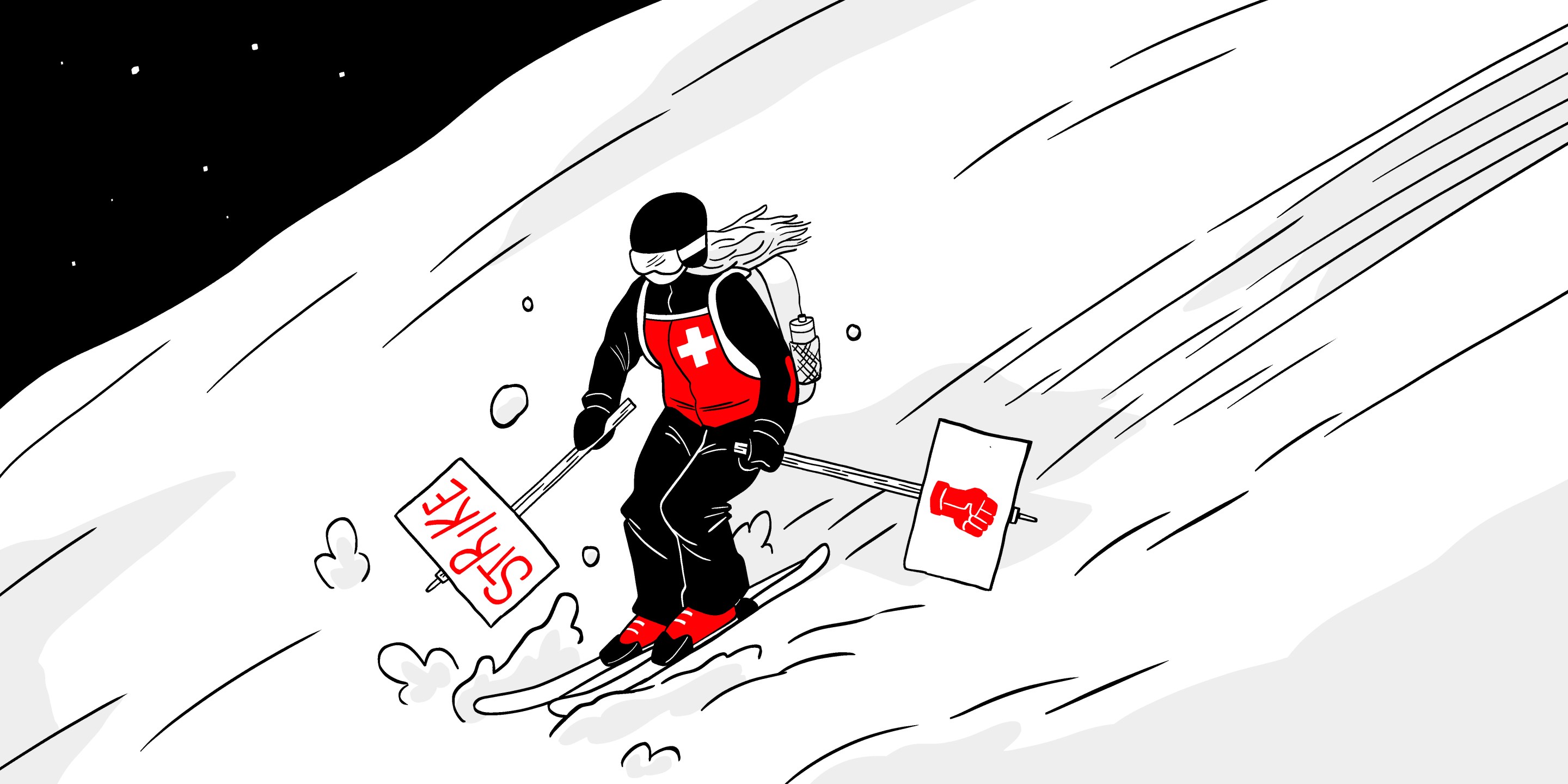
The union organization movement has been steadily gaining steam in the outdoor industry. Most recently, the Telluride Professional Ski Patrollers Association, founded in 2015, went on strike on Dec. 27, 2025, over contract disputes. Members only agreed to end the strike on Jan. 10 after a petition signed by members of the community, asking them to return to work due to the economic damage the town was suffering as a result of the resort being closed. “We must also face a third, darker truth together,“ the petition said. “This strike is not hurting [resort owner] Chuck Horning.”
While the union did successfully negotiate for pay increases, the new contract does not address the resort's overall wage structure, which was among their main concerns.
“I’m still recovering from everything we went through,” said Jessica Lyles, treasurer for the TPSPA. “I’m disappointed, but I’m also really proud of what we did do and what we did get, and that is more money for all of our patrollers across the board. But we didn't fix the problem.”
Despite her disappointment in the strike’s result, Lyles, who has lived in Telluride for 19 years, still sees value in union solidarity.
“We couldn’t have gotten anything done without the union,” she said. “As much noise and banter and negative energy was going around us, it just made us closer as a group within the union, and I feel like we’re stronger than ever in that sense.”
Telluride’s patrollers were also joined on their picket lines by five patrollers from Park City Mountain Resort who travelled down to lend their support and experience. Ski or schadenfreude enthusiasts likely remember last winter when the Park City Professional Ski Patrol Association went on strike from Dec. 27, 2024, until Jan. 7, 2025, sending holiday tourists into a tizzy. Though the much larger mountain never fully closed, it was at times operating at around 20 percent terrain capacity during one of its busiest times of year. The union ultimately secured a base pay increase of $2 per hour, as well as higher increases for more senior patrollers.
The movement isn’t just on the mountains. During the government shutdown this past fall, Outside magazine asked if unions could “save the National Park Service.” According to that article, more than 40 NPS units are unionized, with up to 100 more working on doing the same, all under the National Federation of Federal Employees.
Meanwhile, indoors, a June 2025 press release published in Climbing Business Journal cited 15 unionized indoor climbing gyms across the country. Even REI, seen by many as the wholesome retail face of the outdoor industry, has had its own union saga, with 11 currently unionized stores engaged in an ongoing series of monthly bargaining meetings, with the next scheduled for mid-February after union employees voted not to ratify the initial proposed contract. Its employees’ union efforts started in 2022, originally in reaction to policy changes during COVID-19, and continue to focus on issues around employee hours and scheduling, company stances, and lack of stability.
Unions in outdoor labor sectors aren’t a new phenomenon. U.S. natural tourism destinations have long seen underpaid and overworked employees living in company towns, and those have historically been conditions ripe for organizing. “Any time people are working outdoors, you often see groups of radical workers,” said Steven Beda, an associate professor at University of Oregon. Beda specializes in labor history in the Pacific Northwest, where union efforts in the field of resource extraction go back to the late 19th century in industries like commercial fishing and timber.
These jobs, much like many low-paying, exploitative, and dangerous jobs today, were primarily worked by immigrants. “It’s as true today as it was in the past. Where you see exploitative labor or jobs, you see employers trying to take advantage of immigrants,” Beda said. Those immigrants also bring traditions with them that combine with the dangerous nature of the work to create a history of “radical unionization.”
For example, take Bend, Ore., which started out as a logging town. When the timber mills started to close, and the communities that economically relied on them couldn’t recruit new manufacturing industries, those trees had to start growing money in a different way. Communities like Bend pivoted toward selling themselves as recreational destinations. The move drove the local economy away from those unionized industrial labor jobs and toward lower-paying service sector jobs, which lack all those hard-won union protections.
A shift toward a recreational industry also attracts a whole new kind of resident. Rich people probably aren’t shopping for their second homes in a mining town, but they’ll start looking at properties in a vacation destination. Zillow puts the average home value in Bend at approximately $720,000; one broker in a May 2025 article from Central Oregon Daily News noted that most buyers were coming in offering cash and buying houses for over $1 million. If the workers who power a town’s tourism industry can’t afford to live there, eventually they’ll have to leave, and it’s unlikely that the new millionaire neighbors will be picking up the guide pack.
“Something is going to have to change, and it’s going to have to be dramatic,” Beda said. “If this doesn’t get addressed, then these economies are going to collapse.”
If anyone can tell you about the issue of not being able to live where you work, it’s the ski patrol. In the case of Park City, the former Canyons resort began its union under the Communications Workers of America in 2000 in order to have a more standardized way to hold management responsible, according to Syd Hyer, mountain village vice president of the PCPSPA. The Park City side of the mountain joined the union in 2016 when industry titan Vail Resorts bought both resorts and unified them under one umbrella. Hyer, who grew up in the area, remembered skipping school to picket that purchase outside the resort.
When the ski patrol went on strike last season, the local radio station ran a segment asking people about their thoughts on the strike. “The real locals were saying, ‘We’re so proud of them, this is so amazing,’” Hyer said. “And then they interviewed Joe Schmoe from California, who has his third home here, and he was saying, ‘It’s so outrageous that the patrollers would do this, they’re so selfish.’ Real locals would come up to us and tell us about it, and tell us how they laughed.”
Hyer would wear her union sweatshirt out to get groceries and have community members stop her in the store to express their support; other residents regularly brought coffee and bagels out to the picket lines, and the strike fund raised more than $300,000 to pay workers during those two weeks.
The strike made national news when visitors posted about long lift lines, and even sued Vail Resorts. Afterward, one investor wrote a letter to Vail Resorts, expressing disappointment in the company’s performance over the previous years, pointing out that "the core skiing community has labeled Vail the ‘Evil Empire.’” (The letter itself is more focused on shareholders' disappointment that Vail has not made them more money, and its list of proposed suggestions for fixing this does not include “be less evil.”)
“They actually have some power with striking there,” outdoor guide John Pate said. “If five raft guides at one company strike, who cares, they’ll be fired. But if you can’t ski Provo or Jackson Hole for an entire weekend, that’s a big-deal strike.”
Under the CWA, the United Mountain Workers currently represents 16 different mountain units, with a 17th potentially coming after Jackson Hole patrollers filed for a union election in November, according to the UMW website. They aren’t a new shop, either—the Crested Butte Ski Patrol originally organized in 1978.
Before the 2001 union contract, ski patrollers were making an average starting salary of around $8 per hour. In 2021, entry-level patrollers started at $13.25 per hour, with a wage cap of $24 per hour. A single-day adult lift ticket to Park City this season costs $239 if you buy more than 28 days in advance, or $351 if you don’t. Vail reported a net income of approximately $280 million in its 2025 fiscal year (which ran from Aug. 1, 2024, through July 31, 2025).
Previous union gains at Park City included pay raises, a yearly gear stipend, incentive pay for patrollers who take on training roles, and paid education opportunities like professional search and rescue workshops and medical trauma conferences. The 2001 contract even included a requirement that the company provide patrollers with two cups per day of coffee, tea, or hot chocolate. In 2024, negotiations originally included a union request for a health insurance stipend that was ultimately denied, but that the union will likely prioritize in future negotiations.
Patrollers were also previously expected to provide their own avalanche kit, which is mandatory equipment. Assembling a kit today, which includes an airbag, beacon, shovel, and probe, would cost around $1,000 with the cheapest options currently available at REI, or about 125 hours of work at $8 an hour (not accounting for taxes). Personally, though I’m sure it’s no reflection of their skill or dedication, I have concerns about getting rescued by someone who had to choose their equipment based on sorting by price low-high.
Hyer, who is now in her fourth season with the ski patrol, has often had conversations on lifts with resort guests who see ski patrolling as something she’s doing for fun until she gets a “real job.”
“It’s funny, because the things we do are very real,” Hyer said. Patrollers respond to an average of 25 to 35 wrecks each per season, with some patrollers responding to over 50; a “wreck,” in patrol parlance, is any accident severe enough to require medical attention. In addition to scooping up incapacitated skiers, patrollers perform ski cuts and handle explosives in avalanche terrain to mitigate avalanche risk, climb towers for lift evacuations, and perform tricky rescues with toboggans and ropes in challenging terrain, often carrying both guests and gear.
“We save lives,” Hyer said. “Just because we’re having fun while we’re doing it doesn’t mean it’s not a valid career.”
Organizing can still be slightly easier for ski patrols, where everyone in the field is part of the same single enterprise and mostly in one spot. For workers like hiking guides, who are more likely to work for smaller private operations, it’s a trickier task, but one that’s no less necessary.
“It’s not hiking all day, though some days are like that,” said Pate, who has been in the industry for around 12 years, with jobs in rafting, hiking, outdoor education, wilderness therapy, and more. “You don’t just get a background check and a backpack and go out.”
The usual path of entry for an aspiring raft guide, for example, starts with staff training. Someone decides they want to be a raft guide for a summer, so they pick a company and pay to participate in their staff training program for around one to two weeks, including medical, river, and rescue training. Staff training is rarely free, but the reputable outfits try to keep it affordable and come up with ways to offset the cost for applicants who stay on as employees.
At the end of that training program, our aspiring guide may or may not be offered a job. If they are, it won't come with a guaranteed number of work hours, and trip assignments are usually based on seniority. “Some people don’t know whether or not they’re going to work when they wake up in the morning,” Pate said. “To get to the point where you can make a predictable living takes a lot of years of being at somebody else’s beck and call for not that much money.”
During Pate’s first year at one camp, he was paid $1,800 for an entire summer, which included five or six shifts of 14 days each, with three days off in between. Not only are many workers not getting paid well, but they also frequently have to live on company property in isolated locations, in conditions that Pate once had an owner describe as “a cult that makes money.”
“So many job postings say something like ‘Natural beauty is a perk of the job,’” Pate said. “I’ve never paid an electric bill with fucking beauty before.
“The industry is so fragmented that any organizing power or leverage a worker has, they’re doing it on their own. Your ability to ask for a raise comes completely down to your personal relationship with your boss. There’s no backing when you get fired for a bad reason. When a company owner seems to only hire attractive women for many years and only promote men, there’s nobody to go to for that. When a company is taking tips out of a paycheck, or has hired on someone who’s working with you that is completely unqualified or drunk on the job—things that happen, especially in the raft guiding world—there’s no recourse for that.”
But let’s say you’re somehow fine with the subpar pay, hours, and living conditions. Perhaps you’ve created a machine that transmutes your enthusiasm for a mountain sunrise into electricity for your van. There’s still a physical and psychological risk involved in guiding.
Pate has broken his skull twice while on the clock, fended off a bear with a kayak paddle, narrowly dodged a landslide, and reset a guest’s broken leg in the woods, to name a few. “When I reset that leg, I wasn’t guessing. I train other people on how to do that now,” he said. “But it weighs psychologically on you.
“There are people on this planet who still have appendages because I went above and beyond what I was expected to have for my position. If I hadn’t put extra time and training in to be better than the standard, that lady whose leg I reset might not have a foot right now. I’m not saying that to brag, I'm saying that because that’s a sad thing. I should be able to trust that all the guides I'm working with can do that, and people I take outside should be able to trust that they’re not just lucky.”
Though some states have their own licensing requirements, there’s currently no national standard guiding credential. A wider guide unionization effort could create one, establishing guides’ qualifications both for hiring purposes and client peace of mind.
Guest injuries are infrequent but usually manageable, excluding severe situations. If you’ve ever had your guide joke that the most dangerous part of your trip was the drive out, it’s true. Guide injuries are worse. Most guides will try not to report their own injuries, because they won’t be able to work the next day. “The season is short, there’s only so many trips you get to run, your body’s hurt all the time anyway,” Pate said. “If you’re scheduled to work during peak season and don’t have a replacement, guess what, you're still going out in the field.” Workers' comp claims are highly discouraged, both by not being treated as the norm and through the vilification of guides who have chosen to file. Managers are also known to imply that anyone who files will have to get drug-tested or submit to an incident investigation.
“I didn’t get evacuated for three days while sitting there with a traumatic brain injury,” said Pate of one of his skull fractures. He eventually did get compensation, he said, “but I had to fight for it, and my boss held it over my head the rest of my time.”
That workers’ compensation money is particularly important because guides certainly don’t have health insurance to help treat those injuries, let alone income for any trips they cut short if they have to leave the field. Those scenery benefits don’t include paid time off, sick days, or insurance. Most guides don’t stay out in the field for a decade; those who want to make a long-term career in the outdoors tend to move into managerial or administrator roles, coming full circle back to email jobs.
“I dream of working in an industry where a guide can have a family,” Pate said. "Where I can have security and insurance and all the perks that come along with being in a career. I’ve devoted my life to a career, and I want the benefits that come with that, and the legitimacy.”
There is something classically Puritan in the underlying implication that “having a nice time at work” is so unthinkable that if you do so, you shouldn’t also earn money for it. How dare you simultaneously do something you like, provide a valuable and difficult service, and also be able to pay rent?
Inevitably, we reach the question of class. The resource extraction workers of yesteryear would have been considered solidly “working class,” but as Beda pointed out, “class is as much a cultural as economic construction.” Are today’s ski patrollers coming from working-class backgrounds, he asked, “or are they middle-class people who have an expectation of middle-class security that isn’t being met by the system?”
This is a trick question. If you need to work for a living, rather than your money just making more money for you, you are working class. But the resource extraction workers of yore had a different advantage that today’s workers don’t. “Workers organizing unions today face a much more challenging legal landscape,” Beda said. “Not to say that workers in the ‘30s didn’t face challenges. A lot of their strikes were violent and protracted, and caused a lot of internal disruptions. But at the very least, they had a strong set of labor laws that they could use to propel their union movement.”
While popular support of unions is rising, current political conditions don’t favor a strong workers’ rights movement. In the private sector, even seemingly progressive companies can react negatively when workers start to organize. And the seasonal nature of much outdoor work means that even when momentum does get a chance to build, it can often fizzle at the end of a season. Fittingly, the future of outdoor unions likely lies in solidarity.
“I think we see more and more young workers recognizing that the system in place is not meant to help them succeed, and realizing that they can create a system that helps them,” Hyer said. “Business doesn’t have to only benefit the people in charge. It can benefit all the people who make that business possible.”