
Marc Edelman has spent much of the last two decades fighting to help college athletes get fairly compensated for their labor. A lawyer who is currently a tenured professor at Baruch College, Edelman has been writing about the NCAA's violations of antitrust law since 2002. In 2023, he advised both the states of Ohio and New York in their antitrust cases against the NCAA.
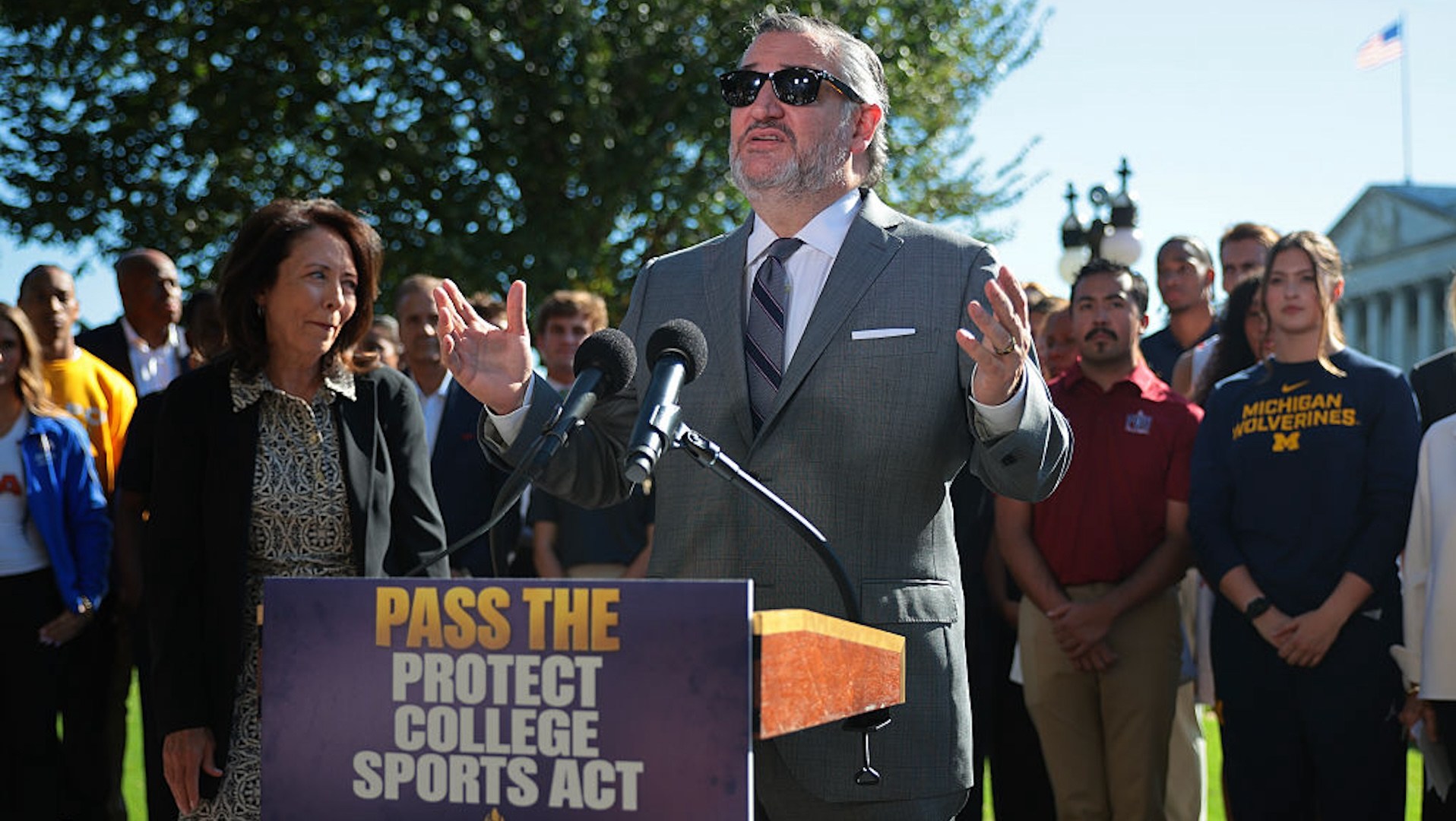
As an antitrust expert who has dedicated so much time to thinking about college sports and how athletes should be properly compensated, Edelman felt like the perfect guy to talk to about the Protect College Sports Act, which was recently passed by the Senate and is expected to be voted on in the House after the midterm elections. Our conversation, which has been edited and condensed for clarity, is below.
What is your assessment of the PCSA as it currently stands? How would you explain it to a layperson?
The gravamen of the bill is to grant a partial antitrust exemption to the NCAA, which substantially reduces college athlete rights in two ways. First, it creates a salary cap on collective compensation of college athletes, and does so through legislation rather than through collective bargaining. Second, it creates a restraint on college athletes transferring between schools, thus harming the bargaining power of a college athlete that wishes to play at a different school than the one they've started, if they've already transferred on one occasion.
Do you mind just quickly explaining what an antitrust exemption is, and how it would be applied in in this case?
Absolutely. Section 1 of the Sherman Act is often described as a Magna Carta of free trade. It states that every contract, combination, or conspiracy in the restraint of trade shall be declared to be illegal. In essence, it is creating a statute to recognize the primary rule of capitalism, which is: To make capitalism work, there needs to be competing entities competing both for consumer demand and in the labor market for individual workers. Typically, the businesses in all industries, when they come together and engage in collective conduct, are subject to challenge under antitrust law.
Even the conduct in sports leagues is evaluated under antitrust law's rule of reason to determine its legality, unless an exemption applies. In our four largest professional sports leagues in the United States (MLB, NBA, NFL, NHL), the salary caps and other restraints on labor that are in place exist through what is known as a non-statutory exemption to antitrust law, meaning it's a court-recognized exemption that applies where the employer unit bargains collectively over these terms with the union, meaning that labor law will apply rather than antitrust law.
What is being suggested here in the PCSA is not a court-recognized exemption for terms that are reached through good-faith collective bargaining, but rather an exemption that is handed statutorily to the members of the NCAA to maintain certain restraints and create new ones on college athletes' free movement and compensation without the need to collectively bargain. That is fundamentally different because under the non-statutory labor exemption, a union representing the athletes, with a legal obligation to represent the athletes, is bargaining over and agreeing to certain restraints. In the context of the PCSA, a group of legislators, arguably with the help of people handpicked by the current president, are writing into statute rules that relate to athlete compensation, and limits on such compensation, without the athletes having a voice whatsoever, much less a fair voice through the collective bargaining process.
That's a part I want to underline, because I think a lot of people are confused. What you're saying is, the antitrust exemptions in the NBA, MLB, NFL, etc. are allowed as a result of the collective bargaining process, whereas the PCSA seeks a similar exemption by circumventing the collective bargaining process. Is that correct?
Generally, yes. When we talk specifically about labor markets, all of the restraints that we see in labor markets of our professional sports leagues—the salary cap, the draft, the limits on player movement, every single one of them—to the extent that they're exempt from antitrust law, are the products of good-faith collective bargaining between the management group and the players group, and exist in a collective bargaining agreement that was reached through good-faith bargaining.
What is being proposed with the Protect College Sports Act is to establish the exact same types of labor restraints, specifically a salary cap, specifically a number of years of eligibility to compete in college sports, and specifically limits on transfers, but not to do so in collective bargaining where there are representatives in the room, on behalf of employer and employee, but rather through a legislative bill, which seems to be negotiated by a number of different constituent groups, none of which is a representative of the players in any meaningful sense, and absolutely none of which have been chosen and selected by the players as a union representative.
What way is there to interpret the attempted passing of this law as anything other than management trying to snuff out labor's bargaining power? Because if the NCAA wanted this stuff, they could still bargain it with the athletes. There's no reason it has to be done through Congress.
That's my interpretation. Now, at this precise moment, there are no college athletes that have been recognized as a bargaining unit. So at this precise moment, collective bargaining cannot take place. However, there are a number of ways in which college athletes presumably could create bargaining units. Those who claim that it's not possible are primarily relying on the fact that not all college athletes play at private universities. Some are at public schools, and the purported argument that college athletes cannot unionize is that certain athletes who are at the public schools would purportedly be employees, if at all, of a public school, and then not subject to National Labor Relations Act. I believe this argument is grandly overstated for a number of reasons.
First, while I believe it's disingenuous to claim that all college athletes meet the definition of employee, at least the revenue-generating college athletes, which consist of a limited number of college athletes and a limited number of sports that bring in revenue, seem to meet the dictionary definition of being an employee. Now, if certain college athletes meet the definition of employee, the question is whether the National Labor Relations Board could or would assert jurisdiction over them for purposes of creating a bargaining unit. With respect to athletes and revenue-generating sports at private schools, there does not seem to be much of a problem at all.
There are a number of ways that seem to clearly get around the issue that would allow for creation of a multi-employer bargaining unit by conference by sport. One that I've suggested in articles I've co-authored with John Holden and Michael McCann is this notion that college athletes are actually jointly employed, not only by their individual school but also by the conference, which broadcasts the games on television, and at the same time exercises a substantial amount of control over the athlete. This is a very pertinent point because if such a relationship exists, then even the athletes who are at public universities such as the University of Michigan and Ohio State University also have an employer in the conference, which is private, and that would create jurisdiction with the National Labor Relations Board under the National Labor Relations Act. So that is one way to address the issue. It also was addressed in a very similar light in a footnote to an advisory opinion that had been written by Jennifer Abruzzo of the National Labor Relations Board, who was General Counsel under the Biden administration. So it's not just three professors coming up with this ad-hoc theory. The General Counsel of the previous president's National Labor Relations Board cited to it, and a number of other professors cited it to it as well.
If the PCSA, or some future version of it, did become law, how would that potentially affect future unionization and collective bargaining efforts?
The present iteration of the PCSA is silent on the issue as to whether college athletes could unionize, though there are proposed amendments to the bill to explicitly disallow college athlete unionization, which would forestall college athlete rights even further.
I believe that if this goes through, it becomes even more imperative for revenue-generating college athletes to unionize, and it might actually expedite the process of them attempting to do so. At present, there are two meaningful ways in which college athletes are able to exercise their rights against the NCAA. One is bringing federal antitrust challenges when the NCAA member schools get together and pass rules that restrict their free-market opportunity. The other would be to attempt to unionize and force groups of colleges into collective bargaining.
The way I interpret this bill, or at least the gravamen of it, is it creates enough of an antitrust exemption to preclude challenges to a salary cap imposed by the NCAA, challenges on transfer restraints, as well the eligibility of certain college athletes. If the antitrust remedy is foreclosed from the athletes, it makes it even more important for them to pursue unionization and rights through labor law. In addition, the number one deterrent at this present moment to college athletes unionizing is that if they were to unionize, it reasonably would foreclose a lot of the antitrust litigation that is ongoing because these would be topics of mandatory bargaining, and thus the decisions that were reached through collective bargaining would be exempt from the antitrust laws under a whole large precedent of cases.
If the antitrust rights are stripped from college athletes by Congress, it's not debating the pros of getting labor rights versus the loss of antitrust rights. The antitrust rights don't exist anymore. There is no downside, from my perspective, to moving forward with unionization. If this goes through, it almost becomes essential for the college athletes' rights movement to move forward with unionization, probably by conference by sport.
The current, most expedient way for an athlete to argue against restrictions put on them by the NCAA is through legal challenges, and you're saying that the antitrust exemption would make those impossible. So then their only choice after that is to unionize?
And negotiate over certain terms. The question: How does a collectively bargained outcome over certain rules apply in the face of a legislative restraint on these rules? That is rather novel question and one I hope that we never have to see litigated.
That seems like it would create a pretty strange environment where, if athletes successfully unionized, bargained with the conferences, and in that period of bargaining came out with transfer rules or a salary cap that is different than what the PCSA forbids, then that's a legal fight again, right? I don't know how that gets sorted out.
And the PCSA, as a number of people have pointed out, might very well forestall antitrust litigation against the NCAA, but in other ways creates new uncertainty, which may lead to different types of litigation against NCAA conduct and even against the bill itself. Which again, I hope in the current iteration we do not see move forward any further.
The proponents of this bill seem to have gained a lot of rhetorical ground just through this idea that college football is "in chaos" or "broken," and it needs to be fixed. But it seems like if you just divorce this from the sports aspect, and just consider that an industry is appealing to to Congress for a bill of this nature, it's obviously unacceptable. If the auto industry was like, "we want this bill that does all of this," would anyone vote for that? Would people put up with that at all?
In the very famous 1940 U.S. Supreme Court case of U.S. v. Socony-Vacuum, the oil companies claimed that they need a limited antitrust exemption to be able to get what they considered bad oil off the market. The Supreme Court told them if that if that's what they want, they should go to Congress. Congress never granted that exemption.
In 1978, in U.S. v. National Society of Professional Engineers, a trade association of engineers argued that they needed to be able to have a certain bidding practice for people seeking to hire engineers. Again, the Supreme Court here, Justice Stevens, suggested they go to Congress. Congress once again declined to pass a bill.
Antitrust exemptions from Congress are disfavored, even where they do rarely exist. Are there ever antitrust exemptions granted to other industries? On rare occasion, but higher education is an incredibly powerful bargaining lobby. They tend to get what they want. The one that is closest to this to me was a special exemption that President George W. Bush signed into law after it was passed by Congress that allows medical hospitals to maintain their resident match program, which limits the choice of new residents of where they would practice, and also substantially restrains their wage. Speaking anecdotally and not from economic evidence, my takeaway is that this restraint pushes out of medical education residency individuals who are first-generation Americans and from lower-income families where they cannot forego a meaningful salary for an additional period of years. So, on rare occasion do we see Congress pass special antitrust exemptions? Yes, but usually it's the most powerful bargaining lobbies like education.
Do you think that's been sort of an under-covered part of this story so far? Just the strength of higher education as a lobbying power?
And specifically college sports, which is a part of higher education. I think we need to acknowledge two individuals, one being a sitting president, Donald Trump, and then the other being the former governor of Massachusetts, who's currently the head of the NCAA, Charlie Baker.
Trump to me is important. I've observed a very real change in higher education in the way it's interacted with Trump and this administration as compared in Trump's first administration. In Trump's first administration, higher education seemed engaged in conflict with Donald Trump, challenging his views, challenging his morality, challenging the rules they want to put in place, taking the very direct view of, We believe in trans rights. We're going to allow trans athletes to compete in sport under certain circumstances. We don't care what the president thinks about it, and standing up against the president in various different ways.
That was Trump 1. Trump 2 has been very decidedly different, and especially in the context of college sports, we don't see the moral fight anymore between the members of the NCAA and Donald Trump. In fact, not long after Donald Trump won his second term as president, higher ed began to play friendly with the sitting president. There were also things that they wanted in return that the president could help them get. The one that stands out being this antitrust exemption under the Protect College Sports Act, which, while it is something that needs to be passed by Congress, the president appointed a committee and promoted it hard, which is one of the reasons I believe this has gotten traction. So that's Trump.
Why and how did this happen? I think a lot of that also relates to Charlie Baker. Under former NCAA president Mark Emmert's leadership, the continued position was not to give in on any issues to college athletes and to continue litigating all these issues to an end. As I think one who knows the antitrust law reasonably could have expected, the Emmert strategy failed miserably. The NCAA lost unanimously in the Alston case and has only continued to lose antitrust litigation since. In hiring Baker, a former governor, someone who's perceived as a Republican moderate, to take over leadership of the NCAA, nothing changed about the membership or its positions. Presumably, the benefit that Baker had as a politician who might be able to work with both sides of the aisle, was to try to achieve for the NCAA through some type of legislative action what they were not able to achieve through defending litigation. In essence, to grant them some form of an antitrust exemption under federal antitrust laws. Baker, strategically on certain grounds in the very beginning, made very small reforms in college sports. He was willing, or the NCAA under his leadership was willing, to settle the House litigation with Jeffrey Kessler, which first invited an agreement amongst the NCAA member schools not to challenge at least certain levels of compensation to college athletes, which was a very different position from Emmert.
The NCAA under Baker presumably began their lobbying efforts both to Congress to pass a bill to grant them an exemption, and then to Trump to try to get this president to help them achieve what they want. To me, it's at least noticeable that prior to or at the same general time that lobbying on behalf of the NCAA sought the support of President Trump, they also changed their position on trans inclusion in sports in a manner that was consistent to not only what Donald Trump wanted, but what Donald Trump promised to deliver to his constituents if he were elected for a second term.
Do you think people appreciate the illegality of the NCAA, and how many lawsuits it has lost? If this bill were to pass, would it basically just reinstall the NCAA as it was in, say, 2003 before all the lawsuits? Does this turn back the clock for them in any way?
A few things. First, the NCAA is brilliant in public relations. So, while I began writing on the NCAA's restraints of trade under antitrust law as early as 2002, it really was not until about 2015, maybe 2019, that the rest of America caught on and realized that the NCAA did have real antitrust liability, and this wasn't just some kooky theory. Even in the worst moments for the NCAA, after they lost the Alston case, they handled themselves brilliantly in public relations.
The NCAA is trying to put out now that somehow they are this caring organization that's trying to help women's sports and Olympic sports, and they've been placed under chaos by unfair litigation, and they haven't done anything wrong. That gets very meaningful traction, albeit not with the limited number of us who have an expertise in antitrust law. To use a quote from Justice Neil Gorsuch, we see things differently.
Would this turn back the clock to 2003? No, it's not that bad. I do, however, think that the bill turns the clock back to right around 2019. It undoes the very important decisions that were reached by federal district courts and thereafter settled in Tennessee v. NCAA, which allowed unlimited compensation of college athletes seeking to attend school by third parties, and by Ohio v. NCAA, which I advised the states of New York and Ohio on, which increased free market movement of college athletes. It's retrograde. It's negative for the college athletes. It's being done with all types of constituent groups in the room, but not one that represents the college athletes.
Have you seen anything in the bill that makes you think it would actually do anything to protect non-revenue sports?
I mean, there are sprinkles. If we want to be fair, there's a certain amount of money that's supposed to be delegated to women's sports, and the argument that's being made by the endorsements of the bill is that if we cut compensation to college athletes and revenue-generating sports, it would leave more money out there to run and operate these other sports.
Amongst other reasons, part of why this feels so disingenuous is we're talking about a collective restraint on one cost of operating big-time intercollegiate sports, that being college athlete compensation, but nobody is talking about passing a bill that would affect the cost structure in its entirety. No one is suggesting a bill that says colleges can't spend more money on their athletics than the revenue they bring in. Nobody is suggesting curbing the salaries of coaches and assistant coaches, which again cannot be done legally without special legislation. Nobody is talking about capping the building of new stadiums. Nobody is talking about capping the number of road games that teams play.
At this precise moment, we have conferences that are getting larger and larger. They're taking their athletes on planes, sometimes private jets, across the country to play in games on national television and pulling them out of classes to do so. If we're serious about trying to make college sports affordable, probably the first thing we should be looking at is asking the question of why are we taking people, who are supposed to be students, putting them on jets in the middle of the week, and taking them across the country just so a television station such as ESPN or CBS can broadcast a game that's more desirable to be seen.
They are taking one of many many costs, which they believe are spiraling out of control, and are constricting it without constricting or holding the other ones constant. Cory Booker came out and suggested that we cap the compensation of coaches as well as cap the compensation of players. Typically, I don't like antitrust exemptions, so I don't like the idea of capping anyone's salary. I would think the free market should handle that. But at the same time, Booker's proposal actually addresses now two, rather than just one, of the things that are affecting the cost portfolio. But the moment the conversation switches to, Well, do we also cap the coaches and assistant coaches' salaries? The response is, Oh my God, no! I think a proposal was put out to cap the increase in ticket prices, and Ted Cruz came out and said that's price fixing. Yes, Ted. Ted, you're right. That is price fixing. How come, however, is it that you only recognize that the legislative action is to legalize price fixing when it's something you don't want?
One more question before I let you go, because I've taken up a lot of your time. As someone who has been thinking about this since 2002 and done a lot of work on this issue, what's your general feeling right now? How optimistic are you? How pessimistic are you?
A lot of me is a little bit sad. When I decided to go into higher education and leave a big firm, my very sincere goal was to create a situation where I made the world just a little bit of a better place, and by moving away from being full-time in a law firm, my intention was to give myself the academic freedom to take the position.
I've published a lot of law review articles on a lot of topics, but my college sports work is the work that means the most to me. Because while the work is always couched in antitrust law, labor law, and occasionally intellectual property law, the reality is by challenging the restraints on free-market compensation for college athletes, it's created a situation where the revenue-generating athletes in America, who happen to be disproportionately low-income, disproportionately first-generation, disproportionately black, are getting to enjoy the same rights as every other member of American society, and by protecting their free-market rights to sell their labor, we are allowing them to actualize themselves just like everybody else in American society.
When I see a bill that now seeks to restrain the free market rights of college athletes, and do so outside the world of collective bargaining, I see a number of very powerful constituencies who have come together, saying that these individuals are not entitled to the same free-market rights as everybody else in the world, or at least everybody else in the United States, and they are making these arguments in many cases for their own preservation and for their own economic interest, and to see such a pushback in that way is hard.
On the other hand, we take a bigger view over a far wider time frame, and I ask the question: Where were we in 2003? Where were we in 2013? And where are we now? We are unequivocally in a better position, where college athletes have the opportunity to endorse products for money and make sums of income in doing so. We are unequivocally in a better position in that revenue-generating college athletes have the opportunity to earn at least some direct compensation for their work product. We are unequivocally in a better position because even with this bill, college athletes will be allowed to transfer once, and that would allow them to avoid at least a single abusive system or abusive coach where they may end up. We're unequivocally better off because the conversations that we've had for several years exist on the public record, and no matter what happens next, and no matter what the NCAA is able to get Congress to do next, there will always be a record of this period of change, and there'll always be a record of this fighting to protect the rights of these underrepresented, low-income, disproportionately minority, certainly young college athletes, and we're better in so many ways than if this movement never began.
I think that's something we could feel good about, even if we feel bad about the fact that these very powerful constituencies are trying to stop it by getting a legislative bill through Congress, rather than having it morph into a collective bargaining relationship for the revenue-generating athletes.