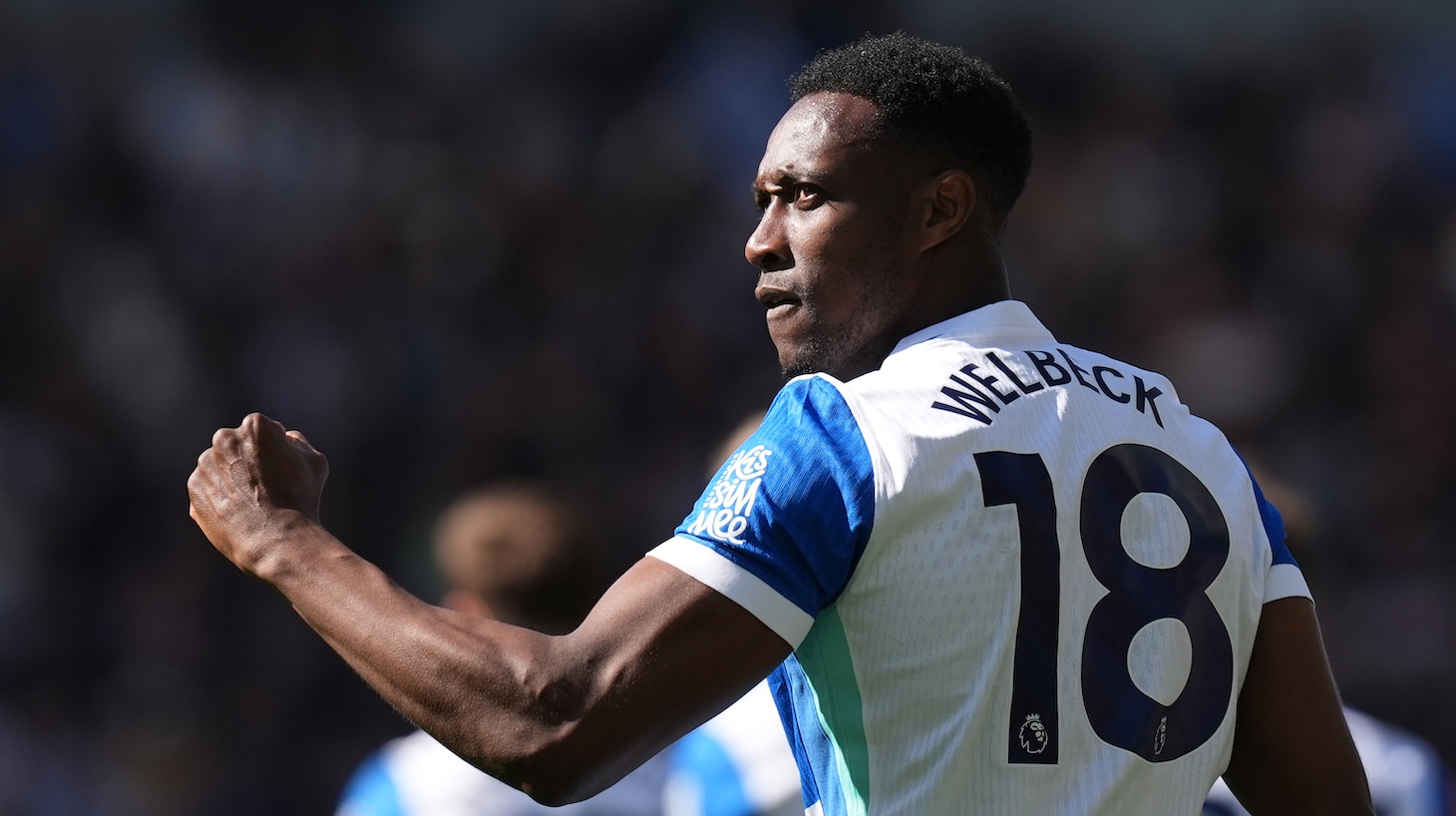
Spend enough time on the soccer side of social media and you're bound to come across one of those video-comp odes to the Barclaysman. As proud guy-rememberers ourselves, we of course do not begrudge the pleasant strolls down memory lane these highlight reels take you for, bathing nostalgic light on once beloved but semi-forgotten cult players, the ones who made the Premier League what it was back when the EPL was known as the BPL. But if it's worth singing the praises of yesterday's lesser nobility, then it's also worth giving props to the ones who are still kicking today. One such player deserving of some shine is Danny Welbeck, whose long career and his belated apex show just how major a minor legend can be.
If it feels like Welbeck has been around forever, that's because he has. I'm unc enough to remember back in the Barclays days when the now-35-year-old was Manchester United's buzzy young hotshot, the latest exciting Carrington product from whom Alex Ferguson was sure to wring 20 goals a season in the coming years. Welbeck made his Premier League debut for United in November of 2008, about a week before his 18th birthday. But it wasn't until a few years later, in 2011, when he really announced himself as a potential force to be reckoned with.
Coming into that 2011–12 season, on the heels of a solid loan campaign with Sunderland, Welbeck was well positioned to seize United's starting striker position, beating out the likes of Dimitar Berbatov and Javier Hernández for the right to take Wayne Rooney's hand in goaly matrimony. Welbeck performed the role respectably, scoring 12 goals across 39 appearances in all competitions in a season capped by United just getting pipped to the title by the famous Agüero goal. On their own, Welbeck's numbers weren't mindblowing, which explains United's addition of Robin van Persie the next summer, but his youth and the breadth of his skill set marked him as a serious talent we'd surely be hearing about for years to come. As it turned out, that both was and wasn't true.
Welbeck's breakout as a 21-year-old wound up being by far the best season of his 20s. In it, he demonstrated much of what has defined his career, for better and for worse: intelligence, savvy movement, speed, workrate, versatility, clean technique, associative quality, and, unfortunately, proneness to injury. Welbeck has always been a textbook all-rounder, good at basically everything you'd want a striker to be good at, but never quite elite at anything, especially not at scoring. Those wide-ranging skills have kept him as an EPL regular for going on 20 years now, but his susceptibility to injury dimmed his prospects, giving the bulk of his career the air of vague disappointment.
In Manchester, Welbeck never recaptured the prominence he enjoyed in that 2011–12 campaign, in no small part due to his recurrent injuries. He spent two more seasons with his boyhood club, mostly (when healthy) as a decent rotation forward playing either through the middle or out on the wing. That fate didn't really serve either party, though, so he left for Arsenal in 2014, becoming one of those merely-solid-and-therefore-frustrating budget signings that hamstrung the later Arsène Wenger years.
Despite a positive start to life in London, Welbeck's injury luck got even worse with the Gunners. A procession of torn knee ligaments meant he was only even moderately healthy for two of his five years with Arsenal: In total, he played a shade over a quarter of the available league minutes in his five seasons as a Gunner. He remained an effective player when he did make it onto the pitch, always helping his team flow with his unfailingly smart interventions, strong back-to-goal play, and inch-perfect movement, and on top of that put up about 0.56 goal contributions per 90 minutes in league play, a tick higher than his average at United. But being consistently effective when available doesn't count for much when you're as consistently unavailable as Welbeck was. It was no surprise when Arsenal didn't extend his contract, and the two parted ways in 2019. After 11 seasons as a pro, a span that presumably would've included his best years as an athlete, he only broke the 1,000 league minutes mark six times, and only cracked 2,000 minutes once, during that first breakout season at United.
The next stage of Welbeck's career was necessarily going to look different. In light of the injuries and middling production, the doors to England's elite clubs were closed to him. In order to continue playing at a high level, he'd have to start over from the lower rungs of the Premier League table, and do something he'd never managed before: stay healthy. Welbeck's attempts got off to a bad start when he joined a relatively spendy Watford outfit in 2019, only to again suffer a couple bad injuries and watch most of the season from the sidelines. The Hornets were eventually relegated, with Welbeck chipping in just two goals to the cause. When Brighton and Hove Albion took a flier on the soon-to-be 30-year-old Welbeck in 2020, it felt like maybe the last kick his worn tires would receive. Instead, it turned out to be the start of a legitimate renaissance.
If Welbeck is still most redolent of the eras of Manchester United decadence and Arsenal austerity, it's only because first impressions are hard to shake, and what happens outside of the biggest clubs often gets overlooked. Welbeck has now worn the Brighton shirt more than he has any other, and with much more on-field success. His past six seasons as a Seagull have been easily his most consistently healthy. And as has always been the case, a healthy Welbeck is an excellent Welbeck.
Brighton surely didn't sign Welbeck intending to make him a foundational part of the club project, but he's become just that. The Albion is one of soccer's most effective Moneyball clubs, built around hunting for undervalued assets and protostars that it can acquire, polish, and sell on for a big profit, which then funds more hunting expeditions. Theoretically, a 30-something striker with no real market value wouldn't fit with that business plan. In reality, though, Welbeck has proven an invaluable resource.
His expansive game makes Welbeck a key figure in the attacking, possession-minded style Brighton tends to favor. Smaller teams that look to treat the ball well often struggle to find a striker who can both help in possession, holding up and laying off the ball outside of the box, while also reliably knocking in the chances those possessions create. That combination of skills is rare and therefore in high demand, which usually prices small clubs out of the market for those kinds of forwards. Welbeck though is great at playing that way, which makes it much easier to showcase your Alexis Mac Allisters, Moisés Caicedos, João Pedros, and Carlos Balebas, the young assets to improve and flip that make up Brighton's livelihood. It's no coincidence that Brighton's recent, incredible success, both in terms of the market and the Premier League table, has come with Welbeck leading the line.
Welbeck's own performances have only gotten better and better the deeper he's gone into his 30s. Last season was probably the best of his career, as he notched career highs in both EPL minutes and EPL goals, scoring 10 times in 30 appearances. This season he's already topped that scoring mark, racking up 12 goals so far, the fifth most in the league, and he's primed to set a new career best in minutes played too.
Lest you think he's piling up all these numbers against bottom feeders like Wolves and Tottenham, Welbeck provided both goals in the Seagulls' 2-1 win over Liverpool last Saturday. His brace wasn't flashy, but was instead a matter of savvy and experience, of knowing that being in the right place at the right time is what makes all the difference.
Danny’s double! ⚽️⚽️ #BHALIV highlights in partnership with @MPBcom. 🤝 pic.twitter.com/wIjWgJVg41
— Brighton & Hove Albion (@OfficialBHAFC) March 21, 2026
The #Barclaysman phenomenon is of course mostly about remembering great goals and good players, the kind who often don't make it into the historical record but were nevertheless crucial in creating the actual context for the period's transcendent talents to transcend. But it's also about memorializing styles of play that the current paradigm has set aside as part of the sport's ever-changing nature, something the most canoncial of Barclaysmen embodied in one way or another. So it's not just that Yakubu played a lot and scored a lot in England during this millennium's first decade; it's also the way he went about scoring those goals that makes him so indicative of the era.
In that same way, Welbeck makes for a good representative for the English soccer of his time. If the Barclays striker was all about blood and thunder, winning mostly literal grappling matches with burly center halves and then clobbering volleys from distance, the median Prem striker of the past decade is closer to the opposite. In the possession-obsessed age of Guardiola, center forwards are often graded more for what they do outside of the box than inside of it. All-rounders are the name of the game, both at the top of the table and in the middle. In addition, the economic might and concomitant aesthetic druthers of the Premier League's middle class are hallmarks of the era. For all those reasons, Welbeck's do-it-all game, and the consistent over-performance and attractive play he's helped Brighton achieve, make for strong emblems of what the Premier League has been over the past decade.
That is to say, for as relatively unremarkable as Welbeck's career has been, I bet it's one that will stick with us for longer than you might imagine. Whatever this period of English soccer winds up getting named, it's likely that Welbeck's feats during it will still be pointed back to as a synecdoche for what Danny Ings and Michail Antonio and Callum Wilson and Raúl Jiménez and Chris Wood and the like were able to do back when the Premier League ruled all. Ten years from now, it will be nice to think back about how good Welbeck was. But it's even nicer to make some time to do so right now.