Dai dai. Ikou. Dale, allez, let's go. So says Shakira in the chorus of the 2026 official World Cup song "Dai Dai," in which she links up with Burna Boy to express the same sentiment in five different languages. Why find the universal in the specific when you can attempt to recreate the magic of your 2010 World Cup hit "Waka Waka" by finding the universal in the universal? “No one's getting tired, I know/‘Cause you got that fire, ayo,” indeed. One Italian sportswriter described the lyrics of "Dai Dai" as “so generic they reach an almost spiritual level of abstraction,” and compared listening to “contemplating a geometric shape.”
It’s a tragedy that “No matter black, white, or beige/Chola or Orient made” was already featured in another anthem, and so could not be included in “Dai Dai.” The feeling, though, is the same. At one point in the song, Shakira sings the names of various iconic players: Pelé, Maradona, Maldini, Romário. What better way to celebrate the spirit of the tournament than with a list of those who, yes, have definitely played the game of soccer! She repeats the trick by listing a bunch of the participating countries, like a drunk uncle who hasn’t prepared a wedding speech and resorts to naming all the places people have traveled from to attend. “We got Wilmington, Delaware, in the house tonight! Thanks for coming all this way!” As always, even supposedly apolitical World Cup choices are rife with politics; Shakira would never sing “Iran” in the song, despite its supple rhyming potential.
The utter unremarkability, the total insipidness of "Dai Dai" got me thinking about the genre of World Cup songs: Has it always been this bad? Here’s the answer, in a brief history of the music of the men’s World Cup.
"El Rock Del Mundial," Los Ramblers (1962, Host: Chile)
The first-ever global World Cup hit was Los Ramblers’ “El Rock Del Mundial,” which is still one of the best-selling records in Chilean history. The rockabilly tune, packed with Chilean chants and pride, is a far way off from "Dai Dai"; Los Ramblers made it out of pure enthusiasm, meaning the song achieves a purity only possible free from FIFA involvement. Unlike its 21st-century counterparts, the lyrics are specific to the host country, and its sound specific to a Chilean nueva ola time and place.
"El Rock" does anticipate what’s to come with an abstract and inoffensive sensibility, detached from the messiness of the game itself. Still, it's sung from the perspective of Chileans, not transnational denizens of the world: “To the foreign teams/We will show good humor/And as good Chileans/Nobility and correctness.” It’s a particularly fun inaugural song given that in the opening match of the ‘62 tournament—known as the Battle of Santiago—Chilean and Italian players feuded so violently that Italy needed a security escort to safely leave the pitch. The ref who officiated the game went on to invent yellow and red cards. Like Los Ramblers sang, “It’s a universal party/Of sports and the ball!”
"Un'estate Italiana (To Be Number One)," Gianna Nannini and Edoardo Bennato (1990, Host: Italy)
It wasn’t until 1990 that FIFA itself got into the World Cup song business, and “Un’estate Italiana” introduced a few key ingredients to the genre. Most importantly: a music video featuring archival footage of iconic soccer moments—men pumping their fists or holding their heads in defeat—interspersed with children playing the game on a dirt field.
This song is … come si dice … not a bop. Its music video, however, is an incredibly corny ripoff of '80s New Wave aesthetics that you absolutely must watch. Floating soccer balls bounce behind Nannini and Bennato as they insist on “magical nights chasing a goal under the sky of an Italian summer.” The graphics are somehow both ancient and extremely current at the same time, New Wave plus ‘90s bowling alley plus iMessage stickers. Like “El Rock Del Mundial,” the song is both a result of cultural exchange and born of the host country’s specific time and place.
"Gloryland," Daryl Hall & Sound of Blackness (1994, Host: USA)
In 1994, the World Cup song’s music video doesn’t just feature children playing soccer, it features a black child and white one playing together before embracing and smiling in front of a billowing flag. Martin Luther King Jr. had a dream, a dream that one day Daryl Hall would take inspiration from the abolitionist Civil War anthem "Battle Hymn of the Republic" to create the most mawkish soccer song imaginable. Slow fades shuffle between Hall and the gospel choir Sound of Blackness as they sing the praises of scoring a goal and the nation alike.
"The Cup of Life," Ricky Martin (1998, Host: France)
What does Ricky Martin have to do with France? It doesn’t matter. What does Latin pop have to do with soccer? Starting with this song, everything.
In 1997, Ricky Martin’s hit single "María" caught the attention of FIFA. They asked him to make a song for the upcoming tournament, and what followed created the World Cup song mold still being abused today. Latin pop? Check. An easily replicable dance move to go along with the chorus? Check. Musical fusion that has little to do with the host country? Check.
“The Cup of Life” became a global pop megahit, charting at number one in 30 different countries. I honestly had not heard it before, but it scratches the same itch as Martin’s other hits. (The “Un, dos, tres/un pasito p’alante” in his song "Maria" sounds like “Here. We. Go./Alle, alle, alle” in "Cup of Life" sounds like “Upside, inside out/Livin' la vida loca.”) Don’t get me wrong, it’s a fun song. But, probably because of its influence, I’ve lived my entire life knowing about the wonders of Latin pop. I have to imagine this song going number one in 30 different countries was something like the “if you gave a medieval peasant Mountain Dew” meme. In 1998, most of the planet had perhaps never been introduced to the pleasure of a pop samba rhythm with a brass hook! That’s how the moment has been historicized in the years since, at least, with Martin himself pointing to the song as the start of the late-‘90s Latin pop takeover.
"The Cup of Life" got so big that the then-closeted Puerto Rican sang it at the inauguration of George W. Bush, almost two years after it first came out. I had no idea that J. Lo’s baffling “This Land is Your Land/Let’s Get Loud” mashup at Joe Biden’s inauguration existed in a lineage. The denouement of the song's trajectory may have marked the downturn of Martin’s career—his longtime collaborator Draco Rosa likened performing it for Bush to “playing a fiddle while Rome burns”—but the overall thing certainly established an international pop hit as a hallmark of the soccer tournament.
"Boom," Anastacia (2002, Host: Korea/Japan)
"Boom" represents FIFA learning all the wrong lessons from the success of “The Cup of Life.” You can’t just take any famous English-speaking pop star and ask them to make a vaguely stirring hit in their style. The lyrics of “Boom” are no more insipid than those of its peers, but somehow they sound more like the soundtrack of a Netflix reality TV show where people sell real estate than they do a World Cup song.
"The Time of Our Lives," Il Divo ft. Toni Braxton (2006, Host: Germany)
Before he made One Direction, Simon Cowell made the multi-ethnic, multi-lingual classical male quartet Il Divo. They joined forces with Toni Braxton to create the World Cup’s snooziest theme ever, an operatic ballad punctuated by Spanish guitar and the swell of an orchestra. In the music video, the boys sing together on a dark and empty pitch while beholding the face of Braxton on a jumbotron. To demonstrate her seriousness, she sings with her chin tilted so far downwards that she looks like she might tumble out the ‘tron and onto the pitch below.
The typical archival soccer footage that accompanies the music video takes on the vibe of an In Memoriam thanks to the dreariness of the song. Who died? Me, while waiting for the time in my life I had to spend listening to "The Time of Our Lives" to end.
"Waka Waka (This Time for Africa)," Shakira (2010, Host: South Africa)
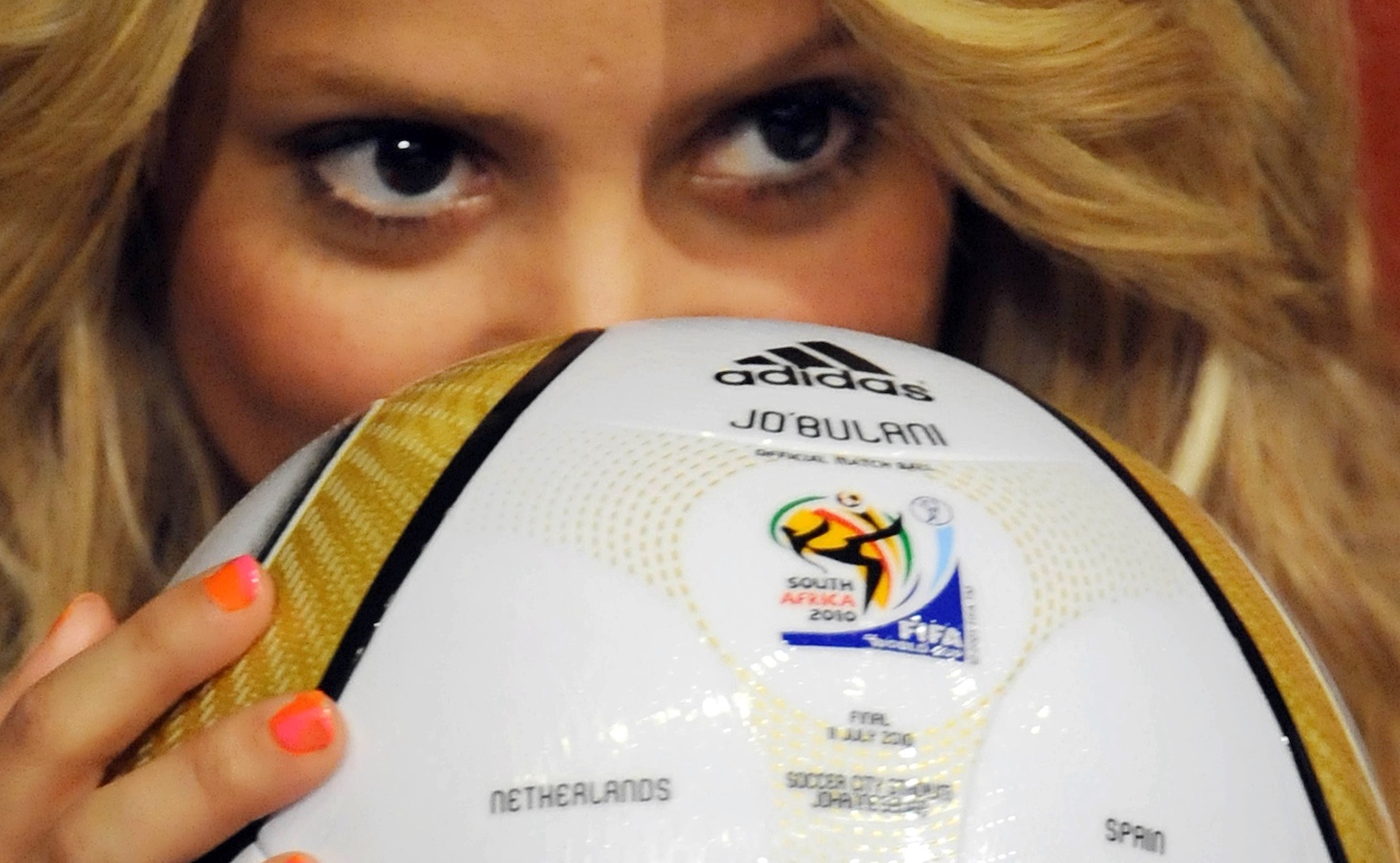
"Waka Waka" is perhaps the only official World Cup song to ever break containment—that is, to be remembered first as a major international hit and second as a song made for a soccer tournament. It took 12 years and three tries to recreate the success of "The Cup of Life." Though Ricky Martin’s blueprint went number one in double the number of countries as "Waka Waka," it's undeniable that the latter’s staying power outdoes that of its predecessor.
The blend of Afro-Colombian and South African music on "Waka Waka" set the Afro-Latin template that FIFA still sticks to today. It was so successful that many of its offspring insist on recreating its title, some sort of two-syllable-max word that means “let’s go” accompanied by a parenthetical. The song made Shakira inseparable from the World Cup, not just any global pop star but one whose exoticism somehow takes on a supranational character. Shakira belongs to the world, the World Cup belongs to Shakira. It's an enmeshment she embraces wholeheartedly, referring to her children as “Waka kids” because it was on the set of the "Waka Waka" video where she met Gerard Piqué, the father of her children.
Sixteen years later, "Dai Dai" attempts to reanimate the corpse of "Waka Waka" with an almost mathematical precision, resulting in an uncanny Afro-Latin zombie that lacks any sense of specificity or meaning. "Dai Dai" won’t strike gold, in part, because "Waka Waka" didn’t either. It simply cashed in on a Cameroonian hit from the ‘80s, which became popular in Shakira’s home country of Colombia after West African DJs brought it over. It makes sense that the most successful version of the multicultural World Cup song came from actual human exchange; the difference between "Waka Waka" and "Dai Dai" is reminiscent of the difference between World Cup songs’ artificial color-of-friendship visuals (black and white children playing soccer) and more organic videos of cultural exchange.
"We Are One (Ole Ola)," Pitbull ft. Jennifer Lopez and Claudia Leitte (2014, Host: Brazil)
Afro-Brazilian rhythms make this song a little less unmoored from the tournament host's culture than others, but it’s still more Pitbull 2010s club hit than anything else. Instead of being asked to put your hands in the sky and wave them side to side, though, Pitbull requests you do so with your flags. J. Lo captures all the tournament’s contradictions between universalism and nationalism when she sings “One night, watch the world unite/Two sides, one fight, and a million eyes (Eyes).” Poetry.
"Live It Up," Nicky Jam ft. Will Smith and Era Istrefi (2018, Host: Russia)
If you bring your thumb up to your mouth and suck it, what does that taste like? Hard to say, right? "Live It Up" evades capture by the English language in much the same way. Calling it generic is not general enough. There’s brass and a drumbeat that conjures the image of straight men jumping up and down; there’s the Puerto Rican singer Nicky Jam imploring you to live your one life up because you don’t get it twice; there’s Albanian singer Era Istrefi in her fake Rihanna era, singing “We got the power make the nation correct” in a voice that is possibly a hate crime against the entirety of the Caribbean. Will Smith is also present.
"Hayya Hayya (Better Together)," Trinidad Cardona, Davido and Aisha (2022, Host: Qatar)
Technically, the 2022 World Cup song is “The Official FIFA World Cup Qatar 2022 Theme,” an instrumental offering that sounds like it could be screensaver music for a Mario Party: Middle East video game.
“Hayya Hayya,” then, is the unofficial official song. Arabic for “let’s go,” the tune adds Gulf flavor to FIFA's Afro-Latin house blend by replacing Latin-feeling background “ole ola’s” and “OoooOoo’s” with more ethnically ambiguous “oyeyoyoye’s,” selecting sand dunes as the setting for its music video, and briefly featuring a Qatari woman named Aisha, who does not appear to have had much of a music career before the song or since. She plays the same role as the at-times visible camel in the background of the music video.
What a journey from “El Rock Del Mundial” to “Cup of Life” to “Dai Dai”! Sixty-four years of music, 64 years of congealment. It’s hard to imagine the 2030 World Cup song won’t continue down this road, given that the tournament itself is leaning into the globalized, everywhere-and-nowhere vibes that the songs conjure. The tournament will be hosted by Morocco, Spain, and Portugal, and a few games will even take place in South America. It’s almost as if the Westernized Afro-Latin non-location that World Cup music purports to speak from bid to host the next tournament, and won. Yallah. Vamos. Bora, chama, let’s go.