

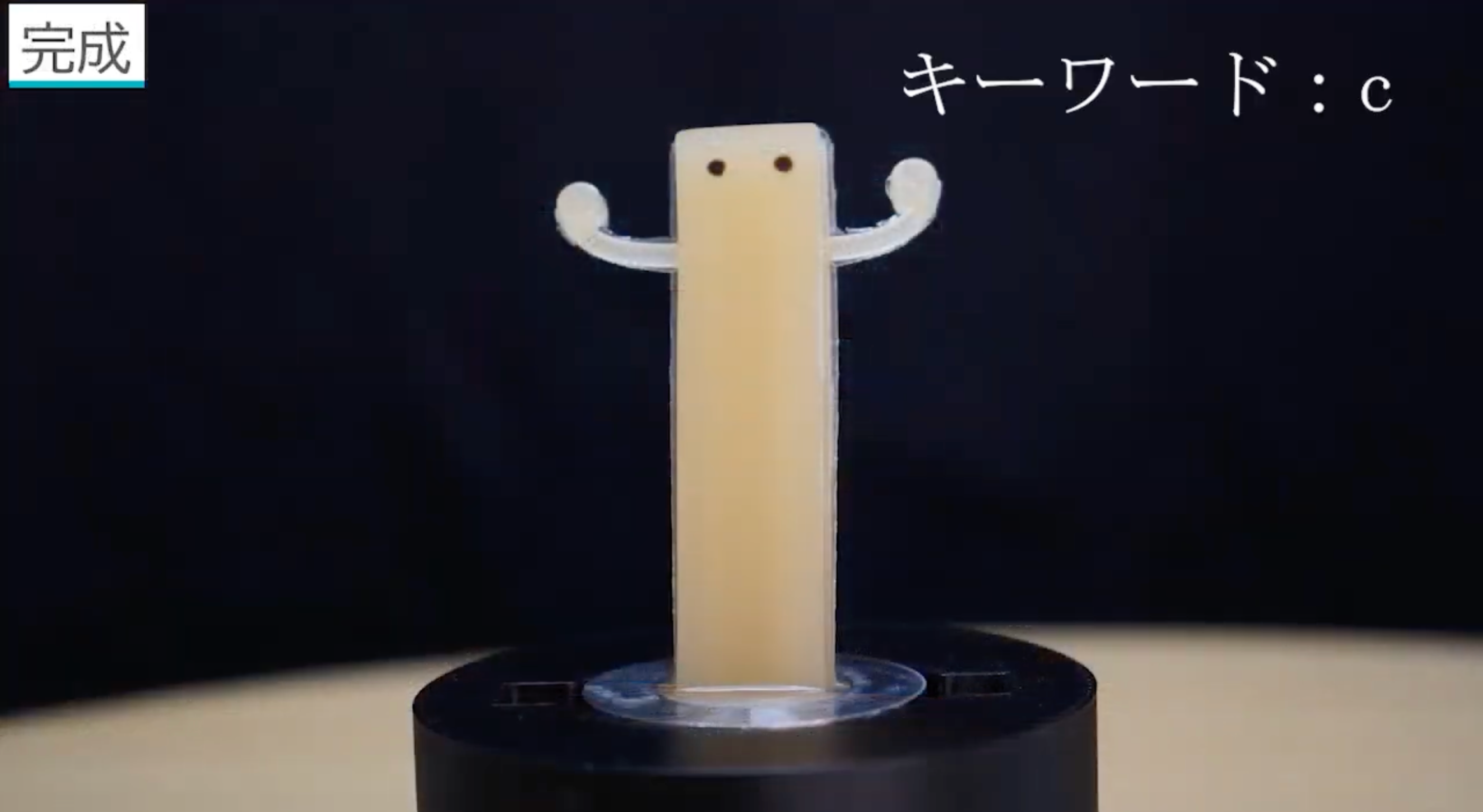
Imagine you are seated at a table. A guy sits across from you. He is vaguely humanoid, with a long torso and two arms raised in fist-like clubs. His full name is Edible Agent, but we will call him Eddie and use he/him pronouns. There's something about Eddie that makes you feel at ease. Maybe it's his fragrance, which reminds you of apple juice, of childhood. Maybe it's his two black eyes that gaze upon you without judgment. You decide to unburden yourself to him. You tell him that you've been making mistakes at work, and you are so afraid of your boss's criticism that you have developed stomach pain. "Fear will only bar the path you are meant to walk," Eddie tells you, wiggling his edible arms to show you he understands. You tell him that to cope with your stress, you've been drinking every day. "There is no solace for those who seek refuge in dependence," Eddie tells you, wiggling once again. When you tell him that you can find no other way to deal with this burden, Eddie tells you to confront the problem, to contemplate your next step forward. "Only by tempering oneself and holding fast to one's convictions can one overcome the burdens one bears," Eddie says, wiggling. This encounter changes you profoundly. Then comes the question: After all you have been through together, would you eat Eddie?
For many participants in a study recently published in PLOS One, the answer was yes—but rather reluctantly. (Turn on subtitles to understand the conversation with edible Eddie.)
The researchers concocted Eddie as a way to better understand how people make ethical judgments around what they choose to eat. Although the world teems with things we can eat, we are often and understandably selective about what we do eat, particularly when it comes to animals. Many people feel conflicted over eating animals that are completely edible but seem strange or disgusting to us, such as an insect or a frog. Many people feel conflicted over eating animals they perceive to be intelligent, such as an octopus or a pig. Many people feel conflicted over eating any animal raised in factory farms, which are scaffolded by brutal practices like grinding up male chicks or separating calves from their mothers. This is the "meat paradox": how many of us see ourselves as moral people and yet manage to justify our decision to eat animals raised and slaughtered under conditions of unimaginable cruelty.
Investigating the meat paradox with real animals would invite a new slew of ethical problems for the researchers designing the study. Asking someone, who has just watched a pig play a video game, to eat said gamer pig? Probably effective, but also hard to standardize and pass by an animal ethics board. So in 2024, a group of researchers in Japan designed an edible robot made of gelatin and sugar, shaped like a plank of wood. It wiggled and waggled. Those researchers reported that robot's autonomous movements could make people feel guilty about eating it, even though it was designed to be eaten. The authors of the new paper decided to tweak the design to make the edible robot look a little more alive: They added arms capable of oscillating chaotically and two black eyes drawn on with edible ink.
The researchers interviewed more than 1,000 participants in an online survey. Before they showed videos of Eddie interacting with anything, they showed a video of how it was made—sugar, apple juice, and gelatin, whisked together, molded, and cooled in a fridge—so that the participants understood that Eddie was actually edible. Then the participants watched two videos, the one above of Eddie consoling a stressed-out office worker, and another where Eddie is presented with a series of toys. In the first video, the researchers explain, Eddie's persona was inspired by God. In the second, Eddie is inspired by a baby. Here is the second video. (Again, subtitles are helpful.)
Why God and a baby, you might be wondering? The researchers wanted to understand how people reacted to two dimensions of the mind: its agency, which encompasses self-control and thought, and its experience of emotions such as joy and fear. As God, Eddie was rational and authoritative. As a baby, Eddie babbled with fear upon encountering a big toy, and joy when encountering a jingling bell. Would people be more likely to eat a gelatinous robot that was omniscient and wise, or a gelatinous robot that cried when presented with a scary object?
Although the researchers hypothesized that the participants would feel far more reluctance and guilt over eating baby Eddie, the participants were actually more reluctant to eat God Eddie. And they expressed the same level of guilt for eating either Eddie. But the experiment did support the researchers' hypothesis that people can perceive distinct minds even in "simple gelatin-based edible artificial objects," which is how they refer to Eddie. Despite the limitations of the study—such as how the survey's virtual nature prevented people from actually eating Eddie—the researchers suggest edible robots like this could be further developed to test people's guilt and reluctance around eating other animals.
If they do another round of experiments, Eddie deserves a full makeover. He deserves more than two beady black eyes and twiggy arms. It's time to raise new questions, such as: Would you eat a simple gelatin-based edible artificial object with dimples? What about a six-pack or a respectable set of buttocks?Would you chew on the boneless body of a gelatin-based edible artificial object that was wearing edible transition lenses or inadvisably low-rise edible jeans? We cannot predict what world we will inhabit in 20 or 30 years. We must seek comfort in the sagely words of God Eddie: "Remember that only your own resolve will light your path."