


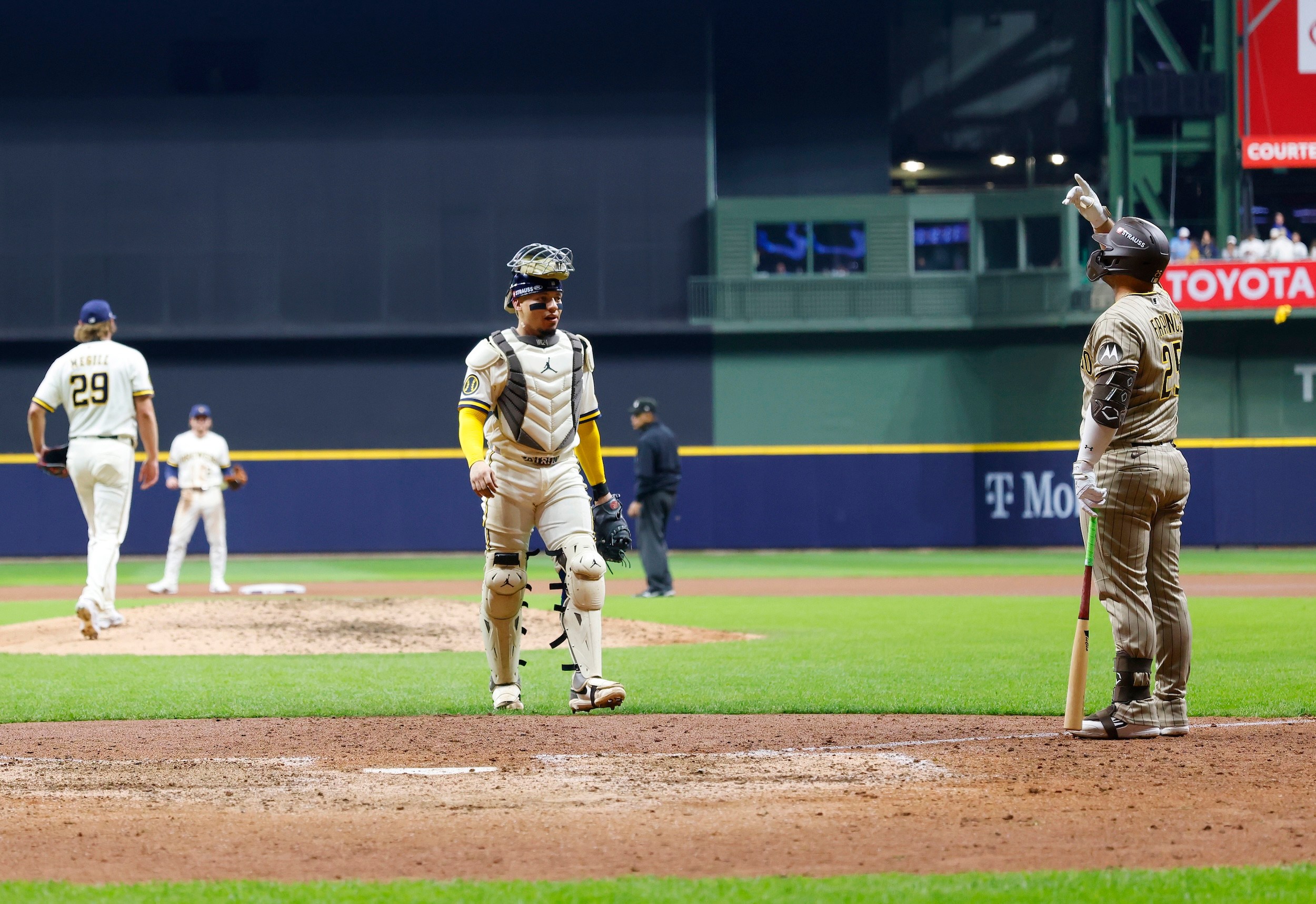
Ty France talks like a guy who is pretty sure he'd socked a game-winning dinger. "I stood there and watched it, and it was going," France said Saturday, of his ninth-inning moonshot. "It was staying fair." The ball did, in fact, stay fair: Soaring down the left-field line, France's fly bonked off a roof cable and dropped, well inside fair territory and directly into the glove of Milwaukee's Jackson Chourio, for San Diego's second out of the ninth inning.
France stood in disbelief, peering and pointing at the approximate spot where his heroic moment was thwarted by an impermeable ceiling. The umpires got together, discussed the stadium's ground rules, and came to a pretty quick conclusion: The ball was fair when it bonked, and thus in play when it fell, and Chourio caught it, and France was out. The Padres went on to lose, 3–2. Sorry.
Because of the way the ground rules work in Milwaukee—a roof strike in fair territory is in play, a roof strike in foul territory is a dead ball—attention in the moment and after the fact tended to focus on the matter of whether France's ball had hooked over the line. France felt it was fair and that it would've stayed fair, but that it would've landed in the stands for a home run. San Diego's manager, Craig Stammen, agreed. Brewers manager Pat Murphy, who has watched a lot of baseball in this park but also benefited by the roof-altered outcome, thinks France's ball was headed for the wrong side of the foul pole. All seem to agree that France hit the dick off the baseball and that it was not going to be caught by anyone in a Brewers uniform until it grazed that cable.
Alan Nathan, physics professor at the University of Illinois and renowned baseball nerd, once worked out a fun tool for estimating the distance of a batted baseball. It's hilarious. When you open it, you encounter approximately 10,000 columns of numerical values labeled things like "vy" and "w_perp/w" and "rowmegaperp," spread out over a handful of pages. It is almost literally how they would be forced to engage with baseball in The Matrix. Thankfully, someone else, a self-described "former mathlete" named Kevin Brown, took all of this stuff and click-clacked and bleep-blooped and turned it into a handy little simulator thing, where you can punch in a batted ball's exit velocity and launch angle, the handedness of the hitter, and its approximate direction off the bat, and get a rough, very basic idea of its expected distance.
According to Statcast, France's sockdolager left his bat at a mighty 105.3 miles per hour, but with a ridiculous 49 degrees of launch angle. With only those to work with, plus basic air-conditioned indoor environmental conditions, France being a right-handed hitter, and the ball soaring down the left-field line, you can get the Baseball Flight Sim to estimate that France had hit nothing even like a home run, a fly ball with an expected distance of 309 feet. But this cannot be correct: Chourio caught the ball, after its deflection, about 325 feet from home plate, per Statcast.
What the simulator doesn't know, because you have not supplied the input, is anything about the spin on France's ball. The simulator is putting in average spin values, and spitting out a lazy fly ball. This part is fun, I swear: It turns out backspin and sidespin have a major role in determining the trajectory of a ball in flight. Take, for example, Coby Mayo's huge 468-foot bomb from back in August, which landed in some outrageously remote concourse of Tropicana Field in St. Petersburg, Florida. The ball was annihilated, of course, but in order to travel as far as it did it needed an almost ideal spin profile, or something like 2,800 rpm of backspin and as little sidespin as could ever be expected from a round projectile propelled by the force of a rounded surface swung on a more or less circular arc.
Add 2,800 rpm of backspin to France's ball and yoink out all the sidespin—basically an impossible batted ball for something headed down the line, but still—and you gain almost 40 feet of distance, but still a fly-ball out. Ah ha! Now is where we get another weird quirk of physics. A line drive like Mayo's benefits from backspin, because backspin produces lift: With 28 degrees of launch angle, a liner can gain 50 feet or more of distance by maxing out the backspin. By contrast, a ball like France's, which is already at about the maximum launch angle for a ball with any hope of making the stands, wants less backspin. A force that lifts it beyond its initial trajectory is stealing distance.
How do we make France's fly ball a dinger? We take away spin! The sweet spot for maximum distance on France's blast, per Baseball Flight Sim, is a delightful 100 rpm of backspin. Had France sent the batted-ball equivalent of a Tim Wakefield knuckleball deep to left, its expected distance would've been something like 397 feet. A dinger!
For what it's worth, a 49-degree dinger is a rare thing. Matt Olson of the Braves hit one back in June that cleared the wall in right field in Atlanta after an eternity of flight. That was a much mightier thwack, with 110 mph of exit velocity, but its expected batting average, per Statcast, was a paltry .120. How the hell did it reach the seats? Per Weather Applied Metrics, a nerd service that "quantifies how much the weather affects the outcomes of sports," Olson's ball was pushed 17 feet further by wind, and moved 29 feet deeper into the corner, where the field's dimensions are shorter.
None of this should be understood as proof that France's ball was doing any particular thing up there in the sterile air of Milwaukee's rafters before it thwacked a cable. Quite the opposite: No one knows anything, and sorting this out along the lines of what might otherwise have happened is both pointless and blessedly unnecessary. Technology is pretty rapidly influencing the way the game is played, changing bat paths and pitch grips and arm angles, but baseball is not yet letting a computer decide whether a ball is a home run. It still needs to clear the actual wall.
France, defeated by circumstances, is ready for a robotic intervention: "You would think with all the technology and data and everything we have now, we'd be able to make a clear call on that," he lamented, still quite sure after the game that somehow, someway, he'd been wronged. "I don't know if that's ever been done before. We've got ball tracking, we've got exit velocity, we've got projected distances. We have all that stuff."
We also have bats, balls, lines, walls, and ground rules. The game needn't be considered too seriously in mathematical projections when it is out there being played and happening in fact. Besides, if anyone should complain about rotten luck, it's France's teammate, Jackson Merrill, whose subsequent lineout to right to end the game was hit at 109.4 mph and had a .650 expected batting average. Robbed! Cheated and robbed!