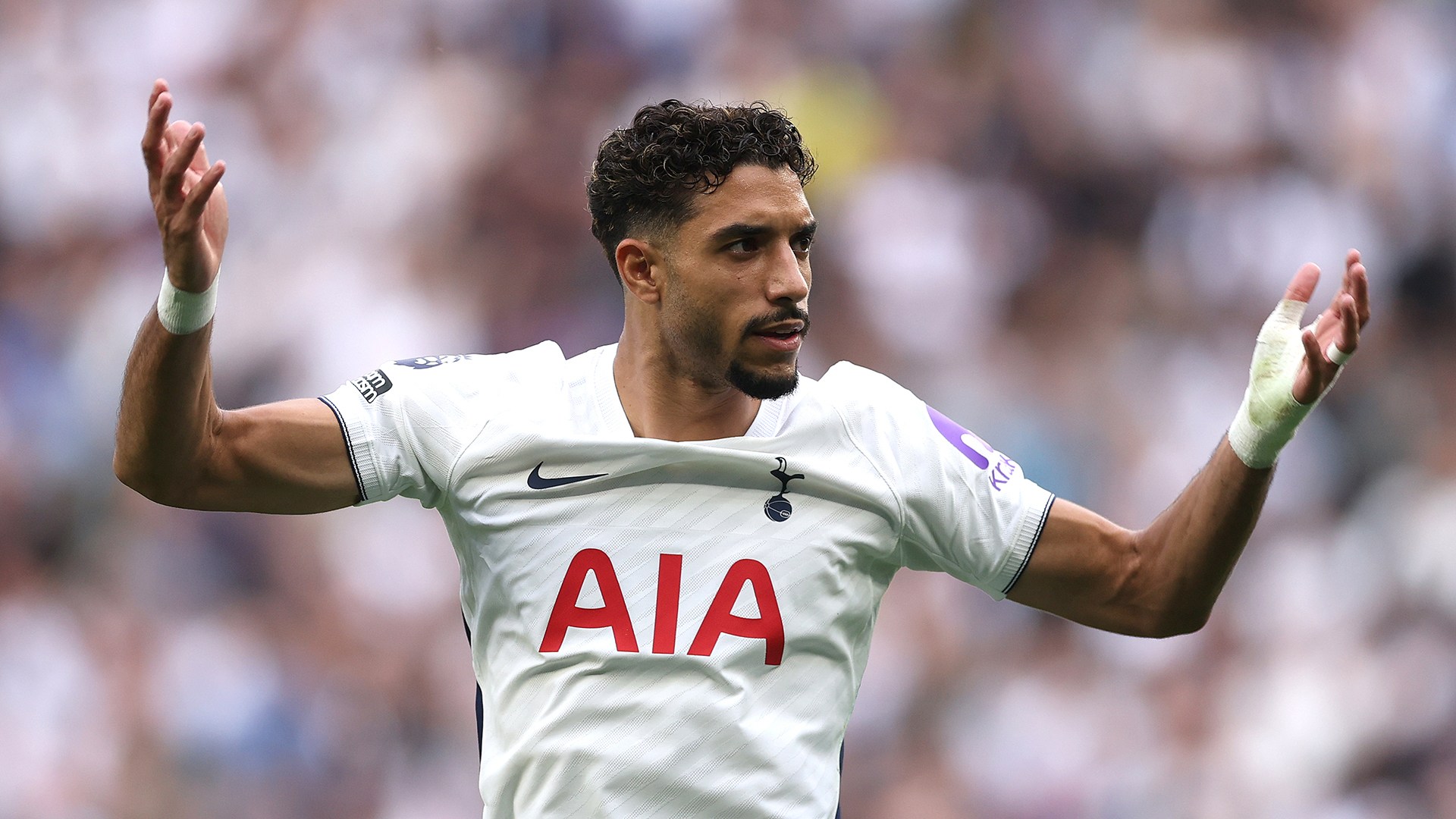
On Tuesday, Tottenham did something that has been out of character since the start of the 2026-27 season: It scored a goal. The goal came in the 69th minute of its third-round League Cup match against Liverpool, it came from a corner, and it ultimately didn't matter all that much. Connor Gallagher capitalized on a weak run-out from backup Pool Boys goalkeeper Giorgi Mamardashvili and headed the ball in, giving Tottenham its first goal in any competition since its 5-1 pounding of Championship side Charlton Athletic in the previous round of the League Cup. Gallagher's header was a necessary tally, even if Tottenham eventually bowed out of the League Cup anyway by a score of 3-1, because the club has been afflicted with an offensive malaise in the Premier League never before seen in the 144-year history of Tottenham Hotspur. Maybe just seeing the ball hit the back of the net again will spark something for the club, and boy does it need a spark.
Through four Premier League games, Tottenham has scored zero goals, and only by similarly impotent chance creation and finishing from Nottingham Forest and Everton does the North London side have any points domestically. Despite spending a lot of money this summer, Spurs are currently in exactly the same spot that they have finished the last two campaigns, 17th on the table and with more questions than answers. This is the first time in the club's history that it has started a season goalless across four games. It's a new low in the series of humiliations, postponed briefly by winning the 2024-25 Europa League, that has stricken Tottenham over the last two-plus seasons.
While it will not be a comfort to anyone associated with the club, Tottenham's issues are quite easy to diagnose. The club has become the latest point of evidence against spending money just to spend. This summer, Tottenham dropped €294 million on Sandro Tonali, Mateus Fernandes, and Sávio, plus it agreed to a loan-with-obligation-to-buy for Omar Marmoush of Manchester City, the fee for next summer coming in at €70 million. That's €364 million committed to players that were meant to bolster the attack (Tonali is more of a withdrawn midfielder, but one of his best traits is his ability to orchestrate counters from deep, so I'll count him), along with a bunch more money on defenders like Jan Paul van Hecke from Brighton and Tosin Adarabioyo from Chelsea. In total, Tottenham spent roughly €366 million this summer (and that doesn't count Marmoush's eventual fee) to be exactly where it was last season, only to look worse in the process.
Put plainly, the various combinations of front four attackers in manager Roberto De Zerbi's 4-2-3-1 formation have all failed spectacularly. Here's a remarkable statistic: Despite deploying Marmoush, Sávio, Fernandes, former 19-goal scorer Dominic Solanke, €40 million man Gallagher, and Mathys Tel, four of Tottenham's top six individual xG tallies come from either defenders by trade (center back Micky van de Ven, right back Pedro Porro, and van Hecke) or a player out on loan (winger Mikey Moore, who racked up a whopping 0.4 xG in 90 minutes before going off to FC Koln for the season). Only Solanke (0.44 xG in only 106 minutes) has a statistical profile that doesn't pain the eyes.
Why is Tottenham's revamped attack not working? The easy answer is that the club never replaced Harry Kane and Son Heung-min. It is not a surprise that losing both players (Kane left to Bayern Munich in the summer of 2023, and Son to LAFC last summer) has tanked Tottenham's offense; not only did both of them score plenty of goals (Kane was good for between 20 and 30 goals per season when healthy, and Son between 10 and 20, peaking at 23 in 2021-22) but, more crucially, they both created a lot as well. Kane is one of the best playmakers from the striker position in recent memory, and Son's speed and technical skill helped create chances on counters. Tottenham was lucky enough to have two of the best attackers in the Premier League, in their primes at roughly the same time, and that papered over any other offensive cracks it might have had.
With both Kane and Son gone, the club has, quite unsurprisingly, failed to recreate their impact in the aggregate. Really, anyone could have seen this coming; committing €150 million to two Manchester City washouts (Sávio and Marmoush) in hopes that Pep Guardiola of all people had not gotten some previously unseen potential out of them was a fool's errand. Continuing to rely on Solanke as the only real striker is similarly misguided; while he did have that 19-goal season with the latter in 2023-24, he has existed exclusively as a sub-10-goal striker in the Premier League every other season he's been in the top flight.
Perhaps De Zerbi wanted to ride the wave of striker-less formations around the top of Europe (namely, Paris Saint-Germain and Barcelona, neither of which employ a traditional striker, to great success), or perhaps Tottenham's scouting department couldn't find one worthy of the amount of money it spent on yet another winger, ad infinitum. I haven't even mentioned Mohammed Kudus, who started his first game of the season across all competitions on Tuesday; the former West Ham standout did have a chance to score but otherwise didn't do much of note in the start, nor in his three 20-ish minute cameos in the league.
A lot of the blame falls squarely at De Zerbi's feet. The Italian came in to "save" Tottenham late last season, and while he did manage to keep the club up, it is astounding that the brass gave him so much money this summer, when his record of success is simply not there. He's still riding the high of getting Brighton into Europe in his first season there (2022-23), but otherwise, his résumé has one second-place finish with Marseille in Ligue 1 and a bunch of failing upward.
His tactical plan is built on slow and methodical play that invites opponents to press up the field, before finding spaces behind. It's a tried-and-true tactic across the top flights of Europe, but whether by inclination or by coaching, Tottenham's players are broadly missing the latter part of the plan. The way this plays out in practice is that Tottenham has a lot of possession (59.5 percent average in the league) but no drive in going forward. The chances just don't create themselves, and the players, regardless of which four are out there ahead of the pivot midfielders, end up trying to force solo plays rather than working into space. It is absurd that after four matches, Tottenham has only played six through balls. What's the point of moving the opponent's press away from its own goal if not to exploit the area behind it? Instead of working team plays into good positions, Tottenham's attack consists of carries from deep (center back van Hecke somehow has the most progressive dribbles on the team with 82; the next highest is Tel's 37) and limp passes across the backline and pivot.
Is there a fix for this that isn't just spending a lot more money to bring in one or two (or three!) creative players who can actually provide some of the spark the other prized transfers are incapable of finding? Probably not, but at the very least, Solanke should get more than 107 minutes of play across four matches. He hasn't been good, to be clear, but neither has Marmoush, who has started three of the four matches at striker. Solanke would at least in theory create a focal point for the attack and allow Marmoush, Fernandes, and Sávio to play off of him, rather than everyone trying to dribble into the same areas, taking way too many touches around the box for little result. Even this probably won't work, though, because Solanke is just not good enough for a team of Tottenham's ambitions. But this striker-less nonsense doesn't work when no one is correctly moving into space and rotating to create confusion in opposing backlines. The way De Zerbi has set his side in the four league matches so far is static, slow, and overly reliant on individual magic that has not been there and which might never arrive.
Even when the shots do arrive, they're not good ones. Tottenham has shot 52 times in its four Premier League matches, and it is only thanks to putting six on target against Newcastle that the overall on-target numbers look bad (12) rather than dire. This isn't a matter of not placing shots on frame, either, which at least could be correctable. This is a tactical failure, as Tottenham consistently fails to find open lines to goal. For the season, Tottenham has fired off 19 shots that were blocked by defenders, and it has created only four shots from inside the six-yard box. More shots is always a good thing, but not if almost half of them come from outside of the box (21 of 52), and that's what Tottenham is settling for far too often when its initial plans fall apart.
With all that said, there is some optimism that things could turn around. Tottenham looked great against Liverpool on Tuesday, and while the Reds did start a partly rotated side for the cup, the result did back De Zerbi's assertion that his side played well and were unlucky to not score. Mamardashvili had to deploy a couple of world class saves to keep Liverpool ahead, and it was only thanks to three stunning goals that Liverpool overcame its own early season woes to advance. Tottenham had more shots, more shots on target, more possession, and more xG (less useful over one game than a bigger sample, but noteworthy anyway), and looked for the first time like a side with a plan in attack.
Maybe the finishing never matches up to the potential, and Tottenham's offense is a nightmare all year long, but finishing is streaky and open to variance. It's possible Tottenham will be on the right side of lucky if it plays more like Tuesday—decisive, attacking, and rapid rather than static and slow—than it has this season. It gets a good chance to fix things in its next league game, with 19th place Aston Villa coming to North London on Saturday. Can Spurs ride the momentum of actually scoring a goal, against Premier League opposition no less, and get back on track? Or will Tuesday's encouraging loss be remembered more for the loss than the encouragement? De Zerbi might run out of time soon if he can't figure out how to make his team score, and Tottenham's expensive roster might find its way down to the second division, a boondoggle of the club's own misguided creation.