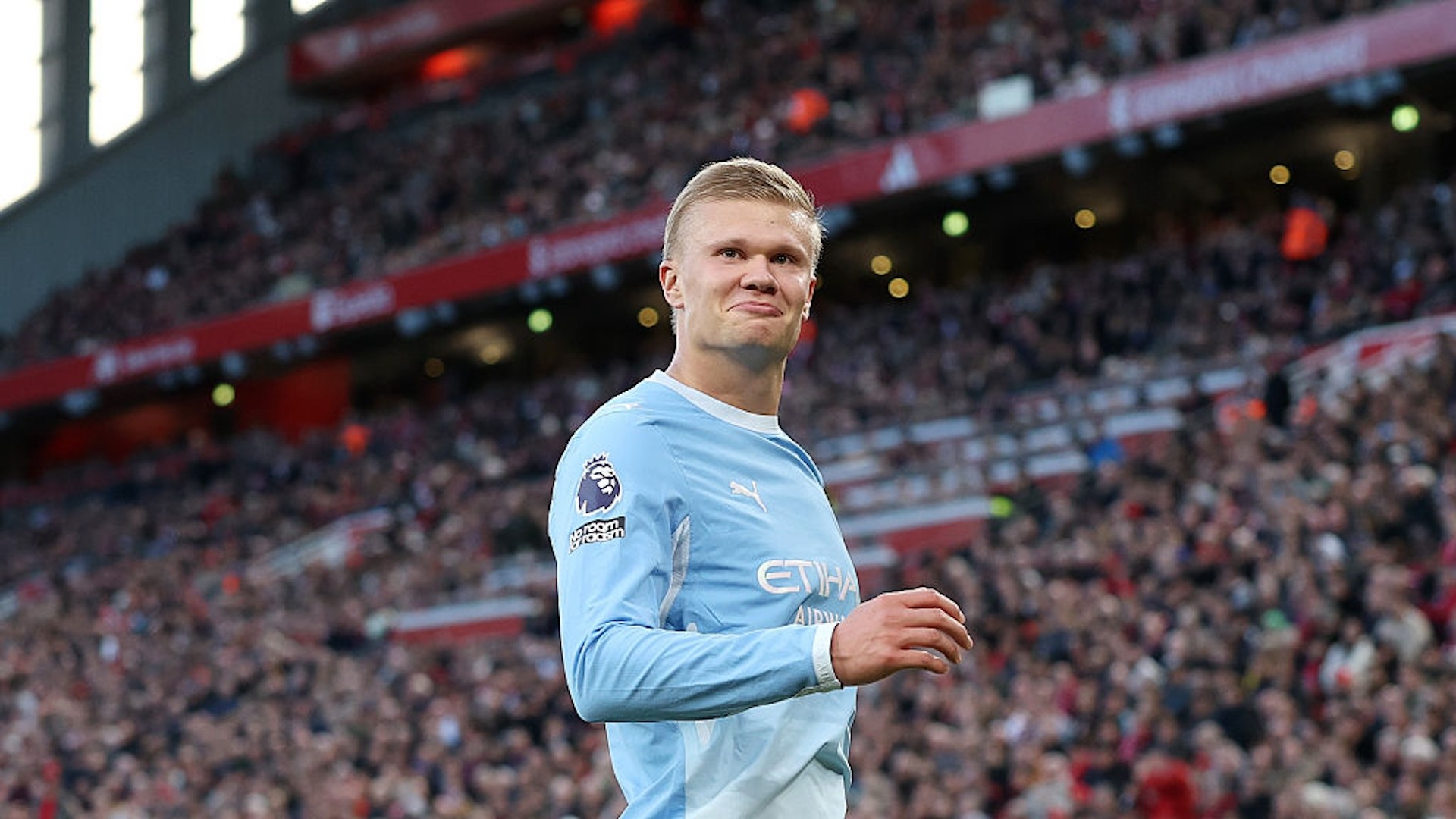


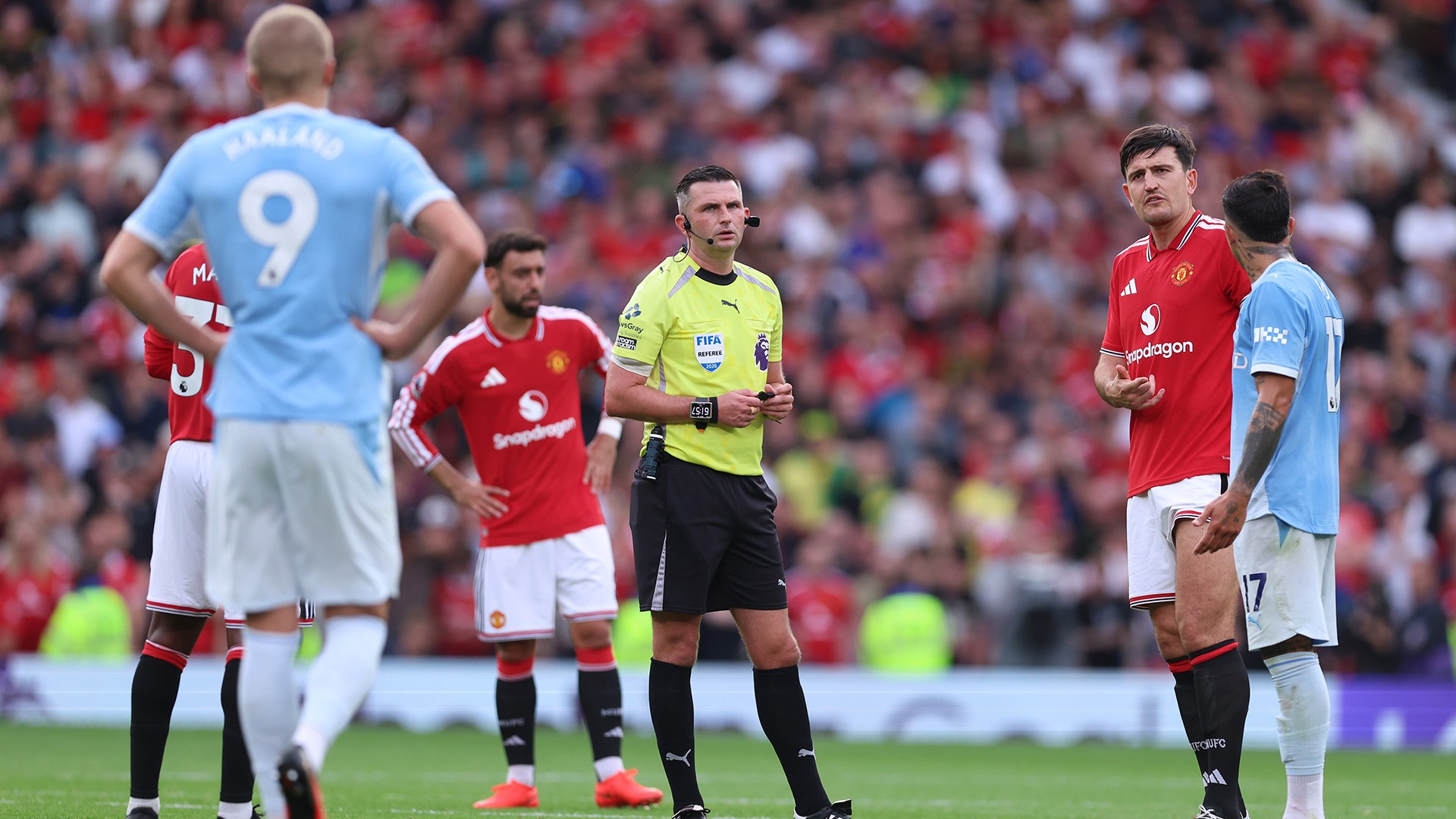
The Video Assistant Referee is supposed to get everything right. This is an incredibly high standard to hold any sort of officiating, but this is VAR's main selling point and raison d'être. All of the delays, ticky-tack calls, and general disruption to the flow of a soccer match are supposed to be worth it; after all, who doesn't want the correct call made when an incorrect call could decide a match, a season, a legacy? But of course, VAR is not perfect, and it will never be, even when called to rule on supposedly cut-and-dry offside decisions. As soon as any sort of subjectivity is thrown into the mix, VAR is no better than a normal ref, and oftentimes worse. With that in mind, I submit into evidence Erling Haaland's 60th-minute goal during Sunday's Manchester derby.
At first glance, this is exactly the type of goal decision that VAR should excel at sorting through. Haaland's back-post finish was ruled out on the field by the sideline referee for an offside, as he judged that Haaland was ahead of both the ball and the last defender when Josko Gvardiol struck the ball across. Since it was a very close decision, even in live action, a VAR review was all but assured, and said review found that Haaland was actually onside at the time of Gvardiol's pass. The camera angle showed on replays didn't make that clear, but the lines as deployed by the VAR, which are more accurate than the TV cameras, did help decide that the Norwegian was just onside. Great, goal given.
Except that there is Enzo Fernández to be accounted for, and this is where things quickly fall apart. On Gvardiol's cross, Fernández attempted to create some magic by diving headfirst at the ball zooming by. The new City midfielder had his Argentina teammate Lisandro Martínez marking him, albeit loosely, and his attempted dive at the ball might also have impacted how United goalie Senne Lammens positioned himself. This will become important shortly.
As part of the VAR review to check if Haaland was onside, every aspect of the play comes under review, particularly any other offside rulings. So while Haaland was ruled (correctly) onside, the VAR needed to take a look and confirm that Fernández was either onside, or that he didn't touch the ball. This part is easy: Fernández was clearly offside when Gvardiol crossed the ball, and the sensors in the ball did not detect a touch.
This is one of the objective rulings, like Haaland's position, where VAR excels. So far, so good. However, the problem comes from deciding whether Fernández made a play on the ball that affected the play, and whether his presence impacted the United defenders. Let's read the rule in question, from the Football Association's own offside rule website: "A player in an offside position at the moment the ball is played or touched* by a team-mate is only penalised on becoming involved in active play by [...] clearly attempting to play a ball which is close when this action impacts on an opponent or making an obvious action which clearly impacts on the ability of an opponent to play the ball."
VAR rules in absolutes, which creates a problem here: No matter how obvious it was that Fernández was both making a play at the ball (by diving at it) and impacting not one but possibly two opponents (Martínez definitely, and Lammens likely), VAR can only really focus on the objective side of the ruling. In this case, the replay showed that Fernández was offside but also that he did not touch the ball with his diving attempt; as stated above, the sensors did not pick up any touch, but VAR is instructed to double-check in case of a faint touch that the sensors might not pick up. Either way, the ruling was that he did not touch the ball, and that passes the eye test. But the rest of the offside rule is not an absolute, and VAR can only detect that there is reason to involve the on-field referee for a subjective ruling. In this scenario, the VAR officials did not send Michael Oliver to the monitors.
#MUNMCI – 59’ VAR OVERTURN
— Premier League Match Centre (@PLMatchCentre) September 13, 2026
VAR checked the referee’s call of no goal for offside – and determined that Haaland was in an onside position and recommended that the goal was awarded.
The VAR also deemed that while in an offside position, Fernandez didn’t play the ball. pic.twitter.com/TyTip3ACIh
After an almost three-minute review, the on-field decision was overturned, without Oliver checking if Fernández's dive had been a play on the ball or if he had impacted Martínez and/or Lammens. Haaland was onside after all, Fernández never touched the ball, and so the goal stands. Manchester City would go on to win the match 1-0, despite an early red card to Phil Foden, and continued its perfect start to the season. United, on the other hand, would have been flattered by a 0-0 draw if the Haaland goal had been ruled out, and its underwhelming start to the campaign would be one point better, but it probably deserved to lose the match.
Later on Sunday, Pro Ref (formerly called PGMOL, and still England's refereeing body) admitted that an error had occurred with the Haaland offside review. Specifically, while all of the positional decisions were made correctly and no contact was detected from Fernández, Pro Ref admits to an "error of judgement" with regards to Fernández's involvement in the play. Crucially, the Pro Ref statement argues that the City midfielder "did not play the ball and therefore that makes any offside offence subjective."
To me that is incorrect, as he clearly is diving to try to hit the ball toward goal, and is close enough that the VAR felt the need to confirm he did not touch the ball. That being said, Pro Ref's "error of judgement" comes from the second part of the offside rule described above: "However, on this occasion, the VAR did not recognise the likely impact of his position and should have recommended an on-field review."
So by Pro Ref's own admittance, Haaland's goal should have been reviewed on the field by Oliver, after which it would have almost certainly been ruled out. That admittance will do little to calm United and its fans' ire toward VAR, nor will Pro Ref's apology. As karmic as it might be to see United, the progenitors of Fergie Time, lose due to a referee mistake, I can't really blame them for the bad feelings here. United manager Michael Carrick was confused after the game, saying that Fernández had "thrown himself at the ball six yards from goal" (correct!) and "pretty nearly touched it" (also correct!). He went to on to say that he "can't understand how they're trying to help referees and putting so many layers behind them with so many people, so many bodies, so many screens, and so many whatever offices they are to try and come up with the right decisions."
Martínez was more direct in his comments, first saying that Haaland was open at the back post strictly because he had to pick up Fernández, and then going on to criticize the referees some more: "Every season [the referees] are coming to our club, they explain for one hour, one hour and a half the rules, and they look so confident with that, and then after five, six people make these kinds of mistakes in the Premier League. It's unacceptable."
The Manchester derby is one of the biggest and most impactful fixtures in the Premier League calendar, so having it decided by a VAR process fuckup feels spiritually correct given how VAR has marred the league in recent years. Who can forget (not me) the Liverpool-Tottenham debacle from 2023? With every VAR fiasco that pops up, it becomes fairer to question whether the value proposition of instant replay reviews has flipped toward the negative. At the very least, there's a disconnect between what VAR should do and what it can do. It is incomprehensible that a three-minute review of Haaland's goal never landed on the "send Oliver to the monitor" decision, except that VAR made a judgement call. I'd rather live with a hundred wrong decisions on the field than even one VAR "error of judgement," and after Sunday, Manchester United might just feel the same way.