
Late last week, the Commonwealth Foundation announced the five regional winners of its 2026 Short Story Prize. The quintet will move on to a final round of judging ahead of the grand prize announcement on June 30, though we can probably count out Caribbean regional winner Jamir Nazir. It seems Nazir's "The Serpent In The Grove," published last Tuesday in Granta, was written by a large-language model.
On Monday, Wharton associate professor Ethan Mollick pointed this out, noting in the process that the AI-checker he used tends toward false negatives more than false positives. Nazir's online footprint is small: a self-published 2018 poetry book called Night Moon Love: Poems For All Who Have Loved Or Dreamed Of Love and a prolific, AI-fueled turn on LinkedIn as an AI evangelist. The Commonwealth Foundation told The Bookseller they are "conducting a thorough, transparent review of the selection process."
A Granta spokesperson, meanwhile, said that they simply copy-edit the stories selected by the Foundation—this one includes the lines "She had the kind of walking that made benches become men," and "The girl smiled like sunrise over a sink," raising the intriguing possibility that "The Serpent in the Grove" won an award and got published in a prestigious literary magazine without anyone ever actually reading any part of it—that they were "alarmed by the speculation," and would keep the story up until the review is complete. Granta publisher Sigrid Rausing also turned to Anthropic LLM Claude for some help analyzing the story, and quoted Claude at length in her statement, in case anyone was feeling sympathetic toward the magazine. Nobody could get in touch with Nazir, who appears to be a real guy with a fake profile picture.
This was not the only literary fraud perpetrated on the human race this week, though it was perhaps the most alarming. It is perhaps easy in retrospect to identify supposed AI tics in Nazir's writing—epistrophe, not-not-but constructions, em-dashes like the two used in this very sentence—though I should emphasize again that AI-checking tools are fallible and likely to have a harder time conducting their Turing tests as LLMs become more sophisticated. In this case, it's less the writing that concerns me (to use a second AI trope) than the Commonwealth panel's inability to distinguish real from fake. The process hums (to use a third) with general paranoia. It's not that I worry about a flood of AI-generated books totally supplanting literature as we know it, not that I care about the integrity of the Commonwealth Foundation, but (ha ha ha!) that a grand blurring could be on the horizon. I worry that people will stop caring.
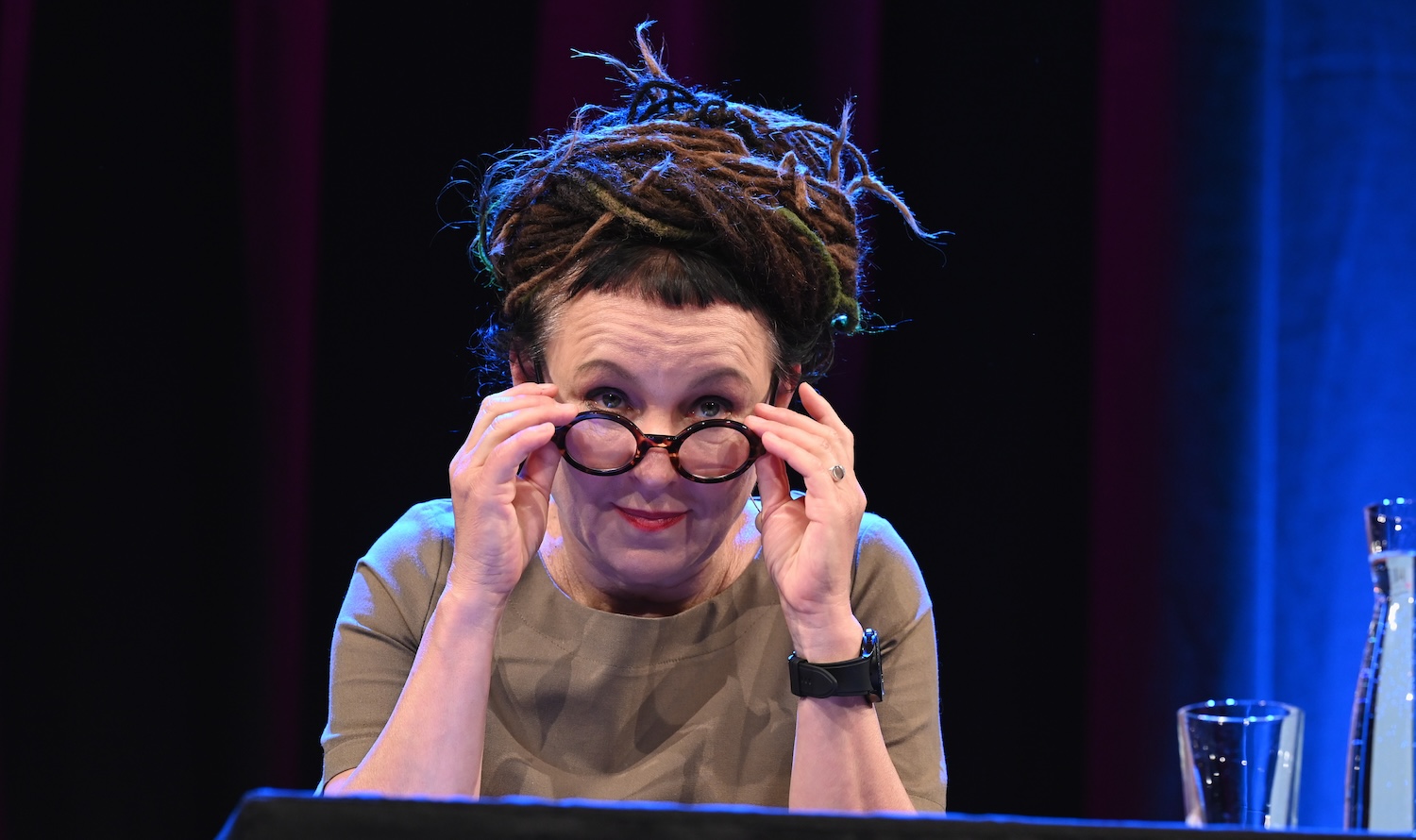
To wit: The prominently be-dreadlocked Nobel Prize winner Olga Tokarczuk gave an interview with a Polish publication in which she boasted of the ways she uses AI in her creative process. Tokarczuk, one of literary fiction's biggest international stars, is the author of Flights, which was awesome; Drive Your Plow Over The Bones Of The Dead, which was too long but ultimately pretty good; and The Books of Jacob, which I didn't finish. She's a big enough deal that her English translator Jennifer Croft wrote a novel about translating an enigmatic Polish genius author, and it received a lot of attention and positive reviews, both for its formal inventiveness and its fictionalization of a vaguely Tokarczukian figure (I should be clear, the book's Irena Rey is a totally different character, and I don't think it's fair to compare her to Tokarczuk at all aside from the writing of novels) despite being a bit of a slog.
Anyway, writer Maks Sipowicz translated the interview, wherein Tokarczuk details how she uses AI:
When writing my latest novel … I asked this advanced model what kind of songs my protagonists would be listening to at a dance, a few dozen years ago, and AI gave me a few titles.
[...]
Often I just ask the machine, 'Darling, how could we develop this beautifully?' Even though I know about hallucinations and many factual errors in the algorithms in terms of economics and hard data, I have to add that in literary fiction this technology is an advantage of unbelievable proportion.
She went on to say writing novels is economically unviable and that this will be her final literary work, since readers don't care about complex works of literary fiction anymore. Maybe that's true, but it's a shame to give up like this. Have some self-respect, ma'am. I would like to think a Booker Prize winner would know which side to pick in the war on the humanities, though maybe the lesson of this story is: Trust no literary prize.
To complete the rule of three, we have New York Times media reporter Ben Mullin to thank. Mullin published a story Tuesday morning about Steven Rosenbaum's new book The Future of Truth: How AI Reshapes Reality, which is about the future of truth and is itself mildly mendacious. Several of the quotes in the book attributed to real people are themselves not real. The meta-textual elements of Rosenbaum's fuckups, given that his book is about AI's powers and limits, are really something. From Mullin's story:
One of the quotes is attributed to Kara Swisher, a prominent technology journalist, in a chapter about AI lies. "The most sophisticated AI language model is like a mirror," the book says Ms. Swisher wrote. "It reflects our own morality back at us, polished and articulate, but ultimately empty behind the surface. It's not bound by Asimov's laws or any ethical framework—it's bound by the patterns in its training data and the objectives set by its creators."
Swisher never said that, and neither did several of the other experts that Rosenbaum quoted. Rosenbaum said he was also launching an investigation, which is a crazy thing to say about a book you ostensibly wrote, to see what else his writing assistants hallucinated in the process. "As I disclosed in the book's acknowledgments, I used AI tools ChatGPT and Claude during the research, writing and editing process," he told the Times. "That does not excuse these errors, of which I take full responsibility."
This all feels really bad. The fact that LLMs are becoming advanced enough to dupe prize judges and pump out nominally Granta-level short stories is depressing, but what's worse is the pathetic behavior of my fellow writers. You idiots! Those models are the enemy! Whatever utility the computational functioning power of AI has for crunching large data sets or serving as a better Google, using it to actually write for you, to come up with "ideas" or have it "generate" prose, is a fundamental misapplication of the technology. There is no working with ChatGPT to make your stuff better, no asking Claude for help that does not change the fundamental nature of the work.
Also, as a human writer, I resent that several rhetorical devices and even punctuation marks have become so associated with ChatGPT prose that my fellow writers and I have become gun-shy about deploying them. Why should OpenAI get to own the em-dash? I had to learn how to use it the old-fashioned way—with the help of Samer Kalaf.