Converts can often seem like the only really religious people around. They tend to take their faith up, whatever it may be, with enthusiasm and vigor and, most importantly, without embarrassment; the cliché of the "zealotry of the convert" is well known even beyond the confines of institutional or traditional belief. No shrug of ambivalence for the initiate. But then, that's what makes them suspect, what raises the eyebrows of the already faithful and the question of who, really, belongs to the faith, and to whom it belongs, and above all who will determine where it goes.
Paul, the one-time persecutor of the troublesome Jesus-followers, and not any of the original disciples who actually knew Christ, is credited with transforming Christianity from a radical Jewish sect into the universal Church. This has long been a subject of contention, or at least conversation. What was lost, and what was added in, when the original encounter was supplanted by the message, the idea, and eventually the institution? For some purists today, that's where it all went wrong. For others, elsewhere: Everyone picks their own beginning.
The self-possession of the convert, so much a double-edged sword within their chosen confines, is also what makes them a source of fascination in the wider world of our secular modernity. For years now we've been told in reporting and opinion pages about the great swathes—or small, indicative pockets—of people taking up "traditional" faiths, largely Roman Catholicism, though with some seekers finding their home in the presumably even more traditional Eastern Orthodoxy. The most famous of these adult converts is the current American vice president, JD Vance, who, under the twin influences of Rod Dreher and Peter Thiel, entered into the Church in 2019. Against the arid monoculture of liberalism, or else against the florid multitudes of multiculturalism, these neophytes seek out the depths and the heights, adventure and homecoming, the paradoxical and the irresistibly rational. This morass, in any case, is how people tend to talk about converts and conversions and the questions around which these words turn.
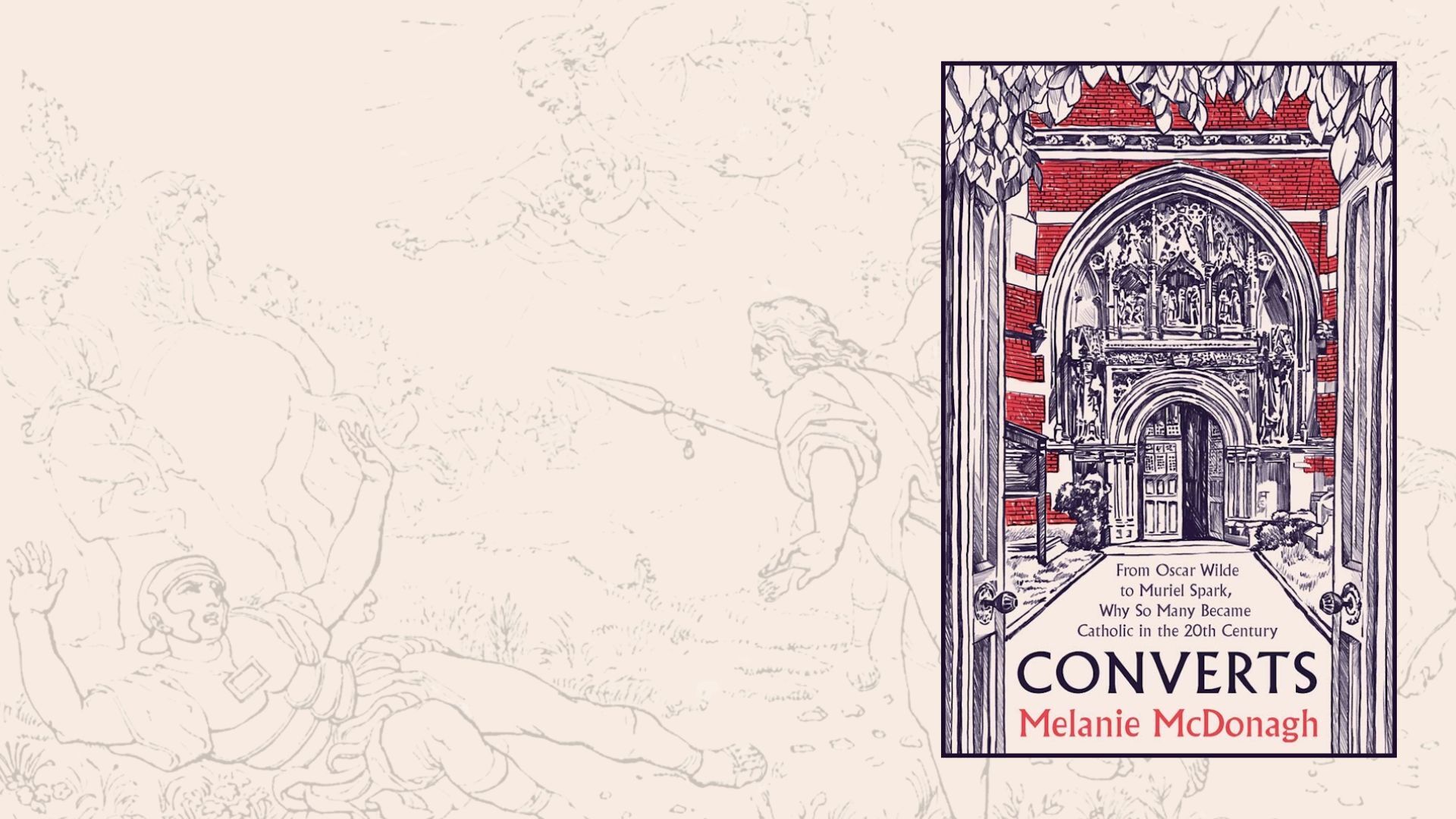
The proximate beginning of this way of thinking is a little over a century ago in Europe, when the hitherto contested project of secularism became ascendant. In response, waves of conversion crashed over the continent, particularly among literary and artistic types, and for reasons as various then as now. Converts: From Oscar Wilde to Muriel Spark, Why So Many Became Catholic in the 20th Century, is British journalist and author Melanie McDonagh’s attempt to synthesize and understand the many strains that made up the conversion contagion in her own country. Beyond Wilde, Spark, and other well-known figures like Graham Greene and Evelyn Waugh, American readers are likely to encounter here for the first time a slew of essayists, novelists, poets, and painters, as well as some soldiers and clerics, and many who were several of each: Gwen John, the great painter overshadowed in her own day by her brother Augustus and her lover, Auguste Rodin; Siegfried Sassoon, perhaps the finest of the World War I memoirists; R.H. Benson, a priest first in the Church of England and then in the Roman Catholic Church who rose to prominence as the author of Lord of the World, a dystopian novel about the reign of a technological Antichrist (it has since been cited as prophetic by Popes Benedict XVI, Francis, and Leo XIV).
Though McDonagh's primary purpose is descriptive and historical, certain contemporary resonances are unavoidable, given both the perennial presence of conversion as a religious theme and the striking prominence of converts in our own culture. She leaves both of these sources of relevance tantalizingly (or, perhaps, frustratingly) unremarked upon. In her introduction, she sums up the book in confidently (or, perhaps, diffidently) historical terms:
For more than half the twentieth century … a time of dramatic political, cultural, and social change, many people gravitated towards the Catholic Church, and that movement included some of the most formidable and brilliant individuals of the time. Whether the reader sympathizes or not with this development, it is worth noting.
McDonagh's account begins with the 1890s, a period of relative political and social stability, but profound cultural transformation. Victorian life, the story goes, bound as it was between the spiritually stagnating forces of liberal progress, industrial production, and Darwinian agnosticism, had also given rise to the Decadent movement, a cultural tendency that began in France but soon spread across Europe. This movement championed aesthetic pleasure both for its own sake and as a weapon: against society, against the self, against nature. The key text is Joris-Karl Huysmans's 1884 novel, À rebours, or Against the Grain. In it, a disillusioned dandy retreats into solitude to pursue truth and beauty, an endeavor that includes a rereading of all of French and Latin literature, amassing a collection of rare and delicate perfumes, and setting precious gemstones in the shell of a tortoise, which labors under the weight of their "dazzling splendor" for a while then dies.
This proved to be a curiously fertile soil, giving rise not only to a range of political dispositions, from monarchism to socialism, but to the resurgence of ritualism, spiritualism, and religiosity more generally. For many of the Decadents—most of whom, for what it's worth, refused the appellation—Catholicism called not only as a matter of personal salvation, but as a point from which to reorient, and even reform, the whole world.
The question of reform is worth pausing over, since its emphasis and character in each case of conversion is really the whole ballgame. Personal or social, political or aesthetic, the conversion to Catholicism was for these figures a reshaping of experience. There were many for whom that meant not simply an aesthetic revolution, but a foundational political and social reform. Between the World Wars, when the flux and flimsiness of daily life seemed to demand something both revolutionary and grounding, socially minded writers and artists who had already rejected both capitalism and scientific socialism as spiritually degrading flocked to Catholic-infused salons and literary journals to discuss the possibility of renewal.
Of course, not everyone was so broad-minded: Lord Alfred Douglas, the object of Wilde's ultimately ruinous affection, had a faith "in many respects like a child's, and his prayers and devotions were simple and unaffected." But where Douglas may have been uncomplicated in his religion, his social life was wracked throughout by scandals and betrayals, both his own and others'. His conversion gave him opportunity less to remake the world than to refashion his image: No longer would he be the openly gay poet and raconteur, but a conservative and anti-Semitic demagogue who was frequently sued for libel, including against Winston Churchill, for which he was jailed.
Perhaps the most conventionally religious convert in McDonagh's pantheon is John Henry Newman. An Anglican priest, Newman became known as the figurehead of the Oxford Movement, a theological and pastoral trend in the mid-to-late nineteenth century Anglican Church emphasizing a renewed attention to sacramental worship, including ostensibly superficial elements like vestments and incense. After years inculcating this Anglo-Catholicism, Newman "swam the Tiber" in earnest, to become a priest of the Roman Catholic Church, eventually a Cardinal and, in 2019, a saint. Newman was not—despite his enthusiastic theological pamphleteering for the Oxford Movement's main outlet, Tracts for the Times—a rabble rouser, and he framed his embrace of the Roman church more as an embrace of himself by the Church, a not wholly unambiguous experience.
McDonagh seems to have some trouble narrating this kind of turn. We find her saying that "[Newman's] life as a Catholic was not a particularly encouraging one," citing the difficulties he attracted as a newly minted papist both from within his chosen Church and from Protestant compatriots. McDonagh quotes Newman's diary, in which he wrote that "what [he] wrote as a Protestant has had far greater power, force, meaning, success, than my Catholic works," though she notes that this was prior to his 1864 Apologia Pro Vita Sua—perhaps the most compelling and influential conversion account since Augustine's Confessions. This is a little like saying Proust was sick of society when he retired to his bedroom and began to write: probably true in a way, but also diametrically false.
In other words, Newman's period of depression and despondency following his conversion is well known. Its sources include things like a near-ruinous libel suit brought against him, an ongoing struggle with the ambiguities of his sexuality, and other extreme stressors. To give the impression, as McDonagh does, that Newman's early trouble as a Catholic was due to the embrace of Mother Church being less warm than he had expected is misleading, to say the least. And what is more, to what end she makes such a claim is unclear, since the following pages are replete with his successes.
This is a peculiar tendency throughout Converts: McDonagh is repeatedly tendentious about what are necessarily fraught and ambiguous situations and experiences. The book is quite enjoyable when dealing with the rebels and raconteurs who lend themselves to one-sided treatment, and, in more complicated cases, either irritatingly unsophisticated or boring. There is a great chapter on Elizabeth Anscombe, the Oxford philosopher who flouted gender norms and skyrocketed to notoriety in the 1950s when she protested the awarding of an honorary degree to Harry Truman, comparing him to Genghis Khan and Hitler for authorizing the use of atomic bombs. But David Jones—perhaps the profoundest artist covered in Converts, whose equally great efforts in watercolor painting, woodcut engraving, and epic modernist poetry can stand with anything the 20th century produced—gets a few pages of standard biography (a father appalled by his conversion to the "Romish church," a life shattered by trench warfare) and rote recitation of key themes ("Jones's subject matter was only occasionally religious. Yet his paintings of a tree or of flowers in a vase were not secular works").
The most egregious example of this tendency is in the book's closing chapter, which covers the revolutionary Second Vatican Council of 1962–65. McDonagh signals her intent—or, less charitably, anticipates potential objection—in the introduction, where she writes:
[This] book ends before the Council, but a brief final chapter records the reaction of individual converts to the violent disruption in the liturgy. Continuity had characterized Catholic worship, and after the Council there was instead radical discontinuity. There were other important and positive effects of the Council, but this is about the converts' experience.
The chapter in question is as good, or as bad, as McDonagh's word. The most important event in the history of the modern Church is treated in terms laid out by a few elderly cranks who likely had as much to say about the kids these days as about the Catechism. "The numinous vanished from people's religious lives," she writes, "or, as one woman who lived through the changes put it, 'the sense of the sacred went.'"
Undoubtedly there were many protests against Vatican II, and not all of them the result of bad tempers and an unwillingness to listen to the reasoning behind the reforms. But to frame the entire period in terms of those objections, without context or even the possibility that the Council might have been carried out for reasons other than vandalism and pride—"liberal authoritarian bishops succeeded conservative authoritarian bishops, usually the same men"—is a tacit endorsement of the kind of philistinism that has marked Catholic conservatism of the past few decades. It is also reminiscent of the pride we see from many converts in our own day, who are willing to, say, lecture the pope on what subject matters he should weigh in on and when he should keep quiet.
"Catholics who had been brought up in the faith had been trained in obedience, not dissent," McDonagh writes. There are few tones of voice in which this might be taken without offense, and much of the evidence she marshals to this and other points on which converts are more rebellious seems to suggest the opposite. "Among the twenty-four English signatories to petition against the wholesale imposition of reform of the Mass in 1971 were eight converts." Well, that makes for 16 cradle Catholics, at least, who could summon the courage to speak out.
But these are all minor points, really, that read as downstream of a basic thinness. The book doesn't so much develop over time or thematically as trundle along from example to example, rarely giving a deeper sense of the converts' experience than, "The Church provided stability," or "The Church seemed revolutionary," or, in many cases, both. What makes converts, rather than conversion itself, a potentially interesting subject is the kaleidoscopic effect their examination puts not only on religious experience, but on questions of identity, community, even political affiliation. This at once doubles and disperses the same effect that is already at the heart of Christianity itself: It is something one choses, and is chosen by, though never with total certainty, part of a process never entirely complete. McDonagh, however, treats it as more or less a door one passes through and closes behind oneself—a curiously naive view. By the end, Converts gives the impression of someone new to the subject, and untroubled by that fact.