
The novelist Walter Tevis described his 1963 sci-fi novel The Man Who Fell to Earth, obliquely inspired by his struggles with alcoholism, as “disguised autobiography.” It had been optioned at least three times before attracting the attention of director Nicolas Roeg, who saw it as a more spiritual story of alienation. Roeg initially wanted the main character, an extraterrestrial inventor, to be played by the 6-foot-9 sci-fi writer and filmmaker Michael Crichton, or Peter O’Toole, the beautiful manic adventurer of Lawrence of Arabia, before being persuaded to check out Cracked Actor, a tour documentary featuring a coked-out-of-his-gourd David Bowie. Through Bowie, Roeg transformed Tevis’s author surrogate into what Pauline Kael would call “a wilted stranger [who] can be said to represent everyone who feels misunderstood,” whose “lesbian-Christ-leering [and] forlorn, limp manner and chalky pallor are alluringly tainted.” In other words, he’s David Bowie as he was in 1976: Fashioning the character around the remnants of Bowie, the rock star from Mars of the Ziggy Stardust period, the film also shaped the zonked-out, esoteric magus Bowie of Station to Station and Low, which both use stills from the film for album covers.
When a pop star appears in a movie, they deepen the movie by bringing everything we already know about their star persona to the role. The movie also deepens them, by giving them a platform to develop what we already know about that star persona in a visual and narrative medium, and to leave a bigger impression as they seem to bestride the entire cultural landscape.
The stakes of each impression—which is also the term in digital marketing for when a potential customer sees an online advertisement—have never been higher, as margins shrink in the culture industry. To put across a persona—or, as the current media-bestriding pop star now has us calling it, an “Era”—stars employ ever-larger teams of creative directors, stylists, videographers, and assistants. They carry the hopes of ever more label executives, brand and agency partners, and potential collaborators, not to mention potential collaborators’ teams, labels, and brand and agency partners.
Charli XCX’s current Era is “cinephile.” She’s on Letterboxd—debate rages as to whether she manages the account herself, as if a woman with access to colors of cocaine that haven’t yet hit the retail market is eager to appropriate the clout that accrues only from logging Angel Heart (Alan Parker, 1987) with a heart and no star rating. She pulled Celine and Julie Go Boating in the Criterion Closet. This time last year, she closed out her Coachella set by declaring the end of “Brat Summer” and the start of “Cronenberg Summer,” “Joachim Trier Summer,” and the meteorologically harrowing “PTA Summer.”
She’s been laying the groundwork for her Cinephile Era with cameos and supporting roles, frequently as characters notable for being played by Charli XCX. In Faces of Death, filmed in 2023 but finally released to theaters this April, she plays a content moderator at a fictional short-form video app. In the film, another moderator, played by Barbie Ferreira, becomes obsessed with tracking down grotesque special effects demos which she becomes convinced are the work of a real serial killer. Director Daniel Goldhaber and cowriter Isa Mazzei’s film is concerned with the desensitization endemic to the extremely online, embodied by Charli as the blackpilled coworker who took the job for the “thrill” (and also the dental plan), and smirks at snuff films while hanging out by the employee lockers like a high-school mean girl.
It’s not exactly Bowie in Man Who Fell to Earth, but you see where the “Mean Girls” singer is going. At Sundance earlier this year, she was seen in The Gallerist and I Want Your Sex, the former an art-world satire skewering the shallowness of the Art Basel Miami set, the latter a playful interrogation of Gen Z prudishness. Despite the films’ reportedly wildly divergent quality, there is in both cases a mutually reinforcing branding exercise at work here, with Charli and directors Cathy Yan and Gregg Araki each benefitting from association with the other’s aura of zeitgeisty naughtiness.
Perhaps the most common pop-star branding exercise at present, one increasingly standard with every Era, is the behind-the-scenes or concert documentary, giving consumers or fans at least the idea of insider insight into how the product is packaged, while getting that product in front of as many eyeballs as possible through the magic of corporate synergy. Instead of one of those, we have The Moment, which premiered at Sundance alongside her other acting roles. In it, Charli plays a somewhat fictionalized version of herself—she’s the singer behind the hit 2024 album Brat, exposited here with a mix of archival clips (screaming crowds; Anthony Fantano) and newly recorded clips (Colbert, “What’s In My Bag?”) that nicely recreates the anodyne textures of mainstream fame. Brat has turned a niche aesthetic, shaped by Dimes Square, party drugs, and the underground hyperpop label PC Music, into a normie phenomenon, so her U.K. label and its U.S. corporate overlords are eager to extend Brat Summer into fall and beyond by bringing in a hired-gun documentarian (Alexander Skarsgård) to make an Amazon documentary.
Though The Moment is described as a mockumentary, that’s not quite accurate. According to director Aidan Zamiri, it’s a fictional story inspired by Black Swan, another story of a woman in the arts crumpled up in the gears of the creative industry. But it relies for its humor on a savvy audience familiar with the tropes of the behind-the-scenes doc, showing Charli-as-Charli as a mostly passive object ferried from activation to activation and told the deal at the last minute by a member of her team, either the bumbling manager’s rep (Jamie Demetriou, more incompetent than on Stath Lets Flat) or the hypercompetent PA who controls her calendar (Trew Mullen).
A colleague of mine likes to tell a story about the time she witnessed an Academy Award–nominated actress, on the threshold of her own film’s premiere party, turn to her assistant and ask, “Remind me—is this a fun one, or one we have to go to?” The Moment is almost as good at the vapid and draining logistics of life on the A-list: The photo shoot disrupted by Sharks vs. Jets tension between the magazine’s photographer and the star’s makeup artist; the label guys in designer streetwear, showing up to rehearsals just to look important; the brokered friendship with a fellow celebrity you don’t actually know that well, represented here by a wildly passive-aggressive bathroom meetup with Rachel Sennott, of the “360” music video. Like Brat, which includes songs like “360,” about people who work with the same producer or all hang out within the same few blocks on the border of Chinatown and the Lower East Side, The Moment is hyperlocal to fameworld, and makes mountains out of molehills like making small talk with Kylie Jenner on the way to or from a facialist appointment.
Charli conceived of the idea for The Moment in the fall of 2024, after Brat took off, and started conversations with “360” video director Zamiri. He and co-writer Bertie Brandes worked on the screenplay in consultation with their star as she embarked on her tour in support of the album in the fall and winter of that year, and shot it around her tour dates (plus what looks like some real B-roll) in early 2025. The film is quite sincere about the pressure Charli would have been feeling at the time to water down her persona. In the film that comes particularly from Skarsgård’s parachuted-in svengali, whose flouncy cult-leader vibes and very vague grasp of his subject’s music go hand in hand with an awareness of optics and a domineering attitude that begins to box out the tour’s creative director (Hailey Benton Gates). Charli is never more committed to her performance than in the moments when she demands to be left alone to simply be creative—her voice takes on a tensile vulnerability—or in her repeated assertions that the only person she trusts is her creative director, an objectively funny thing to be method about. Showing how misunderstood Charli is by the machine is of course branding by other means, and even the development that could constitute self-parody—an overwhelmed Charli ducking out of rehearsals to recharge poolside in Ibiza, leaving her ride-or-dies in the lurch—burnishes the bad-girl brand.
Aside from music videos, Zamiri has worked extensively in the branded content space—and as Victoria Beckham’s personal videographer, to unclear ends—and perhaps relishes going after corporate art as much as Charli does. A key plot point hinges on a brat-green credit card marketed to young queer people, and Charli’s corporate obligations thereto, and Skarsgård is living his best life as the Amazon hack. The Moment takes shots at streamers, but it was pre-bought by a distributor, A24, which is known to inspire the kind of brand loyalty among hard-to-reach demographics that are nevertheless up for a merch drop, if not a credit card. (Then again…) It also looks like an A24 project: It was shot by Sean Price Williams, whose seamy cinematography, developed on the Safdie brothers’ Good Time and other edgy projects, has been absorbed into the studio’s house style. Skarsgård (Pillion) and Gates (The Drama) were both in other A24 releases this year, and even Kylie Jenner is dating Timothée Chalamet, star of a recent A24 film which Charli has also plugged. That The Moment is so calculating even as it appears so reckless fits with its characterization of its star. It’s a parody of everything around Charli XCX, but only intermittently of Charli herself.
In a 2013 episode of HBO’s Girls, Lena Dunham’s Hannah Horvath snorts an inadvisable amount of cocaine for a magazine assignment and dances sweaty in the club to “I Love It” (frequently googled as “i dont care i love it song”) by the Swedish duo Icona Pop and featuring its songwriter, a then-19-year-old Charli XCX. The song’s snotty, reckless abandon made it apt for the precocious showrunner Dunham and her TV show, which was received at the time as a report from the frontlines of the millennial generation, particularly its bad decisions, pre-#MeToo sexual exploits, and intense confusion at the responsibilities then grouped under the heading “adulting.” These days, it’s been rediscovered by younger viewers nostalgic for Obama-era North Brooklyn, and revisited by millennials, not least Dunham herself, now facing down the compromises and disappointments of impending middle age.
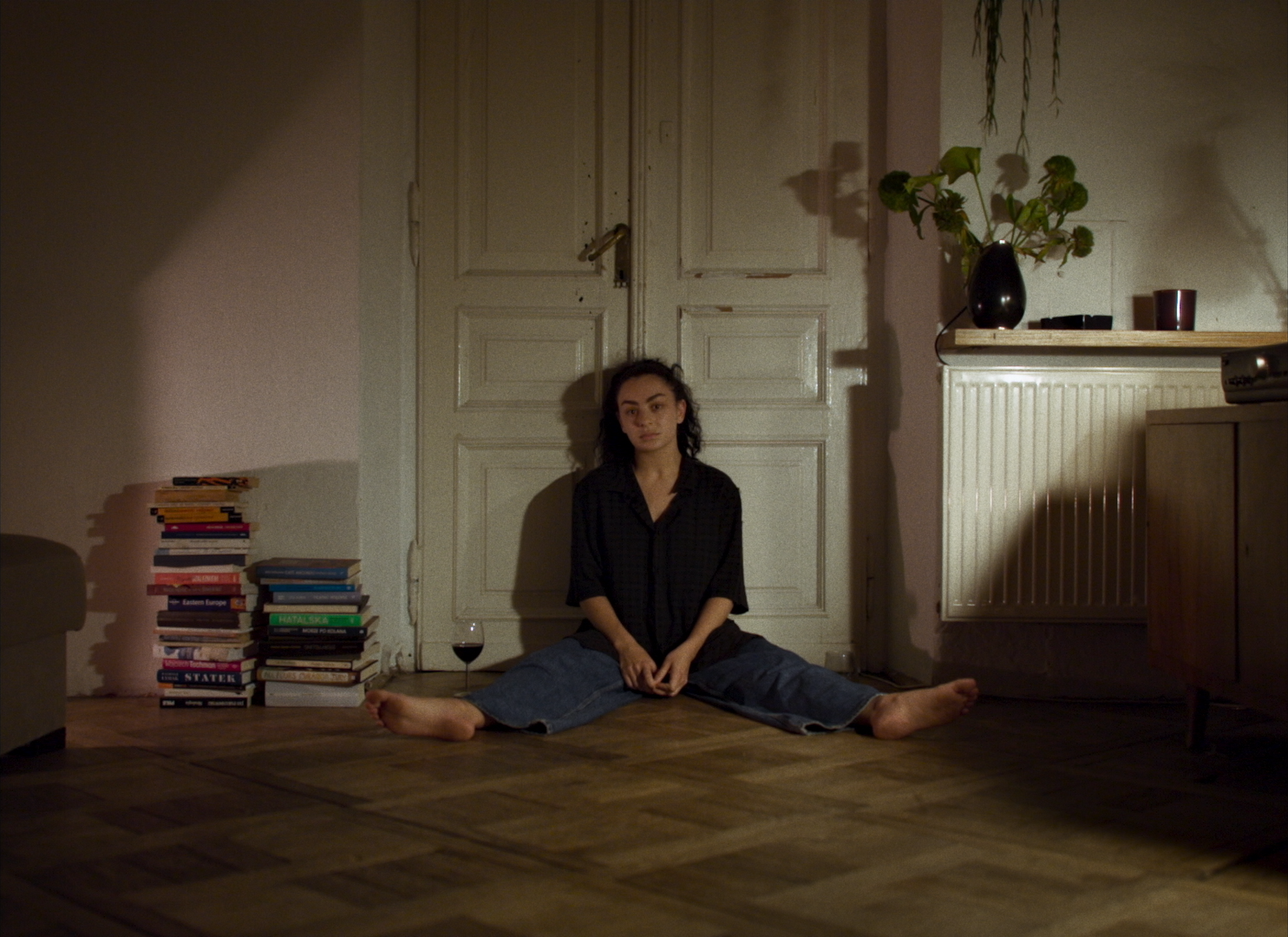
In March 2010, the year Charli XCX signed to Asylum and the month Dunham’s debut feature Tiny Furniture world-premiered at South By Southwest, Eyjafjallajökull erupted in Iceland, disrupting flight patterns across Europe and stranding vacationers—including, in the backstory of the new microindie film Erupcja, the character played by Charli: Bethany, who in 2010 was a teenager on a school trip to Warsaw.
On that trip, Bethany met and befriended Nel (Lena Góra), and has visited her in Poland several times since. Each time, a volcano erupts somewhere in the world, and the two blow up their lives, staying out at the club all night, reciting poetry to each other, and breaking up with their partners. Now, the two are in their 30s; Nel is thinking about getting serious with a very put-together ex, and Bethany’s back in town with her pre-fiancé, surely looking for an out of the relationship, or maybe of aging entirely.
Initially, all this is played as something of a mystery: Bethany stalks Nel home from work, and later appears below her balcony, as if blown in on the breeze. It’s not implied that the two have ever been physically intimate; it seems to me that Bethany, who is putatively straight, is more attracted to Nel, who is gay, than vice versa, though the reverse was probably true initially. It’s more that their friendship is a mutual infatuation, charged with the protean energy of youth.
One initial value proposition of Airbnb—winner of an award for best breakout app at SXSW 2011, the year between the premieres of Tiny Furniture and Girls—was that it got millennials out of hotels and museums and into the real fabric of life in another city, offering a glimpse of an alternate lifestyle while facilitating single-serving friends and consequence-free hedonism. In Erupcja, Airbnb means a romantic city break for Bethany and Rob (Will Madden), who gives their apartment a once-over and declares, satisfied and practical, that it looks like the pictures.
You can see why she brought him to Warsaw and hoped for an eruption: He’s so soppy, making relentlessly sensitive eye contact with Bethany, having her teach him how to say “I love you” in Polish, booking a couple’s massage. If The Moment attempts to show the toll of relentless public scrutiny on an individual psyche, Erupcja shows the same process happening in private, within a couple. There’s a Dean Wareham lyric I’ve always misheard as “I’m writhing underneath your gaze,” and that’s exactly the feeling—of shrinking in a spotlight that seems more harsh than admiring—that Charli gets at in her scenes with Madden. She never looks annoyed, just distracted. There’s a stillness to her performance and a frozenness to her character—it’s always “yes” but never “and.” More polite than passionate, she absorbs her partner’s adoration like a sinkhole, and maintains just enough plausible deniability to shrug away every “You OK, babe?” with a “Just tired, love.”
The film was made very much on the fly, with a director Charli met late at night, at a bar on the border of Chinatown and the Lower East Side, through the introduction of Jeremy O. Harris; the meeting was in May of 2024 and filming was in August, right before the Brat tour and the idea for The Moment. As in The Moment, Charli shares a co-writing credit, as do her co-stars Góra, Madden, Harris, and director Pete Ohs. Ohs likes to shoot cheaply with skeleton crews, and to make his movies on short shoots in unfamiliar places. He and his cast write collaboratively, developing an outline and then writing as they go, developing the story by bouncing ideas off each other in text messages. Here, too, Charli is clearly working through stuff. A line of hers from The Moment is apropos to Bethany, as well: “I know it’s not chic to be the last person at the party, but I think I hate going home.” But these days, the kid who wrote “I Love It” is also the woman wondering about freezing her eggs in “I Think About It All the Time,” and it has not escaped viewers’ notice that Madden looks more than a little like the man Charli actually married a year after the Erupcja shoot wrapped. When Bethany and Rob actually talk, it’s about their friends who have kids.
That conversation is interrupted by Harris’s character Claude, an artist who still regularly relocates from city to city; he’s sitting at the next table at the restaurant and hears them speaking English. Rob is cold to Claude while Bethany is delighted by the diversion, so much so that she implores him to come with her to a party Claude is throwing, rather than to the restaurant where he made reservations.
In this film about characters who live by the rules of force majeure, such chance meetings are like a sign from nature, and a way to let the world author your life story for you, instead of you having to write it yourself, with resources you suspect might turn out to be mediocre. But as Bethany blows off Rob, you begin to see just how rude it is to be chaotic into your 30s, how painful it can be to yourself and others. She comes in for a harsh landing, because you can’t just ghost someone who got a ring resized, not when there’s the cruel and protracted process of moving out to see to. Brat Summer can’t last forever, after all.
Erupcja relates to Charli’s music the way her listeners do, through the filter of everyday life. Usually when stars glam down for a performance, they paradoxically make a big show of it: Watching Charlize Theron as Aileen Wuornos in Monster, you’re supposed to think, But she’s so beautiful! It’s rarer to see a star play a conventionally attractive woman who wouldn’t leap out at you from the boarding line for the EasyJet red-eye because she’s flying in minimal makeup, a greasy ponytail, Lycra shorts, and a baggy sweatshirt. Erupcja is a real movie, small-scale, risky, and resonant, and Charli gives a real performance in it. More to the point, it’s exactly the kind of movie that you’d hope would emerge from her Cinephile Era, one that affirms her commitment to the medium even as it deepens her persona, projecting it into new circumstances and pushing it to evolve. Filmed a few months after Erupcja, The Moment is most convincing as an explanation for how difficult it will be for her to make that kind of movie again.