
I had already done the hard part that night: getting my kids to sleep. It was dark now, May 20, 2022, one of the last cool evenings before summer hit central Indiana. I told my wife I was going on a walk, put in my earbuds, and set out. Tomorrow was trash day, which meant dodging garbage cans and recycling bins. No one else was around. Three blocks from home, on a street lined with bungalows, I smelled smoke, the last breaths of a bonfire. I abandoned the sidewalk for the road; the smoke was still peppery. The podcaster said something about the NBA playoffs. Then, on the edge of my peripheral vision, I saw a big white blur.
Somehow I knew it was a dog. I began to backpedal, expecting a leash to restrain it, but it didn't. The dog launched itself into me. Suddenly I was rolling on the ground, kicking and swinging and screaming for help. I could feel the teeth clamped into my calf, the jaws tearing and grinding. The dog released and bit again.
We fought for I'm not sure how long. Eventually, I grabbed a recycling bin and used it to bludgeon the dog until it backed off, snapping and snarling.
The owner finally appeared and dragged the dog inside. In the flat light of the streetlamps, I looked at my legs. Nothing hurt yet, not exactly, but I could see that my entire lower half was smeared with blood. I found myself staring at my calf, the site of that first bite.
The tissue was just hanging there, loose and slack. My skin had seemingly doubled in size. It was drooping, deflated. I'd never seen anything like it, until I realized I had. It looked like the leg of my grandfather when he was 90 years old.
I stumbled home and drove myself to the emergency room. My wife stayed with our sleeping kids. It took 30 stitches to close the deepest wounds, but the nurses left most of them open because dog saliva raises the risk of infection. They threw away my shoes, which were saturated with blood. I drove home in my hospital socks. "You weren't bitten by a dog," one nurse told me. "You were mauled by one."
It took me months to recover, and that gave me time to think. I thought about my body, which hurt in ways I'd never felt—not just in worse ways, but in new ones. Even my throat burned and ached. At some point, I realized it was because I'd never screamed so loudly before.
I also thought about the book I was writing, a history of the Lewis and Clark expedition. To me, the animal attack felt so brutal, so irrational, so life-changing. But to Lewis and Clark and their men, it was just a Saturday.
I mean this literally: On Saturday, July 26, 1806, a wolf attacked a few of the soldiers. It bit one man "through his hand," in Clark's words, before another soldier shot and killed it.
"This animal," Clark wrote in his journal, "was so vicious." But that's all he said. No one else even mentioned the incident.
Once I was ready to write again, I decided to revise my approach. Historians and nonfiction authors often glide over lived experience. They prefer actions, citations, details, dates. But I had just gone through something primal—something beyond my control and beyond the boundaries of modern life. Gliding no longer felt honest or accurate. I thought I needed to dig deeper, to consider the intensity, the uncertainty, and the violence that defined the expedition.
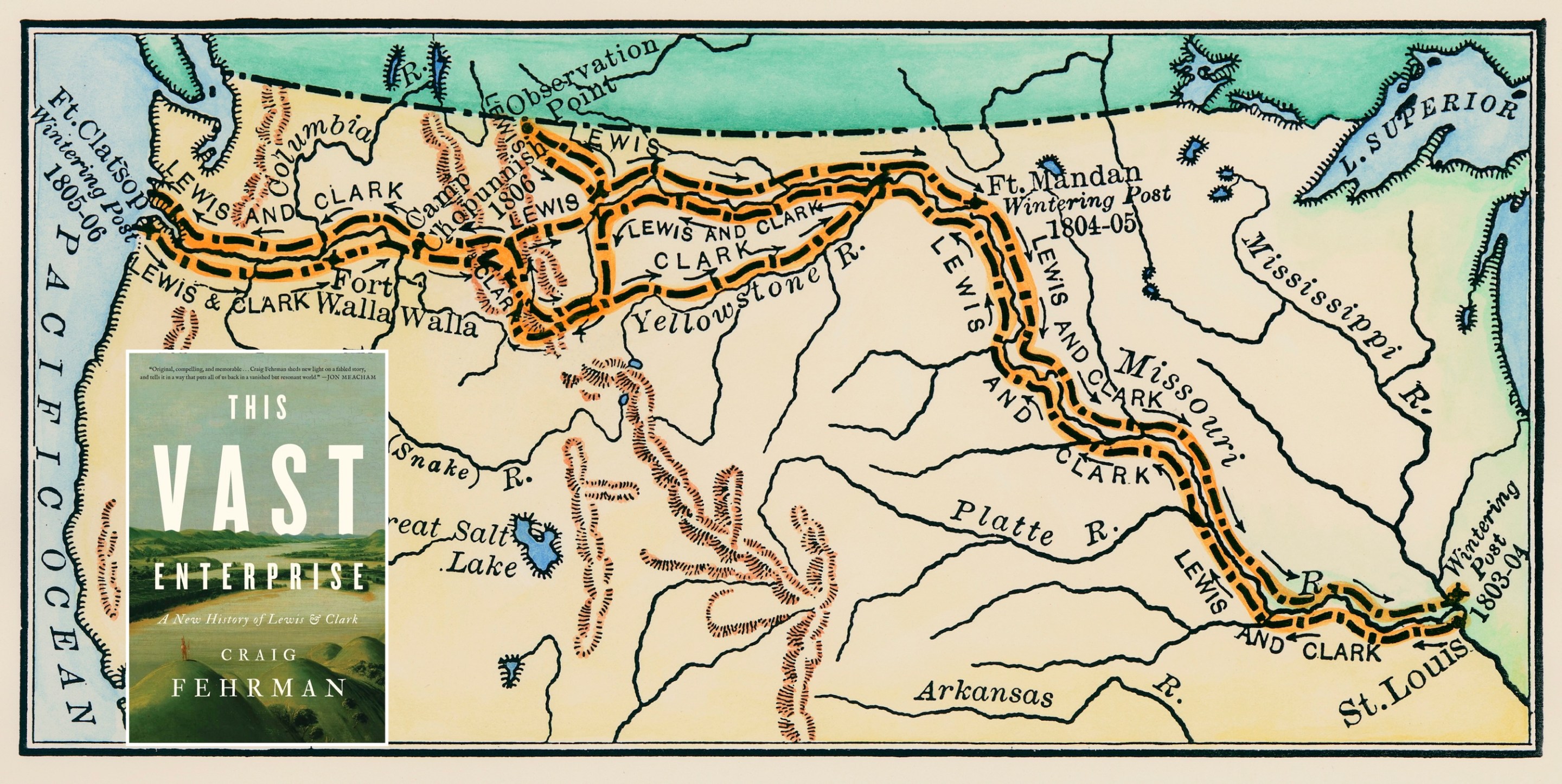
You likely know the outline from elementary school: Meriwether Lewis and William Clark departed from near St. Louis in 1804, traveling up the Missouri River, across the Rocky Mountains, and to the Pacific Ocean. By the time they returned in 1806, they'd covered about 8,000 miles.
Countless emotions and experiences lurked beneath those facts, and I tried to capture as many as I could. Take the first winter at Fort Mandan, which the Americans built in present-day North Dakota, one of many places where they relied on Native help. The winter was brutally cold. Lewis, ever the scientist, recorded the temperature twice a day. Some of his readings dipped to 40 degrees below zero.
But how cold did it feel? And how did their bodies respond to that feeling? After the dog attack, that's what I wanted to know.
John Ordway, a sergeant and hardy New Englander, declared the weather worse "than I ever knew it to be in the States." He noticed frost creeping down the fort's chimneys. He adjusted his soldiers' schedules, relieving the outdoor sentinels once an hour, then once every 30 minutes.
Everyone else hunkered in rooms that were always somehow simultaneously smoky and cold. They braced before they stepped outside. They got frostbite, their faces tingling until they didn't, their skin beginning to peel. One day York, a black man enslaved by Clark, hunted buffalo for so long that he took more extensive damage. "My servant’s feet also frosted," Clark wrote, "and his penis a little."
York recovered, but not everyone did. A Native boy of about 13 lost his way and spent a night on the bitter prairie, badly damaging his feet. His father, Clark noted, was "much distressed." The captains kept the boy at Fort Mandan for more than two weeks, trying everything to save his feet. Eventually, in an act of kindness, Lewis removed his toes with a saw.
Sacajawea, who was only a year or two older than that boy, was also at Fort Mandan, and she was pregnant. She spent her last trimester in a room that was 14 by 14 feet, a space she shared with eight other people and their noise, their stale air, their inescapable odors. This was the truth of the expedition, as much as any course on a map.
One of the people in that room was Otter Woman, a Shoshone teenager. I wondered if she set up a chamber pot for Sacajawea. Perhaps she'd want to save her friend from having to wobble to the latrine pit, 100 yards outside the frozen fort.
Then again, perhaps Sacajawea welcomed the break.
A few days after the dog attack, one of my legs began to puff up. It was itchy and red, and when I took my temperature, I had a slight fever. I went to the doctor, who took one look and told me to get to a hospital as quickly as I could. I said I would, but wanted to ask one last question. While thrashing with the dog, I had rolled through bushes and scrub. Was there any chance this was poison ivy? The doctor checked again and decided to try a steroid shot. My leg cleared up quickly, but when I got back to my car, I still broke down and sobbed.
That fever, and that fear, came back to me many months later, when I was writing about Lewis and the return trip.
Scholarly research helped me recreate what the expedition felt like. So did the expedition's journals, especially the smaller moments like Lewis's love of animals. He brought a wonderful dog along, a Newfoundland named Seaman. He also had a favorite horse. On the way home, the men castrated their herd, again with Native help, but Lewis's horse got sick. "He is the most wretched spectacle," the captain wrote. While Lewis tried to keep the incision clean, washing out the maggots, in the end he had to put his horse down.
One afternoon, three months after the horse, Lewis and another man went hunting for elk. Lewis was about to drop his second kill when he felt a blunt blow rip across his leg and buttocks. He heard a rifle ring out, a hundred feet away. His leg began to throb, the pain erupting outward. His own soldier had accidentally shot him in the ass.
Lewis could feel his pants sticking to him. His men helped remove them, exposing a wound that was ragged and brick-red, a small crater leaking blood. According to ballistic experts, 19th-century bullets tended to tunnel and tear. Reading their analysis, I realized that Lewis's flesh would have appeared loose and baggy, too.
Then I thought about what came next. Lewis noted in his journal that he was suffering from a slight "fever," which he hoped was due to the pain. I understood his dread, and I made sure to put it in the scene. Lewis didn't have modern germ theory, but he didn't need it. He had just watched his horse's body fester and putrefy.
I was trying to find the human side of history, and humans were often my best source. When I thought about Sacajawea in the Rockies, trying to keep her infant son alive, I thought about my own kids at that age—about my wife breastfeeding them, both parties always hungry, always thirsty. Breastfeeding burns an extra 500 calories a day, and the Rockies were a time of serious hunger for the expedition. The men ended up killing and eating some of their horses. When I interviewed Shoshone people, though, they told me that eating horse flesh was a Shoshone taboo.
In the Rockies, on peaks 8,800 feet above sea level, Sacajawea's lungs would have been burning. Her legs would have been burning. Her son had to eat. She needed calories more than anyone, but she wasn't getting them. She went to sleep hungry. And the next morning, she woke up and climbed another mountain.
Describing these moments of suffering and endurance didn’t change how I felt about the dog attack. They surely made me happy to be alive in the 21st century instead of the 19th, but they weren't therapeutic to write. I started carrying a can of mace on my keychain. On Monday nights, when it was time to wheel out our trash, I had to talk myself through it. Standing in the dark, I always noticed the heft of the recycling bin.
The attack haunted me in stranger ways. When I returned to my favorite coffee shop for the first time, I knew to prepare for the friendly dogs on the patio. But I didn't anticipate that the squirrels on the walk over would spook me—that even their tiny peripheral blurs would cause my heart to race again.
Something else was therapeutic: therapy. I started talking to a professional for the first time, processing the attack and paying attention to my emotions. At some point, my therapist suggested we try a technique called EMDR. That's what finally helped me relax around squirrels.
Therapy also changed me as a writer. I began noticing patterns in Lewis's thinking, probably because once a week I was noticing different patterns in my own.
Three years after the expedition, Lewis killed himself. Many historians have tried to explain this clinically: Lewis had bipolar disorder, Lewis had complex PTSD. I've never agreed with this approach. Thomas Jefferson said Lewis struggled with addiction and "sensible depressions of mind," and that seems like enough. The president was there. We were not.
And yet, in the journals, I did spot something new—not a modern diagnosis, projected backward, but a method Lewis created for himself. I watched him analyze his mind as carefully as he analyzed plants or animals. He was funny. He was self-aware. He wrote asides like, "The state of mind in which we are generally gives the coloring to events." He was trying to record and understand the role of emotion in his own life.
I found new things in archives. There was a lost interview with Wolf Calf, a Blackfoot man who fought a "battle" against the Americans. (That was Wolf Calf’s word.) There was a letter from John Quincy Adams, who had dinner with Lewis after the expedition. Adams could already see the cost. "I did not know him again, though I expected to meet him," he wrote of Lewis. "He looks fifteen years older."
But my best discoveries came from reading the journals closely. I could see Lewis catch himself falling into old tendencies—focusing on the negative, fretting about the future—and I could see him attempting to stand up to those tendencies. Sometimes he succeeded. Sometimes he failed. But he always tried, and I came to believe that this was the most heroic thing about him.
The dog attack reminded me to pay attention to bodies. It reminded me to pay attention to minds. But it also reminded me that, no matter how hard I tried, I would never be able to access fully the bodies and minds that survived this expedition. We all shared a certain neurochemistry—Lewis's and Sacajawea's hearts raced, too. But their world was so different from mine. Our ideas were different. Our values were different. Our material realities were different. I could get antibiotics if I needed them. I could try EMDR.
Most importantly, I had one bad thing happen to me. But remember: To them, that was Saturday. On Sunday, they had to wake up and climb another mountain.
Sometimes the past can offer us intriguing parallels, but they always come with strange and unbridgeable gaps—gaps of identity, gaps in the historical record. The biggest gap is time.
I doubt these gaps can be resolved. We should try. That's the historian's job: to find and tell the truth. We should also acknowledge that these gaps exist.
Now I sound like my therapist. But there is value in noting something, in naming it. Something changed in my book because something changed in me. Every historian has a history, and every life is written by a life.