
Pittsburgh had a hell of a winter storm in January, with more than a foot of snow, and freezing temperatures that created towering walls of ice and annoyed locals whose parking situations wouldn’t return to normal for a month. Some of the city's oldest buildings suffered the most damage, victims of a phenomenon known as ice damming. The warmth from a building rises to the snow banks on the roof, but it's only enough to defrost the bottommost layer, which then flows to the eaves and then re-freezes, creating a trapped reservoir of snowmelt that penetrates cracks and crevices, and flows into the walls to create conditions for mold. Ice damming alone caused millions of dollars' worth of damage in Pittsburgh, but perhaps nobody in the city felt as targeted by thermodynamics as Naomi Ruiz, a conservator currently working on some priceless and suddenly damp treasures at St. Nicholas Croatian Church.
"I had, like, just gotten back home [to Europe] when they sent me a picture," Ruiz says, pointing up toward the corner of the Church's arched ceiling. Even from down here, I could see the intersection of the balcony and the wall was stripped of paint and had the unmistakable flaky look of water damage. She sighs as she remembers the sinking feeling. "That was the spot I'd spent a bunch of time fixing just before leaving."
Naomi specializes in the painstaking process of preserving art in aging churches. It's much more complicated than simply putting a fresh layer of paint over the water damage or scrubbing candle soot from the walls. At St. Nicholas, Naomi is tasked with conserving internationally renowned—and uniquely provocative—murals painted by the Croatian artist Maxo Vanka.
Upon entering the church, which is in the Catholic Diocese of Pittsburgh but just across the Allegheny River in the borough of Millvale, new visitors can be overwhelmed by the images on display, with some breaking down into tears; I've seen it. These aren't traditional church images. In 25 murals completed just before and during World War II, Vanka applied the visual language of Catholicism to the horrors that fascism had inflicted on his homeland.
On a ceiling panel at the back of the sanctuary is a painting of Christ on the Cross, His eyes bulging with pain as a soldier wearing a World War I–era helmet drives a bayonet into his side. Across from them is another soldier, with a subtle wound of his own appearing in the same place. The depiction of Jesus stands out by itself: His eyes are not complacent or knowing but panicked, and His skin has taken on the greenish hue of a person suffering from poison gas.
How did Vanka achieve that striking, pallid shade of green? As Naomi describes it, she's forced to be not just an expert on art history and religious iconography, but must also act as a pre-modern chemistry sleuth in order to figure out what Vanka used to create his bindings and colors in the vivid technicolor created with pre-industrial materials. There's no documented "recipe" for Vanka's paint that Ruiz can rely on, thus individual pieces must be tested to find the proper way to clean and conserve them. This can vary from piece to piece, even sometimes within pieces. "He's an artist, you know," Ruiz says, pointing to the dizzyingly high ceilings. "He's on his makeshift scaffolding up there, he's in the middle of painting Moses, and he's not going to climb all the way down. He's going to mix in what he has on hand."
Maksimilijan Vanka's life in Europe is fundamental to understanding the unique liberties he took with Christian iconography at St. Nicholas. His early life unfolded like a fairy tale: Born the illegitimate son of nobility, Vanka was hidden away with peasant women in rural Croatia until he was eight years old. When his grandfather learned of his existence, he arranged for Vanka to be sent to a castle and receive an aristocratic education. Vanka showed a preternatural gift for the arts, studying in Zagreb under master painter Bela Cikos Sesija before serving with the Belgian Red Cross in World War I. It was there that Vanka first witnessed the horrors of war, and the artist with the gentle demeanor spent the rest of his life engaged in pacifist movements. He came to America when his wife Margaret Stetten, an American-born Jewish woman, was threatened by Nazism.
Vanka's life inspired a play called Gift to America, by author David Demarest. The play is built around multiple conversations between Vanka and Father Albert Zagar, who arrived in Pittsburgh after being deported from Italy for refusing to preach the fascist gospel. The play was a success and sparked the modern effort to keep Vanka's art alive for future generations, according to Anna Doering, the executive director of the Society to Preserve the Millvale Murals of Maxo Vanka, a nonprofit organization formed in 1991.
"There were four shows, I think, and all of them sold out," says Doering, who took on the role of managing director in 2016 after nearly a decade consulting for the society, and ascended to the top role in 2021. "As part of putting on that play, they put theatrical lights on the murals, and I think that's where people really saw them in their glory for the first time."
Doering views the work of the organization as an essential piece of the effort to preserve portions of Pittsburgh's radical history, especially as the city wipes away the soot of its industrial past to rebrand as a modern healthcare and educational hub. The strategic priority of the Society is to continue promoting the work—and raising funds for its preservation and restoration—not just as a world-class piece of art history (tour guides note that Croatians travel all the way from Europe just to see the murals), but as a way of sparking conversation about Pittsburgh's role in America's immigrant and labor history.
St. Nicholas is an active Church community, and there have been multiple generations that have now passed through the pews beneath Vanka's work. Educators that lead tours of the murals say that one of the first questions visitors often ask is how the congregants feel about the overtly political imagery on the walls. It's not especially hard to see why the question is posed so frequently. The iconography itself is unique, an entire "language," as Ruiz puts it when asked how it differs from her other church gigs in Europe. Some of that is owed to Vanka's early childhood exposure to rural, peasant-forward Christian art in Croatia. Depictions of Mary holding Jesus after retrieving him from the cross feature unique embellishments, such as the daggers surrounding her or the depictions of Seraphim holding the sun and moon that seem more at home in a tarot deck than a Roman Catholic Church. Even the centerpiece of the church is slightly odd: rather than the Crucifix, a gorgeously rendered mural of the Theotokos, an icon that is usually central to Byzantine Catholic art. Beneath the Theotokos is a quiet scene of pastoral Croatians overlooking the countryside of their homeland, a portal for its viewers, huddled Croatian immigrants, to peek into the not-so-long-ago days of their forebears.
Mary overlooks a bleak depiction of that experience in the 19th and 20th centuries, most prominently on the two adjacent murals called Croatian Mother Raises Her Son For War and Immigrant Mother Raises Her Son For American Industry. In War, Vanka depicts a wailing flock of mothers in white linens mourning a dead soldier in a casket, while Industry shows mothers whose linens are now darkened by soot, looming over a dead laborer, tools lying at his side. In both murals, Vanka deploys a clever trick by setting the small-scale human suffering at the forefront of the mass devastation of the institutions manufacturing each tragedy. War's mothers mourn against the backdrop of rolling hills of freshly minted graves with roughshod wooden crosses, while Industry features a smoking industrial accident with more laborers on their way into the furnace.
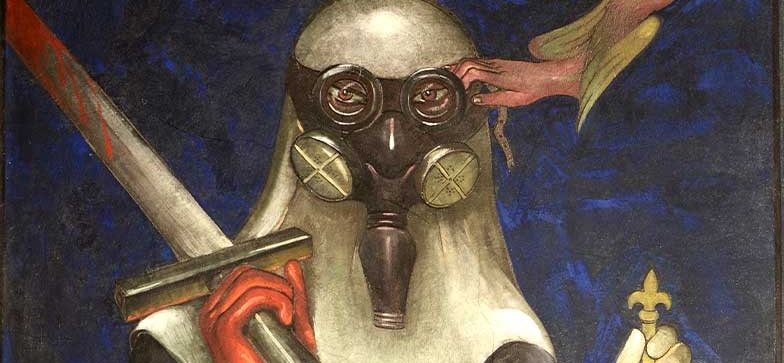
In Vanka's murals, evil lurks in the details of otherwise tranquil settings. In perhaps his most "on the nose" mural, The Capitalist, a lonely rich man enjoys an exquisite feast served by a black servant, as an angel looks away and a skeleton's hand holds hellfire just above his head. On the opposite wall, The Simple Family Meal depicts a peasant family in Croatia dividing the meager portion of bread they have on hand, heads bowed in prayer while an emanation of Christ blesses them. Justice and Injustice, added in 1941 after German forces had taken Croatia, depict angels holding the scales of the universe. The just angel in divine robes holds balanced scales of flame; the unjust angel wields a bloody sword and wears a gas mask. Their scales are imbalanced by a mountain of coins, the spoils of war and profiteering.
Notably, Vanka's anticapitalist murals came first. But as the war in Europe progressed, images depicting the exploitation of labor were supplemented with images reminding congregants that St. Nicholas might have been one of the last places left on Earth where Croatians could worship without persecution. Here, stories from the New Testament and its promises of eternal love sit adjacent to images from the Old Testament, whose prophets are rarely featured prominently in Catholic churches. They continue Vanka's obsession with duality in the work and remind worshippers of the tribulations necessary for believers. Here on Earth, peace does not come easily, and it may not be a static state of affairs.
One mural, The Old Testament, features several scenes, and is centered on the Prophet Aaron and the Golden Calf, featuring a wide-eyed and extremely angry Moses.
"Moses's eyebrows are one of my favorite details," Ruiz says. "There's so much texture in there. That's one of the things I really love about this job. I get to see details of this kind of work up close that nobody ever gets to see. To think about why he would put so much effort into making sure Moses' angry eyebrows look just right."
The imagery is unmooring, but so too was the experience of being a Croatian immigrant in 20th-century America. Even before the "great wars," the Croatian identity was itself a thorny ethnoreligious issue in Europe, as the 19th century ushered in an era of romantic nationalism for Croatia and its neighbors. As German and Hungarian aristocracies sought to instill their cultural norms and systems onto the Croatian people by coercion and force, Croatian nationals planted the seeds for an independence movement that would continue to thrive amid a series of oppressors.
Its church was in a similarly unfortunate position. Croatian Christianity had its own distinct rituals and liturgical language, but its authority was constantly undermined by more prominent and powerful neighboring Christian authorities, supported by monarchies that sought to rewrite Croatian history and create a unified identity. The most blatant attempt to destroy the Croatian Church was when the Third Reich invaded, but by the time the atrocities of the Nazis had reached fever pitch—and by the time Vanka was painting in Millvale—the Croatian identity had already been the center of active ethnoreligious struggle for a century.
While the foundation to preserve Vanka's murals avoids public comment on the current political issues in America for obvious reasons, the murals themselves do the heavy lifting. There is little question how the St. Nicholas Croatian Church feels about the persecution of immigrants.
A conservator who proudly claims her heritage as "100 percent Mexican," Ruiz is a little less bound by the political need to stay neutral. "I see the story of the immigrant experience for sure," she says. "I grew up around a way different version of it, but it's still applicable. Taking the jobs nobody else wants to take, the construction jobs my family members took when they first came here, being forced to work underage labor to make their way."
It is through this lens that St. Nicholas and Vanka's masterworks may be best experienced: where the Croatian immigrant experience in tiny Millvale becomes something universal to the American immigrant experience. Each Sunday, Croatians came together in a place where they could be Croatian, if only for a few hours at a time. They gathered with other people who recognized the images of their homeland and spoke its language and its slang.
On an adjacent ceiling panel to the chlorine-gassed Savior, Saint Mary fiercely destroys the bayonet of a soldier over her knee. In a less victorious depiction, however, Vanka added a mural called Mati, completed shortly after the invasion of Croatia. A nun is hung on a cross against a blacked-out Croatian sky, her hands chained, a symbol of Germany's suppression of the Croatian Church and Vanka's stark reminder to the congregants of St. Nicholas that it was their responsibility to keep a piece of their home and their faith alive.