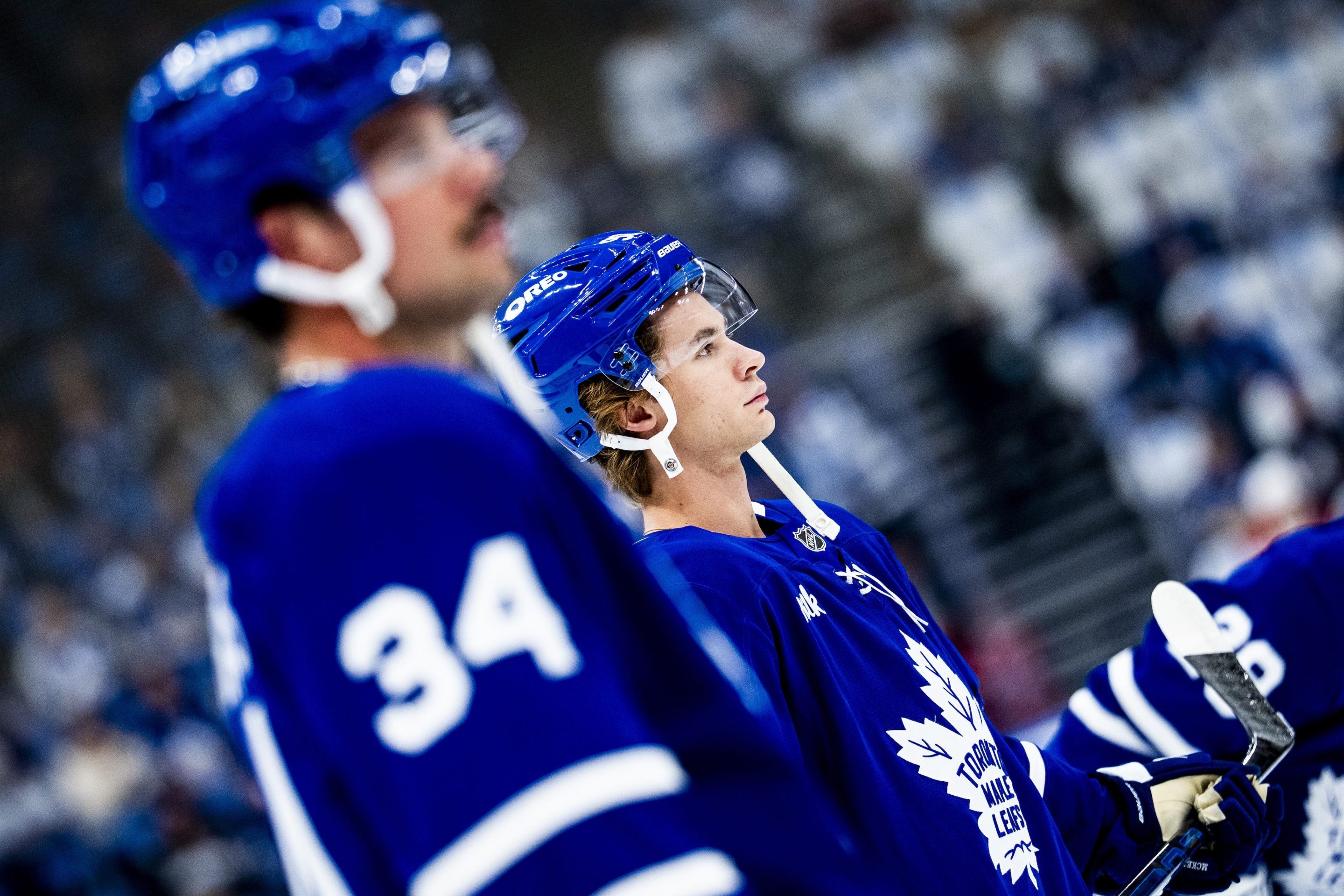



I think it's important we set some axioms for discussion of Anaheim's Leo Carlsson signing an offer sheet with Philadelphia, because it helps a superficially mindblowing contract feel something closer to logical—both in that the Flyers were wise to offer it, and in that the Ducks would be fools not to match it. The first thing to be agreed upon is that Carlsson is very, very good: 21 years old, putting up better numbers every year, 67 points in his third season. Whether you think he's neared his ceiling already or whether you believe he's got much more room to grow, he's a great and valuable player right now, full stop. He'd be a 1C on something like 20–25 teams in the NHL, certainly on the Ducks or Flyers, and 1Cs don't come cheap.
The second thing to agree on is that while the Flyers' offer of $18 million a year over five years sounds like a lot, it's going to be the new normal very soon. Kirill Kaprizov's $17M-per-year deal kicks in this year, and while Carlsson will briefly be the NHL's highest-paid player, it won't be for long. Cale Makar and Quinn Hughes should be up there within a year; I can't even conceive of what Nikita Kucherov is going to get. Salaries are up because the salary cap is up: The projected cap in 2027–28 will be exactly (and coincidentally?) $18 million higher than it was last season. By the end of his deal, Carlsson's salary will be roughly the same percentage of his team's cap that Auston Matthews's is today, and Toronto would do that again in a heartbeat.
The third truism here is that draft picks are overrated. The Flyers would have to give the Ducks their next four first-round picks. With Philadelphia a young team on the rise, those probably won't be lottery picks. Go ahead and pick four guys drafted 17–32 in recent years—no really, try it—and you'll be highly unlikely to land anyone nearly as good as Leo Carlsson. You could argue that Philly's picks are more valuable as potential trade bait, and I'd agree with you, but again: Who is Philadelphia going to trade for that's better than Carlsson?
So there it is. When Carlsson signed Philadelphia's offer sheet on Friday, which would cost them $18M/5 and require them to send four first-round picks to the Ducks, it was immediately mind-boggling, but upon even just a little reflection, it's fair-market value. (Indeed, three other teams offer-sheeted Carlsson; we don't know what those contracts looked like.) The Ducks have until July 10 to match, or say goodbye to their top centerman.
Offer sheets have come a long way in a league that long had a gentlemen's agreement among front offices not to use them (a nasty piece of salary suppression, that). Newly minted Hall of Famer Brian Burke once threatened/promised to rent out a barn for the purposes of hosting a fistfight against a rival GM who had offer-sheeted one of his players. Carlsson's is just the eighth offer sheet signed since 2010, but they're getting more aggressive on money and term, and more bespoke in structure to be difficult to match—the last three have resulted in players switching clubs.
The Ducks would be silly not to match on Carlsson, for as much as it might complicate their roster construction. On some level, that was surely Philadelphia's goal—there's still bad blood here, dating back to Cutter Gauthier's refusal to play for the Flyers and subsequent trade to Anaheim. Coincidentally or not, it's Gauthier's first real contract that is now up in the air. A restricted free agent, the Ducks might not be able to fit him in under the cap if they match the front-loaded contract for Carlsson. That's not the Flyers' problem, though, and they're not shedding tears over it.
It's been kind of a disastrous last 12 months for the Ducks in terms of keeping their core together. They traded away Trevor Zegras and Jamie Drysdale a year before they would hit restricted free agency. They traded Mason McTavish during last month's draft. On Sunday they locked up Pavel Mintyukov, perhaps fearing an offer sheet, and they're paying him enough that they might not be able to afford both Gauthier and Carlsson. There was no question of re-signing veteran defensemen John Carlson and Jacob Trouba. The Ducks are, for lack of a more delicate term, in cap hell, which is a bad and improbable place to be for what is still fundamentally a young team that should be looking to take the next step.
Blame here lands on Anaheim's front office, led by GM Pat Verbeek. It was voted the hardest front office to deal with by NHL agents in an Athletic poll. "There's always something they nickel you," one agent said. Another, intending it as partial praise, called them "assholes." Saving a few tens of thousands here and there can have totally foreseeable consequences. Carlsson didn't have to sign an offer sheet, and maybe he doesn't if he has confidence the Ducks are going to take care of him. But if you know they're going to fight you on every penny, what player isn't signing a deal that would make them the highest-paid player in the league and let them hit free agency when they're still just 26 years old?
Of course, it wouldn't even have gotten this far if the Ducks locked up their young studs before they hit the market. That's what the Canadiens have done, and they're in great cap shape. That's what the Hurricanes have done, and they're Cup champs without ever facing a real cap crunch. But that's not how Verbeek does business—a slight and early overpay for potential is haram in Duckland—and now it's coming back to bite them. They could've had Carlsson long-term for something like $10 million AAV not too long ago. If Anaheim is now going to have to pay through the nose for his services, we know exactly whose fault that is, and it's not the Flyers'.